TRANSFORMING EQUATIONS INTO
QUADRATIC FORMS
Objective:
Solve equations transformable to quadratic equations (including rational
algebraic equations).
Solve problems involving quadratic equations and rational algebraic
equations
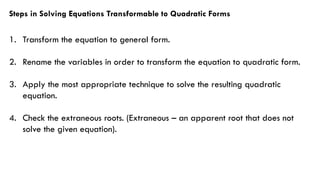
Steps in Solving Equations Transformable to Quadratic Forms
1. Transform the equation to general form.
2. Rename the variables in order to transform the equation to quadratic form.
3. Apply the most appropriate technique to solve the resulting quadratic
equation.
4. Check the extraneous roots. (Extraneous – an apparent root that does not
solve the given equation).
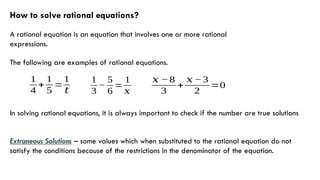
How to solve rational equations?
A rational equation is an equation that involves one or more rational
expressions.
The following are examples of rational equations.
1
4
+
1
5
=
1
𝑡
1
3
−
5
6
=
1
𝑥
𝑥 −8
3
+
𝑥 −3
2
=0
In solving rational equations, it is always important to check if the number are true solutions
Extraneous Solutions – some values which when substituted to the rational equation do not
satisfy the conditions because of the restrictions in the denominator of the equation.
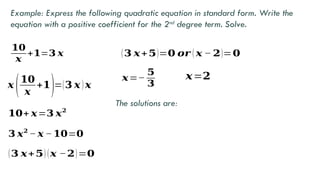
Example: Express the following quadratic equation in standard form. Write the
equation with a positive coefficient for the 2nd
degree term. Solve.
𝟏𝟎
𝒙
+𝟏=𝟑 𝒙
𝒙 (𝟏𝟎
𝒙
+𝟏)=(𝟑 𝒙 )𝒙
𝟏𝟎+ 𝒙=𝟑 𝒙𝟐
𝟑 𝒙𝟐
− 𝒙 − 𝟏𝟎=𝟎
(𝟑 𝒙+𝟓) (𝒙 −𝟐)=𝟎
(𝟑 𝒙+𝟓)=𝟎 𝒐𝒓 ( 𝒙 − 𝟐)=𝟎
𝒙=−
𝟓
𝟑
𝒙=𝟐
The solutions are:
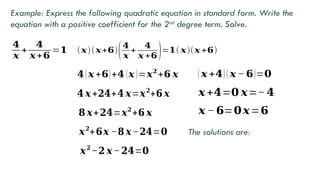
𝟒
𝒙
+
𝟒
𝒙+𝟔
=𝟏
Example: Express the following quadratic equation in standard form. Write the
equation with a positive coefficient for the 2nd
degree term. Solve.
(𝒙)(𝒙+𝟔)(𝟒
𝒙
+
𝟒
𝒙 +𝟔)=𝟏( 𝒙)(𝒙 +𝟔)
𝟒(𝒙 +𝟔)+𝟒 (𝒙 )=𝒙𝟐
+𝟔 𝒙
𝟒 𝒙+𝟐𝟒+𝟒 𝒙=𝒙𝟐
+𝟔 𝒙
𝟖 𝒙+𝟐𝟒=𝒙𝟐
+𝟔 𝒙
𝒙𝟐
+𝟔𝒙 −𝟖 𝒙−𝟐𝟒=𝟎
𝒙𝟐
−𝟐 𝒙−𝟐𝟒=𝟎
( 𝒙 +𝟒)( 𝒙 − 𝟔)=𝟎
𝒙 +𝟒=𝟎 𝒙=−𝟒
𝒙 −𝟔=𝟎𝒙=𝟔
The solutions are:
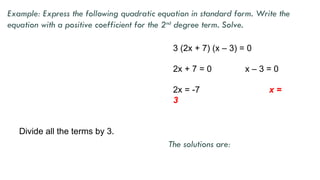
Divide all the terms by 3.
3 (2x + 7) (x – 3) = 0
2x + 7 = 0 x – 3 = 0
2x = -7 x =
3
Example: Express the following quadratic equation in standard form. Write the
equation with a positive coefficient for the 2nd
degree term. Solve.
The solutions are:
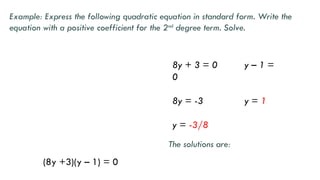
(8y +3)(y – 1) = 0
8y + 3 = 0 y – 1 =
0
8y = -3 y = 1
y = -3/8
Example: Express the following quadratic equation in standard form. Write the
equation with a positive coefficient for the 2nd
degree term. Solve.
The solutions are:
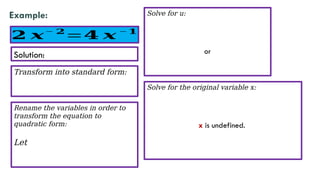
Example:
𝟐 𝒙− 𝟐
=𝟒 𝒙 −𝟏
Transform into standard form:
Solution:
Rename the variables in order to
transform the equation to
quadratic form:
Let
Solve for u:
or
Solve for the original variable x:
x is undefined.
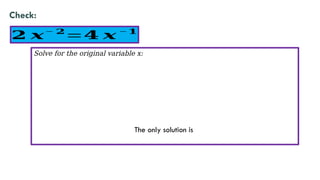
Check:
𝟐 𝒙− 𝟐
=𝟒 𝒙 −𝟏
Solve for the original variable x:
The only solution is
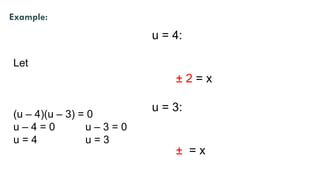
Let
(u – 4)(u – 3) = 0
u – 4 = 0 u – 3 = 0
u = 4 u = 3
Example:
u = 4:
± 2 = x
u = 3:
± = x
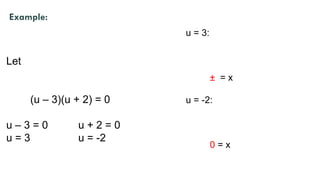
Let
(u – 3)(u + 2) = 0
u – 3 = 0 u + 2 = 0
u = 3 u = -2
Example:
u = 3:
± = x
u = -2:
0 = x
Activity:
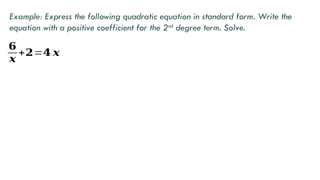
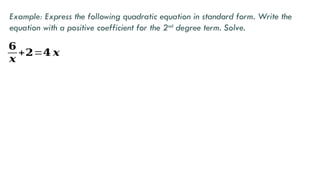
Solve the following equations.
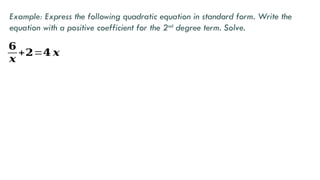
𝟔
𝒙
+𝟐=𝟒 𝒙
Example: Express the following quadratic equation in standard form. Write the
equation with a positive coefficient for the 2nd
degree term. Solve.
Example: Express the following quadratic equation in standard form. Write the
equation with a positive coefficient for the 2nd
degree term. Solve.
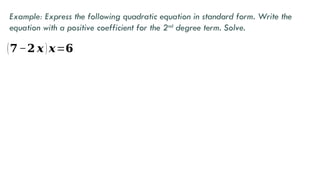
(𝟕−𝟐 𝒙 )𝒙=𝟔
Example: Express the following quadratic equation in standard form. Write the
equation with a positive coefficient for the 2nd
degree term. Solve.
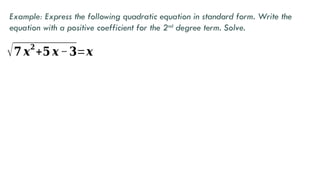
√𝟕 𝒙
𝟐
+𝟓 𝒙−𝟑=𝒙
𝟔
𝒙
+𝟐=𝟒 𝒙
Example: Express the following quadratic equation in standard form. Write the
equation with a positive coefficient for the 2nd
degree term. Solve.
𝟔
𝒙
+𝟐=𝟒 𝒙
Example: Express the following quadratic equation in standard form. Write the
equation with a positive coefficient for the 2nd
degree term. Solve.

Unit-1-Mod-5-Transforming-equations-into-quadratic-forms.pptx

  • 1.
  • 2.
    Objective: Solve equations transformableto quadratic equations (including rational algebraic equations). Solve problems involving quadratic equations and rational algebraic equations
  • 3.
    Steps in SolvingEquations Transformable to Quadratic Forms 1. Transform the equation to general form. 2. Rename the variables in order to transform the equation to quadratic form. 3. Apply the most appropriate technique to solve the resulting quadratic equation. 4. Check the extraneous roots. (Extraneous – an apparent root that does not solve the given equation).
  • 4.
    How to solverational equations? A rational equation is an equation that involves one or more rational expressions. The following are examples of rational equations. 1 4 + 1 5 = 1 𝑡 1 3 − 5 6 = 1 𝑥 𝑥 −8 3 + 𝑥 −3 2 =0 In solving rational equations, it is always important to check if the number are true solutions Extraneous Solutions – some values which when substituted to the rational equation do not satisfy the conditions because of the restrictions in the denominator of the equation.
  • 5.
    Example: Express thefollowing quadratic equation in standard form. Write the equation with a positive coefficient for the 2nd degree term. Solve. 𝟏𝟎 𝒙 +𝟏=𝟑 𝒙 𝒙 (𝟏𝟎 𝒙 +𝟏)=(𝟑 𝒙 )𝒙 𝟏𝟎+ 𝒙=𝟑 𝒙𝟐 𝟑 𝒙𝟐 − 𝒙 − 𝟏𝟎=𝟎 (𝟑 𝒙+𝟓) (𝒙 −𝟐)=𝟎 (𝟑 𝒙+𝟓)=𝟎 𝒐𝒓 ( 𝒙 − 𝟐)=𝟎 𝒙=− 𝟓 𝟑 𝒙=𝟐 The solutions are:
  • 6.
    𝟒 𝒙 + 𝟒 𝒙+𝟔 =𝟏 Example: Express thefollowing quadratic equation in standard form. Write the equation with a positive coefficient for the 2nd degree term. Solve. (𝒙)(𝒙+𝟔)(𝟒 𝒙 + 𝟒 𝒙 +𝟔)=𝟏( 𝒙)(𝒙 +𝟔) 𝟒(𝒙 +𝟔)+𝟒 (𝒙 )=𝒙𝟐 +𝟔 𝒙 𝟒 𝒙+𝟐𝟒+𝟒 𝒙=𝒙𝟐 +𝟔 𝒙 𝟖 𝒙+𝟐𝟒=𝒙𝟐 +𝟔 𝒙 𝒙𝟐 +𝟔𝒙 −𝟖 𝒙−𝟐𝟒=𝟎 𝒙𝟐 −𝟐 𝒙−𝟐𝟒=𝟎 ( 𝒙 +𝟒)( 𝒙 − 𝟔)=𝟎 𝒙 +𝟒=𝟎 𝒙=−𝟒 𝒙 −𝟔=𝟎𝒙=𝟔 The solutions are:
  • 7.
    Divide all theterms by 3. 3 (2x + 7) (x – 3) = 0 2x + 7 = 0 x – 3 = 0 2x = -7 x = 3 Example: Express the following quadratic equation in standard form. Write the equation with a positive coefficient for the 2nd degree term. Solve. The solutions are:
  • 8.
    (8y +3)(y –1) = 0 8y + 3 = 0 y – 1 = 0 8y = -3 y = 1 y = -3/8 Example: Express the following quadratic equation in standard form. Write the equation with a positive coefficient for the 2nd degree term. Solve. The solutions are:
  • 9.
    Example: 𝟐 𝒙− 𝟐 =𝟒𝒙 −𝟏 Transform into standard form: Solution: Rename the variables in order to transform the equation to quadratic form: Let Solve for u: or Solve for the original variable x: x is undefined.
  • 10.
    Check: 𝟐 𝒙− 𝟐 =𝟒𝒙 −𝟏 Solve for the original variable x: The only solution is
  • 11.
    Let (u – 4)(u– 3) = 0 u – 4 = 0 u – 3 = 0 u = 4 u = 3 Example: u = 4: ± 2 = x u = 3: ± = x
  • 12.
    Let (u – 3)(u+ 2) = 0 u – 3 = 0 u + 2 = 0 u = 3 u = -2 Example: u = 3: ± = x u = -2: 0 = x
  • 13.
  • 14.
    𝟔 𝒙 +𝟐=𝟒 𝒙 Example: Expressthe following quadratic equation in standard form. Write the equation with a positive coefficient for the 2nd degree term. Solve.
  • 15.
    Example: Express thefollowing quadratic equation in standard form. Write the equation with a positive coefficient for the 2nd degree term. Solve. (𝟕−𝟐 𝒙 )𝒙=𝟔
  • 16.
    Example: Express thefollowing quadratic equation in standard form. Write the equation with a positive coefficient for the 2nd degree term. Solve. √𝟕 𝒙 𝟐 +𝟓 𝒙−𝟑=𝒙
  • 17.
    𝟔 𝒙 +𝟐=𝟒 𝒙 Example: Expressthe following quadratic equation in standard form. Write the equation with a positive coefficient for the 2nd degree term. Solve.
  • 18.
    𝟔 𝒙 +𝟐=𝟒 𝒙 Example: Expressthe following quadratic equation in standard form. Write the equation with a positive coefficient for the 2nd degree term. Solve.