Random Process
Spectral Characteristics
Dr. Vijaykumar R. Urkude
Professor, VMTW
Content
 Introduction
 Power Density Spectrum
 Average Power of the Random Process
 Properties of the Power Density Spectrum
 Cross Power Density Spectrum
 Average Cross Power
 Properties of Cross Power Density Spectrum
 Spectral Characteristic of System Response
 Problems
Introduction
 This unit explores the important concept of characterizing
random processes in the frequency domain. These characteristics
are called spectral characteristics. All the concepts in this unit
can be easily learnt from the theory of Fourier transforms.
 Consider a random process X (t). The amplitude of the random
process, when it varies randomly with time, does not satisfy
Dirichlet’s conditions. Therefore it is not possible to apply the
Fourier transform directly on the random process for a
frequency domain analysis. Thus the autocorrelation function of
a WSS random process is used to study spectral characteristics
such as power density spectrum or power spectral density (psd).
Power Density Spectrum
The power spectrum of a WSS random process X (t) is defined as
the Fourier transform of the autocorrelation function RXX(τ) of
X(t). It can be expressed as
We can obtain the autocorrelation function from the power spectral
density by taking the inverse Fourier transform i.e.
Therefore, the power density spectrum SXX(ω) and the
autocorrelation function RXX (τ) are Fourier transform pairs.
   





 

 
d
e
R
S j
XX
XX
   




 


 
d
e
S
R j
XX
XX
2
1
Power spectral density can also be defined as
Where XT(ω) is a Fourier transform of X(t) in
interval [-T,T]
 
T
X
E
S T
T
XX
2
]
|
)
(
[|
lim
2





Average Power of the Random Process
The average power PXX of a WSS random process X(t) is defined
as the time average of its second order moment or autocorrelation
function at τ =0.
We know that from the power density spectrum,
At τ=0
Therefore average power of X(t) is
  )
(
)]
(
[
2
1
lim
)]
(
[ 2
2

XX
T
T
T
XX R
dt
t
X
E
T
t
X
E
A
P 

 







 


 
d
e
S
R j
XX
XX )
(
2
1
)
(





 


d
S
R
P XX
XX
XX )
(
2
1
)
0
(




 


d
S
P XX
XX )
(
2
1
Properties of power density spectrum
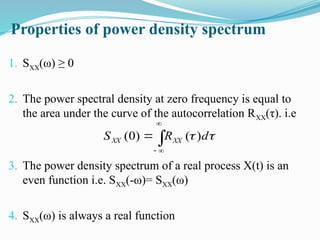
1. SXX(ω) ≥ 0
2. The power spectral density at zero frequency is equal to
the area under the curve of the autocorrelation RXX(τ). i.e
3. The power density spectrum of a real process X(t) is an
even function i.e. SXX(-ω)= SXX(ω)
4. SXX(ω) is always a real function




 
 d
R
S XX
XX )
(
)
0
(
5. If SXX(ω) is a psd of the WSS random process X(t), then
(or) The time average of the mean square value of a WSS
random process equals the area under the curve of the power
spectral density.
6. If X(t) is a WSS random process with psd SXX(ω), then the psd
of the derivative of X(t) is equal to ω2
times the psd SXX(ω).
that is
7. The power density spectrum and the time average of the
autocorrelation function form a Fourier transform pair (also
known as Wiener-Khintchine relation)
 





 )
0
(
)]
(
[
)
(
2
1 2
XX
XX R
t
X
E
A
d
S 


)
(
)
( 2
.
. 

 XX
X
X
S
S 





 

 
d
e
R
S j
XX
XX )
(
)
( 



 


 
d
e
S
R j
XX
XX )
(
2
1
)
(
Cross Power Density Spectrum
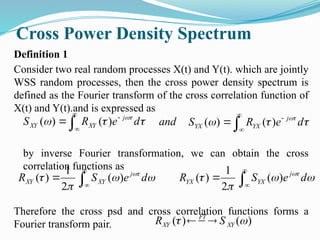
Definition 1
Consider two real random processes X(t) and Y(t). which are jointly
WSS random processes, then the cross power density spectrum is
defined as the Fourier transform of the cross correlation function of
X(t) and Y(t).and is expressed as
by inverse Fourier transformation, we can obtain the cross
correlation functions as
Therefore the cross psd and cross correlation functions forms a
Fourier transform pair.





 

 
d
e
R
S j
XY
XY )
(
)
( 




 

 
d
e
R
S j
YX
YX )
(
)
(




 


 
d
e
S
R j
XY
XY )
(
2
1
)
( 



 


 
d
e
S
R j
YX
YX )
(
2
1
)
(
and
)
(
)
( 
 XY
FT
XY S
R 

Definition 2
If XT(ω) and YT(ω) are Fourier transforms of X(t)
and Y(t) respectively in interval [-T,T], Then the
cross power density spectrum is defined as
 
T
Y
X
E
S T
T
T
XY
2
)]
(
)
(
[
lim
*






 
T
X
Y
E
S T
T
T
YX
2
)]
(
)
(
[
lim
*






and
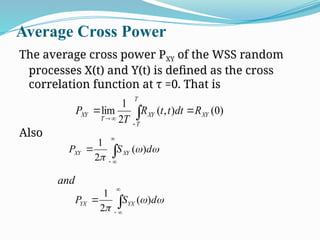
Average Cross Power
The average cross power PXY of the WSS random
processes X(t) and Y(t) is defined as the cross
correlation function at τ =0. That is
Also
)
0
(
)
,
(
2
1
lim XY
T
T
XY
T
XY R
dt
t
t
R
T
P 
 







 


d
S
P XY
XY )
(
2
1




 


d
S
P YX
YX )
(
2
1
and
Properties of Cross Power Density Spectrum
1. SXY(ω) = SYX(-ω) = SYX
*
(ω)
2. The real part of SXY(ω) and real part SYX(ω) are even functions of ω, i.e. Re
[SXY(ω)] and Re [SYX(ω)] are even functions.
3. The imaginary part of SXY(ω) and imaginary part SYX(ω) are odd functions of
ω, i.e. Im[SXY(ω)] and Im[SYX(ω)] are odd functions.
4. If X(t) and Y(t) are Orthogonal then SXY(ω) = 0 and SYX(ω) = 0
5. If X(t) and Y(t) are uncorrelated and have constant mean values, then
6. SXY(ω) = FT{A[RXY(t,t+τ)]} and SYX(ω) = FT{A[RYX(t,t+τ)]}. Also if X(t)
and Y(t) are jointly WSS random processes, then SXY(ω) = FT[RXY(τ)] and
SYX(ω) = FT[RYX(τ)]
)
(
2
)
( 


 Y
X
SXY 
Problems
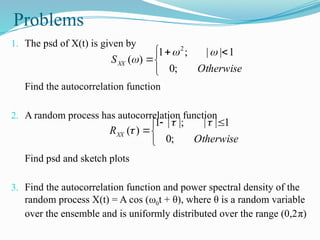
1. The psd of X(t) is given by
Find the autocorrelation function
2. A random process has autocorrelation function
Find psd and sketch plots
3. Find the autocorrelation function and power spectral density of the
random process X(t) = A cos (ω0t + θ), where θ is a random variable
over the ensemble and is uniformly distributed over the range (0,2π)


 


Otherwise
SXX
;
0
1
|
|
;
1
)
(
2





 


Otherwise
RXX
;
0
1
|
|
|;
|
1
)
(



Problems
4. The autocorrelation function of a WSS random process is RXX(τ) = a
exp(-(τ/b)2
). Find the power spectral density and normalized average
power of the signal.
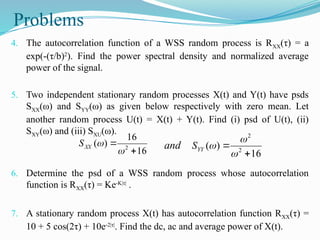
5. Two independent stationary random processes X(t) and Y(t) have psds
SXX(ω) and SYY(ω) as given below respectively with zero mean. Let
another random process U(t) = X(t) + Y(t). Find (i) psd of U(t), (ii)
SXY(ω) and (iii) SXU(ω).
6. Determine the psd of a WSS random process whose autocorrelation
function is RXX(τ) = Ke-K|τ|
.
7. A stationary random process X(t) has autocorrelation function RXX(τ) =
10 + 5 cos(2τ) + 10e-2|τ|
. Find the dc, ac and average power of X(t).
16
16
)
( 2




XX
S
16
)
( 2
2





YY
S
and
Problems
7. The spectral density of a WSS random process X(t) is
given by
Find the autocorrelation and average power of the process.
8. The psd of a WSS random process is
a) What are the frequencies in X(t)
b) Find men, variance and average power of X(t).
36
13
)
( 2
4
2







XX
S
)
4
(
2
)
4
(
2
)
5
(
3
)
5
(
3
)
(
4
)
( 







 












XX
S
Spectral Characteristics of System Response
Consider that the random process X(t) is a WSS process
with the auto correlation function RXX(τ) applied through
an LTI system. The output process Y(t) is also a WSS and
the processes X(t) and Y(t) are jointly WSS. One can
obtain the spectral characteristics of output response Y(t)
by applying Fourier transform to a correlation function.
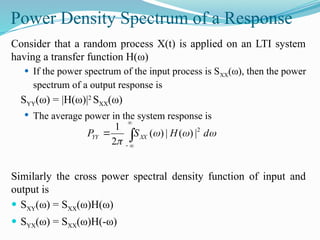
Power Density Spectrum of a Response
Consider that a random process X(t) is applied on an LTI system
having a transfer function H(ω)
 If the power spectrum of the input process is SXX(ω), then the power
spectrum of a output response is
SYY(ω) = |H(ω)|2
SXX(ω)
 The average power in the system response is
Similarly the cross power spectral density function of input and
output is
 SXY(ω) = SXX(ω)H(ω)
 SYX(ω) = SXX(ω)H(-ω)




 



d
H
S
P XX
YY
2
|
)
(
|
)
(
2
1
Problems
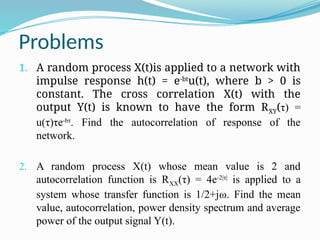
1. A random process X(t)is applied to a network with
impulse response h(t) = e-bt
u(t), where b > 0 is
constant. The cross correlation X(t) with the
output Y(t) is known to have the form RXY(τ) =
u(τ)τe-bτ
. Find the autocorrelation of response of the
network.
2. A random process X(t) whose mean value is 2 and
autocorrelation function is RXX(τ) = 4e-2|τ|
is applied to a
system whose transfer function is 1/2+jω. Find the mean
value, autocorrelation, power density spectrum and average
power of the output signal Y(t).

Random processes spectral characteristics

  • 1.
    Random Process Spectral Characteristics Dr.Vijaykumar R. Urkude Professor, VMTW
  • 2.
    Content  Introduction  PowerDensity Spectrum  Average Power of the Random Process  Properties of the Power Density Spectrum  Cross Power Density Spectrum  Average Cross Power  Properties of Cross Power Density Spectrum  Spectral Characteristic of System Response  Problems
  • 3.
    Introduction  This unitexplores the important concept of characterizing random processes in the frequency domain. These characteristics are called spectral characteristics. All the concepts in this unit can be easily learnt from the theory of Fourier transforms.  Consider a random process X (t). The amplitude of the random process, when it varies randomly with time, does not satisfy Dirichlet’s conditions. Therefore it is not possible to apply the Fourier transform directly on the random process for a frequency domain analysis. Thus the autocorrelation function of a WSS random process is used to study spectral characteristics such as power density spectrum or power spectral density (psd).
  • 4.
    Power Density Spectrum Thepower spectrum of a WSS random process X (t) is defined as the Fourier transform of the autocorrelation function RXX(τ) of X(t). It can be expressed as We can obtain the autocorrelation function from the power spectral density by taking the inverse Fourier transform i.e. Therefore, the power density spectrum SXX(ω) and the autocorrelation function RXX (τ) are Fourier transform pairs.               d e R S j XX XX               d e S R j XX XX 2 1
  • 5.
    Power spectral densitycan also be defined as Where XT(ω) is a Fourier transform of X(t) in interval [-T,T]   T X E S T T XX 2 ] | ) ( [| lim 2     
  • 6.
    Average Power ofthe Random Process The average power PXX of a WSS random process X(t) is defined as the time average of its second order moment or autocorrelation function at τ =0. We know that from the power density spectrum, At τ=0 Therefore average power of X(t) is   ) ( )] ( [ 2 1 lim )] ( [ 2 2  XX T T T XX R dt t X E T t X E A P                  d e S R j XX XX ) ( 2 1 ) (          d S R P XX XX XX ) ( 2 1 ) 0 (         d S P XX XX ) ( 2 1
  • 7.
    Properties of powerdensity spectrum 1. SXX(ω) ≥ 0 2. The power spectral density at zero frequency is equal to the area under the curve of the autocorrelation RXX(τ). i.e 3. The power density spectrum of a real process X(t) is an even function i.e. SXX(-ω)= SXX(ω) 4. SXX(ω) is always a real function        d R S XX XX ) ( ) 0 (
  • 8.
    5. If SXX(ω)is a psd of the WSS random process X(t), then (or) The time average of the mean square value of a WSS random process equals the area under the curve of the power spectral density. 6. If X(t) is a WSS random process with psd SXX(ω), then the psd of the derivative of X(t) is equal to ω2 times the psd SXX(ω). that is 7. The power density spectrum and the time average of the autocorrelation function form a Fourier transform pair (also known as Wiener-Khintchine relation)         ) 0 ( )] ( [ ) ( 2 1 2 XX XX R t X E A d S    ) ( ) ( 2 . .    XX X X S S            d e R S j XX XX ) ( ) (           d e S R j XX XX ) ( 2 1 ) (
  • 9.
    Cross Power DensitySpectrum Definition 1 Consider two real random processes X(t) and Y(t). which are jointly WSS random processes, then the cross power density spectrum is defined as the Fourier transform of the cross correlation function of X(t) and Y(t).and is expressed as by inverse Fourier transformation, we can obtain the cross correlation functions as Therefore the cross psd and cross correlation functions forms a Fourier transform pair.           d e R S j XY XY ) ( ) (           d e R S j YX YX ) ( ) (           d e S R j XY XY ) ( 2 1 ) (           d e S R j YX YX ) ( 2 1 ) ( and ) ( ) (   XY FT XY S R  
  • 10.
    Definition 2 If XT(ω)and YT(ω) are Fourier transforms of X(t) and Y(t) respectively in interval [-T,T], Then the cross power density spectrum is defined as   T Y X E S T T T XY 2 )] ( ) ( [ lim *         T X Y E S T T T YX 2 )] ( ) ( [ lim *       and
  • 11.
    Average Cross Power Theaverage cross power PXY of the WSS random processes X(t) and Y(t) is defined as the cross correlation function at τ =0. That is Also ) 0 ( ) , ( 2 1 lim XY T T XY T XY R dt t t R T P               d S P XY XY ) ( 2 1         d S P YX YX ) ( 2 1 and
  • 12.
    Properties of CrossPower Density Spectrum 1. SXY(ω) = SYX(-ω) = SYX * (ω) 2. The real part of SXY(ω) and real part SYX(ω) are even functions of ω, i.e. Re [SXY(ω)] and Re [SYX(ω)] are even functions. 3. The imaginary part of SXY(ω) and imaginary part SYX(ω) are odd functions of ω, i.e. Im[SXY(ω)] and Im[SYX(ω)] are odd functions. 4. If X(t) and Y(t) are Orthogonal then SXY(ω) = 0 and SYX(ω) = 0 5. If X(t) and Y(t) are uncorrelated and have constant mean values, then 6. SXY(ω) = FT{A[RXY(t,t+τ)]} and SYX(ω) = FT{A[RYX(t,t+τ)]}. Also if X(t) and Y(t) are jointly WSS random processes, then SXY(ω) = FT[RXY(τ)] and SYX(ω) = FT[RYX(τ)] ) ( 2 ) (     Y X SXY 
  • 13.
    Problems 1. The psdof X(t) is given by Find the autocorrelation function 2. A random process has autocorrelation function Find psd and sketch plots 3. Find the autocorrelation function and power spectral density of the random process X(t) = A cos (ω0t + θ), where θ is a random variable over the ensemble and is uniformly distributed over the range (0,2π)       Otherwise SXX ; 0 1 | | ; 1 ) ( 2          Otherwise RXX ; 0 1 | | |; | 1 ) (   
  • 14.
    Problems 4. The autocorrelationfunction of a WSS random process is RXX(τ) = a exp(-(τ/b)2 ). Find the power spectral density and normalized average power of the signal. 5. Two independent stationary random processes X(t) and Y(t) have psds SXX(ω) and SYY(ω) as given below respectively with zero mean. Let another random process U(t) = X(t) + Y(t). Find (i) psd of U(t), (ii) SXY(ω) and (iii) SXU(ω). 6. Determine the psd of a WSS random process whose autocorrelation function is RXX(τ) = Ke-K|τ| . 7. A stationary random process X(t) has autocorrelation function RXX(τ) = 10 + 5 cos(2τ) + 10e-2|τ| . Find the dc, ac and average power of X(t). 16 16 ) ( 2     XX S 16 ) ( 2 2      YY S and
  • 15.
    Problems 7. The spectraldensity of a WSS random process X(t) is given by Find the autocorrelation and average power of the process. 8. The psd of a WSS random process is a) What are the frequencies in X(t) b) Find men, variance and average power of X(t). 36 13 ) ( 2 4 2        XX S ) 4 ( 2 ) 4 ( 2 ) 5 ( 3 ) 5 ( 3 ) ( 4 ) (                       XX S
  • 16.
    Spectral Characteristics ofSystem Response Consider that the random process X(t) is a WSS process with the auto correlation function RXX(τ) applied through an LTI system. The output process Y(t) is also a WSS and the processes X(t) and Y(t) are jointly WSS. One can obtain the spectral characteristics of output response Y(t) by applying Fourier transform to a correlation function.
  • 17.
    Power Density Spectrumof a Response Consider that a random process X(t) is applied on an LTI system having a transfer function H(ω)  If the power spectrum of the input process is SXX(ω), then the power spectrum of a output response is SYY(ω) = |H(ω)|2 SXX(ω)  The average power in the system response is Similarly the cross power spectral density function of input and output is  SXY(ω) = SXX(ω)H(ω)  SYX(ω) = SXX(ω)H(-ω)          d H S P XX YY 2 | ) ( | ) ( 2 1
  • 18.
    Problems 1. A randomprocess X(t)is applied to a network with impulse response h(t) = e-bt u(t), where b > 0 is constant. The cross correlation X(t) with the output Y(t) is known to have the form RXY(τ) = u(τ)τe-bτ . Find the autocorrelation of response of the network. 2. A random process X(t) whose mean value is 2 and autocorrelation function is RXX(τ) = 4e-2|τ| is applied to a system whose transfer function is 1/2+jω. Find the mean value, autocorrelation, power density spectrum and average power of the output signal Y(t).