Random English Terms
Here are the types of literary terms students should
know:
•simile (by far the most popular)
•symbolism
•irony (sometimes listed as ironic, sometimes specific
to dramatic, situational, and verbal)
•mood
•point of view
•repetition
•hyperbole
•imagery
•foreshadowing
•personification
•paradox
•conflict
•analogy (as a word – not as in old SAT)
•anecdote
•pun
•dialect
•metaphor
•allusion
•rhyme scheme
•archetype
•tone
Simile
• Comparison using ‘like’ or ‘as’

– Is this a simile?
• OMG, that girl was so, like, mean!

– Is this a simile?
• She was as beautiful as a fresh red rose.
Symbolism
• When a physical object represents/stands for
something meaningful.
• What is the American flag a symbol of?
Irony
• Situational Irony – When a situation occurs that
is the opposite of what we would reasonably
expect
– Titanic, the unsinkable ship, sinks on its first voyage

• Verbal Irony – When someone says something
that is the opposite of what they mean
– “I spilled ketchup on my shirt? Just great!”

• Dramatic Irony – When the audience is aware of
something that a character is not
– We know Juliet isn’t dead, but Romeo doesn’t
Mood vs. Tone
Mood is the ‘feeling’ of a story (how it makes
the audience feel)

Tone is the feelings of the author/narrator
Paradox
• a statement that seems self-contradictory or
absurd but in reality expresses a possible truth
• My original example: Having your birthday on
leap year means that you might have been
alive for twenty years, but you are really only
five.
Other examples
• In Shakespeare's Hamlet, the title character states "I
must be cruel to be kind." On the surface, once again,
this statement does not seem to make much sense.
Can an individual convey kindness through evil?
• However, Hamlet is speaking about his mother, and
how he plans to ultimately slay Claudius in order to
avenge his father's death. His mother is now married
to Claudius, so of course this will be a tragedy for her.
However, he does not want his mother to be the lover
of his father's murderer (unbeknownst to her) any
longer, and so he believes the murder will be for her
own good.
More examples
• "I have found the paradox, that if you love
until it hurts, there can be no more hurt, only
more love."
(Mother Teresa)
• "Je ne parle pas Français."
(Bart Simpson, The Simpsons)
Purpose of Paradox
• After examining the examples from works of literature, one
will see that a paradox is not just a witty or amusing
statement. Paradoxes have serious implications in the
world of literature, because they make statements that
often sum up the main ideas of the work.
• What is the purpose of using such a statement then,
instead of just forthrightly stating the work's intent? One
reason is that to do so would be boring. It is much more
interesting for a reader to carve out the meaning, than to
have it fed to them on a silver platter. Furthermore,
summing up the totality of the work in one statement is
more memorable. "I must be cruel to be kind" is a famous
statement that has transcended history, whether or not
people know where the words originally came from.
Analogy
• a similarity between like features of two
things, on which a comparison may be based
• Example: a heart as compared to a pump
– In DOAS, Willy Loman compared the working man
to a piece of fruit (an orange).
How you might see analogy….
• It may just be part of the question (What does
Benvolio’s analogy about the women at the
party imply about Rosaline?)
– Rosaline : crow :: Other women : swan
OR: You might have to determine a
relationship
• Fire: water :: Crying : ___________
– Explosion
– Laughter
– An ocean
– A smile
Archetype
• a universally understood symbol or term or
pattern of behavior
– Examples: Mother Figure, Damsel in Distress,
Mentor (F451-Faber), Hero, etc.
Repetition
• Repeating a word or phrase
– Half a league, half a league, half a league onward
Hyperbole
• After five forevers, Jem returned
Imagery
• Creating a clear, descriptive, visual image
through the author’s word choice
Foreshadowing
Hints about what is going to happen in the future

Romeo’s dream about being dead
“And thus began our longest
Journey together” - Scout
Personification
• Giving human qualities to nonhuman things

– The sun smiled down
– The jaws of Death
– Dawn with her fingertips of rose
Anecdote
• A short tale

– In Romeo and Juliet, Mercutio tells an anecdote
about Queen Mab to make fun of Romeo’s belief
in dreams.
Pun
• Wordplay
• When words are given a double meaning
– Mr. Vroom: “As we were walking along the shore
of Bonaire, an island we were visiting in the
Caribbean Sea, I saw this bakery. I had read about
the bakery in a newspaper. It was known for its
wonderful cakes, pies, doughnuts, and other
baked goods, but it had to shut down. It had a
terrible infestation of rodents! They called them
the pie rats of the Caribbean.” 
Metaphor
• Comparison not using ‘like’ or ‘as’
• The sun was a shiny penny up in the sky
• Your courage was a sword you would sharpen
Theme
• Main message/topic of a piece
• Themes from To Kill a Mockingbird: Innocence,
Prejudice, Courage
• Themes from The Odyssey: Temptation, Cleverness
• Themes from Romeo and Juliet: Love, Violence, Fate
• Themes from Fahrenheit 451: Technology,
Government control
• Themes from Hamlet: Suicide, Revenge
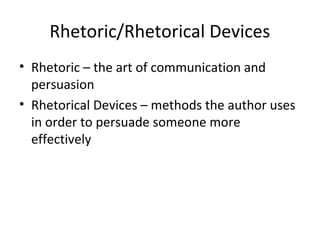
Rhetoric/Rhetorical Devices
• Rhetoric – the art of communication and
persuasion
• Rhetorical Devices – methods the author uses
in order to persuade someone more
effectively
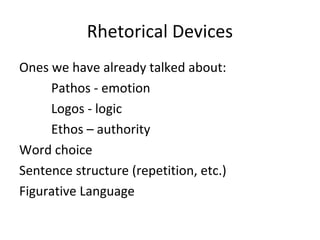
Rhetorical Devices
Ones we have already talked about:
Pathos - emotion
Logos - logic
Ethos – authority
Word choice
Sentence structure (repetition, etc.)
Figurative Language

Random eoc terms

  • 1.
  • 2.
    Here are thetypes of literary terms students should know: •simile (by far the most popular) •symbolism •irony (sometimes listed as ironic, sometimes specific to dramatic, situational, and verbal) •mood •point of view •repetition •hyperbole •imagery •foreshadowing •personification •paradox •conflict •analogy (as a word – not as in old SAT) •anecdote •pun •dialect •metaphor •allusion •rhyme scheme •archetype •tone
  • 3.
    Simile • Comparison using‘like’ or ‘as’ – Is this a simile? • OMG, that girl was so, like, mean! – Is this a simile? • She was as beautiful as a fresh red rose.
  • 4.
    Symbolism • When aphysical object represents/stands for something meaningful. • What is the American flag a symbol of?
  • 5.
    Irony • Situational Irony– When a situation occurs that is the opposite of what we would reasonably expect – Titanic, the unsinkable ship, sinks on its first voyage • Verbal Irony – When someone says something that is the opposite of what they mean – “I spilled ketchup on my shirt? Just great!” • Dramatic Irony – When the audience is aware of something that a character is not – We know Juliet isn’t dead, but Romeo doesn’t
  • 6.
    Mood vs. Tone Moodis the ‘feeling’ of a story (how it makes the audience feel) Tone is the feelings of the author/narrator
  • 7.
    Paradox • a statementthat seems self-contradictory or absurd but in reality expresses a possible truth • My original example: Having your birthday on leap year means that you might have been alive for twenty years, but you are really only five.
  • 8.
    Other examples • InShakespeare's Hamlet, the title character states "I must be cruel to be kind." On the surface, once again, this statement does not seem to make much sense. Can an individual convey kindness through evil? • However, Hamlet is speaking about his mother, and how he plans to ultimately slay Claudius in order to avenge his father's death. His mother is now married to Claudius, so of course this will be a tragedy for her. However, he does not want his mother to be the lover of his father's murderer (unbeknownst to her) any longer, and so he believes the murder will be for her own good.
  • 9.
    More examples • "Ihave found the paradox, that if you love until it hurts, there can be no more hurt, only more love." (Mother Teresa) • "Je ne parle pas Français." (Bart Simpson, The Simpsons)
  • 10.
    Purpose of Paradox •After examining the examples from works of literature, one will see that a paradox is not just a witty or amusing statement. Paradoxes have serious implications in the world of literature, because they make statements that often sum up the main ideas of the work. • What is the purpose of using such a statement then, instead of just forthrightly stating the work's intent? One reason is that to do so would be boring. It is much more interesting for a reader to carve out the meaning, than to have it fed to them on a silver platter. Furthermore, summing up the totality of the work in one statement is more memorable. "I must be cruel to be kind" is a famous statement that has transcended history, whether or not people know where the words originally came from.
  • 11.
    Analogy • a similaritybetween like features of two things, on which a comparison may be based • Example: a heart as compared to a pump – In DOAS, Willy Loman compared the working man to a piece of fruit (an orange).
  • 12.
    How you mightsee analogy…. • It may just be part of the question (What does Benvolio’s analogy about the women at the party imply about Rosaline?) – Rosaline : crow :: Other women : swan
  • 13.
    OR: You mighthave to determine a relationship • Fire: water :: Crying : ___________ – Explosion – Laughter – An ocean – A smile
  • 14.
    Archetype • a universallyunderstood symbol or term or pattern of behavior – Examples: Mother Figure, Damsel in Distress, Mentor (F451-Faber), Hero, etc.
  • 15.
    Repetition • Repeating aword or phrase – Half a league, half a league, half a league onward
  • 16.
    Hyperbole • After fiveforevers, Jem returned
  • 17.
    Imagery • Creating aclear, descriptive, visual image through the author’s word choice
  • 18.
    Foreshadowing Hints about whatis going to happen in the future Romeo’s dream about being dead “And thus began our longest Journey together” - Scout
  • 19.
    Personification • Giving humanqualities to nonhuman things – The sun smiled down – The jaws of Death – Dawn with her fingertips of rose
  • 20.
    Anecdote • A shorttale – In Romeo and Juliet, Mercutio tells an anecdote about Queen Mab to make fun of Romeo’s belief in dreams.
  • 21.
    Pun • Wordplay • Whenwords are given a double meaning – Mr. Vroom: “As we were walking along the shore of Bonaire, an island we were visiting in the Caribbean Sea, I saw this bakery. I had read about the bakery in a newspaper. It was known for its wonderful cakes, pies, doughnuts, and other baked goods, but it had to shut down. It had a terrible infestation of rodents! They called them the pie rats of the Caribbean.” 
  • 22.
    Metaphor • Comparison notusing ‘like’ or ‘as’ • The sun was a shiny penny up in the sky • Your courage was a sword you would sharpen
  • 23.
    Theme • Main message/topicof a piece • Themes from To Kill a Mockingbird: Innocence, Prejudice, Courage • Themes from The Odyssey: Temptation, Cleverness • Themes from Romeo and Juliet: Love, Violence, Fate • Themes from Fahrenheit 451: Technology, Government control • Themes from Hamlet: Suicide, Revenge
  • 24.
    Rhetoric/Rhetorical Devices • Rhetoric– the art of communication and persuasion • Rhetorical Devices – methods the author uses in order to persuade someone more effectively
  • 25.
    Rhetorical Devices Ones wehave already talked about: Pathos - emotion Logos - logic Ethos – authority Word choice Sentence structure (repetition, etc.) Figurative Language