English7: Philippine Literature
PerformanceAssessment
LiteratureGenre:Poem/PoetryInterpretation
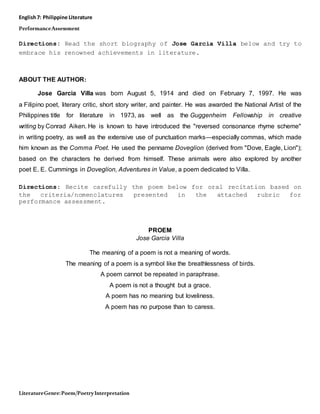
Directions: Read the short biography of Jose Garcia Villa below and try to
embrace his renowned achievements in literature.
ABOUT THE AUTHOR:
Jose Garcia Villa was born August 5, 1914 and died on February 7, 1997. He was
a Filipino poet, literary critic, short story writer, and painter. He was awarded the National Artist of the
Philippines title for literature in 1973, as well as the Guggenheim Fellowship in creative
writing by Conrad Aiken. He is known to have introduced the "reversed consonance rhyme scheme"
in writing poetry, as well as the extensive use of punctuation marks—especially commas, which made
him known as the Comma Poet. He used the penname Doveglion (derived from "Dove, Eagle, Lion");
based on the characters he derived from himself. These animals were also explored by another
poet E. E. Cummings in Doveglion, Adventures in Value, a poem dedicated to Villa.
Directions: Recite carefully the poem below for oral recitation based on
the criteria/nomenclatures presented in the attached rubric for
performance assessment.
PROEM
Jose Garcia Villa
The meaning of a poem is not a meaning of words.
The meaning of a poem is a symbol like the breathlessness of birds.
A poem cannot be repeated in paraphrase.
A poem is not a thought but a grace.
A poem has no meaning but loveliness.
A poem has no purpose than to caress.
English7: Philippine Literature
PerformanceAssessment
LiteratureGenre:Poem/PoetryInterpretation
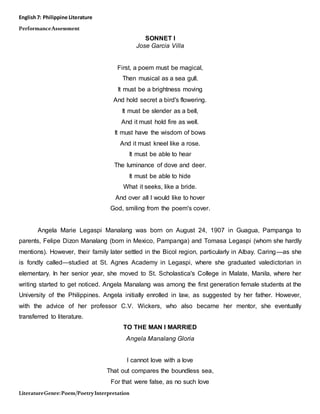
SONNET I
Jose Garcia Villa
First, a poem must be magical,
Then musical as a sea gull.
It must be a brightness moving
And hold secret a bird's flowering.
It must be slender as a bell,
And it must hold fire as well.
It must have the wisdom of bows
And it must kneel like a rose.
It must be able to hear
The luminance of dove and deer.
It must be able to hide
What it seeks, like a bride.
And over all I would like to hover
God, smiling from the poem's cover.
Angela Marie Legaspi Manalang was born on August 24, 1907 in Guagua, Pampanga to
parents, Felipe Dizon Manalang (born in Mexico, Pampanga) and Tomasa Legaspi (whom she hardly
mentions). However, their family later settled in the Bicol region, particularly in Albay. Caring—as she
is fondly called—studied at St. Agnes Academy in Legaspi, where she graduated valedictorian in
elementary. In her senior year, she moved to St. Scholastica's College in Malate, Manila, where her
writing started to get noticed. Angela Manalang was among the first generation female students at the
University of the Philippines. Angela initially enrolled in law, as suggested by her father. However,
with the advice of her professor C.V. Wickers, who also became her mentor, she eventually
transferred to literature.
TO THE MAN I MARRIED
Angela Manalang Gloria
I cannot love with a love
That out compares the boundless sea,
For that were false, as no such love
English7: Philippine Literature
PerformanceAssessment
LiteratureGenre:Poem/PoetryInterpretation
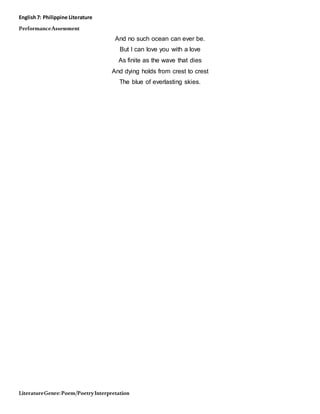
And no such ocean can ever be.
But I can love you with a love
As finite as the wave that dies
And dying holds from crest to crest
The blue of everlasting skies.
English7: Philippine Literature
PerformanceAssessment
LiteratureGenre:Poem/PoetryInterpretation
Name:__________________________________ Date:_____________________
Grade Level and Section:_________________________ Score:____________________
Teacher:______________________________________
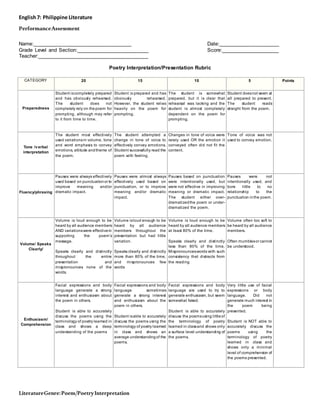
Poetry Interpretation/Presentation Rubric
CATEGORY 20 15 10 5 Points
Preparedness
Student iscompletely prepared
and has obviously rehearsed.
The student does not
completely rely on thepoem for
prompting, although may refer
to it from time to time.
Student is prepared and has
obviously rehearsed.
However, the student relies
heavily on the poem for
prompting.
The student is somewhat
prepared, but it is clear that
rehearsal was lacking and the
student is almost completely
dependent on the poem for
prompting.
Student doesnot seem at
all prepared to present.
The student reads
straight from the poem.
Tone /verbal
interpretation
The student most effectively
used variationsin volume, tone
and word emphasis to convey
emotions, attitude andtheme of
the poem.
The student attempted a
change in tone of voice to
effectively convey emotions.
Student successfully read the
poem with feeling.
Changes in tone of voice were
rarely used OR the emotion it
conveyed often did not fit the
content.
Tone of voice was not
used to convey emotion.
Fluency/phrasing
Pauses were always effectively
used based on punctuationor to
improve meaning and/or
dramatic impact.
Pauses were almost always
effectively used based on
punctuation, or to improve
meaning and/or dramatic
impact.
Pauses based on punctuation
were intentionally used, but
were not effective in improving
meaning or dramatic impact.
The student either over-
dramatizedthe poem or under-
dramatized the poem.
Pauses were not
intentionally used, and
bore little to no
relationship to the
punctuation inthe poem.
Volume/ Speaks
Clearly/
Volume is loud enough to be
heard by all audience members
AND variationswere effectivein
supporting the poem’s
message.
Speaks clearly and distinctly
throughout the entire
presentation and
mispronounces none of the
words.
Volume isloud enough to be
heard by all audience
members throughout the
presentation but had little
variation.
Speaks clearly and distinctly
more than 80% of the time,
and mispronounces few
words
Volume is loud enough to be
heard by all audience members
at least 80% of the time.
Speaks clearly and distinctly
less than 80% of the time.
Mispronounceswords with such
consistency that distracts from
the reading
Volume often too soft to
be heard by all audience
members.
Often mumblesor cannot
be understood.
Enthusiasm/
Comprehension
Facial expressions and body
language generate a strong
interest and enthusiasm about
the poem in others.
Student is able to accurately
discuss the poems using the
terminology of poetry learned in
class and shows a deep
understanding of the poems
Facial expressions and body
language sometimes
generate a strong interest
and enthusiasm about the
poem in others.
Student isable to accurately
discuss the poems using the
terminology of poetry learned
in class and shows an
average understandingof the
poems.
Facial expressions and body
language are used to try to
generate enthusiasm, but seem
somewhat faked.
Student is able to accurately
discuss the poemsusing littleof
the terminology of poetry
learned in classand shows only
a surface level understanding of
the poems.
Very little use of facial
expressions or body
language. Did not
generate much interest in
the poem being
presented.
Student is NOT able to
accurately discuss the
poems using the
terminology of poetry
learned in class and
shows only a minimal
level of comprehension of
the poems presented.
English7: Philippine Literature
PerformanceAssessment
LiteratureGenre:Poem/PoetryInterpretation
Comments:_________________________________________________________________________________________
__________________________________________________________________________________________________
__________________________________________________________________________________________________.

Poetry

  • 1.
    English7: Philippine Literature PerformanceAssessment LiteratureGenre:Poem/PoetryInterpretation Directions:Read the short biography of Jose Garcia Villa below and try to embrace his renowned achievements in literature. ABOUT THE AUTHOR: Jose Garcia Villa was born August 5, 1914 and died on February 7, 1997. He was a Filipino poet, literary critic, short story writer, and painter. He was awarded the National Artist of the Philippines title for literature in 1973, as well as the Guggenheim Fellowship in creative writing by Conrad Aiken. He is known to have introduced the "reversed consonance rhyme scheme" in writing poetry, as well as the extensive use of punctuation marks—especially commas, which made him known as the Comma Poet. He used the penname Doveglion (derived from "Dove, Eagle, Lion"); based on the characters he derived from himself. These animals were also explored by another poet E. E. Cummings in Doveglion, Adventures in Value, a poem dedicated to Villa. Directions: Recite carefully the poem below for oral recitation based on the criteria/nomenclatures presented in the attached rubric for performance assessment. PROEM Jose Garcia Villa The meaning of a poem is not a meaning of words. The meaning of a poem is a symbol like the breathlessness of birds. A poem cannot be repeated in paraphrase. A poem is not a thought but a grace. A poem has no meaning but loveliness. A poem has no purpose than to caress.
  • 2.
    English7: Philippine Literature PerformanceAssessment LiteratureGenre:Poem/PoetryInterpretation SONNETI Jose Garcia Villa First, a poem must be magical, Then musical as a sea gull. It must be a brightness moving And hold secret a bird's flowering. It must be slender as a bell, And it must hold fire as well. It must have the wisdom of bows And it must kneel like a rose. It must be able to hear The luminance of dove and deer. It must be able to hide What it seeks, like a bride. And over all I would like to hover God, smiling from the poem's cover. Angela Marie Legaspi Manalang was born on August 24, 1907 in Guagua, Pampanga to parents, Felipe Dizon Manalang (born in Mexico, Pampanga) and Tomasa Legaspi (whom she hardly mentions). However, their family later settled in the Bicol region, particularly in Albay. Caring—as she is fondly called—studied at St. Agnes Academy in Legaspi, where she graduated valedictorian in elementary. In her senior year, she moved to St. Scholastica's College in Malate, Manila, where her writing started to get noticed. Angela Manalang was among the first generation female students at the University of the Philippines. Angela initially enrolled in law, as suggested by her father. However, with the advice of her professor C.V. Wickers, who also became her mentor, she eventually transferred to literature. TO THE MAN I MARRIED Angela Manalang Gloria I cannot love with a love That out compares the boundless sea, For that were false, as no such love
  • 3.
    English7: Philippine Literature PerformanceAssessment LiteratureGenre:Poem/PoetryInterpretation Andno such ocean can ever be. But I can love you with a love As finite as the wave that dies And dying holds from crest to crest The blue of everlasting skies.
  • 4.
    English7: Philippine Literature PerformanceAssessment LiteratureGenre:Poem/PoetryInterpretation Name:__________________________________Date:_____________________ Grade Level and Section:_________________________ Score:____________________ Teacher:______________________________________ Poetry Interpretation/Presentation Rubric CATEGORY 20 15 10 5 Points Preparedness Student iscompletely prepared and has obviously rehearsed. The student does not completely rely on thepoem for prompting, although may refer to it from time to time. Student is prepared and has obviously rehearsed. However, the student relies heavily on the poem for prompting. The student is somewhat prepared, but it is clear that rehearsal was lacking and the student is almost completely dependent on the poem for prompting. Student doesnot seem at all prepared to present. The student reads straight from the poem. Tone /verbal interpretation The student most effectively used variationsin volume, tone and word emphasis to convey emotions, attitude andtheme of the poem. The student attempted a change in tone of voice to effectively convey emotions. Student successfully read the poem with feeling. Changes in tone of voice were rarely used OR the emotion it conveyed often did not fit the content. Tone of voice was not used to convey emotion. Fluency/phrasing Pauses were always effectively used based on punctuationor to improve meaning and/or dramatic impact. Pauses were almost always effectively used based on punctuation, or to improve meaning and/or dramatic impact. Pauses based on punctuation were intentionally used, but were not effective in improving meaning or dramatic impact. The student either over- dramatizedthe poem or under- dramatized the poem. Pauses were not intentionally used, and bore little to no relationship to the punctuation inthe poem. Volume/ Speaks Clearly/ Volume is loud enough to be heard by all audience members AND variationswere effectivein supporting the poem’s message. Speaks clearly and distinctly throughout the entire presentation and mispronounces none of the words. Volume isloud enough to be heard by all audience members throughout the presentation but had little variation. Speaks clearly and distinctly more than 80% of the time, and mispronounces few words Volume is loud enough to be heard by all audience members at least 80% of the time. Speaks clearly and distinctly less than 80% of the time. Mispronounceswords with such consistency that distracts from the reading Volume often too soft to be heard by all audience members. Often mumblesor cannot be understood. Enthusiasm/ Comprehension Facial expressions and body language generate a strong interest and enthusiasm about the poem in others. Student is able to accurately discuss the poems using the terminology of poetry learned in class and shows a deep understanding of the poems Facial expressions and body language sometimes generate a strong interest and enthusiasm about the poem in others. Student isable to accurately discuss the poems using the terminology of poetry learned in class and shows an average understandingof the poems. Facial expressions and body language are used to try to generate enthusiasm, but seem somewhat faked. Student is able to accurately discuss the poemsusing littleof the terminology of poetry learned in classand shows only a surface level understanding of the poems. Very little use of facial expressions or body language. Did not generate much interest in the poem being presented. Student is NOT able to accurately discuss the poems using the terminology of poetry learned in class and shows only a minimal level of comprehension of the poems presented.
  • 5.