Hamartia refers to the tragic flaw or error in judgment that leads to the downfall of the tragic hero. It's one of the key characteristics of a tragic hero according to Aristotle.
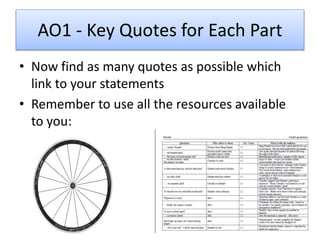
So, your mothermarried your
uncle… who killed your father
(his own brother)
What are you going to do?
a) Kill the b*****d!
b) Cry and think deep,
philosophical thoughts about
your own existence?
c) Go on the Jerry Springer show
and let the depths of humanity
bask in your freaky life
2.
GCSE English Literature
Unit3C
The significance of
Shakespeare and the
English Literary Heritage
Hamlet and Othello
Controlled Assessment
3.
What We WillNeed for this Topic
Hamlet
(The Arden Shakespeare,
Third Series)
Othello
(Arden Shakespeare, Third
Series)
4.
New Knowledge -Your Question
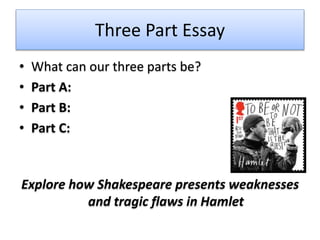
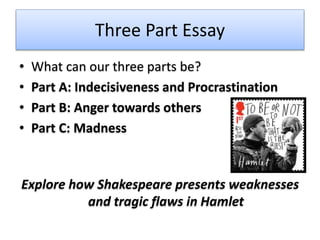
Explore how Shakespeare presents weaknesses
and tragic flaws in Hamlet and Othello
Inscribeth in
thy books!
5.
The Task
• ThisControlled Assessment is out of 40 marks
and is worth 25% of your overall mark (that’s a
lot!)
• Your work must be about 2000 words
• You will have four hours to complete the
assessment
• You will be linking two different texts – Hamlet
and Othello
Please note that this is the only piece of
coursework for Literature!
6.
Assessment Objectives
• AO1:Responding to texts critically and sensitively,
evaluating textual detail to support
interpretations
• AO2: Explain how language, structure and form
contribute to writers’ presentation of ideas and
themes
• AO3: Making comparisons and links between
texts
• AO4: Relating text to their social, cultural and
historical contexts
7.
Learning Objective: Tounderstand how
Shakespeare still influences modern culture
I know lots of
different things
about
Shakespeare
and his plays
I can compare
Shakespeare’s
themes in
Hamlet to
modern texts
I can use my
knowledge to ask
whether modern
writers are just
imitating
Shakespeare
This is our
success
criteria
Hamlet – TheSummary
• Read the summary of the play
• Answer the following questions:
– Name the three main characters of the play and their
relationship
– Why does Hamlet not kill his uncle?
– Why does he pretend to be insane?
– Who dies throughout the play and how does each
character meet their demise?
– Do you feel sorry for Hamlet?
– What are Hamlet’s weaknesses?
12.
Hamlet Themes –15 minutes
• With a partner, start mind mapping some of
the themes that you see emerging already.
• Approaching texts thematically is an effective
way of thinking about texts.
• Use the character list to help you keep track of
characters
• Mind map using specific ideas.
Character List (10mins)
• Read through the character list on the second
page
• Create a family tree conveying the
relationships between each character
• Add a little bit more information than just
their name
15.
Compare to ModernTexts
• Which other texts share these themes?
• Can we see any elements of Hamlet’s
character in modern texts?
• Do you think if Hamlet was modernised it
would be a popular play/film?
Compare to ModernTexts
• Now write a paragraph comparing
your modern text to Shakespeare’s
Macbeth.
–What themes are similar?
–Which character traits are similar?
–Which events are similar?
18.
Compare to ModernTexts
The bulk of the story and several key scenes remain
intact, with Denmark swapped for the African savanna,
and people swapped for animals (mostly lions). It's easy
to overlook the relationship between "Hamlet" and The
Lion King, since Shakespeare certainly didn't invent the
idea of an 'evil uncle.' But any theatre fan would be able
to follow the parallels along: the proud king (Mufasa) is
killed 'accidentally' by his evil, power-hungry brother
(Scar), and after a time away from the kingdom, the
prince and rightful heir (Simba) returns to bring the truth
to light. The film even includes the ghostly vision of
Mufasa, and Simba's pair of fast-talking friends Timon
and Pumbaa (Rosencrantz and Guildenstern in the
original). A musical treatment and happier ending, of
course, but "Hamlet" nonetheless.
19.
Are modern writersimitating
Shakespeare?
• Based on our work today, do we agree of
disagree with this statement?
20.
SOLO Self Assessment
MultistructuralStage
I know lots of different things about
Shakespeare’s play Hamlet
How I achieved this/How I can meet this:
During the animated tales I noted the main themes and
character traits and thought about how these link to one another.
When questioned, I was able to explore where the main themes are
presented in the play.
Relational
I can compare the themes of Hamlet to a
modern text and see how they are similar of
different.
How I achieved this/How I can meet this:
I was able to mindmap how the film The Lion King is similar to
Hamlet as it focuses on the main protagonist wanting
revenge for the death of his father, who was killed by his
power-hungry uncle.
Extended Abstract
I can use my knowledge of the play Hamlet
and comparison to a modern text to
understand how Shakespeare still influences
our society today
How I achieved this/How I can meet this:
I did not meet this, however next time I know I need to think
more critically about what elements of the play can be seen
in a variety of different modern texts and how Shakespeare’s
influence can be seen today. I will work on this during our
‘Dedicated Improvement and Reflection Time’ (DIRT) next
lesson.
Learning Objective: Torelate texts to the social
and historical contexts they were written
I can retrieve
facts about the
Renaissance
period
I can comment
on
Shakespeare’s
use of context
I can analyse the
language
Shakespeare uses
make subtle
inferences about
the context
This is our
success
criteria
24.
Information Stations
• Youhave 15 minutes to collect as much
information from around the room as
possible.
• You will need to answer the following essay
question at the end:
– How is the Elizabethan and Jacobean society in
which Shakespeare was writing in reflected in the
play Hamlet?
25.
Shakespeare wrote hisplays and poetry during the
Elizabethan Renaissance
• Early 16th century into the early 17th
century.
• Time of “rebirth” and new ideas
– writing poetry and drama
– composing music
– painting
– experimenting in monarch’s name
• Exploration became vital in this era.
• This was the first time people in England
had excess wealth to spend.
– This was one of the factors that created
the theatre
26.
Queen Elizabeth
• Notaccepted due to birth, gender.
• First real female ruler.
• Refuses to marry; leaves no heir.
• Tolerant.
• Loved the theatre and the arts.
• Defeated the Spanish armada, then is
accepted and grows to be liked.
• Survives several assassination attempts.
• Dies in 1603.
27.
King James 1:The New Era
• King James takes the throne
• Scottish
• Hamlet spans this transition (probably
written in 1600 or 1601 and first
performed in 1602. Not written down
until 1603!)
• Private
• Still supports the theatre, in particular
Shakespeare’s company
• Commissions the Bible in English
• Interested in the occult and unknown
• Not as much pomp and circumstance
(or drama)
• Shakespeare dies when he is king
28.
London: Cultural Epicentre
•Major trade centre.
• Population hits 100,000 (current population 8 million!)
• Rise of a new middle class of tradesmen, or merchants.
• Zero sanitation.
• Disease is high, plague closed down theatres.
• High infant and female mortality rate.
• Rise of the theatre.
29.
Life and Laws
•Women were treated as property and
could own nothing (unless they were
widowed).
• Only options for women: brothel,
nunnery, marriage.
• Husbands could beat wives. No real
divorce options for women.
• Laws were in place that determined
what a person could wear, where they
could live, what they could eat; all based
on social standing and class.
• Marriages are arranged. The upper
class, courtier marriages, had to be
approved by the monarch. Esp. under
Elizabeth.
30.
The Elizabethan Theatre
•The theatre was for the uneducated masses.
• Considered a “low” profession.
• No women on stage. Young boys only.
• Puritans hated the theatre and tried to close
them.
• Open to the elements.
• The Groundlings.
• No “fourth wall” audience interacted with
actors.
• Shakespeare would have played some of the
parts.
• Most could not read. The color of the flag
that flew above the theatre indicated what
type of play was being performed.
31.
More Theatre •Before a play could appear on the
Elizabethan stage, it first had to be
approved by the Master of the
Revels.
• Parts were often written for certain
actors. Most likely the part of
Hamlet was written for lead actor
Richard Burbage, for example.
• Only the property master has
complete script.
• Actors have their lines only and lines
before entrances and exits
• Rhymed Couplets
• Quartos
32.
Shakespeare’s Globe
• Shakespeare’stheatre was not the first, but one
of the most famous.
• It was built in the seedy area just outside London.
• An almost exact replica was created in London in
the mid 1980’s. Only additions were safety
features and speakers. It is built right next to the
original Globe site.
• Shakespeare's plays are intentionally ambiguous
in places.
Globe virtual tour
33.
A Few Noteson Customs….
Marriage and Women
• Marriages are arranged.
• Members of the royal family are
“subject to their birth”.
• Virginity is valued above all else in a
woman.
• A divorced or unmarriable woman
is a disgrace to her family and has
two options: nunnery or brothel.
• Not permitted to be in the company
of men unaccompanied.
The King and His Position
• One must have permission from the
king to leave his palace.
• Mourning period for a king is 6
months to a year.
• Speaking against a king is
considered “treason” and can be
punished by death.
• King may hire a traveling acting
group to entertain at a party.
• Kings are often sent away to school
(from about age 13).
34.
More Customs…
• Childrenwere excepted to
avenge a parent’s murder.
• Suicide is a mortal sin.
• Belief in Astrology and the
supernatural.
• Women are considered fragile
and weak.
• Duals or playing are common
entertainment in a
Renaissance castle.
• Honour is of the utmost
importance.
35.
You now have
15minutes to
improve your
mind-map
Theatre
Life and Laws
Customs
King James
Elizabethan
England
Renaissance
London
36.
Essay
How is theElizabethan and Jacobean society in which
Shakespeare was writing in reflected in the play Hamlet?
• You must include facts about Elizabeth I, James I
and Shakespeare’s life
• You must reference the role of women and men
in Elizabethan and Jacobean society
• You must include at least three references from
Hamlet that link to the context
• You could consider how today’s context is similar
and/or different, and why Hamlet is still a popular
play.
• You must use sophisticated lexis
37.
Assessment Objectives
• AO1:Responding to texts critically and sensitively,
evaluating textual detail to support
interpretations
• AO2: Explain how language, structure and form
contribute to writers’ presentation of ideas and
themes
• AO3: Making comparisons and links between
texts
• AO4: Relating text to their social, cultural and
historical contexts
OBJECTIVE
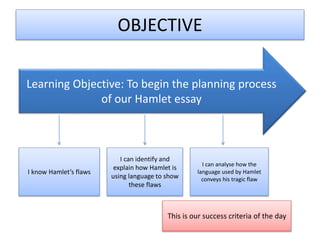
Learning Objective: Toexplain how Hamlet is a
Tragic Hero
I know the key
differences between
tragedies and comedies
I can identify and
explain how Hamlet is a
tragic hero
I can use my knowledge of
tragic heroes to analyse
who the audience feels
empathy for: Hamlet or
Ophelia
This is our success criteria of the day
41.
Tragedy
• What arethe connotations of this word?
• Can we think of any modern tragedies?
• Do we also see tragic elements in the play?
• What are the key differences between
tragedies and comedies?
You have two minutes to discuss with the people
around you. We will then feed back.
42.
TRAGEDY COMEDY
Simplicity: Tragicheroes tend to approach
problems and situations in a fairly straight-forward
manner. Life can be understood in simple binaries
-- good/bad; just/unjust; beautiful/ugly.
Complex: Comic heroes tend to be more
flexible. Life tends to be messier, full of diversity
and unexpected twists and turns. It is more
difficult to classify experience.
Low Tolerance for Disorder: Tragic plots tend to
stress order and process -- the end follows from
the beginning.
High Tolerance for Disorder: Comic plots tend
to be more random; they seem to be improvised,
leaving a number of loose ends.
Heroism: Characters tend to be "superhuman,
semi divine, larger-than-life" beings.
Antiheroism: Characters tend to be normal,
down-to-earth individuals. Comedies tend to
parody authority.
Militarism: Tragedies often arise in warrior
cultures. And its values are those of the good
soldier--duty, honour, commitment.
Pacifism: Comedies tend to call into question
warrior values: Better to lose your dignity and
save your life.
Vengeance: Offending a tragic hero often results
in a cycle of vengeance.
Forgiveness: In comedies, forgiveness, even
friendship among former enemies, happens.
Hierarchy: Tragedies tend to stress the upper-
class, the noble few, royalty, and leaders.
Equality: Comedies tend to include all classes of
people. The lower classes are often the butt of
the jokes, but they also tend to triumph in
unexpected ways.
Less Sexual Equality: Tragedies are often male-
dominated.
More Sexual Equality: Comedies, while often
sexist too, are sometimes less so. Women play a
larger, more active role.
Rule-based Ethics: The tragic vision tends to
stress the consequences of disobeying the
accepted order of things.
Situation-based Ethics: Comic heroes tend to
make up the rules as they go along or at least be
wary of generalizations.
43.
Tragic Hero
• Whatdo you think is meant by the term
‘Tragic Hero’?
TRAGEDY HERO
44.
Tragic Hero
• Whatdo you think is meant by the term
‘Tragic Hero’?
1. A tragic hero is the main character (or
"protagonist") in a tragedy.
2. The tragic hero is a character who makes an
error of judgment or has a fatal flaw that,
combined with fate and external forces,
brings on a tragedy.
45.
Characteristics of theTragic Hero
• According to ARISTOTLE (very old, Ancient
Greek, dead philosopher bloke), the common
characteristics in a Tragic Hero are:
– Usually of noble birth, or starts off as a ruddy
good chap.
– Hamartia - a.k.a. the tragic flaw that eventually
leads to his downfall.
– Peripeteia - a reversal of fortune brought about by
the hero's tragic flaw
– The audience must feel pity and fear for this
character.
Hamlet as aTragic Hero
1. How is Hamlet described in the first
paragraph?
2. How is Hamlet defined as a tragic hero?
3. Which quotes demonstrate Hamlet as a
tragic hero?
48.
• Do weagree that Hamlet is a tragic hero?
• Overall, who do we feel most empathy for:
Macbeth or the speaker?
Hamlet as a Tragic Hero
49.
Quizzy Rascal
What arethe two texts you will be writing your
controlled assessment on?
A: Hamlet and Othello
50.
What is atragic hero?
1. A tragic hero is the main character (or
"protagonist") in a tragedy.
2. The tragic hero is a character who makes an
error of judgment or has a fatal flaw that,
combined with fate and external forces, brings
on a tragedy.
51.
What does hamartiamean?
Hamartia is the tragic flaw that
eventually leads to the tragic
hero’s downfall
52.
Which was theancient Greek philosopher who
came up with the idea of the tragic hero?
ARISTOTLE
53.
What is Hamlet’stragic flaw?
He is too philosophical and fails to act.
He should have avenged his father
and become the rightful king. But, he
waffles like a big girl and dies
because of it!
Who is MrMorris’ favourite tragic hero of all
time, and like, the coolest things ever, you
know, he’s just awesome, and fantastic, and
he is quintessentially a Leg-End!
Batman, of course! Duh!
56.
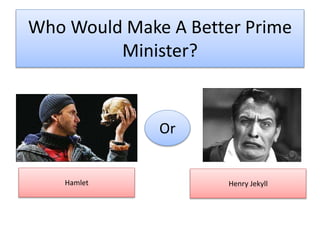
Who Would MakeA Better Prime
Minister?
Or
Hamlet Henry Jekyll
57.
OBJECTIVE
Learning Objective: Toanalyse Shakespeare’s
language in detail
I know the key quotes of
the opening of the play
I can identify and
explain how Hamlet is
using language to
create effect
I can analyse how the
language used by Hamlet
conveys his tragic flaw
This is our success criteria of the day
58.
Construct Meaning –Hamlet in a
Minute!
• In groups of three, you must act out the entire
play of Hamlet in a minute.
• Choose what are the most important
elements of the play and get through them as
quickly as you can.
• Try to include one quotation if possible...
59.
Possible Quotations
• Thisabove all: to thine own self be true,
And it must follow, as the night the day,
Thou canst not then be false to any man.”
• “Doubt thou the stars are fire;
Doubt that the sun doth move;
Doubt truth to be a liar;
But never doubt I love.”
• “There is nothing either good or bad, but thinking
makes it so.”
• “To be, or not to be: that is the question:
Whether 'tis nobler in the mind to suffer
The slings and arrows of outrageous fortune,
Or to take arms against a sea of troubles,
And by opposing end them?”
• “Lord Polonius: What do you read, my lord?
Hamlet: Words, words, words.
Lord Polonius: What is the matter, my lord?
Hamlet: Between who?
Lord Polonius: I mean, the matter that you read,
my lord.”
• “Madness in great ones must not unwatched go.”
• “To die, to sleep -
To sleep, perchance to dream - ay, there's the rub,
For in this sleep of death what dreams may
come...”
• “There are more things in Heaven and Earth,
Horatio, than are dreamt of in your philosophy.”
• “Though this be madness, yet there is method
in't.”
• “Brevity is the soul of wit.”
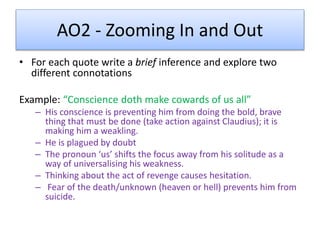
• “Conscience doth make cowards of us all.”
• “My words fly up, my thoughts remain below:
Words without thoughts never to heaven go.”
• “One may smile, and smile, and be a villain. ”
• “The lady doth protest too much, methinks.”
• “When sorrows come, they come not single spies.
But in battalions!”
• “God hath given you one face, and you make
yourself another.”
60.
New Knowledge
• We’regoing to move in a bit closer to the text
and read our first few scenes
• We are going to approach this scene in a
similar way that we approach poetry:
61.
How to approachthe language....
You will be doing the following:
– Focus on what we learn about the character of Hamlet
in the following quotes (focus specifically on Hamlet’s
soliloquies in the early scenes).
1. What poetic devices are used?
2. What kind of language is used?
3. What images are used?
4. Remember that this is a tragedy—how does the
language reflect this?
5. How does the language show Hamlet’s tragic flaws?
62.
“Something is rottenin the state of Denmark.”
Key Quotes 1 – Act I, Sc IV (67)
This line is spoken by Marcellus in Act I, scene iv
(67), as he and Horatio debate whether or not to
follow Hamlet and the ghost into the dark night. The
line refers both to the idea that the ghost is an
ominous omen for Denmark and to the larger
theme of the connection between the moral
legitimacy of a ruler and the health of the state as a
whole. The ghost is a visible symptom of the
rottenness of Denmark created by Claudius’s crime.
63.
Key Quotes 2– Act I, Sc ii (129-158)
O that this too too solid flesh would melt,
Thaw, and resolve itself into a dew!
Or that the Everlasting had not fix’d
His canon ’gainst self-slaughter! O God! O God!
How weary, stale, flat, and unprofitable
Seem to me all the uses of this world!
Fie on’t! O fie! ’tis an unweeded garden,
That grows to seed; things rank and gross in nature
Possess it merely. That it should come to this!
But two months dead!—nay, not so much, not two:
So excellent a king; that was, to this,
Hyperion to a satyr; so loving to my mother,
That he might not beteem the winds of heaven
Visit her face too roughly. Heaven and earth!
Must I remember? Why, she would hang on him
As if increase of appetite had grown
By what it fed on: and yet, within a month,—
Let me not think on’t,—Frailty, thy name is woman!—
A little month; or ere those shoes were old
With which she followed my poor father’s body
Like Niobe, all tears;—why she, even she,—
O God! a beast that wants discourse of reason,
Would have mourn’d longer,—married with mine uncle,
My father’s brother; but no more like my father
Than I to Hercules: within a month;
Ere yet the salt of most unrighteous tears
Had left the flushing in her galled eyes,
She married:— O, most wicked speed, to post
With such dexterity to incestuous sheets!
It is not, nor it cannot come to good;
But break my heart,—for I must hold my tongue.
This quotation, Hamlet’s first important soliloquy, occurs in Act
I, scene ii (129–158). Hamlet speaks these lines after enduring
the unpleasant scene at Claudius and Gertrude’s court, then
being asked by his mother and stepfather not to return to his
studies at Wittenberg but to remain in Denmark, presumably
against his wishes. Here, Hamlet thinks for the first time about
suicide (desiring his flesh to “melt,” and wishing that God had
not made “self-slaughter” a sin), saying that the world is
“weary, stale, flat, and unprofitable.” In other words, suicide
seems like a desirable alternative to life in a painful world, but
Hamlet feels that the option of suicide is closed to him because
it is forbidden by religion. Hamlet then goes on to describe the
causes of his pain, specifically his intense disgust at his mother’s
marriage to Claudius. He describes the haste of their marriage,
noting that the shoes his mother wore to his father’s funeral
were not worn out before her marriage to Claudius. He
compares Claudius to his father (his father was “so excellent a
king” while Claudius is a bestial “satyr”). As he runs through his
description of their marriage, he touches upon the important
motifs of misogyny, crying, “Frailty, thy name is woman”; incest,
commenting that his mother moved “[w]ith such dexterity to
incestuous sheets”; and the ominous omen the marriage
represents for Denmark, that “[i]t is not nor it cannot come to
good.” Each of these motifs recurs throughout the play.
64.
I have oflate,—but wherefore I know
not,—lost all my mirth, forgone all
custom of exercises; and indeed, it goes
so heavily with my disposition that this
goodly frame, the earth, seems to me a
sterile promontory; this most excellent
canopy, the air, look you, this brave
o’erhanging firmament, this majestical
roof fretted with golden fire,—why, it
appears no other thing to me than a foul
and pestilent congregation of vapours.
What a piece of work is man! How noble
in reason! how infinite in faculties! in
form and moving, how express and
admirable! in action how like an angel! in
apprehension, how like a god! the
beauty of the world! the paragon of
animals! And yet, to me, what is this
quintessence of dust?
Key Quotes 3 – Act II, Sc ii (287-298)
In these lines, Hamlet speaks to Rosencrantz and
Guildenstern in Act II, scene ii (287–298), explaining
the melancholy that has afflicted him since his
father’s death. Perhaps moved by the presence of his
former university companions, Hamlet essentially
engages in a rhetorical exercise, building up an
elaborate and glorified picture of the earth and
humanity before declaring it all merely a
“quintessence of dust.” He examines the earth, the
air, and the sun, and rejects them as “a sterile
promontory” and “a foul and pestilent congregation
of vapors.” He then describes human beings from
several perspectives, each one adding to his
glorification of them. Human beings’ reason is noble,
their faculties infinite, their forms and movements
fast and admirable, their actions angelic, and their
understanding godlike. But, to Hamlet, humankind is
merely dust. This motif, an expression of his
obsession with the physicality of death, recurs
throughout the play, reaching its height in his speech
over Yorick’s skull. Finally, it is also telling that Hamlet
makes humankind more impressive in
“apprehension” (meaning understanding) than in
“action.” Hamlet himself is more prone to
apprehension than to action, which is why he delays
so long before seeking his revenge on Claudius.
65.
Apply to Demonstrate- Your turn!
• Think about how language has been used in these
quotes (by this we mean what features has
Shakespeare used—we can learn a lot about characters
and theme from language). This is linked to AO2.
– Focus on what we learn about the character of Hamlet in
one of the quotes.
– What poetic devices are used?
– What kind of language is used?
– What images are used?
– Remember that this is a tragedy—how does the language
reflect this?
– How does the language show Hamlet’s tragic flaws?
66.
Review
• Write threesentences about the effect of at
least ONE language device or one image that
you see in one of the quotes. Relate it to the
character and to the essay question.
• Look at the example on the next slide.
67.
Example
"To be, ornot to be: that is the question." (Act III, Scene I)
In the beginning of his fourth, and best known, soliloquy
Hamlet muses about the conundrum of suicide. He wonders if
one route is "nobler" than the next. At this point in the play,
Hamlet has been unable to act upon his motives for personal
revenge, and this frustrates him. We anticipate the tragic
elements of the play as he decides which opportunity is
better: suffering as he has been or ending it all? The tone of
Hamlet's soliloquy is more meditative than angry, and he
often stalls throughout his delivery; this can be conveyed
through the use of comma and colon in quick succession in
the opening line, as if he is delaying the inevitable act he will
have to commit to avenge his father. Nevertheless, it is this
delay and continuous questioning that acts as his tragic flaw,
ensuring his own downfall is not far away.
68.
OBJECTIVE
Learning Objective: Toanalyse Hamlet’s tragic
qualities in different monologues
I know the key quotes of
the opening of the play
I can identify and
explain how Hamlet is
using language to
create effect
I can analyse how the
language used by Hamlet
conveys his tragic flaw
This is our success criteria of the day
69.
Key Question
Hamlet asks,"Am I a coward?" (II.ii.543)
What would your answer be to Hamlet's
question?
70.
New Knowledge
• We’regoing to move in a bit closer to the text
and analyse the language in detail
• We are going to approach this in a similar way
that we approach any poem:
– Meaning
– Techniques
– Effect
What are poetic techniques?
71.
How to approachthe language....
Focus on what we learn about the character of
Hamlet in one of the quotes.
– What poetic devices are used?
– What kind of language is used?
– What images are used?
– Remember that this is a tragedy—how does the
language reflect this?
– How does the language show Hamlet’s tragic
flaws?
72.
Create an AnalysisFrame
Top Left =
explanation
of quote
The most important
quotation from the
extract
Top Right =
poetic
techniques
used
Bottom
Right= draw
an image of
the line
Bottom Left =
analyse the
quote
73.
Create an AnalysisFrame
Hamlet
muses about
the
conundrum of
suicide To be, or not to
be: that is the
question
• Repetition
• comma/colon
• brevity
The tone of Hamlet's soliloquy
is more meditative than angry,
and he often stalls throughout
his delivery; this can be
conveyed through the use of
comma and colon in quick
succession in the opening line,
as if he is delaying the
inevitable act he will have to
commit to avenge his father.
Nevertheless, it is this delay
and continuous questioning
that acts as his tragic flaw,
ensuring his own downfall is
not far away.
74.
Key Quotes 2– Act I, Sc ii (129-158)
O that this too too solid flesh would melt,
Thaw, and resolve itself into a dew!
Or that the Everlasting had not fix’d
His canon ’gainst self-slaughter! O God! O God!
How weary, stale, flat, and unprofitable
Seem to me all the uses of this world!
Fie on’t! O fie! ’tis an unweeded garden,
That grows to seed; things rank and gross in nature
Possess it merely. That it should come to this!
But two months dead!—nay, not so much, not two:
So excellent a king; that was, to this,
Hyperion to a satyr; so loving to my mother,
That he might not beteem the winds of heaven
Visit her face too roughly. Heaven and earth!
Must I remember? Why, she would hang on him
As if increase of appetite had grown
By what it fed on: and yet, within a month,—
Let me not think on’t,—Frailty, thy name is woman!—
A little month; or ere those shoes were old
With which she followed my poor father’s body
Like Niobe, all tears;—why she, even she,—
O God! a beast that wants discourse of reason,
Would have mourn’d longer,—married with mine uncle,
My father’s brother; but no more like my father
Than I to Hercules: within a month;
Ere yet the salt of most unrighteous tears
Had left the flushing in her galled eyes,
She married:— O, most wicked speed, to post
With such dexterity to incestuous sheets!
It is not, nor it cannot come to good;
But break my heart,—for I must hold my tongue.
This quotation, Hamlet’s first important soliloquy, occurs in Act I, scene
ii (129–158). Hamlet speaks these lines after enduring the unpleasant
scene at Claudius and Gertrude’s court, then being asked by his mother
and stepfather not to return to his studies at Wittenberg but to remain
in Denmark, presumably against his wishes. Here, Hamlet thinks for the
first time about suicide (desiring his flesh to “melt,” and wishing that
God had not made “self-slaughter” a sin), saying that the world is
“weary, stale, flat, and unprofitable.” In other words, suicide seems like
a desirable alternative to life in a painful world, but Hamlet feels that
the option of suicide is closed to him because it is forbidden by religion.
Hamlet then goes on to describe the causes of his pain, specifically his
intense disgust at his mother’s marriage to Claudius. He describes the
haste of their marriage, noting that the shoes his mother wore to his
father’s funeral were not worn out before her marriage to Claudius. He
compares Claudius to his father (his father was “so excellent a king”
while Claudius is a bestial “satyr”). As he runs through his description of
their marriage, he touches upon the important motifs of misogyny,
crying, “Frailty, thy name is woman”; incest, commenting that his
mother moved “[w]ith such dexterity to incestuous sheets”; and the
ominous omen the marriage represents for Denmark, that “[i]t is not
nor it cannot come to good.” Each of these motifs recurs throughout
the play.
Still haven’t got
the foggiest?
Look here:
75.
Quote 2 -Detailed Analysis
Hamlet's passionate first soliloquy provides a striking contrast to the controlled and artificial dialogue
that he must exchange with Claudius and his court. The primary function of the soliloquy is to reveal to
the audience Hamlet's profound melancholia and the reasons for his despair. In a disjointed outpouring
of disgust, anger, sorrow, and grief, Hamlet explains that, without exception, everything in his world is
either futile or contemptible. His speech is saturated with suggestions of rot and corruption, as seen in
the basic usage of words like "rank" (138) and "gross" (138), and in the metaphor associating the world
with "an unweeded garden" (137). The nature of his grief is soon exposed, as we learn that his mother,
Gertrude, has married her own brother-in-law only two months after the death of Hamlet's father.
Hamlet is tormented by images of Gertrude's tender affections toward his father, believing that her
display of love was a pretense to satisfy her own lust and greed. Hamlet even negates Gertrude's initial
grief over the loss of her husband. She cried "unrighteous tears" (156) because the sorrow she
expressed was insincere, belied by her reprehensible conduct.
Notice Shakespeare's use of juxtaposition and contrast to enhance Hamlet's feelings of contempt,
disgust, and inadequacy. "The counterpointing between things divine and things earthly or profane is
apparent from the opening sentence of the soliloquy, in which Hamlet expresses his anguished sense of
being captive to his flesh. His desire for dissolution into dew, an impermanent substance, is expressive
of his desire to escape from the corporality into a process suggestive of spiritual release. Immediately
juxtaposed to this notion, and standing in contrast to "flesh", is his reference to the "Everlasting", the
spiritual term for the duality. Paradoxically, in his aversion from the flesh, his body must seem to him to
possess a state of permanence, closer to something everlasting than to the ephemeral nature of the
dew he yearns to become" (Newell 35).
Another striking juxtaposition in the soliloquy is Hamlet's use of Hyperion and a satyr to denote his
father and his uncle, respectively. Hyperion, the Titan god of light, represents honor, virtue, and regality
-- all traits belonging to Hamlet's father, the true King of Denmark. Satyrs, the half-human and half-
beast companions of the wine-god Dionysus, represent lasciviousness and overindulgence, much like
Hamlet's usurping uncle Claudius. It is no wonder, then, that Hamlet develops a disgust for, not only
Claudius the man, but all of the behaviours and excesses associated with Claudius. In other passages
from the play we see that Hamlet has begun to find revelry of any kind unacceptable, and, in particular,
he loathes drinking and sensual dancing.
76.
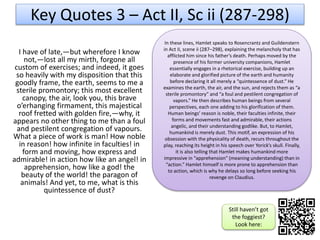
I have oflate,—but wherefore I know
not,—lost all my mirth, forgone all
custom of exercises; and indeed, it goes
so heavily with my disposition that this
goodly frame, the earth, seems to me a
sterile promontory; this most excellent
canopy, the air, look you, this brave
o’erhanging firmament, this majestical
roof fretted with golden fire,—why, it
appears no other thing to me than a foul
and pestilent congregation of vapours.
What a piece of work is man! How noble
in reason! how infinite in faculties! in
form and moving, how express and
admirable! in action how like an angel! in
apprehension, how like a god! the
beauty of the world! the paragon of
animals! And yet, to me, what is this
quintessence of dust?
Key Quotes 3 – Act II, Sc ii (287-298)
In these lines, Hamlet speaks to Rosencrantz and Guildenstern
in Act II, scene ii (287–298), explaining the melancholy that has
afflicted him since his father’s death. Perhaps moved by the
presence of his former university companions, Hamlet
essentially engages in a rhetorical exercise, building up an
elaborate and glorified picture of the earth and humanity
before declaring it all merely a “quintessence of dust.” He
examines the earth, the air, and the sun, and rejects them as “a
sterile promontory” and “a foul and pestilent congregation of
vapors.” He then describes human beings from several
perspectives, each one adding to his glorification of them.
Human beings’ reason is noble, their faculties infinite, their
forms and movements fast and admirable, their actions
angelic, and their understanding godlike. But, to Hamlet,
humankind is merely dust. This motif, an expression of his
obsession with the physicality of death, recurs throughout the
play, reaching its height in his speech over Yorick’s skull. Finally,
it is also telling that Hamlet makes humankind more
impressive in “apprehension” (meaning understanding) than in
“action.” Hamlet himself is more prone to apprehension than
to action, which is why he delays so long before seeking his
revenge on Claudius.
Still haven’t got
the foggiest?
Look here:
77.
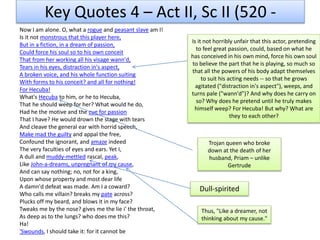
Key Quotes 4– Act II, Sc II (520 -
Now I am alone. O, what a rogue and peasant slave am I!
Is it not monstrous that this player here,
But in a fiction, in a dream of passion,
Could force his soul so to his own conceit
That from her working all his visage wann'd,
Tears in his eyes, distraction in's aspect,
A broken voice, and his whole function suiting
With forms to his conceit? and all for nothing!
For Hecuba!
What's Hecuba to him, or he to Hecuba,
That he should weep for her? What would he do,
Had he the motive and the cue for passion
That I have? He would drown the stage with tears
And cleave the general ear with horrid speech,
Make mad the guilty and appal the free,
Confound the ignorant, and amaze indeed
The very faculties of eyes and ears. Yet I,
A dull and muddy-mettled rascal, peak,
Like John-a-dreams, unpregnant of my cause,
And can say nothing; no, not for a king,
Upon whose property and most dear life
A damn'd defeat was made. Am I a coward?
Who calls me villain? breaks my pate across?
Plucks off my beard, and blows it in my face?
Tweaks me by the nose? gives me the lie i' the throat,
As deep as to the lungs? who does me this?
Ha!
'Swounds, I should take it: for it cannot be
Is it not horribly unfair that this actor, pretending
to feel great passion, could, based on what he
has conceived in his own mind, force his own soul
to believe the part that he is playing, so much so
that all the powers of his body adapt themselves
to suit his acting needs -- so that he grows
agitated ("distraction in's aspect"), weeps, and
turns pale ("wann'd")? And why does he carry on
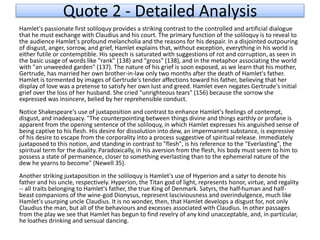
so? Why does he pretend until he truly makes
himself weep? For Hecuba! But why? What are
they to each other?
Trojan queen who broke
down at the death of her
husband, Priam – unlike
Gertrude
Dull-spirited
Thus, "Like a dreamer, not
thinking about my cause."
78.
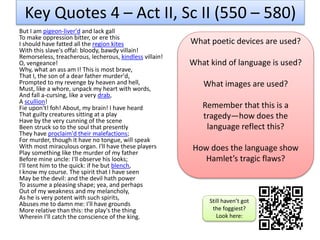
Key Quotes 4– Act II, Sc II (550 – 580)
But I am pigeon-liver'd and lack gall
To make oppression bitter, or ere this
I should have fatted all the region kites
With this slave's offal: bloody, bawdy villain!
Remorseless, treacherous, lecherous, kindless villain!
O, vengeance!
Why, what an ass am I! This is most brave,
That I, the son of a dear father murder'd,
Prompted to my revenge by heaven and hell,
Must, like a whore, unpack my heart with words,
And fall a-cursing, like a very drab,
A scullion!
Fie upon't! foh! About, my brain! I have heard
That guilty creatures sitting at a play
Have by the very cunning of the scene
Been struck so to the soul that presently
They have proclaim'd their malefactions;
For murder, though it have no tongue, will speak
With most miraculous organ. I'll have these players
Play something like the murder of my father
Before mine uncle: I'll observe his looks;
I'll tent him to the quick: if he but blench,
I know my course. The spirit that I have seen
May be the devil: and the devil hath power
To assume a pleasing shape; yea, and perhaps
Out of my weakness and my melancholy,
As he is very potent with such spirits,
Abuses me to damn me: I'll have grounds
More relative than this: the play's the thing
Wherein I'll catch the conscience of the king.
What poetic devices are used?
What kind of language is used?
What images are used?
Remember that this is a
tragedy—how does the
language reflect this?
How does the language show
Hamlet’s tragic flaws?
Still haven’t got
the foggiest?
Look here:
79.
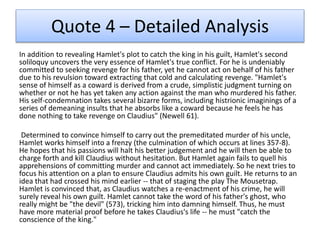
Quote 4 –Detailed Analysis
In addition to revealing Hamlet's plot to catch the king in his guilt, Hamlet's second
soliloquy uncovers the very essence of Hamlet's true conflict. For he is undeniably
committed to seeking revenge for his father, yet he cannot act on behalf of his father
due to his revulsion toward extracting that cold and calculating revenge. "Hamlet's
sense of himself as a coward is derived from a crude, simplistic judgment turning on
whether or not he has yet taken any action against the man who murdered his father.
His self-condemnation takes several bizarre forms, including histrionic imaginings of a
series of demeaning insults that he absorbs like a coward because he feels he has
done nothing to take revenge on Claudius" (Newell 61).
Determined to convince himself to carry out the premeditated murder of his uncle,
Hamlet works himself into a frenzy (the culmination of which occurs at lines 357-8).
He hopes that his passions will halt his better judgement and he will then be able to
charge forth and kill Claudius without hesitation. But Hamlet again fails to quell his
apprehensions of committing murder and cannot act immediately. So he next tries to
focus his attention on a plan to ensure Claudius admits his own guilt. He returns to an
idea that had crossed his mind earlier -- that of staging the play The Mousetrap.
Hamlet is convinced that, as Claudius watches a re-enactment of his crime, he will
surely reveal his own guilt. Hamlet cannot take the word of his father's ghost, who
really might be "the devil" (573), tricking him into damning himself. Thus, he must
have more material proof before he takes Claudius's life -- he must "catch the
conscience of the king."
80.
OBJECTIVE
Learning Objective: Towrite an analytical
paragraph on Hamlet’s tragic flaws
I know Hamlet’s flaws
I can identify and
explain how Hamlet is
using language to show
these flaws
I can analyse how the
language used by Hamlet
conveys his tragic flaw
This is our success criteria of the day
81.
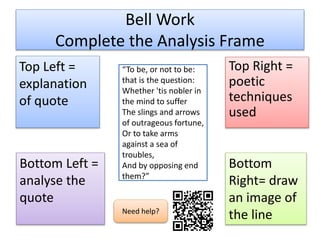
Bell Work
Complete theAnalysis Frame
Top Left =
explanation
of quote
“To be, or not to be:
that is the question:
Whether 'tis nobler in
the mind to suffer
The slings and arrows
of outrageous fortune,
Or to take arms
against a sea of
troubles,
And by opposing end
them?”
Top Right =
poetic
techniques
used
Bottom
Right= draw
an image of
the line
Bottom Left =
analyse the
quote
Need help?
82.
Let’s Revive Hammy…
1.In groups of four, draw round the head and torso
of one student on the paper provided
2. Write as many adjective in the following places
that describe Hamlet’s personality:
– Head = thoughts about life
– Heart = feelings and emotions
– Stomach = his strengths and weaknesses
– Arms = relationships with others
3. Around the body, find quotes from the extracts
we have study to support your adjectives
83.
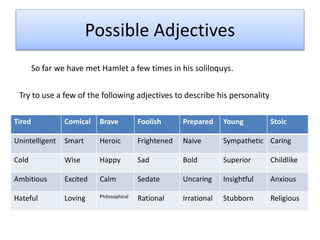
Possible Adjectives
So farwe have met Hamlet a few times in his soliloquys.
Try to use a few of the following adjectives to describe his personality
Tired Comical Brave Foolish Prepared Young Stoic
Unintelligent Smart Heroic Frightened Naive Sympathetic Caring
Cold Wise Happy Sad Bold Superior Childlike
Ambitious Excited Calm Sedate Uncaring Insightful Anxious
Hateful Loving Philosophical Rational Irrational Stubborn Religious
84.
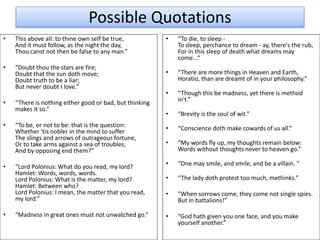
Possible Quotations
• Thisabove all: to thine own self be true,
And it must follow, as the night the day,
Thou canst not then be false to any man.”
• “Doubt thou the stars are fire;
Doubt that the sun doth move;
Doubt truth to be a liar;
But never doubt I love.”
• “There is nothing either good or bad, but thinking
makes it so.”
• “To be, or not to be: that is the question:
Whether 'tis nobler in the mind to suffer
The slings and arrows of outrageous fortune,
Or to take arms against a sea of troubles,
And by opposing end them?”
• “Lord Polonius: What do you read, my lord?
Hamlet: Words, words, words.
Lord Polonius: What is the matter, my lord?
Hamlet: Between who?
Lord Polonius: I mean, the matter that you read,
my lord.”
• “Madness in great ones must not unwatched go.”
• “To die, to sleep -
To sleep, perchance to dream - ay, there's the rub,
For in this sleep of death what dreams may
come...”
• “There are more things in Heaven and Earth,
Horatio, than are dreamt of in your philosophy.”
• “Though this be madness, yet there is method
in't.”
• “Brevity is the soul of wit.”
• “Conscience doth make cowards of us all.”
• “My words fly up, my thoughts remain below:
Words without thoughts never to heaven go.”
• “One may smile, and smile, and be a villain. ”
• “The lady doth protest too much, methinks.”
• “When sorrows come, they come not single spies.
But in battalions!”
• “God hath given you one face, and you make
yourself another.”
85.
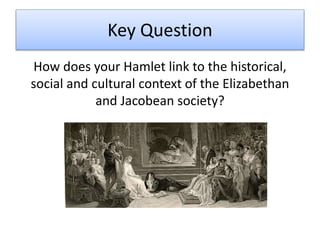
Key Question
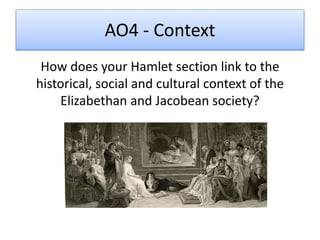
How doesyour Hamlet link to the historical,
social and cultural context of the Elizabethan
and Jacobean society?
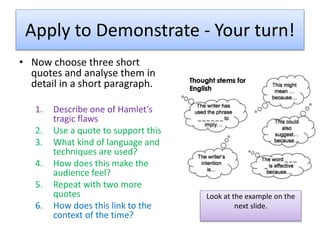
Apply to Demonstrate- Your turn!
• Now choose three short
quotes and analyse them in
detail in a short paragraph.
1. Describe one of Hamlet’s
tragic flaws
2. Use a quote to support this
3. What kind of language and
techniques are used?
4. How does this make the
audience feel?
5. Repeat with two more
quotes
6. How does this link to the
context of the time?
Look at the example on the
next slide.
88.
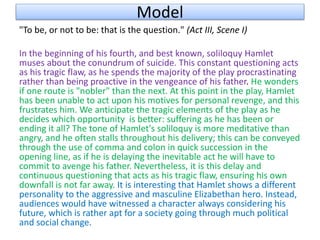
Model
"To be, ornot to be: that is the question." (Act III, Scene I)
In the beginning of his fourth, and best known, soliloquy Hamlet
muses about the conundrum of suicide. This constant questioning acts
as his tragic flaw, as he spends the majority of the play procrastinating
rather than being proactive in the vengeance of his father. He wonders
if one route is "nobler" than the next. At this point in the play, Hamlet
has been unable to act upon his motives for personal revenge, and this
frustrates him. We anticipate the tragic elements of the play as he
decides which opportunity is better: suffering as he has been or
ending it all? The tone of Hamlet's soliloquy is more meditative than
angry, and he often stalls throughout his delivery; this can be conveyed
through the use of comma and colon in quick succession in the
opening line, as if he is delaying the inevitable act he will have to
commit to avenge his father. Nevertheless, it is this delay and
continuous questioning that acts as his tragic flaw, ensuring his own
downfall is not far away. It is interesting that Hamlet shows a different
personality to the aggressive and masculine Elizabethan hero. Instead,
audiences would have witnessed a character always considering his
future, which is rather apt for a society going through much political
and social change.
89.
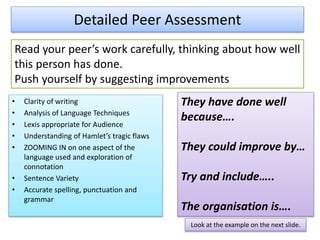
Detailed Peer Assessment
•Clarity of writing
• Analysis of Language Techniques
• Lexis appropriate for Audience
• Understanding of Hamlet’s tragic flaws
• ZOOMING IN on one aspect of the
language used and exploration of
connotation
• Sentence Variety
• Accurate spelling, punctuation and
grammar
Read your peer’s work carefully, thinking about how well
this person has done.
Push yourself by suggesting improvements
They have done well
because….
They could improve by…
Try and include…..
The organisation is….
Look at the example on the next slide.
90.
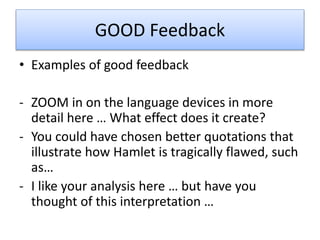
GOOD Feedback
• Examplesof good feedback
- ZOOM in on the language devices in more
detail here … What effect does it create?
- You could have chosen better quotations that
illustrate how Hamlet is tragically flawed, such
as…
- I like your analysis here … but have you
thought of this interpretation …
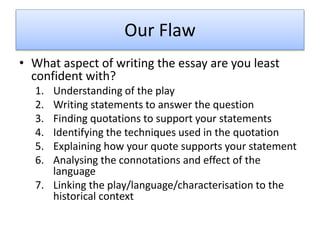
92.
Our Flaw
• Whataspect of writing the essay are you least
confident with?
1. Understanding of the play
2. Writing statements to answer the question
3. Finding quotations to support your statements
4. Identifying the techniques used in the quotation
5. Explaining how your quote supports your statement
6. Analysing the connotations and effect of the
language
7. Linking the play/language/characterisation to the
historical context
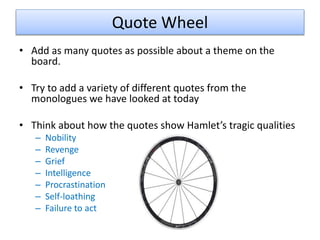
93.
Quote Wheel
• Addas many quotes as possible about a theme on the
board.
• Try to add a variety of different quotes from the
monologues we have looked at today
• Think about how the quotes show Hamlet’s tragic qualities
– Nobility
– Revenge
– Grief
– Intelligence
– Procrastination
– Self-loathing
– Failure to act
94.
OBJECTIVE
Learning Objective: Toanalyse and evaluate Act III,
Sc III – where Hamlet bottles it!
I know Hamlet’s flaws
I can identify and
explain how Hamlet is
using language to show
these flaws
I can analyse how the
language used by Hamlet
conveys his tragic flaw
This is our success criteria of the day
Act III, ScIII – Why doesn’t Hamlet kill Claudius?
Hamlet slips quietly into the room and steels himself to
kill the unseeing Claudius. But suddenly it occurs to him
that if he kills Claudius while he is praying, he will end the
king’s life at the moment when he was seeking
forgiveness for his sins, sending Claudius’s soul to heaven.
This is hardly an adequate revenge, Hamlet thinks,
especially since Claudius, by killing Hamlet’s father before
he had time to make his last confession, ensured that his
brother would not go to heaven. Hamlet decides to wait,
resolving to kill Claudius when the king is sinning—when
he is either drunk, angry, or lustful. He leaves. Claudius
rises and declares that he has been unable to pray
sincerely: “My words fly up, my thoughts remain below”
(III.iii.96).
100.
Explanation
In Act III,scene iii, Hamlet finally seems ready to put his desire for
revenge into action. He is satisfied that the play has proven his uncle’s
guilt. When Claudius prays, the audience is given real certainty that
Claudius murdered his brother: a full, spontaneous confession, even
though nobody else hears it. This only heightens our sense that the
climax of the play is due to arrive. But Hamlet waits.
On the surface, it seems that he waits because he wants a more radical
revenge. Critics such as Samuel Taylor Coleridge have been horrified by
Hamlet’s words here—he completely oversteps the bounds of
Christian morality in trying to damn his opponent’s soul as well as kill
him. But apart from this ultraviolent posturing, Hamlet has once again
avoided the imperative to act by involving himself in a problem of
knowledge. Now that he’s satisfied that he knows Claudius’s guilt, he
wants to know that his punishment will be sufficient. It may have been
difficult to prove the former, but how can Hamlet ever hope to know
the fate of Claudius’s immortal soul?
101.
Explanation
Hamlet poses hisdesire to damn Claudius as a matter of fairness: his own father was
killed without having cleansed his soul by praying or confessing, so why should his
murderer be given that chance? But Hamlet is forced to admit that he doesn’t really
know what happened to his father, remarking “how his audit stands, who knows, save
heaven?” (III.iv.82). The most he can say is that “in our circumstance and course of
thought / ’Tis heavy with him” (III.iv.83–84). The Norton Shakespeare paraphrases “in
our circumstance and course of thought” as “in our indirect and limited way of
knowing on earth.” Having proven his uncle’s guilt to himself, against all odds, Hamlet
suddenly finds something else to be uncertain about.
At this point, Hamlet has gone beyond his earlier need to know the facts about the
crime, and he now craves metaphysical knowledge, knowledge of the afterlife and of
God, before he is willing to act. The audience has had plenty of opportunity to see
that Hamlet is fascinated with philosophical questions. In the case of the “to be, or not
to be” soliloquy, we saw that his philosophizing can be a way for him to avoid thinking
about or acknowledging something more immediately important (in that case, his
urge to kill himself). Is Hamlet using his speculations about Claudius’s soul to avoid
thinking about something in this case? Perhaps the task he has set for himself—killing
another human being in cold blood—is too much for him to face. Whatever it is, the
audience may once again get the sense that there is something more to Hamlet’s
behavior than meets the eye. That Shakespeare is able to convey this sense is a
remarkable achievement in itself, quite apart from how we try to explain what
Hamlet’s unacknowledged motives might be.
102.
Key Quotes fromthis Scene
Now might I do it pat, now he is praying;
And now I'll do't. And so he goes to heaven,
And so am I reveng'd. That would be scann'd.
A villain kills my father; and for that,
I, his sole son, do this same villain send
To heaven.
Why, this is hire and salary, not revenge!
He took my father grossly, full of bread,
With all his crimes broad blown, as flush as May;
And how his audit stands, who knows save heaven?
But in our circumstance and course of thought,
'Tis heavy with him; and am I then reveng'd,
To take him in the purging of his soul,
When he is fit and seasoned for his passage?
No.
Up, sword, and know thou a more horrid hent.
When he is drunk asleep; or in his rage;
Or in th' incestuous pleasure of his bed;
At gaming, swearing, or about some act
That has no relish of salvation in't-
Then trip him, that his heels may kick at heaven,
And that his soul may be as damn'd and black
As hell, whereto it goes. My mother stays.
This physic but prolongs thy sickly days.
How does the language show
Hamlet’s tragic flaws?
What poetic devices and
images are used?
What kind of language is
used?
How is structure used for
effect?
How does this speech reflect
the historical context?
103.
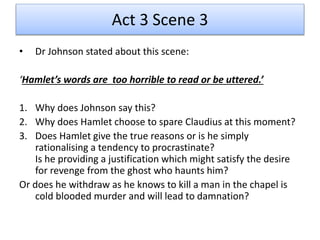
Act 3 Scene3
• Dr Johnson stated about this scene:
‘Hamlet’s words are too horrible to read or be uttered.’
1. Why does Johnson say this?
2. Why does Hamlet choose to spare Claudius at this moment?
3. Does Hamlet give the true reasons or is he simply
rationalising a tendency to procrastinate?
Is he providing a justification which might satisfy the desire
for revenge from the ghost who haunts him?
Or does he withdraw as he knows to kill a man in the chapel is
cold blooded murder and will lead to damnation?
104.
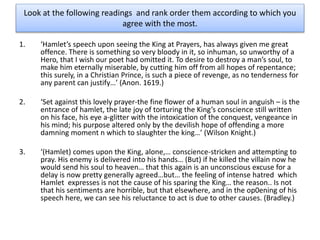
Look at thefollowing readings and rank order them according to which you
agree with the most.
1. ‘Hamlet’s speech upon seeing the King at Prayers, has always given me great
offence. There is something so very bloody in it, so inhuman, so unworthy of a
Hero, that I wish our poet had omitted it. To desire to destroy a man’s soul, to
make him eternally miserable, by cutting him off from all hopes of repentance;
this surely, in a Christian Prince, is such a piece of revenge, as no tenderness for
any parent can justify…’ (Anon. 1619.)
2. ‘Set against this lovely prayer-the fine flower of a human soul in anguish – is the
entrance of hamlet, the late joy of torturing the King’s conscience still written
on his face, his eye a-glitter with the intoxication of the conquest, vengeance in
his mind; his purpose altered only by the devilish hope of offending a more
damning moment n which to slaughter the king…’ (Wilson Knight.)
3. ‘(Hamlet) comes upon the King, alone,… conscience-stricken and attempting to
pray. His enemy is delivered into his hands… (But) if he killed the villain now he
would send his soul to heaven… that this again is an unconscious excuse for a
delay is now pretty generally agreed…but… the feeling of intense hatred which
Hamlet expresses is not the cause of his sparing the King… the reason.. Is not
that his sentiments are horrible, but that elsewhere, and in the op0ening of his
speech here, we can see his reluctance to act is due to other causes. (Bradley.)
105.
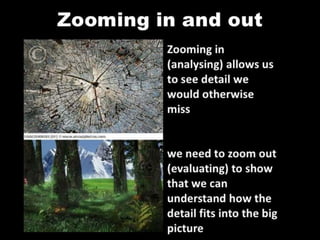
Analysing
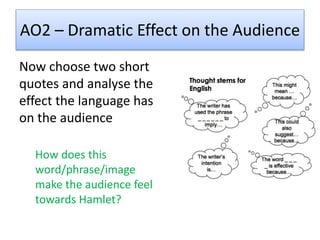
• ZOOM INon how Shakespeare’s use of
language presents Hamlet’s personality
• Focus on one or two words and think about
the connotations
• What can we infer?
106.
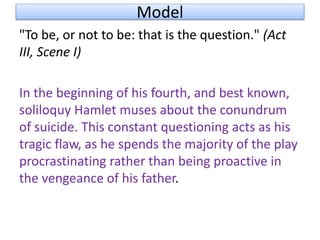
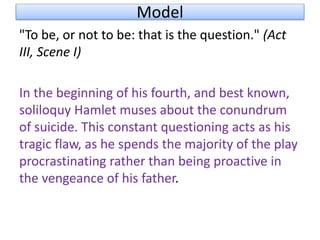
Model
"To be, ornot to be: that is the question." (Act
III, Scene I)
In the beginning of his fourth, and best known,
soliloquy Hamlet muses about the conundrum
of suicide. This constant questioning acts as his
tragic flaw, as he spends the majority of the play
procrastinating rather than being proactive in
the vengeance of his father.
107.
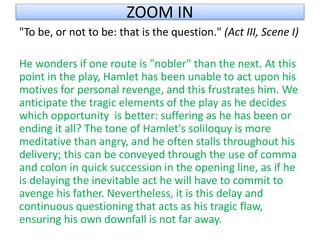
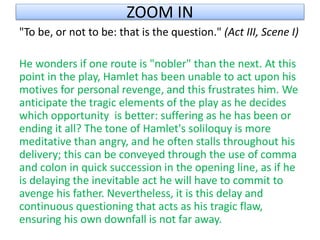
ZOOM IN
"To be,or not to be: that is the question." (Act III, Scene I)
He wonders if one route is "nobler" than the next. At this
point in the play, Hamlet has been unable to act upon his
motives for personal revenge, and this frustrates him. We
anticipate the tragic elements of the play as he decides
which opportunity is better: suffering as he has been or
ending it all? The tone of Hamlet's soliloquy is more
meditative than angry, and he often stalls throughout his
delivery; this can be conveyed through the use of comma
and colon in quick succession in the opening line, as if he
is delaying the inevitable act he will have to commit to
avenge his father. Nevertheless, it is this delay and
continuous questioning that acts as his tragic flaw,
ensuring his own downfall is not far away.
108.
• Now ZOOMOUT to show how this links to the
author’s purpose or what it shows about the
historical and social context or the theme of
the play…
Evaluating
109.
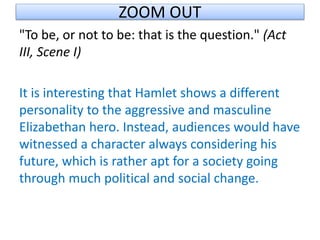
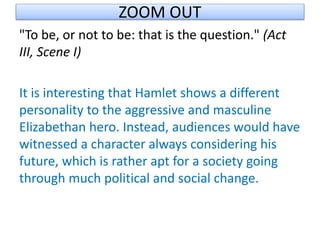
ZOOM OUT
"To be,or not to be: that is the question." (Act
III, Scene I)
It is interesting that Hamlet shows a different
personality to the aggressive and masculine
Elizabethan hero. Instead, audiences would have
witnessed a character always considering his
future, which is rather apt for a society going
through much political and social change.
110.
Review
• Highlight thethree different parts to your
paragraph:
– Statement that answers the question
– ZOOMING in and analysing the language
– ZOOMING out to link it to the context
111.
Review
Learning Objective: Toanalyse and evaluate Act III,
Sc III – where Hamlet bottles it!
I know Hamlet’s flaws
I can identify and
explain how Hamlet is
using language to show
these flaws
I can analyse how the
language used by Hamlet
conveys his tragic flaw
This is our success criteria of the day
112.
Who Would MakeA Better Prime
Minister?
Or
Hamlet Henry Jekyll
113.
OBJECTIVE
Learning Objective: ToZOOM IN and ZOOM OUT
on Hamlet’s final soliloquy
I know Hamlet’s flaws
I can identify and
explain how Hamlet is
using language to show
these flaws
I can analyse how the
language used by Hamlet
conveys his tragic flaw
This is our success criteria of the day
114.
Mindmap!
• What doesyour writing need in order to get
an A* in your controlled assessment?
– Fluency (like an embedded quotation)
– Originality (not just what your teacher told you)
– Detail (not just generalisations)
– Sophistication (not using words like ‘stuff’)
– Language Analysis (writers don’t choose words by
accident!)
116.
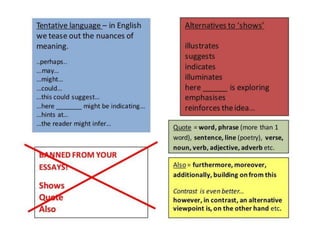
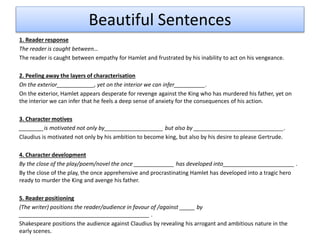
Beautiful Sentences
1. Readerresponse
The reader is caught between…
The reader is caught between empathy for Hamlet and frustrated by his inability to act on his vengeance.
2. Peeling away the layers of characterisation
On the exterior____________, yet on the interior we can infer__________.
On the exterior, Hamlet appears desperate for revenge against the King who has murdered his father, yet on
the interior we can infer that he feels a deep sense of anxiety for the consequences of his action.
3. Character motives
________is motivated not only by___________________ but also by _____________________________.
Claudius is motivated not only by his ambition to become king, but also by his desire to please Gertrude.
4. Character development
By the close of the play/poem/novel the once _____________ has developed into_______________________ .
By the close of the play, the once apprehensive and procrastinating Hamlet has developed into a tragic hero
ready to murder the King and avenge his father.
5. Reader positioning
(The writer) positions the reader/audience in favour of /against _____ by
__________________________________________ .
Shakespeare positions the audience against Claudius by revealing his arrogant and ambitious nature in the
early scenes.
117.
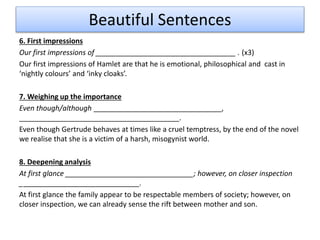
Beautiful Sentences
6. Firstimpressions
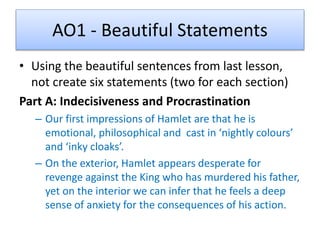
Our first impressions of ___________________________________ . (x3)
Our first impressions of Hamlet are that he is emotional, philosophical and cast in
‘nightly colours’ and ‘inky cloaks’.
7. Weighing up the importance
Even though/although ________________________________,
________________________________________.
Even though Gertrude behaves at times like a cruel temptress, by the end of the novel
we realise that she is a victim of a harsh, misogynist world.
8. Deepening analysis
At first glance ________________________________; however, on closer inspection
______________________________.
At first glance the family appear to be respectable members of society; however, on
closer inspection, we can already sense the rift between mother and son.
118.
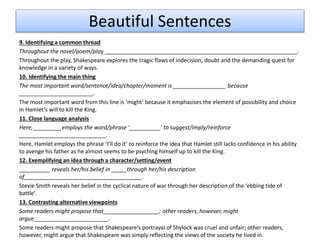
Beautiful Sentences
9. Identifyinga common thread
Throughout the novel/poem/play ______________________________________________________________.
Throughout the play, Shakespeare explores the tragic flaws of indecision, doubt and the demanding quest for
knowledge in a variety of ways.
10. Identifying the main thing
The most important word/sentence/idea/chapter/moment is _________________ because
________________________.
The most important word from this line is ‘might’ because it emphasises the element of possibility and choice
in Hamlet’s will to kill the King.
11. Close language analysis
Here, _________employs the word/phrase ‘__________’ to suggest/imply/reinforce
____________________________.
Here, Hamlet employs the phrase ‘I’ll do it’ to reinforce the idea that Hamlet still lacks confidence in his ability
to avenge his father as he almost seems to be psyching himself up to kill the King.
12. Exemplifying an idea through a character/setting/event
__________ reveals her/his belief in _____through her/his description
of______________________________________.
Stevie Smith reveals her belief in the cyclical nature of war through her description of the ‘ebbing tide of
battle’.
13. Contrasting alternative viewpoints
Some readers might propose that__________________; other readers, however, might
argue________________________.
Some readers might propose that Shakespeare’s portrayal of Shylock was cruel and unfair; other readers,
however, might argue that Shakespeare was simply reflecting the views of the society he lived in.
119.
Beautiful Sentences
14. Notingsubtleties
Here, the writer
cleverly________________________________________________________.
Here, Shakespeare cleverly employs the gruesome image of flesh melting into
dew to remind the reader once again of Hamlet’s dark depression.
15. Proposing a tentative idea
Perhaps, (writer’s name) was hinting that
______________________________________________________.
Perhaps Shakespeare was hinting that Hamlet’s bitterness towards Ophelia
was because ultimately he know he would have to die to avenge his father,
thus sparing the heartbreak of grieving for the dead Prince.
120.
Act IV, Sciv – Bloody Hamlet!
On a nearby plain in Denmark, young Prince Fortinbras marches at the
head of his army, traveling through Denmark on the way to attack
Poland. Fortinbras orders his captain to go and ask the King of
Denmark for permission to travel through his lands. On his way, the
captain encounters Hamlet, Rosencrantz, and Guildenstern on their
way to the ship bound for England. The captain informs them that the
Norwegian army rides to fight the Poles.
Hamlet asks about the basis of the conflict, and the man tells him that
the armies will fight over “a little patch of land / That hath in it no
profit but the name” (IV.iv.98–99). Astonished by the thought that a
bloody war could be fought over something so insignificant, Hamlet
marvels that human beings are able to act so violently and
purposefully for so little gain. By comparison, Hamlet has a great deal
to gain from seeking his own bloody revenge on Claudius, and yet he
still delays and fails to act toward his purpose. Disgusted with himself
for having failed to gain his revenge on Claudius, Hamlet declares that
from this moment on, his thoughts will be bloody.
121.
Act IV, Sciv – Bloody Hamlet!
Act IV, scene iv restores the focus of the play to the theme of human
action. Hamlet’s encounter with the Norwegian captain serves to
remind the reader of Fortinbras’s presence in the world of the play and
gives Hamlet another example of the will to action that he lacks.
Earlier, he was amazed by the player’s evocation of powerful feeling
for Hecuba, a legendary character who meant nothing to him (II.ii).
Now, he is awestruck by the willingness of Fortinbras to devote the
energy of an entire army, probably wasting hundreds of lives and
risking his own, to reclaim a worthless scrap of land in Poland. Hamlet
considers the moral ambiguity of Fortinbras’s action, but more than
anything else he is impressed by the forcefulness of it, and that
forcefulness becomes a kind of ideal toward which Hamlet decides at
last to strive. “My thoughts be bloody, or be nothing worth!” he
declares (IV.iv.9.56). Of course, he fails to put this exclamation into
action, as he has failed at every previous turn to achieve his revenge
on Claudius. “My thoughts be bloody,” Hamlet says. Tellingly, he does
not say “My deeds be bloody.”
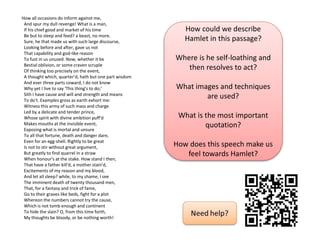
122.
How all occasionsdo inform against me,
And spur my dull revenge! What is a man,
If his chief good and market of his time
Be but to sleep and feed? a beast, no more.
Sure, he that made us with such large discourse,
Looking before and after, gave us not
That capability and god-like reason
To fust in us unused. Now, whether it be
Bestial oblivion, or some craven scruple
Of thinking too precisely on the event,
A thought which, quarter'd, hath but one part wisdom
And ever three parts coward, I do not know
Why yet I live to say 'This thing's to do;'
Sith I have cause and will and strength and means
To do't. Examples gross as earth exhort me:
Witness this army of such mass and charge
Led by a delicate and tender prince,
Whose spirit with divine ambition puff'd
Makes mouths at the invisible event,
Exposing what is mortal and unsure
To all that fortune, death and danger dare,
Even for an egg-shell. Rightly to be great
Is not to stir without great argument,
But greatly to find quarrel in a straw
When honour's at the stake. How stand I then,
That have a father kill'd, a mother stain'd,
Excitements of my reason and my blood,
And let all sleep? while, to my shame, I see
The imminent death of twenty thousand men,
That, for a fantasy and trick of fame,
Go to their graves like beds, fight for a plot
Whereon the numbers cannot try the cause,
Which is not tomb enough and continent
To hide the slain? O, from this time forth,
My thoughts be bloody, or be nothing worth!
How could we describe
Hamlet in this passage?
Where is he self-loathing and
then resolves to act?
What images and techniques
are used?
What is the most important
quotation?
How does this speech make us
feel towards Hamlet?
123.
Analysing
• ZOOM INon how Shakespeare’s use of
language presents Hamlet’s personality
• Focus on one or two words and think about
the connotations
• What can we infer?
124.
Model
"To be, ornot to be: that is the question." (Act
III, Scene I)
In the beginning of his fourth, and best known,
soliloquy Hamlet muses about the conundrum
of suicide. This constant questioning acts as his
tragic flaw, as he spends the majority of the play
procrastinating rather than being proactive in
the vengeance of his father.
125.
ZOOM IN
"To be,or not to be: that is the question." (Act III, Scene I)
He wonders if one route is "nobler" than the next. At this
point in the play, Hamlet has been unable to act upon his
motives for personal revenge, and this frustrates him. We
anticipate the tragic elements of the play as he decides
which opportunity is better: suffering as he has been or
ending it all? The tone of Hamlet's soliloquy is more
meditative than angry, and he often stalls throughout his
delivery; this can be conveyed through the use of comma
and colon in quick succession in the opening line, as if he
is delaying the inevitable act he will have to commit to
avenge his father. Nevertheless, it is this delay and
continuous questioning that acts as his tragic flaw,
ensuring his own downfall is not far away.
126.
• Now ZOOMOUT to show how this links to the
author’s purpose or what it shows about the
historical and social context or the theme of
the play…
Evaluating
127.
ZOOM OUT
"To be,or not to be: that is the question." (Act
III, Scene I)
It is interesting that Hamlet shows a different
personality to the aggressive and masculine
Elizabethan hero. Instead, audiences would have
witnessed a character always considering his
future, which is rather apt for a society going
through much political and social change.
128.
Review
• Highlight thethree different parts to your
paragraph:
– Statement that answers the question
– ZOOMING in and analysing the language
– ZOOMING out to link it to the context
129.
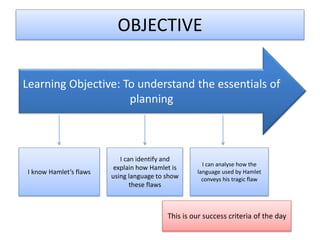
OBJECTIVE
Learning Objective: Tounderstand the essentials of
planning
I know Hamlet’s flaws
I can identify and
explain how Hamlet is
using language to show
these flaws
I can analyse how the
language used by Hamlet
conveys his tragic flaw
This is our success criteria of the day
130.
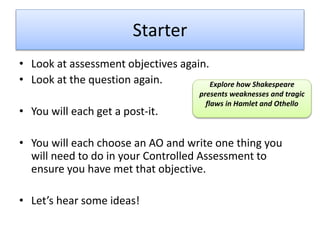
Starter
• Look atassessment objectives again.
• Look at the question again.
• You will each get a post-it.
• You will each choose an AO and write one thing you
will need to do in your Controlled Assessment to
ensure you have met that objective.
• Let’s hear some ideas!
Explore how Shakespeare
presents weaknesses and tragic
flaws in Hamlet and Othello
131.
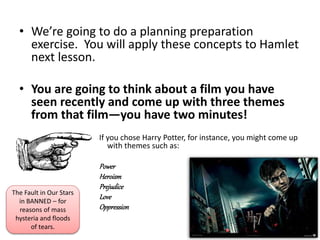
• We’re goingto do a planning preparation
exercise. You will apply these concepts to Hamlet
next lesson.
• You are going to think about a film you have
seen recently and come up with three themes
from that film—you have two minutes!
If you chose Harry Potter, for instance, you might come up
with themes such as:
Power
Heroism
Prejudice
Love
Oppression
The Fault in Our Stars
in BANNED – for
reasons of mass
hysteria and floods
of tears.
132.
• This lessonwill walk you through an effective
way of organising your writing. It follows the
pattern of a five-part essay:
– Introduction
– Part A
– Part B
– Part C
– Conclusion
You can use
this for any
essay, whether
it be an exam
or Controlled
Assessment!!!
133.
Introduction
• You shouldalready know what three things
you MUST have in your Introduction:
Authors and texts
Key words of the question
Themes or concepts you will
use to answer the question.
You will
NOT write:
In this
essay I
will...
134.
Introduction Example –Poetry
QUESTION: Explore how ‘Medusa’ by Carol Ann
Duffy and ‘The River God’ by Stevie Smith explore
the notion of jealousy.
Both ‘Medusa’ by Carol Ann Duffy and ‘The River
God’ by Stevie Smith explore the notion of
jealousy through the voice of the speakers. We
see this jealousy through their relationships,
emotions and physical description.
135.
Introduction – 5minutes
• Write your introduction for the film that you
have chosen, and ensure that you have
included all the appropriate information.
• Your question is this:
– How is the protagonist in your film presented and
developed throughout?
136.
Parts A, Band C Example – Harry
Potter
• This does NOT mean paragraphs! It means
sections. You will use your themes to organise
your essay.
• I am going to use Harry Potter as my example
for this section. Follow along and use the
same idea for your film. Listen first, and then
you will have time to do your own.
137.
Harry Potter andthe Deathly Hallows
• Group ideas in concepts first.
Part A: Love
Part B: Prejudice
Part C: Power
With this part of my essay, I’m going to show how
different characters are presented through different
means; in this case, love, prejudice and power
138.
Next, expand onthose concepts by
creating sub-points (or statements)
Part A: Love
– Parental Love: Lily Potter’s sacrificial love for Harry evokes the old
magic
– Love in friendship: The Order, Dumbledore, Ron and Hermione’s
friendship with Harry
Part B: Prejudice
- Voldemort’s utlisation of Slytherin’s ideology of pure-bloods
- The Ministry’s enforcement of prejudice and intolerance
- Prejudice as a tool to create fear
Part C: Power
- How power corrupts (Umbridge, Voldemort, Fudge)
- Voldemort’s rise to power (conquering of death)
- How love ultimately is shown to be more powerful than
conquering death
139.
Task – 20minutes
• Do this for your film as well. Each point would
equate to a SQEEL paragraph so you don’t want
to have too many.
• Now choose ONE section to develop further (in
your planning you will do this with all of them).
You will create statements and quotations for
these (or details of the film in this case)
140.
I’ve chosen Power
PartC: Power
- How power corrupts (Umbridge, Fudge)
- Characters such as Umbridge, Fudge and Voldemort become drunk
on power and use it as a means to intimidate. For the Ministry, we
see a transformation in how it is run as the ‘magic is might’ motto
is corrupted to mean control rather than freedom.
- Voldemort’s rise to power (conquering of death)
- Voldemort is convinced that through conquering death he will
hold ultimate power; furthermore, this notion is embodied in the
character of Harry who becomes ‘the boy who lived, come to die.’
- How love ultimately is shown to be more powerful than
conquering death
- Members of the Order, who ultimately serve Dumbledore, thrive
on their relationships with each other and their love of freedom
and truth. Harry articulates this when he says what sets them
apart from Voldemort is that they have ‘something worth fighting
for.’
Now do
this with
one of
your
sections
141.
Conclusion
• This iswhere you revise what you put in your
Introduction and join it together with what
was in the body of your essay. It should show
that you have answered the question.
142.
Conclusion
• You usethe same things in your conclusion that you
used in your introduction, but they are revised.
• So let’s look at an example from my Y11 chaps last
year. The question was about how a character was
developed and presented.
Name of text(s)—you
don’t need to mention the
author(s) again
Key words of the question
Themes or concepts you used to
answer the question.
143.
Conclusion Example -Mockingbird
• Boo Radley is presented differently
throughout ‘To Kill a Mockingbird’ as he
develops. Initially we see him as a character
that should be feared, but this changes by the
end of the novel. We can see this
development through his relationship with the
children, the mystery surrounding him being
unveiled as well as his heroism in saving Jem.
144.
Task
• Write aconclusion for your film—it shouldn’t
be any longer than three sentences.
145.
Plenary
• Write downthree things you will do next
lesson during your planning time to ensure
that you achieve the Band you want for your
Controlled Assessment.
• Everyone will share one thing.
146.
Homework
• If youwant to take your Hamlet texts and
exercise books home to revise in preparation
for planning, feel free to do so.
• HOWEVER, you MUST have it with you next
lesson!!! No excuses!
147.
OBJECTIVE
Learning Objective: Tobegin the planning process
of our Hamlet essay
I know Hamlet’s flaws
I can identify and
explain how Hamlet is
using language to show
these flaws
I can analyse how the
language used by Hamlet
conveys his tragic flaw
This is our success criteria of the day
148.
Three Part Essay
•What can our three parts be?
• Part A:
• Part B:
• Part C:
Explore how Shakespeare presents weaknesses
and tragic flaws in Hamlet
149.
Three Part Essay
•What can our three parts be?
• Part A: Indecisiveness and Procrastination
• Part B: Anger towards others
• Part C: Madness
Explore how Shakespeare presents weaknesses
and tragic flaws in Hamlet
150.
AO1 - BeautifulStatements
• Using the beautiful sentences from last lesson,
not create six statements (two for each section)
Part A: Indecisiveness and Procrastination
– Our first impressions of Hamlet are that he is
emotional, philosophical and cast in ‘nightly colours’
and ‘inky cloaks’.
– On the exterior, Hamlet appears desperate for
revenge against the King who has murdered his father,
yet on the interior we can infer that he feels a deep
sense of anxiety for the consequences of his action.
151.
AO1 - KeyQuotes for Each Part
• Now find as many quotes as possible which
link to your statements
• Remember to use all the resources available
to you:
152.
AO2 - ZoomingIn and Out
• For each quote write a brief inference and explore two
different connotations
Example: “Conscience doth make cowards of us all”
– His conscience is preventing him from doing the bold, brave
thing that must be done (take action against Claudius); it is
making him a weakling.
– He is plagued by doubt
– The pronoun ‘us’ shifts the focus away from his solitude as a
way of universalising his weakness.
– Thinking about the act of revenge causes hesitation.
– Fear of the death/unknown (heaven or hell) prevents him from
suicide.
153.
AO2 – DramaticEffect on the Audience
Now choose two short
quotes and analyse the
effect the language has
on the audience
How does this
word/phrase/image
make the audience feel
towards Hamlet?
154.
AO4 - Context
Howdoes your Hamlet section link to the
historical, social and cultural context of the
Elizabethan and Jacobean society?
155.
Our first impressionsof Hamlet are that he is emotional,
philosophical and cast in ‘nightly colours’ and ‘inky cloaks’. In the
beginning of his fourth, and best known, soliloquy Hamlet muses
about the conundrum of suicide. This constant questioning acts as
his tragic flaw, as he spends the majority of the play procrastinating
rather than being proactive in the vengeance of his father. He
wonders if one route is "nobler" than the next. At this point in the
play, Hamlet has been unable to act upon his motives for personal
revenge, and this frustrates him. We anticipate the tragic elements
of the play as he decides which opportunity is better: suffering as
he has been or ending it all? The tone of Hamlet's soliloquy is more
meditative than angry, and he often stalls throughout his delivery;
this can be conveyed through the use of comma and colon in quick
succession in the opening line, as if he is delaying the inevitable act
he will have to commit to avenge his father. Nevertheless, it is this
delay and continuous questioning that acts as his tragic flaw,
ensuring his own downfall is not far away. It is interesting that
Hamlet shows a different personality to the aggressive and
masculine Elizabethan hero. Instead, audiences would have
witnessed a character always considering his future, which is rather
apt for a society going through much political and social change.
156.
Exit Ticket
On apost-it note, write which area of the essay
you are least confident with:
– Beautiful statements that answer the question
– Finding accurate and supportive quotations
– Zooming in and out on the language
– Analysing the effect on the reader
– Relating the play to the historical and social
context
157.
Introduction
• Brief answerto the essay question (use the
headings of Part A, B and C)
• Very brief synopsis of the play
• Name play, play-write and facts about them
• Historical and social context: dates of play,
who was King/Queen, what was life generally
like
• What is a tragedy and tragic hero?
– How is Hamlet a tragic hero
Editor's Notes
#6 You can either give them this or photocopy the actual criteria from the Spec.
#22 Learning Objective: To understand why some texts and writers are regarded as highly influential and important.
Do now: Label A and B. One minute each to share ideas. As feedback Bs fact. Students times 30 seconds to feedback.
#26 The English Renaissance takes place during the early 16th century and continues into the early 17th century under the Tudor rule of England (Beginning with Henry VIII, more on him later)
This is a time of “rebirth” and new ideas. People began writing poetry and drama, composing music, painting, and experimenting in the name of the monarch. The Tudors were great admirers of the arts.
Exploration became vital in this era.
This was the first time people in England (other than the members of the court) had excess wealth to spend. This was one of the factors that created the theater (more on this)
The whole reason the theater became the force it was in this period is due to this excess wealth. For the first time the average person had the ability to pay for unnecessary entertainment in the theaters. This also leads to the Puritan out cry in opposition to it. The theater distracts from man praising and worshipping God as he should be doing in his free time.
#27 She is the reason for the success of this era
Enjoyed the plays of Shakespeare and there are records of her attending some of them
#28 Not nearly as well liked as Elizabeth
Because he was private, he did not believe in all the pomp and circumstance that Elizabeth did. Fashion becomes more subdued as does the literature. Fewer poems/songs, more tragedies than comedies performed
James ran the country into a large debt. Since he did not go out among the people and stay in small towns (having the monarch in your home was a huge honor, so people would feed and entertain the royal family and the entire household for sometimes weeks. This meant the monarch was not spending money out of the royal coffers)
Shakespeare’s troop becomes the King’s Men and achieves fame and fortune.
#30 Relate the idea about women to Ophelia
Clothing to the warning that Polonius gives to Laertes in 1.3
#32 . A good play could gain a playwright instant fame, an inappropriate play could land the playwright in prison. An inappropriate play could be one that provided biting commentary about the court or nobility, or a play that could upset social stability.
The rhymed couplet is specifically places to help cue on the actors in the next scene
If a play was popular, often the actor might try to sell it to be printed (no copywrite laws). Since no one had the whole play, actors sometimes told the book seller the lines from memory. These printed copies are the quartos and many are quite bad. The Folger edition indicates in the text if it drew from the quarto version or if the quarto differed from the folio with brackets and parenthesis.
#33 . Many actors have said that playing Hamlet is their favorite role because it is open to interpretation.
http://www.shakespearesglobe.com/about-us/virtual-tour
The globe tour should link you to the internet (only active when showing slide show). There are options on the side to tour different parts. I believe you must have quicktime, so make sure you open it early in case you are asked to download.
#34 and women have no say in their mate. Fathers choose based on financial matters.
their marriages are political.
. Only virgins are considered “marriable.” One of the few grounds a husband has for divorce is if it turns out his betrothed was not a virgin.
#36 These timers appear initially as a cream, coloured circle. The timer is initiated by clicking on, at which point the circle will fill up in a clockwise direction with the colour you see above.
At the end of the time, a bell will sound.
It is possible to change the timings of the timers by entering the animation settings and changing the timings of the relevant ‘Oval’. Note the timings have to be entered in seconds.
It is possible to have multiple timers on the same slide as these work independently of each other.

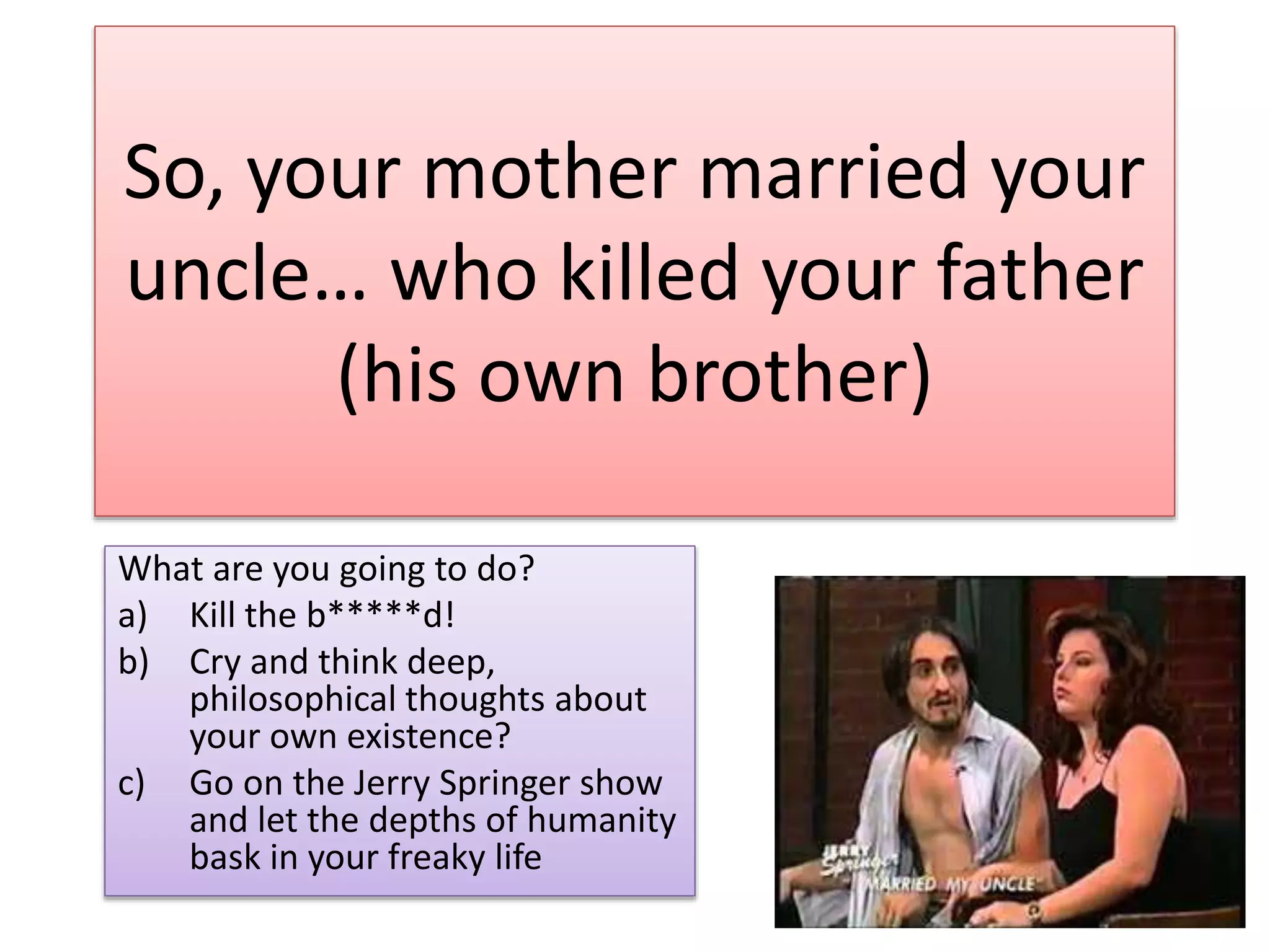
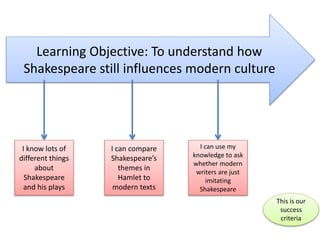
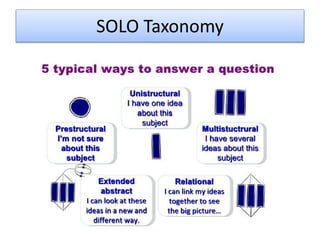
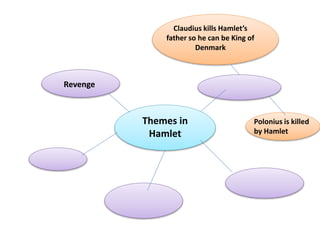
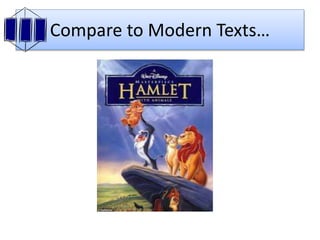
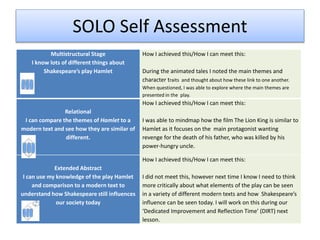
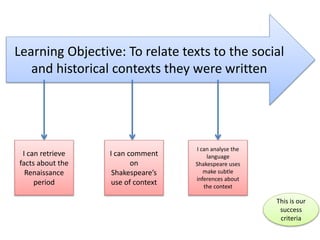
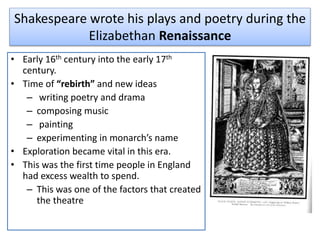
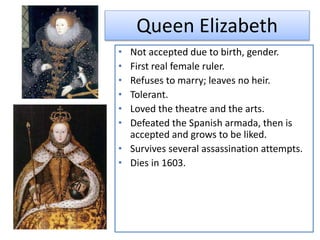
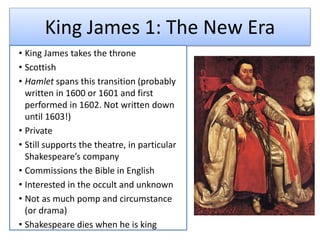
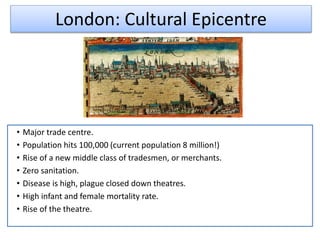
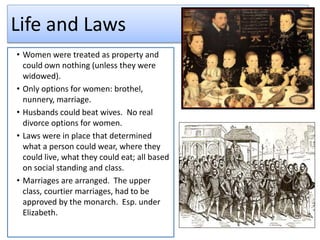
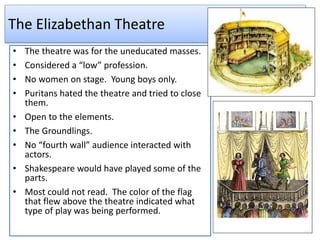
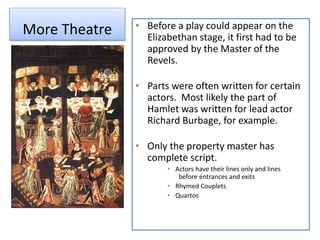
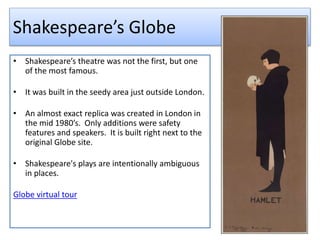
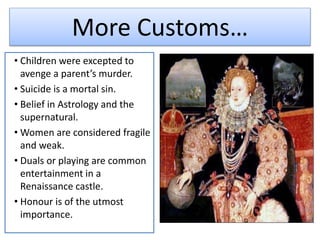
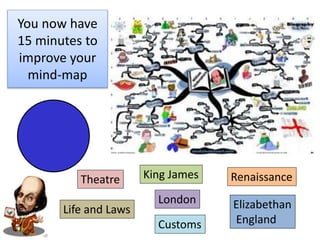
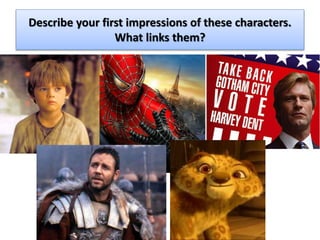
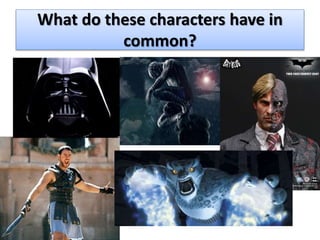
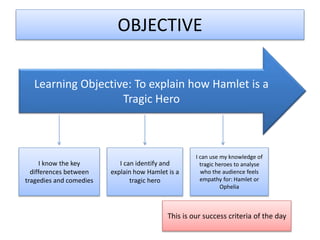
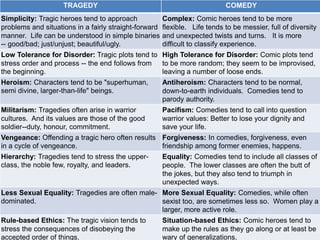
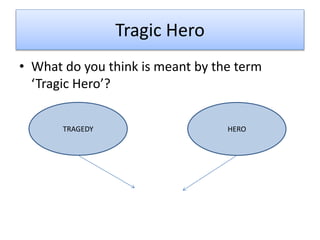
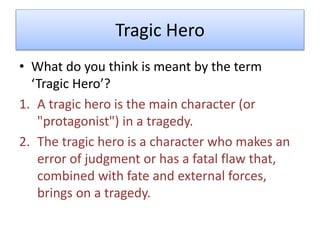
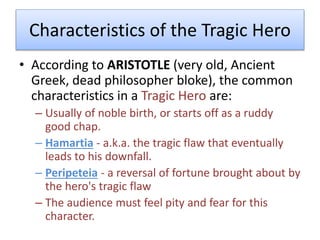
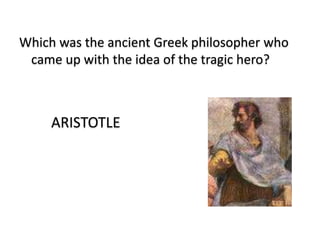
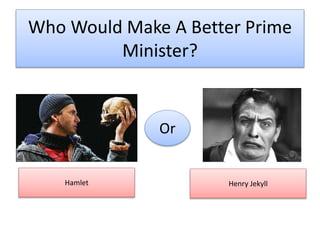
![Key Quotes 2 – Act I, Sc ii (129-158)
O that this too too solid flesh would melt,
Thaw, and resolve itself into a dew!
Or that the Everlasting had not fix’d
His canon ’gainst self-slaughter! O God! O God!
How weary, stale, flat, and unprofitable
Seem to me all the uses of this world!
Fie on’t! O fie! ’tis an unweeded garden,
That grows to seed; things rank and gross in nature
Possess it merely. That it should come to this!
But two months dead!—nay, not so much, not two:
So excellent a king; that was, to this,
Hyperion to a satyr; so loving to my mother,
That he might not beteem the winds of heaven
Visit her face too roughly. Heaven and earth!
Must I remember? Why, she would hang on him
As if increase of appetite had grown
By what it fed on: and yet, within a month,—
Let me not think on’t,—Frailty, thy name is woman!—
A little month; or ere those shoes were old
With which she followed my poor father’s body
Like Niobe, all tears;—why she, even she,—
O God! a beast that wants discourse of reason,
Would have mourn’d longer,—married with mine uncle,
My father’s brother; but no more like my father
Than I to Hercules: within a month;
Ere yet the salt of most unrighteous tears
Had left the flushing in her galled eyes,
She married:— O, most wicked speed, to post
With such dexterity to incestuous sheets!
It is not, nor it cannot come to good;
But break my heart,—for I must hold my tongue.
This quotation, Hamlet’s first important soliloquy, occurs in Act
I, scene ii (129–158). Hamlet speaks these lines after enduring
the unpleasant scene at Claudius and Gertrude’s court, then
being asked by his mother and stepfather not to return to his
studies at Wittenberg but to remain in Denmark, presumably
against his wishes. Here, Hamlet thinks for the first time about
suicide (desiring his flesh to “melt,” and wishing that God had
not made “self-slaughter” a sin), saying that the world is
“weary, stale, flat, and unprofitable.” In other words, suicide
seems like a desirable alternative to life in a painful world, but
Hamlet feels that the option of suicide is closed to him because
it is forbidden by religion. Hamlet then goes on to describe the
causes of his pain, specifically his intense disgust at his mother’s
marriage to Claudius. He describes the haste of their marriage,
noting that the shoes his mother wore to his father’s funeral
were not worn out before her marriage to Claudius. He
compares Claudius to his father (his father was “so excellent a
king” while Claudius is a bestial “satyr”). As he runs through his
description of their marriage, he touches upon the important
motifs of misogyny, crying, “Frailty, thy name is woman”; incest,
commenting that his mother moved “[w]ith such dexterity to
incestuous sheets”; and the ominous omen the marriage
represents for Denmark, that “[i]t is not nor it cannot come to
good.” Each of these motifs recurs throughout the play.](https://image.slidesharecdn.com/hamletandothello-tragicheroes-140706100854-phpapp01/85/Hamlet-Controlled-Assessment-Tragic-heroes-63-320.jpg)
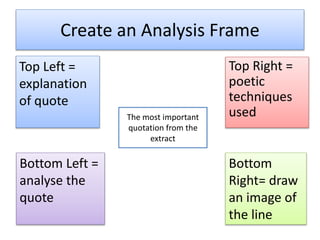
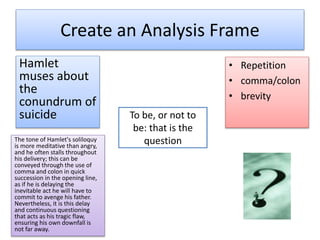
![Key Quotes 2 – Act I, Sc ii (129-158)
O that this too too solid flesh would melt,
Thaw, and resolve itself into a dew!
Or that the Everlasting had not fix’d
His canon ’gainst self-slaughter! O God! O God!
How weary, stale, flat, and unprofitable
Seem to me all the uses of this world!
Fie on’t! O fie! ’tis an unweeded garden,
That grows to seed; things rank and gross in nature
Possess it merely. That it should come to this!
But two months dead!—nay, not so much, not two:
So excellent a king; that was, to this,
Hyperion to a satyr; so loving to my mother,
That he might not beteem the winds of heaven
Visit her face too roughly. Heaven and earth!
Must I remember? Why, she would hang on him
As if increase of appetite had grown
By what it fed on: and yet, within a month,—
Let me not think on’t,—Frailty, thy name is woman!—
A little month; or ere those shoes were old
With which she followed my poor father’s body
Like Niobe, all tears;—why she, even she,—
O God! a beast that wants discourse of reason,
Would have mourn’d longer,—married with mine uncle,
My father’s brother; but no more like my father
Than I to Hercules: within a month;
Ere yet the salt of most unrighteous tears
Had left the flushing in her galled eyes,
She married:— O, most wicked speed, to post
With such dexterity to incestuous sheets!
It is not, nor it cannot come to good;
But break my heart,—for I must hold my tongue.
This quotation, Hamlet’s first important soliloquy, occurs in Act I, scene
ii (129–158). Hamlet speaks these lines after enduring the unpleasant
scene at Claudius and Gertrude’s court, then being asked by his mother
and stepfather not to return to his studies at Wittenberg but to remain
in Denmark, presumably against his wishes. Here, Hamlet thinks for the
first time about suicide (desiring his flesh to “melt,” and wishing that
God had not made “self-slaughter” a sin), saying that the world is
“weary, stale, flat, and unprofitable.” In other words, suicide seems like
a desirable alternative to life in a painful world, but Hamlet feels that
the option of suicide is closed to him because it is forbidden by religion.
Hamlet then goes on to describe the causes of his pain, specifically his
intense disgust at his mother’s marriage to Claudius. He describes the
haste of their marriage, noting that the shoes his mother wore to his
father’s funeral were not worn out before her marriage to Claudius. He
compares Claudius to his father (his father was “so excellent a king”
while Claudius is a bestial “satyr”). As he runs through his description of
their marriage, he touches upon the important motifs of misogyny,
crying, “Frailty, thy name is woman”; incest, commenting that his
mother moved “[w]ith such dexterity to incestuous sheets”; and the
ominous omen the marriage represents for Denmark, that “[i]t is not
nor it cannot come to good.” Each of these motifs recurs throughout
the play.
Still haven’t got
the foggiest?
Look here:](https://image.slidesharecdn.com/hamletandothello-tragicheroes-140706100854-phpapp01/85/Hamlet-Controlled-Assessment-Tragic-heroes-74-320.jpg)