EWRT 1C Class 3
Online Email me if
you need
help!
Agenda
• New Critical Rhetorical Strategies
• Paradox
• Irony
• Tension
• Ambiguity
• Poetry Reading:
• “My Papa’s Waltz”
• Critical Essay Reading:
• “‘My Papa’s Waltz’: A New Critical Reading.”
• For New Criticism, the complexity of a
text is created by the multiple and often
conflicting meanings woven through it.
And these meanings are a product
primarily of four kinds of linguistic
devices: paradox, irony, ambiguity,
and tension.
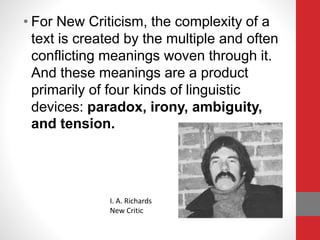
I. A. Richards
New Critic
Paradox
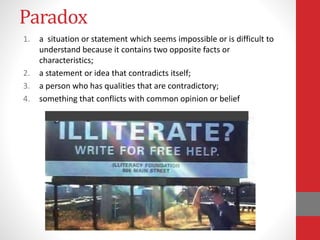
1. a situation or statement which seems impossible or is difficult to
understand because it contains two opposite facts or
characteristics;
2. a statement or idea that contradicts itself;
3. a person who has qualities that are contradictory;
4. something that conflicts with common opinion or belief
“All animals are equal, but some are more
equal than others.”
• In George Orwell’s Animal Farm, one part of the
cardinal rule is the statement above. This
statement seems to not make any sense.
However, on closer examination, it gets clear that
Orwell points out a political truth. The
government in the novel claims that everyone is
equal but it has never treated everyone equally. It
is the concept of equality stated in this paradox
that is opposite to the common belief of equality.
“I must be cruel to be kind.”
• This statement by Hamlet seems contradictory at
first. How can an individual treat others kindly
even when he is cruel? However, Hamlet is
referring to his mother and his intention to kill
Claudius (his father’s brother [and murderer]
and his mother’s husband) to avenge his father’s
death. This act will be a tragedy for his mother,
but Hamlet does not want her to be with his
father’s murderer any longer; he believes that
the murder will be good for his mother.
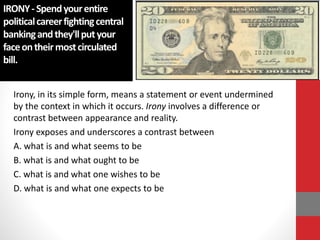
IRONY-Spendyourentire
politicalcareerfightingcentral
bankingandthey'llputyour
faceontheirmostcirculated
bill.
Irony, in its simple form, means a statement or event undermined
by the context in which it occurs. Irony involves a difference or
contrast between appearance and reality.
Irony exposes and underscores a contrast between
A. what is and what seems to be
B. what is and what ought to be
C. what is and what one wishes to be
D. what is and what one expects to be
There are three common types of irony in literature:
1. Verbal irony occurs when people say the opposite of what they mean.
This is perhaps the most common type of irony. The reader knows that a
statement is ironic because of familiarity with the situation or a
description of voice, facial, or bodily expressions which show the
discrepancy.
• There are two kinds of verbal irony :
• Understatement occurs when one minimizes the nature of something.
• Overstatement occurs when one exaggerates the nature of something.
• Verbal irony in its most bitter and destructive form becomes sarcasm .
• Someone is condemned by a speaker pretending to praise him or her.
2. In situational irony , the situation is different from what common sense
indicates it is, will be, or ought to be. Situational irony is often used to
expose hypocrisy and injustice. (The pickpocket being pickpocketed).
3. Dramatic irony occurs when a character states something that they
believe to be true but that the reader knows is not true. The key to
dramatic irony is the reader's foreknowledge of coming events.
• Second readings of stories often increases dramatic irony because of
knowledge that was not present in the first reading.
The followingdescription of a wealthyhusband’s sense
of moralrectitude, from Edith Wharton’s House of
Mirth (1905), is an example of an ironic statement.
Once in the winter the rector would come to dine, and her
husband would beg her to go over the list and see that no
divorcées were included, except those who had showed signs of
penitence by being remarried to the very wealthy (57).
Part of the ironic implication of this passage is that the husband
is a hypocrite: he condemns divorce only if it is not followed by
the acquisition of equal or greater wealth, so what he really
condemns, under the guise of moral principles, is financial
decline (Tyson)
New Criticism, however, primarily valued irony in a broader
sense of the term, to indicate a text’s inclusion of varying
perspectives on the same characters or events (Tyson)
Jane Austen’s Sense and Sensibility (1811) offers us perspectives
from which we may utterly condemn Willoughby for his treachery
to Maryanne; forgive him because his behavior resulted from a
combination of love, financial desperation, and a weakness of
character which he himself laments; sympathize with him for the
severity of the punishment his behavior has brought upon him;
and see the ways in which Maryanne’s willful foolishness
contributed to her own heartbreak.
Such a variety of possible viewpoints is considered a form of irony
because the credibility of each viewpoint undermines to some
extent the credibility of the others. The result is a complexity of
meaning that mirrors the complexity of human experience and
increases the text’s believability
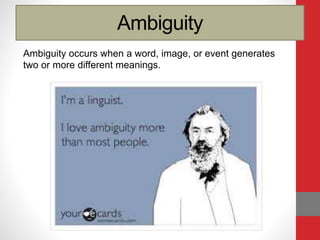
Ambiguity
Ambiguity occurs when a word, image, or event generates
two or more different meanings.
Toni Morrison’s Beloved (1987)
• For example, in Toni Morrison’s Beloved (1987), the
image of the tree produced by the scar tissue on Sethe’s
back implies, among other things, suffering (the “tree”
resulted from a brutal whipping, which is emblematic of
all the hardships experienced under slavery), endurance
(trees can live for hundreds of years, and the scar tissue
itself testifies to Sethe’s remarkable ability to survive the
most traumatic experiences), and renewal (like the trees
that lose their leaves in the fall and are “reborn” every
spring, Sethe is offered, at the novel’s close, the chance
to make a new life).
• In scientific or everyday language, ambiguity is usually
considered a flaw because it’s equated with a lack of
clarity and precision. In literary language, however,
ambiguity is considered a source of richness, depth, and
complexity that adds to the text’s value.
Tension
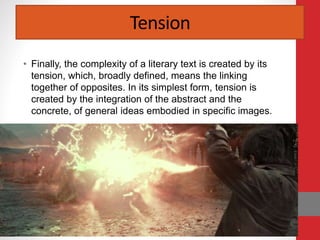
• Finally, the complexity of a literary text is created by its
tension, which, broadly defined, means the linking
together of opposites. In its simplest form, tension is
created by the integration of the abstract and the
concrete, of general ideas embodied in specific images.
Tension in Arthur Miller’s Death of a Salesman
For example, the concrete image of Willy’s tiny house, bathed in
blue light and surrounded by enormous apartment buildings that
emanate an angry orange glow, embodies the general idea of the
underdog, the victim of forces larger and more numerous than
itself. Similarly, the concrete image of Linda Loman singing Willy
to sleep embodies the general idea of the devoted wife, the
caretaker, the nurturer. Such concrete universals—or images and
fictional characters that are meaningful on both the concrete
level, where their meaning is literal and specific, and on the
symbolic level, where they have universal significance—are
considered a form of tension because they hold together the
opposing realms of physical reality and symbolic reality in a
way characteristic of literary language. In other words, the
Loman home and the character of Linda Loman represent both
themselves and something larger than themselves.
Tension is also created by the dynamic interplay among the text’s
opposing tendencies, that is, among its paradoxes, ironies, and
ambiguities (Tyson).
For example, we might say that the action of Death of a
Salesman is structured by the tension between reality and
illusion: between the harsh reality of Willy Loman’s life and
the self-delusion into which he keeps trying to escape.
Ideally, the text’s opposing tendencies are held in
equilibrium by working together to make a stable and
coherent meaning. For example, the tension between
harsh reality and self-delusion in Death of a Salesman is
held in equilibrium by the following meaning: so great is
Willy’s desire to succeed as a salesman and a father that
his only defense against the common man’s inevitable
failures in a dog-eat-dog world is self-delusion, but that
self-delusion only increases his failure. Thus, the play
shows us how harsh reality and self-delusion feed off each
other until the only escape is death.
First, Read The Poem!
• “My Papa’s Waltz” (link)
• Then look for images, symbols, metaphors,
similes, alliteration, hyperbole, personification,
paradox, irony, ambiguity, and tension.
• If you are familiar with other conventions, feel
free to note those as well. What do these figures
of speech bring to mind? What do they say about
the poem?
Then Read The Essay!
• Read “My Papa’s Waltz: A New Critical Approach.
(course readings; theory texts; new criticism)
• Note the images the writer uses to make his points.
• Look at your own list of figures of speech. Did you
see these? What other conventions did you see
that might reinforce or disrupt this author’s
reading of this poem?
• Do you agree with the assertion the writer makes
about the meaning of the poem? (Look at the last
line of the poem).
Homework
• Post #2: Post a paragraph or two outlining your own New
Critical insights about “My Papa’s Waltz.” Then write a
paragraph discussing your agreement or disagreement with
the author of the New Critical Essay. Consider thesis, the
interpretation of figurative language, and conclusion.
• Bring copies of “My Papa’s Waltz” and “My Papa’s Waltz: A
New Critical Approach” to class.

Ewrt 1 c class 3 online

  • 1.
    EWRT 1C Class3 Online Email me if you need help!
  • 2.
    Agenda • New CriticalRhetorical Strategies • Paradox • Irony • Tension • Ambiguity • Poetry Reading: • “My Papa’s Waltz” • Critical Essay Reading: • “‘My Papa’s Waltz’: A New Critical Reading.”
  • 3.
    • For NewCriticism, the complexity of a text is created by the multiple and often conflicting meanings woven through it. And these meanings are a product primarily of four kinds of linguistic devices: paradox, irony, ambiguity, and tension. I. A. Richards New Critic
  • 4.
    Paradox 1. a situationor statement which seems impossible or is difficult to understand because it contains two opposite facts or characteristics; 2. a statement or idea that contradicts itself; 3. a person who has qualities that are contradictory; 4. something that conflicts with common opinion or belief
  • 5.
    “All animals areequal, but some are more equal than others.” • In George Orwell’s Animal Farm, one part of the cardinal rule is the statement above. This statement seems to not make any sense. However, on closer examination, it gets clear that Orwell points out a political truth. The government in the novel claims that everyone is equal but it has never treated everyone equally. It is the concept of equality stated in this paradox that is opposite to the common belief of equality.
  • 6.
    “I must becruel to be kind.” • This statement by Hamlet seems contradictory at first. How can an individual treat others kindly even when he is cruel? However, Hamlet is referring to his mother and his intention to kill Claudius (his father’s brother [and murderer] and his mother’s husband) to avenge his father’s death. This act will be a tragedy for his mother, but Hamlet does not want her to be with his father’s murderer any longer; he believes that the murder will be good for his mother.
  • 7.
    IRONY-Spendyourentire politicalcareerfightingcentral bankingandthey'llputyour faceontheirmostcirculated bill. Irony, in itssimple form, means a statement or event undermined by the context in which it occurs. Irony involves a difference or contrast between appearance and reality. Irony exposes and underscores a contrast between A. what is and what seems to be B. what is and what ought to be C. what is and what one wishes to be D. what is and what one expects to be
  • 8.
    There are threecommon types of irony in literature: 1. Verbal irony occurs when people say the opposite of what they mean. This is perhaps the most common type of irony. The reader knows that a statement is ironic because of familiarity with the situation or a description of voice, facial, or bodily expressions which show the discrepancy. • There are two kinds of verbal irony : • Understatement occurs when one minimizes the nature of something. • Overstatement occurs when one exaggerates the nature of something. • Verbal irony in its most bitter and destructive form becomes sarcasm . • Someone is condemned by a speaker pretending to praise him or her. 2. In situational irony , the situation is different from what common sense indicates it is, will be, or ought to be. Situational irony is often used to expose hypocrisy and injustice. (The pickpocket being pickpocketed). 3. Dramatic irony occurs when a character states something that they believe to be true but that the reader knows is not true. The key to dramatic irony is the reader's foreknowledge of coming events. • Second readings of stories often increases dramatic irony because of knowledge that was not present in the first reading.
  • 9.
    The followingdescription ofa wealthyhusband’s sense of moralrectitude, from Edith Wharton’s House of Mirth (1905), is an example of an ironic statement. Once in the winter the rector would come to dine, and her husband would beg her to go over the list and see that no divorcées were included, except those who had showed signs of penitence by being remarried to the very wealthy (57). Part of the ironic implication of this passage is that the husband is a hypocrite: he condemns divorce only if it is not followed by the acquisition of equal or greater wealth, so what he really condemns, under the guise of moral principles, is financial decline (Tyson)
  • 10.
    New Criticism, however,primarily valued irony in a broader sense of the term, to indicate a text’s inclusion of varying perspectives on the same characters or events (Tyson) Jane Austen’s Sense and Sensibility (1811) offers us perspectives from which we may utterly condemn Willoughby for his treachery to Maryanne; forgive him because his behavior resulted from a combination of love, financial desperation, and a weakness of character which he himself laments; sympathize with him for the severity of the punishment his behavior has brought upon him; and see the ways in which Maryanne’s willful foolishness contributed to her own heartbreak. Such a variety of possible viewpoints is considered a form of irony because the credibility of each viewpoint undermines to some extent the credibility of the others. The result is a complexity of meaning that mirrors the complexity of human experience and increases the text’s believability
  • 11.
    Ambiguity Ambiguity occurs whena word, image, or event generates two or more different meanings.
  • 12.
    Toni Morrison’s Beloved(1987) • For example, in Toni Morrison’s Beloved (1987), the image of the tree produced by the scar tissue on Sethe’s back implies, among other things, suffering (the “tree” resulted from a brutal whipping, which is emblematic of all the hardships experienced under slavery), endurance (trees can live for hundreds of years, and the scar tissue itself testifies to Sethe’s remarkable ability to survive the most traumatic experiences), and renewal (like the trees that lose their leaves in the fall and are “reborn” every spring, Sethe is offered, at the novel’s close, the chance to make a new life). • In scientific or everyday language, ambiguity is usually considered a flaw because it’s equated with a lack of clarity and precision. In literary language, however, ambiguity is considered a source of richness, depth, and complexity that adds to the text’s value.
  • 13.
    Tension • Finally, thecomplexity of a literary text is created by its tension, which, broadly defined, means the linking together of opposites. In its simplest form, tension is created by the integration of the abstract and the concrete, of general ideas embodied in specific images.
  • 14.
    Tension in ArthurMiller’s Death of a Salesman For example, the concrete image of Willy’s tiny house, bathed in blue light and surrounded by enormous apartment buildings that emanate an angry orange glow, embodies the general idea of the underdog, the victim of forces larger and more numerous than itself. Similarly, the concrete image of Linda Loman singing Willy to sleep embodies the general idea of the devoted wife, the caretaker, the nurturer. Such concrete universals—or images and fictional characters that are meaningful on both the concrete level, where their meaning is literal and specific, and on the symbolic level, where they have universal significance—are considered a form of tension because they hold together the opposing realms of physical reality and symbolic reality in a way characteristic of literary language. In other words, the Loman home and the character of Linda Loman represent both themselves and something larger than themselves.
  • 15.
    Tension is alsocreated by the dynamic interplay among the text’s opposing tendencies, that is, among its paradoxes, ironies, and ambiguities (Tyson). For example, we might say that the action of Death of a Salesman is structured by the tension between reality and illusion: between the harsh reality of Willy Loman’s life and the self-delusion into which he keeps trying to escape. Ideally, the text’s opposing tendencies are held in equilibrium by working together to make a stable and coherent meaning. For example, the tension between harsh reality and self-delusion in Death of a Salesman is held in equilibrium by the following meaning: so great is Willy’s desire to succeed as a salesman and a father that his only defense against the common man’s inevitable failures in a dog-eat-dog world is self-delusion, but that self-delusion only increases his failure. Thus, the play shows us how harsh reality and self-delusion feed off each other until the only escape is death.
  • 16.
    First, Read ThePoem! • “My Papa’s Waltz” (link) • Then look for images, symbols, metaphors, similes, alliteration, hyperbole, personification, paradox, irony, ambiguity, and tension. • If you are familiar with other conventions, feel free to note those as well. What do these figures of speech bring to mind? What do they say about the poem?
  • 17.
    Then Read TheEssay! • Read “My Papa’s Waltz: A New Critical Approach. (course readings; theory texts; new criticism) • Note the images the writer uses to make his points. • Look at your own list of figures of speech. Did you see these? What other conventions did you see that might reinforce or disrupt this author’s reading of this poem? • Do you agree with the assertion the writer makes about the meaning of the poem? (Look at the last line of the poem).
  • 18.
    Homework • Post #2:Post a paragraph or two outlining your own New Critical insights about “My Papa’s Waltz.” Then write a paragraph discussing your agreement or disagreement with the author of the New Critical Essay. Consider thesis, the interpretation of figurative language, and conclusion. • Bring copies of “My Papa’s Waltz” and “My Papa’s Waltz: A New Critical Approach” to class.