Figurative Language


An overview
Metaphors and Similes
s   Metaphors and similes involve comparisons
    between two unlike things
s   Literal comparison
     – His car is as fast as Tom’s car
     – The Exorcist is scarier than The Blair Witch
       Project
s   Figurative comparison
     – His car is as fast as lighting (simile)
     – My love life is a soap opera (metaphor)
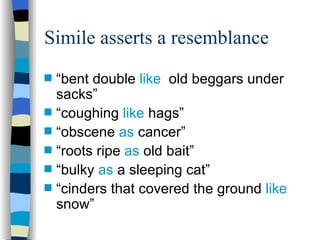
Simile asserts a resemblance
s   “bent double like old beggars under
    sacks”
s   “coughing like hags”
s   “obscene as cancer”
s   “roots ripe as old bait”
s   “bulky as a sleeping cat”
s   “cinders that covered the ground like
    snow”
Metaphor asserts an identity
s   “the mountain of beans in my lap”
s   [hailstones are] “little white planets”
s   “It was festival, carnival”
s   “the wolf whine of the siren”
s   “Old age is a flight of small cheeping
    birds.”
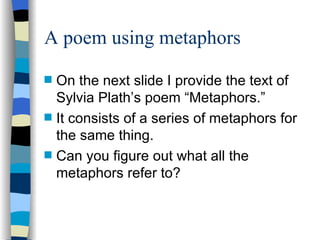
A poem using metaphors
s   On the next slide I provide the text of
    Sylvia Plath’s poem “Metaphors.”
s   It consists of a series of metaphors for
    the same thing.
s   Can you figure out what all the
    metaphors refer to?
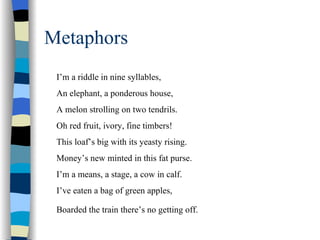
Metaphors
 I’m a riddle in nine syllables,
 An elephant, a ponderous house,
 A melon strolling on two tendrils.
 Oh red fruit, ivory, fine timbers!
 This loaf’s big with its yeasty rising.
 Money’s new minted in this fat purse.
 I’m a means, a stage, a cow in calf.
 I’ve eaten a bag of green apples,

 Boarded the train there’s no getting off.
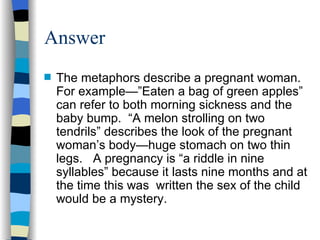
Answer
s   The metaphors describe a pregnant woman.
    For example—”Eaten a bag of green apples”
    can refer to both morning sickness and the
    baby bump. “A melon strolling on two
    tendrils” describes the look of the pregnant
    woman’s body—huge stomach on two thin
    legs. A pregnancy is “a riddle in nine
    syllables” because it lasts nine months and at
    the time this was written the sex of the child
    would be a mystery.
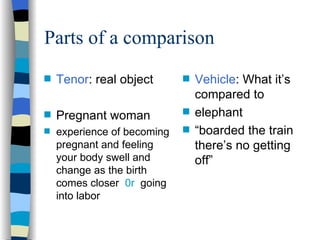
Parts of a comparison
s   Tenor: real object       s   Vehicle: What it’s
                                 compared to
s   Pregnant woman           s   elephant
s   experience of becoming   s   “boarded the train
    pregnant and feeling         there’s no getting
    your body swell and          off”
    change as the birth
    comes closer 0r going
    into labor
Extended metaphor
s   In “Metaphors” several different
    metaphors were provided for one thing.
    In some poems a single metaphor is
    elaborated on for several lines,
    supported by various related
    comparisons. Let’s look at Langston
    Hughes’s “Mother to Son.” What
    metaphor for life is used in this poem?
Extended metaphor
 Mother to Son
 Well, son I’ll tell you:
 Life for me ain’t been no crystal stair
 It’s had tacks in it,
 And splinters,
 And boards torn up,
 And places with no carpet on the floor--
 Bare.
 But all the time I’se been a climbin’ on,
 And reachin’ landin’s
 And turnin’ corners
 And sometimes goin’ in the dark
 Where there ain’t been no light.
 . . . Life for me ain’t been no crystal stair.
Extended metaphor
s   An extended metaphor is continued over at
    least several lines of the poem. When the
    whole poem involves an extended metaphor
    we can also call that the controlling metaphor
    of the poem. In “Mother to Son” the
    controlling metaphor is that the journey
    through life is like climbing a staircase, but
    everyone does not have the same sort of
    staircase to climb. The next page breaks
    down some of the smaller comparisons that
    are part of this controlling metaphor.
“Mother to Son”
s   Vehicle                  s   Tenor
s   Crystal stair            s   An easy life filled with
                                 luxuries
                             s   Hard life of poverty and
s   Dark staircase in need       struggle
    of repair
s   Splinters                s   Small problems
s   Tacks                    s   Significant hardships
s   Boards torn up           s   Lacking basic support
s   Reaching landings        s   Reaching turning points
                                 or milestones
“MARKS”
s   Linda Pastan’s “Marks” is another good
    example of a poem with a controlling
    metaphor. The speaker is a woman who
    compares herself to a student ready to
    drop out of school as she explains that
    she is tried of feeling criticized or
    unappreciated by her family.
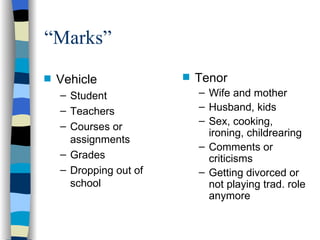
“Marks”
s   Vehicle             s   Tenor
    – Student               – Wife and mother
    – Teachers              – Husband, kids
                            – Sex, cooking,
    – Courses or
                              ironing, childrearing
      assignments
                            – Comments or
    – Grades                  criticisms
    – Dropping out of       – Getting divorced or
      school                  not playing trad. role
                              anymore
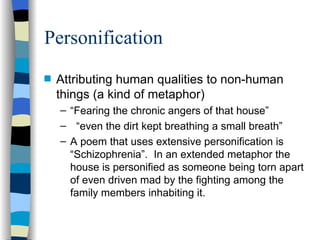
Personification
s   Attributing human qualities to non-human
    things (a kind of metaphor)
    – “Fearing the chronic angers of that house”
    – “even the dirt kept breathing a small breath”
    – A poem that uses extensive personification is
      “Schizophrenia”. In an extended metaphor the
      house is personified as someone being torn apart
      of even driven mad by the fighting among the
      family members inhabiting it.
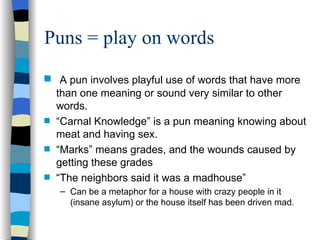
Puns = play on words
s    A pun involves playful use of words that have more
    than one meaning or sound very similar to other
    words.
s   “Carnal Knowledge” is a pun meaning knowing about
    meat and having sex.
s   “Marks” means grades, and the wounds caused by
    getting these grades
s   “The neighbors said it was a madhouse”
    – Can be a metaphor for a house with crazy people in it
      (insane asylum) or the house itself has been driven mad.
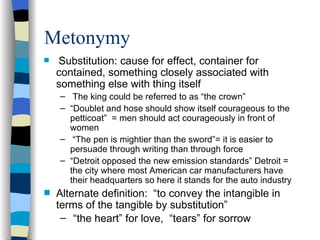
Metonymy
s   Substitution: cause for effect, container for
    contained, something closely associated with
    something else with thing itself
    – The king could be referred to as “the crown”
    – “Doublet and hose should show itself courageous to the
      petticoat” = men should act courageously in front of
      women
    – “The pen is mightier than the sword”= it is easier to
      persuade through writing than through force
    – “Detroit opposed the new emission standards” Detroit =
      the city where most American car manufacturers have
      their headquarters so here it stands for the auto industry
s   Alternate definition: “to convey the intangible in
    terms of the tangible by substitution”
     – “the heart” for love, “tears” for sorrow
Synecdoche
s   Part is used to signify the whole:
    – Child is “another mouth to feed”
    – Ten workers are “ten hands “
    – “He belongs behind bars.”
s   Whole for a part
     – “Germany invaded Poland.”
s   By some definitions, synecdoche is viewed as a
    special case of metonymy. They can be hard to tell
    apart.
Synecdoche/metonymy
s   “Her heart was learning to lie down forever”
    (heart=dog; “lie down forever” stands for
    dying.)
s   “All pajamas and running noses” (both stand
    for children)
s   “We longed for burnt wood” (stands for fire)
s   “. . . Rage. . . Walked in the ironlike black coat
    before him” (coat for father) (and father is the
    personification of rage)—This line is from
    “Barn Burning.”
Hyperbole = exaggeration
s   “The whiskey on your breath could
    make a small boy dizzy”
s   “Men marched asleep”
s   “A mountain of beans”
Understatement=saying less than
you mean
s   “No one ever thanked him”
    – When the poet says no one ever thanked
      the father for warming the house, it seems
      to mean that no one appreciated anything
      he did.
s   “Life for me ain’t been no crystal stair”
    – The implication is that it’s been the
      extreme opposite
Oxymoron and paradox
s   Paradox is a self-contradictory
    statement that is nevertheless true
    – “It was the house that suffered most”
s   An oxymoron is the combination of
    contradictory words
    – Sweet sorrow
    – Jumbo shrimp
    – Deceitful candor

Figurative language

  • 1.
  • 2.
    Metaphors and Similes s Metaphors and similes involve comparisons between two unlike things s Literal comparison – His car is as fast as Tom’s car – The Exorcist is scarier than The Blair Witch Project s Figurative comparison – His car is as fast as lighting (simile) – My love life is a soap opera (metaphor)
  • 3.
    Simile asserts aresemblance s “bent double like old beggars under sacks” s “coughing like hags” s “obscene as cancer” s “roots ripe as old bait” s “bulky as a sleeping cat” s “cinders that covered the ground like snow”
  • 4.
    Metaphor asserts anidentity s “the mountain of beans in my lap” s [hailstones are] “little white planets” s “It was festival, carnival” s “the wolf whine of the siren” s “Old age is a flight of small cheeping birds.”
  • 5.
    A poem usingmetaphors s On the next slide I provide the text of Sylvia Plath’s poem “Metaphors.” s It consists of a series of metaphors for the same thing. s Can you figure out what all the metaphors refer to?
  • 6.
    Metaphors I’m ariddle in nine syllables, An elephant, a ponderous house, A melon strolling on two tendrils. Oh red fruit, ivory, fine timbers! This loaf’s big with its yeasty rising. Money’s new minted in this fat purse. I’m a means, a stage, a cow in calf. I’ve eaten a bag of green apples, Boarded the train there’s no getting off.
  • 7.
    Answer s The metaphors describe a pregnant woman. For example—”Eaten a bag of green apples” can refer to both morning sickness and the baby bump. “A melon strolling on two tendrils” describes the look of the pregnant woman’s body—huge stomach on two thin legs. A pregnancy is “a riddle in nine syllables” because it lasts nine months and at the time this was written the sex of the child would be a mystery.
  • 8.
    Parts of acomparison s Tenor: real object s Vehicle: What it’s compared to s Pregnant woman s elephant s experience of becoming s “boarded the train pregnant and feeling there’s no getting your body swell and off” change as the birth comes closer 0r going into labor
  • 9.
    Extended metaphor s In “Metaphors” several different metaphors were provided for one thing. In some poems a single metaphor is elaborated on for several lines, supported by various related comparisons. Let’s look at Langston Hughes’s “Mother to Son.” What metaphor for life is used in this poem?
  • 10.
    Extended metaphor Motherto Son Well, son I’ll tell you: Life for me ain’t been no crystal stair It’s had tacks in it, And splinters, And boards torn up, And places with no carpet on the floor-- Bare. But all the time I’se been a climbin’ on, And reachin’ landin’s And turnin’ corners And sometimes goin’ in the dark Where there ain’t been no light. . . . Life for me ain’t been no crystal stair.
  • 11.
    Extended metaphor s An extended metaphor is continued over at least several lines of the poem. When the whole poem involves an extended metaphor we can also call that the controlling metaphor of the poem. In “Mother to Son” the controlling metaphor is that the journey through life is like climbing a staircase, but everyone does not have the same sort of staircase to climb. The next page breaks down some of the smaller comparisons that are part of this controlling metaphor.
  • 12.
    “Mother to Son” s Vehicle s Tenor s Crystal stair s An easy life filled with luxuries s Hard life of poverty and s Dark staircase in need struggle of repair s Splinters s Small problems s Tacks s Significant hardships s Boards torn up s Lacking basic support s Reaching landings s Reaching turning points or milestones
  • 13.
    “MARKS” s Linda Pastan’s “Marks” is another good example of a poem with a controlling metaphor. The speaker is a woman who compares herself to a student ready to drop out of school as she explains that she is tried of feeling criticized or unappreciated by her family.
  • 14.
    “Marks” s Vehicle s Tenor – Student – Wife and mother – Teachers – Husband, kids – Sex, cooking, – Courses or ironing, childrearing assignments – Comments or – Grades criticisms – Dropping out of – Getting divorced or school not playing trad. role anymore
  • 15.
    Personification s Attributing human qualities to non-human things (a kind of metaphor) – “Fearing the chronic angers of that house” – “even the dirt kept breathing a small breath” – A poem that uses extensive personification is “Schizophrenia”. In an extended metaphor the house is personified as someone being torn apart of even driven mad by the fighting among the family members inhabiting it.
  • 16.
    Puns = playon words s A pun involves playful use of words that have more than one meaning or sound very similar to other words. s “Carnal Knowledge” is a pun meaning knowing about meat and having sex. s “Marks” means grades, and the wounds caused by getting these grades s “The neighbors said it was a madhouse” – Can be a metaphor for a house with crazy people in it (insane asylum) or the house itself has been driven mad.
  • 17.
    Metonymy s Substitution: cause for effect, container for contained, something closely associated with something else with thing itself – The king could be referred to as “the crown” – “Doublet and hose should show itself courageous to the petticoat” = men should act courageously in front of women – “The pen is mightier than the sword”= it is easier to persuade through writing than through force – “Detroit opposed the new emission standards” Detroit = the city where most American car manufacturers have their headquarters so here it stands for the auto industry s Alternate definition: “to convey the intangible in terms of the tangible by substitution” – “the heart” for love, “tears” for sorrow
  • 18.
    Synecdoche s Part is used to signify the whole: – Child is “another mouth to feed” – Ten workers are “ten hands “ – “He belongs behind bars.” s Whole for a part – “Germany invaded Poland.” s By some definitions, synecdoche is viewed as a special case of metonymy. They can be hard to tell apart.
  • 19.
    Synecdoche/metonymy s “Her heart was learning to lie down forever” (heart=dog; “lie down forever” stands for dying.) s “All pajamas and running noses” (both stand for children) s “We longed for burnt wood” (stands for fire) s “. . . Rage. . . Walked in the ironlike black coat before him” (coat for father) (and father is the personification of rage)—This line is from “Barn Burning.”
  • 20.
    Hyperbole = exaggeration s “The whiskey on your breath could make a small boy dizzy” s “Men marched asleep” s “A mountain of beans”
  • 21.
    Understatement=saying less than youmean s “No one ever thanked him” – When the poet says no one ever thanked the father for warming the house, it seems to mean that no one appreciated anything he did. s “Life for me ain’t been no crystal stair” – The implication is that it’s been the extreme opposite
  • 22.
    Oxymoron and paradox s Paradox is a self-contradictory statement that is nevertheless true – “It was the house that suffered most” s An oxymoron is the combination of contradictory words – Sweet sorrow – Jumbo shrimp – Deceitful candor