wwww.digitalerra.com
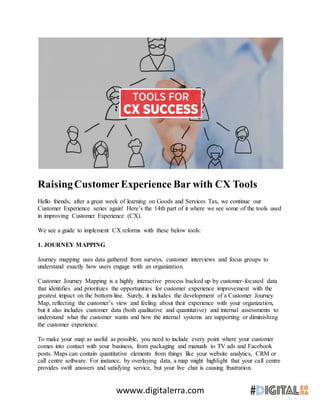
RaisingCustomerExperience Bar with CX Tools
Hello friends, after a great week of learning on Goods and Services Tax, we continue our
Customer Experience series again! Here’s the 14th part of it where we see some of the tools used
in improving Customer Experience (CX).
We see a guide to implement CX reforms with these below tools:
1. JOURNEY MAPPING
Journey mapping uses data gathered from surveys, customer interviews and focus groups to
understand exactly how users engage with an organization.
Customer Journey Mapping is a highly interactive process backed up by customer-focused data
that identifies and prioritizes the opportunities for customer experience improvement with the
greatest impact on the bottom-line. Surely, it includes the development of a Customer Journey
Map, reflecting the customer’s view and feeling about their experience with your organization,
but it also includes customer data (both qualitative and quantitative) and internal assessments to
understand what the customer wants and how the internal systems are supporting or diminishing
the customer experience.
To make your map as useful as possible, you need to include every point where your customer
comes into contact with your business, from packaging and manuals to TV ads and Facebook
posts. Maps can contain quantitative elements from things like your website analytics, CRM or
call centre software. For instance, by overlaying data, a map might highlight that your call centre
provides swift answers and satisfying service, but your live chat is causing frustration.
wwww.digitalerra.com
As your relationship with a customer develops, your map will also cover the long-term, post
purchase journey they take with you. Looking at the completed journeys of many customers can
help highlight whether there is a clear route from research and enquiry to sale, mapping potential
obstacles and opportunities for the business to improve the journey.
2. SEGMENTATION
Segmentation recognizes that people have different needs, not just in terms of the services they
receive but also in how services are delivered. Well, connecting with today’s buyers requires a
new segmentation approach- Experiential segmentation.
Experiential segmentation is a strategic resource shared across Product, Marketing, Sales and
Support functions with appropriate elements to help anyone involved in shaping the customer
experience make more customer-centric choices and decisions.
This involves a rich appreciation for the context in which buyers conduct their buying journey
and decisions, and is built on a deep understanding of customer motivations, goals and
behaviors.
The fundamental principles of segmentation are:
 Only split customers into segments or groups on the database if you want to do
something differently to or with them
 If you want to treat everybody the same, don’t behaviourally segment them
 Refresh your view of customers and put your organization in a better position to compete
based on a customer-centric advantage
3. BUDGET OPTIMIZATION
A well-designed CX reform can advance mission goals and cut costs. The key is allocating the
right resources to the right people. Here are some ways.
 Prioritization
Customer lifetime value (CLV) is the cumulative profit stream over the duration of a customer's
interest in a brand category. To enable CLV-based decision-making, provide executives and
customer-facing employees with tools that keep CLV policies top-of-mind. CLV prioritization
also aids customer listening strategies and experience improvement initiatives.
 Listening
Referring to the customer experience personas and CLV findings, evaluate customer sentiment
monitoring methods. Is the customer's full experience reflected? Are CLV-prioritized segments
represented accordingly? Does it incorporate the typically latent data to provide a panoramic
view? The answers to these questions indicate whether your data collection needs to be adjusted
for higher return on investment regarding its use for innovation.
wwww.digitalerra.com
 Innovation
Expand innovation horizons to include the full customer experience spectrum. Inspire
development teams by streaming customer listening data, CLV and customer experience
personas to them. Involve representatives from manufacturing, customer service, support
functions and channel partners along with the development teams in improving products,
services, and customer touch points. A broader viewpoint, supported by streaming fresh
customer inputs, can propel innovation well beyond competitors' offerings. Customer experience
innovation is bolstered by effective internal branding.
Customer’s expectations never cease, but pervasive adoption of the CX tools can so effectively
improve the experience- giving people a lot less to complain about.

Raising customer experience bar with cx tools

  • 1.
    wwww.digitalerra.com RaisingCustomerExperience Bar withCX Tools Hello friends, after a great week of learning on Goods and Services Tax, we continue our Customer Experience series again! Here’s the 14th part of it where we see some of the tools used in improving Customer Experience (CX). We see a guide to implement CX reforms with these below tools: 1. JOURNEY MAPPING Journey mapping uses data gathered from surveys, customer interviews and focus groups to understand exactly how users engage with an organization. Customer Journey Mapping is a highly interactive process backed up by customer-focused data that identifies and prioritizes the opportunities for customer experience improvement with the greatest impact on the bottom-line. Surely, it includes the development of a Customer Journey Map, reflecting the customer’s view and feeling about their experience with your organization, but it also includes customer data (both qualitative and quantitative) and internal assessments to understand what the customer wants and how the internal systems are supporting or diminishing the customer experience. To make your map as useful as possible, you need to include every point where your customer comes into contact with your business, from packaging and manuals to TV ads and Facebook posts. Maps can contain quantitative elements from things like your website analytics, CRM or call centre software. For instance, by overlaying data, a map might highlight that your call centre provides swift answers and satisfying service, but your live chat is causing frustration.
  • 2.
    wwww.digitalerra.com As your relationshipwith a customer develops, your map will also cover the long-term, post purchase journey they take with you. Looking at the completed journeys of many customers can help highlight whether there is a clear route from research and enquiry to sale, mapping potential obstacles and opportunities for the business to improve the journey. 2. SEGMENTATION Segmentation recognizes that people have different needs, not just in terms of the services they receive but also in how services are delivered. Well, connecting with today’s buyers requires a new segmentation approach- Experiential segmentation. Experiential segmentation is a strategic resource shared across Product, Marketing, Sales and Support functions with appropriate elements to help anyone involved in shaping the customer experience make more customer-centric choices and decisions. This involves a rich appreciation for the context in which buyers conduct their buying journey and decisions, and is built on a deep understanding of customer motivations, goals and behaviors. The fundamental principles of segmentation are:  Only split customers into segments or groups on the database if you want to do something differently to or with them  If you want to treat everybody the same, don’t behaviourally segment them  Refresh your view of customers and put your organization in a better position to compete based on a customer-centric advantage 3. BUDGET OPTIMIZATION A well-designed CX reform can advance mission goals and cut costs. The key is allocating the right resources to the right people. Here are some ways.  Prioritization Customer lifetime value (CLV) is the cumulative profit stream over the duration of a customer's interest in a brand category. To enable CLV-based decision-making, provide executives and customer-facing employees with tools that keep CLV policies top-of-mind. CLV prioritization also aids customer listening strategies and experience improvement initiatives.  Listening Referring to the customer experience personas and CLV findings, evaluate customer sentiment monitoring methods. Is the customer's full experience reflected? Are CLV-prioritized segments represented accordingly? Does it incorporate the typically latent data to provide a panoramic view? The answers to these questions indicate whether your data collection needs to be adjusted for higher return on investment regarding its use for innovation.
  • 3.
    wwww.digitalerra.com  Innovation Expand innovationhorizons to include the full customer experience spectrum. Inspire development teams by streaming customer listening data, CLV and customer experience personas to them. Involve representatives from manufacturing, customer service, support functions and channel partners along with the development teams in improving products, services, and customer touch points. A broader viewpoint, supported by streaming fresh customer inputs, can propel innovation well beyond competitors' offerings. Customer experience innovation is bolstered by effective internal branding. Customer’s expectations never cease, but pervasive adoption of the CX tools can so effectively improve the experience- giving people a lot less to complain about.