1
Designing a Successful Loyalty Program
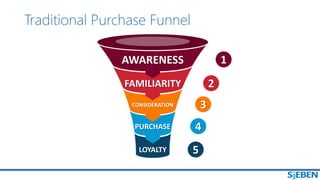
Traditional Purchase Funnel
LOYALTY
AWARENESS
FAMILIARITY
CONSIDERATION
PURCHASE
1
5
4
3
2
3
What is a loyalty programme?
• The systematic collection of customer data in return for rewards or
benefits, often used to give customer additional privileges or services to
best/loyal customers
Opportunities
• Understand customers
• Give discounts to best customers only
• Adjust real price for certain customers
• Use data to negotiate with partners
What is a loyalty program?
Points Discount Rebate
Earn points and redeem
for rewards
Good
-Offers control
-Customer understands
-Lower cost
Bad
- Points cost are knowledge
- Accrued liability
Immediate discount for
presenting card
Good
-Easy and instant
- No liability
Bad
- Discount has to be large
(+10%)
- No control
Reward spend over
time
Good
-Easy to manage
Bad
- Little control
- Easy to copy e.g. stampcard
- Little emotional connection
KrisflyerPrivilege
Earn points and redeem for rewards plus tiers of privilege
Good
-Privileges lead to loyalty
-Offers control
-Customer understands
Bad
- Low spend customer disillusion
- Competitors can match
Loyalty Program Options
2
5 46
1
37
8
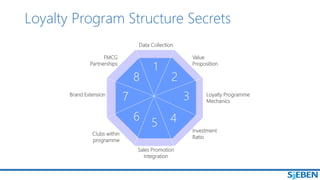
Data Collection
Sales Promotion
Integration
Loyalty Programme
Mechanics
Brand Extension
Clubs within
programme
FMCG
Partnerships
Value
Proposition
Investment
Ratio
Loyalty Program Structure Secrets
7
Strategic Details
Many Loyalty Programs Fail to Deliver Positive ROI
• Failure to develop a shared management
perspective of loyalty opportunity.
• Quality of data not properly addressed (e.g.,
invalid customer info, too small of sales base)
• Lack of clearly defined and measurable
business objectives.
• Little or no attention paid to employee skill
sets and abilities; too great a focus on tools
and hardware
• Customers don’t understand what it takes to
earn rewards or to achieve new status levels.
• Data is not leveraged to communicate to
customers.
• Program was launched and went into “auto”
drive
• Change behavior rather than just reinforce it.
• Each year program results are analyzed to optimize
customer enrollment, retention, redemption and ROI.
• Over-invest in coordination with users and across functions.
• Link technology implementation priorities to business
objectives.
• Advocacy by senior management.
• Segment and tailor the program and offers.
• Demonstrate innovation and regular re-invention.
• Develop robust multi-channel communications to engage,
keep and grow profitable customer relationships.
• Understand customers and how segments differ from one
another.
Designing a Successful Loyalty Program
1. Successful loyalty programs are strategic
2. Trade-offs are required to realize financial goals
3. Objectives must drive program strategy
4. Identity how program design delivers value
5. Leverage best practices of industry leaders
Successful Loyalty Programs are Strategic
• Do customers know what it takes to earn
rewards?
• Benefit mix (soft and hard benefits)
• Strategies to move customers up in
tiers/spend
• What distinctive assets can be leveraged?
(e.g., assortment, receipts, community,
mobile app, affinity programs)
• How will these assets reshape economics
and expected returns?
• What is the primary business
objective goal for customer
impact? (e.g., frequency, avg.
sale, LTV)
• Are potential benefits compelling
enough to achieve required
customer impact?
• Is value message simple to
understand?
• How deliver and reinforce
engagement over time (e.g., POS
technology, frontline training,
mobile, social media, fulfillment,
and marketing support)?
Execute
skillfully
and
persistently to
sustain
impact
Set realistic
and targeted
program
objectives
Make rigorous
design trade-
offs to
achieve
objectives
Leverage
distinctive
assets
to make
economics
work
Trade-offs are required to realize financial goals
Which Customers are
Targeted
How and When
Customers Are Enrolled
Qualification &
Re-qualification Criteria
Value and Structure of
Rewards
How Program is
Communicated
•Breadth of appeal and participation
•Level of participation over time
•Types of customers participating
•Degree of offer-tailoring
•Types and degrees of impact
•Depth and consistency of data capture
•Level of frontline involvement
•Culture to drive sales or margin
•System capabilities
•Cost of program
•Long- and short-term measurement
•Exit flexibility/cost
Objectives Must Drive Program Strategy
• Develop strong relationships with
most valuable segment(s)
• Target growth segments only,
significant ability to target and
tailor between and within
segments
• Continue to
pursue defined
initiatives
• Collect customer data to make
better decisions across the
business
• Target all segments, significant
ability to target & tailor between
and within segments
• Provide direct,
targeted messages and
offers across customer
base
• Target all segments,
with limited ability to
target and tailor
between segments
Expand marketing
channel with
direct
capabilities
Collect data to be
us used as a core
business asset
Build strong
relationships with
growth segments
No explicit
strategy
Main segments of targeting
• 2 main segments
• Buyers
• Analysis of
• Behavior
• Profile
• Shopping habits
• Save on investment through rewarding accordingly, and not the full spectrum of
investment, and thus maximize effect
• Non Buyers
• Statistical profile per category
• Identify possible correlations to existing buyers
• Historic buyers
• Reactivation of Historic buyers with increased investment
Key rule buildup of increasing ROI
1. Identify the gross profit of the main categories
2. Identify correlations between categories
3. Invest part of the gross profit (as an investment cost) on products
with high frequency but low profitability to lead to categories with
less frequency but greater profitability
4. Monitor
5. Assess
6. Recalibrate
7. Execute
Target
Audience
Brand
Positioning
Customer
Loyalty
Drivers
Degree of
Participation
Choice of
rewards
Generosity
Delivery of
rewards
Liability
risk
Investment
Cost
Getting
Customers to
join
Competitor
Strength
Sales
Focus
Critical Success Factors for Customer Loyalty
• Programs offer opportunity to get to know customer – that’s cost of
knowledge that must be recovered
• Opportunity comes from using the data – to drive more spend -
personal shopping lists
• Customers enjoy being part of programs if they get privileges of
whatever value therefore work hard to give them value
• When Loyalty Schemes are properly implemented and maintained,
they will minimize marketing investment with guaranteed
maximized ROMI
All in all…
www.sieben.gr
www.linkedin.com/company/sieben.gr
www.facebook.com/sieben.gr

Loyalty presentation

  • 1.
    1 Designing a SuccessfulLoyalty Program
  • 2.
  • 3.
    3 What is aloyalty programme?
  • 4.
    • The systematiccollection of customer data in return for rewards or benefits, often used to give customer additional privileges or services to best/loyal customers Opportunities • Understand customers • Give discounts to best customers only • Adjust real price for certain customers • Use data to negotiate with partners What is a loyalty program?
  • 5.
    Points Discount Rebate Earnpoints and redeem for rewards Good -Offers control -Customer understands -Lower cost Bad - Points cost are knowledge - Accrued liability Immediate discount for presenting card Good -Easy and instant - No liability Bad - Discount has to be large (+10%) - No control Reward spend over time Good -Easy to manage Bad - Little control - Easy to copy e.g. stampcard - Little emotional connection KrisflyerPrivilege Earn points and redeem for rewards plus tiers of privilege Good -Privileges lead to loyalty -Offers control -Customer understands Bad - Low spend customer disillusion - Competitors can match Loyalty Program Options
  • 6.
    2 5 46 1 37 8 Data Collection SalesPromotion Integration Loyalty Programme Mechanics Brand Extension Clubs within programme FMCG Partnerships Value Proposition Investment Ratio Loyalty Program Structure Secrets
  • 7.
  • 8.
    Many Loyalty ProgramsFail to Deliver Positive ROI • Failure to develop a shared management perspective of loyalty opportunity. • Quality of data not properly addressed (e.g., invalid customer info, too small of sales base) • Lack of clearly defined and measurable business objectives. • Little or no attention paid to employee skill sets and abilities; too great a focus on tools and hardware • Customers don’t understand what it takes to earn rewards or to achieve new status levels. • Data is not leveraged to communicate to customers. • Program was launched and went into “auto” drive • Change behavior rather than just reinforce it. • Each year program results are analyzed to optimize customer enrollment, retention, redemption and ROI. • Over-invest in coordination with users and across functions. • Link technology implementation priorities to business objectives. • Advocacy by senior management. • Segment and tailor the program and offers. • Demonstrate innovation and regular re-invention. • Develop robust multi-channel communications to engage, keep and grow profitable customer relationships. • Understand customers and how segments differ from one another.
  • 9.
    Designing a SuccessfulLoyalty Program 1. Successful loyalty programs are strategic 2. Trade-offs are required to realize financial goals 3. Objectives must drive program strategy 4. Identity how program design delivers value 5. Leverage best practices of industry leaders
  • 10.
    Successful Loyalty Programsare Strategic • Do customers know what it takes to earn rewards? • Benefit mix (soft and hard benefits) • Strategies to move customers up in tiers/spend • What distinctive assets can be leveraged? (e.g., assortment, receipts, community, mobile app, affinity programs) • How will these assets reshape economics and expected returns? • What is the primary business objective goal for customer impact? (e.g., frequency, avg. sale, LTV) • Are potential benefits compelling enough to achieve required customer impact? • Is value message simple to understand? • How deliver and reinforce engagement over time (e.g., POS technology, frontline training, mobile, social media, fulfillment, and marketing support)? Execute skillfully and persistently to sustain impact Set realistic and targeted program objectives Make rigorous design trade- offs to achieve objectives Leverage distinctive assets to make economics work
  • 11.
    Trade-offs are requiredto realize financial goals Which Customers are Targeted How and When Customers Are Enrolled Qualification & Re-qualification Criteria Value and Structure of Rewards How Program is Communicated •Breadth of appeal and participation •Level of participation over time •Types of customers participating •Degree of offer-tailoring •Types and degrees of impact •Depth and consistency of data capture •Level of frontline involvement •Culture to drive sales or margin •System capabilities •Cost of program •Long- and short-term measurement •Exit flexibility/cost
  • 12.
    Objectives Must DriveProgram Strategy • Develop strong relationships with most valuable segment(s) • Target growth segments only, significant ability to target and tailor between and within segments • Continue to pursue defined initiatives • Collect customer data to make better decisions across the business • Target all segments, significant ability to target & tailor between and within segments • Provide direct, targeted messages and offers across customer base • Target all segments, with limited ability to target and tailor between segments Expand marketing channel with direct capabilities Collect data to be us used as a core business asset Build strong relationships with growth segments No explicit strategy
  • 13.
    Main segments oftargeting • 2 main segments • Buyers • Analysis of • Behavior • Profile • Shopping habits • Save on investment through rewarding accordingly, and not the full spectrum of investment, and thus maximize effect • Non Buyers • Statistical profile per category • Identify possible correlations to existing buyers • Historic buyers • Reactivation of Historic buyers with increased investment
  • 14.
    Key rule buildupof increasing ROI 1. Identify the gross profit of the main categories 2. Identify correlations between categories 3. Invest part of the gross profit (as an investment cost) on products with high frequency but low profitability to lead to categories with less frequency but greater profitability 4. Monitor 5. Assess 6. Recalibrate 7. Execute
  • 15.
    Target Audience Brand Positioning Customer Loyalty Drivers Degree of Participation Choice of rewards Generosity Deliveryof rewards Liability risk Investment Cost Getting Customers to join Competitor Strength Sales Focus Critical Success Factors for Customer Loyalty
  • 16.
    • Programs offeropportunity to get to know customer – that’s cost of knowledge that must be recovered • Opportunity comes from using the data – to drive more spend - personal shopping lists • Customers enjoy being part of programs if they get privileges of whatever value therefore work hard to give them value • When Loyalty Schemes are properly implemented and maintained, they will minimize marketing investment with guaranteed maximized ROMI All in all…
  • 17.

Editor's Notes

  • #14 Mobile Application (iOS & Android) – Offline & Online Marera Integration -> to collect users data Mobile App Map (User Profile, Terms & Conditions, About, brand details) Game Passive: Interactive: Push Notifications Design Costs Social Media Promotion (Να κάνουμε ένα estimation με Αλέξανδρο) Media Plan is required -> Henkel Media Shop should take care
  • #15 Mobile Application (iOS & Android) – Offline & Online Marera Integration -> to collect users data Mobile App Map (User Profile, Terms & Conditions, About, brand details) Game Passive: Interactive: Push Notifications Design Costs Social Media Promotion (Να κάνουμε ένα estimation με Αλέξανδρο) Media Plan is required -> Henkel Media Shop should take care