Why keeping your customers happy is good for business
Trevor Isherwood & Dr. Tiia Maekinen
In 2014 many brands showed
improvements in their customer
experiences. In fact, just 1 percent of
the brands ranked by Forrester’s annual
Customer Experience Index (CXi)
benchmark fell into the “very poor”
category for customer experience.
That’s the lowest number of very poor
performers in the benchmark’s seven-
year history. So it appears that customer
experience is gaining attention as a
business driver.
Yet many companies are still to
prioritise customer experience as a
fundamental business driver. Research
by Bain & Company demonstrated
that whilst 80% of companies felt they
delivered good customer service only 8%
of customers agreed. This implies that
many companies do not fully understand
whatkindofcustomerexperiencetheyare
actually delivering, or what is important
to customers in that experience that helps
generate greater revenues.
Fully utilising and enabling growth
through customer experience requires
a shift in mind-set within organisations,
moving the focus away from short-term,
campaign-based marketing projects
normally targeted for prospects and
acquiring new customers, into long-
term value creation efforts for existing
clients. Research clearly shows that happy
customers spend more, spend more
frequently and tell their friends about
the company. Excellence in customer
experience with existing customers can
become your most effective marketing
tool to attract new customers.
Customer churn and negative word of
mouth due to poor service experiences
are costing businesses valuable revenue.
To drive effective return on marketing
investment, it makes sense to focus on
what is important to customers. Driving
business strategy in sync with customer
experience strategy not only delivers
growth, it also allows businesses to
organise themselves most cost-effectively
around customer experience.
CUSTOMER UNDERSTANDING AND
EXPERIENCEMEASUREMENTASBASIC
BUILDING BLOCKS FOR GROWTH
Some customers want to continually
be made to feel special, some want
more attention than others, some need
guidance, and others just want to be left
alone. By developing insights on their
preferences, needs and behaviours,
customer experiences can be improved
and more effectively managed at critical
touch points. Consistently delivering
positive experiences establishes
relationships that help build preference
and loyalty, and create growth.
What is it that prevents companies from
deliveringonwhattheircustomersexpect?
Often it’s a lack of clear understanding of
the kinds of customer experiences that
create and sustain customer loyalty and
advocacy. It might not be rocket science
but the top three expectations as revealed
in a recent Forrester study are:
Make me feel valued - In most cases
emotion has a bigger impact on
customer loyalty than product or service
effectiveness or ease of purchase. In
particular feeling that a brand values
you as a customer is critical in every
industry. Customers feel valued as
a result of brands showing genuine
interest, creating empathy towards the
customers’ experiences and generating
relevant understanding of its impact on
customers.
Resolve my problems quickly - Rapid
issue resolution is also a key driver.
What makes an experience feel quick
to customers? Sales staff who are
T H E P U R S U I T
O F H A P P I N E S S
promotion
available when, where, and how it’s
most convenient for the customer and
who are empowered to resolve problems
immediately.
Speak my language - Just like billionaire
investor Warren Buffett, customers don’t
like to spend money on things they don’t
understand.Firmsthatavoidusingjargon
when talking to customers offer better
customer experiences and achieve more
loyal customers than those that don’t.
Measuring customer experience
requires a focused, but multi-
dimensional view of the customer
experience. Overall, the better the
company understands its customer
experience and the associated value
drivers, the easier it is to make targeted
and effective enhancements to it. A
variety of qualitative and data analytic
methods can be used to complete the
picture and understanding of customer
experience status and trends.
Customer journey mapping can then
be used as one of the tools for customer
experience management and alignment
of internal processes to the customer
experience deliveries through variety
touch points.
ACHIEVING BUSINESS GROWTH
THROUGH CUSTOMER EXPERIENCE
In order to drive revenues your customer
experience management an orchestrated
effort of strategy, technology, internal
coordination, knowledge sharing and
dialogue building with the customer.
THE STEPS R EQUIR ED FOR
BUILDING GROWTH THROUGH
CUSTOMER EXPERIENCE:
1.Proactivity-Movingfromunconscious
or unknown customer experience to
active customer experience management
is essential. Customer experience
happens all the time and everywhere
in your business. Acknowledging these
experiences and their importance to
your business will take you a step closer
to establishing them as your key source
of growth.
2. Insights & Design - Some customer
experience improvements can be
achieved by increasing basic knowledge
about your customers, for example
segments, target customer definition
and customer satisfaction. Customer
experience can also be improved by
better design of the individual touch-
point interface, such as improving user
experience of an online tool. This rather
aesthetic improvement of customer
experience is important but as a business
strategy this alone will not be adequate
to drive sustainable growth.
3. Process - Customer experience
management as a process means
focusing on the processes and operations
that play a part in delivering customer
experience. The heart of this approach
is cross-organisational collaboration,
which incorporates streamlining and
simplifying processes, getting rid of
silos and systematically sharing the
customer insights. Effective processes
enable organisational focus on relevant
customerexperiencesandtoremovethose
which do not deliver value, increasing
organisational effectiveness and growth.
4. Culture - Engaging employees is often
overlooked as a driver for improving
customer experience. Genuinely
placing your customer at the heart of
your organisation will require more
than a change in internal structures or
effective client journey management.
Customer-centricity comes alive in
the values, strategy and attitudes of
the whole company. Driving growth
through client experience requires
a culture of relentless innovation,
demonstrating that customers are
heard, their actions are understood
and a focus for continuous development
of customer experience is set. It is
essential that enough tools, training
and communication are undertaken to
enable everyone in the organisation to
‘walk the talk’. Additionally, appropriate
reward systems and alignment of
organisational interests play a pivotal
role. The quality of your employee’s
experiences is also an indicator of the
overall quality of customer experience.
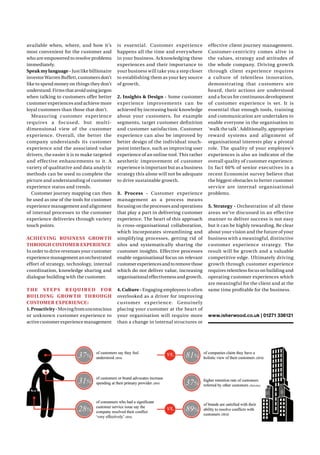
In fact 60% of senior executives in a
recent Economist survey believe that
the biggest obstacles to better customer
service are internal organisational
problems.
5. Strategy - Orchestration of all these
areas we’ve discussed in an effective
manner to deliver success is not easy
but it can be highly rewarding. Be clear
about your vision and the future of your
business with a meaningful, distinctive
customer experience strategy. The
result will be growth and a valuable
competitive edge. Ultimately driving
growth through customer experience
requires relentless focus on building and
operating customer experiences which
are meaningful for the client and at the
same time profitable for the business.
www.isherwood.co.uk | 01271 336121

CXarticle_Published

  • 1.
    Why keeping yourcustomers happy is good for business Trevor Isherwood & Dr. Tiia Maekinen In 2014 many brands showed improvements in their customer experiences. In fact, just 1 percent of the brands ranked by Forrester’s annual Customer Experience Index (CXi) benchmark fell into the “very poor” category for customer experience. That’s the lowest number of very poor performers in the benchmark’s seven- year history. So it appears that customer experience is gaining attention as a business driver. Yet many companies are still to prioritise customer experience as a fundamental business driver. Research by Bain & Company demonstrated that whilst 80% of companies felt they delivered good customer service only 8% of customers agreed. This implies that many companies do not fully understand whatkindofcustomerexperiencetheyare actually delivering, or what is important to customers in that experience that helps generate greater revenues. Fully utilising and enabling growth through customer experience requires a shift in mind-set within organisations, moving the focus away from short-term, campaign-based marketing projects normally targeted for prospects and acquiring new customers, into long- term value creation efforts for existing clients. Research clearly shows that happy customers spend more, spend more frequently and tell their friends about the company. Excellence in customer experience with existing customers can become your most effective marketing tool to attract new customers. Customer churn and negative word of mouth due to poor service experiences are costing businesses valuable revenue. To drive effective return on marketing investment, it makes sense to focus on what is important to customers. Driving business strategy in sync with customer experience strategy not only delivers growth, it also allows businesses to organise themselves most cost-effectively around customer experience. CUSTOMER UNDERSTANDING AND EXPERIENCEMEASUREMENTASBASIC BUILDING BLOCKS FOR GROWTH Some customers want to continually be made to feel special, some want more attention than others, some need guidance, and others just want to be left alone. By developing insights on their preferences, needs and behaviours, customer experiences can be improved and more effectively managed at critical touch points. Consistently delivering positive experiences establishes relationships that help build preference and loyalty, and create growth. What is it that prevents companies from deliveringonwhattheircustomersexpect? Often it’s a lack of clear understanding of the kinds of customer experiences that create and sustain customer loyalty and advocacy. It might not be rocket science but the top three expectations as revealed in a recent Forrester study are: Make me feel valued - In most cases emotion has a bigger impact on customer loyalty than product or service effectiveness or ease of purchase. In particular feeling that a brand values you as a customer is critical in every industry. Customers feel valued as a result of brands showing genuine interest, creating empathy towards the customers’ experiences and generating relevant understanding of its impact on customers. Resolve my problems quickly - Rapid issue resolution is also a key driver. What makes an experience feel quick to customers? Sales staff who are T H E P U R S U I T O F H A P P I N E S S promotion
  • 2.
    available when, where,and how it’s most convenient for the customer and who are empowered to resolve problems immediately. Speak my language - Just like billionaire investor Warren Buffett, customers don’t like to spend money on things they don’t understand.Firmsthatavoidusingjargon when talking to customers offer better customer experiences and achieve more loyal customers than those that don’t. Measuring customer experience requires a focused, but multi- dimensional view of the customer experience. Overall, the better the company understands its customer experience and the associated value drivers, the easier it is to make targeted and effective enhancements to it. A variety of qualitative and data analytic methods can be used to complete the picture and understanding of customer experience status and trends. Customer journey mapping can then be used as one of the tools for customer experience management and alignment of internal processes to the customer experience deliveries through variety touch points. ACHIEVING BUSINESS GROWTH THROUGH CUSTOMER EXPERIENCE In order to drive revenues your customer experience management an orchestrated effort of strategy, technology, internal coordination, knowledge sharing and dialogue building with the customer. THE STEPS R EQUIR ED FOR BUILDING GROWTH THROUGH CUSTOMER EXPERIENCE: 1.Proactivity-Movingfromunconscious or unknown customer experience to active customer experience management is essential. Customer experience happens all the time and everywhere in your business. Acknowledging these experiences and their importance to your business will take you a step closer to establishing them as your key source of growth. 2. Insights & Design - Some customer experience improvements can be achieved by increasing basic knowledge about your customers, for example segments, target customer definition and customer satisfaction. Customer experience can also be improved by better design of the individual touch- point interface, such as improving user experience of an online tool. This rather aesthetic improvement of customer experience is important but as a business strategy this alone will not be adequate to drive sustainable growth. 3. Process - Customer experience management as a process means focusing on the processes and operations that play a part in delivering customer experience. The heart of this approach is cross-organisational collaboration, which incorporates streamlining and simplifying processes, getting rid of silos and systematically sharing the customer insights. Effective processes enable organisational focus on relevant customerexperiencesandtoremovethose which do not deliver value, increasing organisational effectiveness and growth. 4. Culture - Engaging employees is often overlooked as a driver for improving customer experience. Genuinely placing your customer at the heart of your organisation will require more than a change in internal structures or effective client journey management. Customer-centricity comes alive in the values, strategy and attitudes of the whole company. Driving growth through client experience requires a culture of relentless innovation, demonstrating that customers are heard, their actions are understood and a focus for continuous development of customer experience is set. It is essential that enough tools, training and communication are undertaken to enable everyone in the organisation to ‘walk the talk’. Additionally, appropriate reward systems and alignment of organisational interests play a pivotal role. The quality of your employee’s experiences is also an indicator of the overall quality of customer experience. In fact 60% of senior executives in a recent Economist survey believe that the biggest obstacles to better customer service are internal organisational problems. 5. Strategy - Orchestration of all these areas we’ve discussed in an effective manner to deliver success is not easy but it can be highly rewarding. Be clear about your vision and the future of your business with a meaningful, distinctive customer experience strategy. The result will be growth and a valuable competitive edge. Ultimately driving growth through customer experience requires relentless focus on building and operating customer experiences which are meaningful for the client and at the same time profitable for the business. www.isherwood.co.uk | 01271 336121