Implement the appropriate rain water harvesting scheme
Rainwater harvesting is a technology used for collecting and storing rainwater from rooftops, the land surface or rock catchments using simple techniques such as jars and pots as well as more complex techniques such as underground check dams
Learning
outcomes
● Implement the
appropriaterain
water harvesting
scheme.
● list out and suggest
the required
structures for
managing water
resources under
After session you will be able
to
3.
What is rainwater harvesting?
●Rainwater harvesting is a technology used for
collecting and storing rainwater from rooftops,
the land surface or rock catchments using simple
techniques such as jars and pots as well as more
complex techniques such as underground check
dams.
●Rainwater harvesting is the accumulation and
deposition of rainwater for reuse on-site, rather
than allowing it to run off.
5.
Uses of rainwater
●Recharge underground water
●Gardening
●Livestock
●Drinking purpose
●for irrigation purpose
6.
ADVANTAGE
●Rainwater harvesting technologiesare simple
to install and operate.
●Local people can be easily trained to implement
such technologies, and construction materials
are also readily available.
●Running costs, also, are almost negligible.
●Water collected from roof catchments usually is
of acceptable quality for domestic purposes.
7.
How we canharvest rainwater?
● Broadly there are two ways harvesting rainwater.
(i) Surface runoff harvesting .
(ii) Roof top rainwater harvesting.
● Surface runoff harvesting:-
In urban area rainwater flows away as surface
runoff. This runoff could be caught and used for
recharging aquifers by adopting appropriate
methods.
9.
ROOF TOP RAINWATER HARVESTING
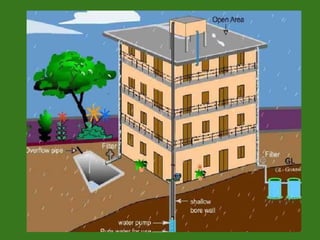
●It is a system of catching rainwater
where it falls.
●In rooftop harvesting, the roof becomes
the catchments, and the rainwater is
collected from the roof of the
house/building. This method is less
expensive and very effective.
10.
Components of theroof top rainwater harvesting
system.
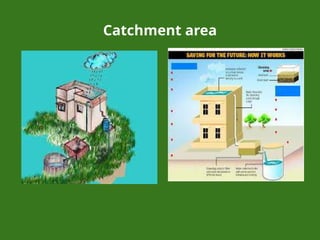
●1- Catchment area
●2- Transportation
●3- First flush
●4- Storage system
●5- Delivery system
●6- Filtration system
Transportation
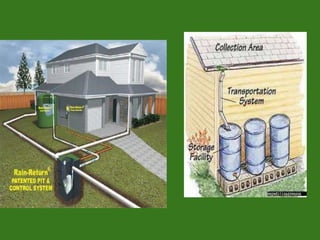
●Rainwater from rooftopshould be carried
through down take water pipes or drains to
storage/harvesting system. Water pipes
should be UV resistant (ISI HDPE/PVC pipes)
of required capacity.
14.
First Flush
●First flushis a device used to flush off the
water received in first shower. The first
shower of rains needs to be flushed-off to
avoid contaminating storable/rechargeable
water by the probable contaminants of the
atmosphere and the catchment roof.
●It will also help in cleaning of silt and other
material deposited on roof during dry
seasons Provisions of first rain separator
should be made at outlet of each drainpipe.
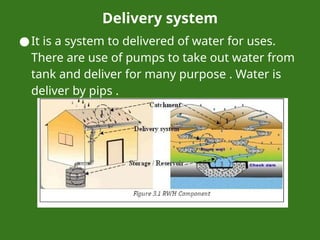
Delivery system
●It isa system to delivered of water for uses.
There are use of pumps to take out water from
tank and deliver for many purpose . Water is
deliver by pips .
17.
Filtration system
● Filtersare used for treatment of water to
effectively remove turbidity, colour and
microorganisms. After first flushing of rainfall,
water should pass through filters.
● There are different types of filters in practice,
but basic function is to purify water.
18.
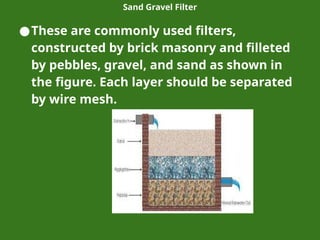
Sand Gravel Filter
●Theseare commonly used filters,
constructed by brick masonry and filleted
by pebbles, gravel, and sand as shown in
the figure. Each layer should be separated
by wire mesh.
19.
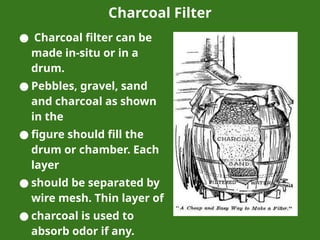
Charcoal Filter
● Charcoalfilter can be
made in-situ or in a
drum.
● Pebbles, gravel, sand
and charcoal as shown
in the
● figure should fill the
drum or chamber. Each
layer
● should be separated by
wire mesh. Thin layer of
● charcoal is used to
absorb odor if any.
20.
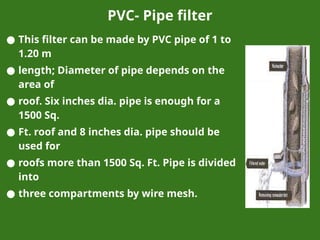
PVC- Pipe filter
●This filter can be made by PVC pipe of 1 to
1.20 m
● length; Diameter of pipe depends on the
area of
● roof. Six inches dia. pipe is enough for a
1500 Sq.
● Ft. roof and 8 inches dia. pipe should be
used for
● roofs more than 1500 Sq. Ft. Pipe is divided
into
● three compartments by wire mesh.
21.
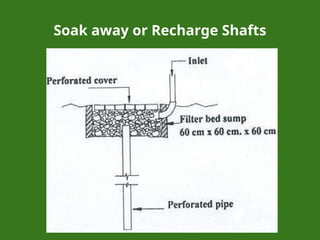
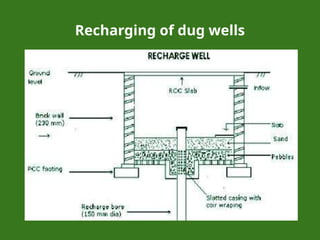
Recharging ground wateraquifers
●Commonly used recharging methods
are:-
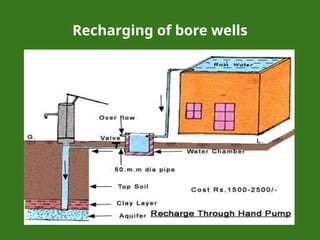
●a) Recharging of bore wells
●b) Recharging of dug wells.
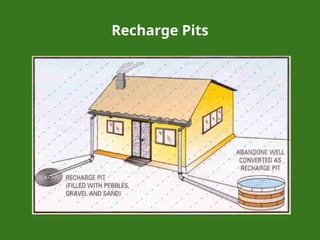
●c) Recharge pits
●d) Recharge Trenches
●e) Percolation Tanks
SUMMARY
●Rains water isa precious resource due to
increases in demand from our ever growing
population. Changes in rainfall patterns in the
UK have seen both drought conditions and
flooding
• Rainwater harvesting can provide around 50
percent of a family’s water needs.
• This not only saves water, but saves money
and reduces our impact on the environment.
●To inculcate a culture of water
conservation
27.
REFERENCE:
- Hydrology andwater resource engineering by S K Garg
- Hydrology & Water Resources by R.K. Sharma
- CGWB (1999), “Activities and Achievements of Central Ground Water Board
on Rain Water Harvesting and Artificial Recharge”, Central Ground Water
Board, Ministry of Water Resources, Government of India, New Delhi, 1999
- Dhaval M Patel, Abhijitsinh Parmar , Harpalsinh Raol, Jitendra Jayswal,
Gajjar Harshil , Roof Top Rain Water Harvesting for Water Storage at
UVPCE, Ganpat University. International Journal of Engineering Research &
Technology (IJERT) Vol. 2 Issue 12, December – 2013.
- Gould et al (1999), Gould, John and Nissen- Petersen, Erik, “Rainwater
Catchment Systems for Domestic Security”, London, UK, Intermediate
Technology Publications (ISBN 1853394564), 1999
- http://en.wikipedia.org/wiki/Gandhinagar
- http://www.ambatownship.com
- http://www.imd.gov.in/section/hydro/distrainfall/webrain/gujarat/
gandhinagar.txt
- http://www.rainwaterharvesting.org