PRESENTATION ON PRACTICALTRAINING
TAKEN AT-
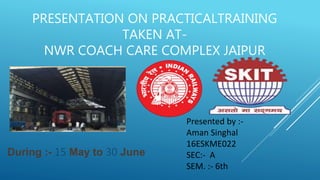
NWR COACH CARE COMPLEX JAIPUR
During :- 15 May to 30 June
Presented by :-
Aman Singhal
16ESKME022
SEC:- A
SEM. :- 6th
• History of Indian Railway
• Railway Introduction
• Type Of Railway Coaches
• Advantages of LHB coaches
• Disadvantages of LHB coaches
• Difference in bogie
• Bio toilet
• Coupling
• Classification of brake
• Train maintenance
Content
HISTORY OF INDIAN RAILWAY
● Indian Railway founded 8 may 1845 (172 year ago)
● In 1849 GIPR(Great Indian Peninsula Railway)
was established by East India Company.
● First train in Indian Railway between Mumbai to
Thana on 16th April 1853.
● Now 17 Railways Zones one is NWR Jaipur and
Jaipur junction established in 1875 and in 2002 it
made a NWR Zone
● One of India’s most famous and luxurious train
The Palace On Wheels stop at Jaipur.
RAILWAY INTRODUCTION
● Minister of Railways – Piyush Goyal.
● Indian Railway runs around 11000 trains every day of
which 7000 are passenger trains.
● Presently 9 pairs of Rajdhani and 13 pairs of shatabdi
Express trains run on rail tracks of India.
● Indian railway is 3th largest railway network in the
world having route length of 66,687km(41,437).
● 6,909 Total stations in Indian railways.
TYPES OF RAILWAYS
COACHES
• Mainly used in Indian railways
coaches
• ICF Coach
• LHB coach
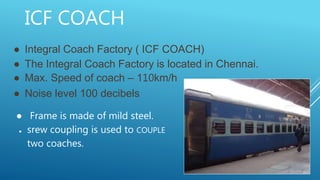
● Integral Coach Factory ( ICF COACH)
● The Integral Coach Factory is located in Chennai.
● Max. Speed of coach – 110km/h
● Noise level 100 decibels
● Frame is made of mild steel.
● srew coupling is used to COUPLE
two coaches.
ICF COACH
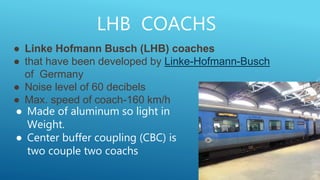
● Linke Hofmann Busch (LHB) coaches
● that have been developed by Linke-Hofmann-Busch
of Germany
● Noise level of 60 decibels
● Max. speed of coach-160 km/h
● Made of aluminum so light in
Weight.
● Center buffer coupling (CBC) is
two couple two coachs
ADVANTAGES OF LHB COACHS
 These are formed at Kapurthala, Punjab and in Raebareli.
 These are 1.7m longer than ICF coach thus inhance seating
capacity.
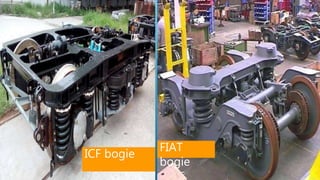
 These coaches used FIAT bogies instead of ICF bogies.
 These are employed with disc brakes.
 Controlled discharge toilet and bio toilet are used in these
coaches.
 Overall maintenance and manufacturing cost of these
coaches is less than ICF coaches.
 ICF coaches are over climb over another
and crash badly at the time of accidents
so that no. of people were killed.
 But LHB coaches don't climb over
another, they were derail at the time if
accidents, they have anti telescopic
design so there is minimum chances of
crashing.
Disadvantages of LHB coaches
● LHB coaches is not self
generating like ICF, they are
working on EOG system ( end
on generation).
● It uses two generator or power
cars in full rake one at each
end.
● Each supplies 3 phase 750V
AC power.
● This voltage is stepped down
to 3 phase 400V and supply to
coaches.
● It produces very loud noise.
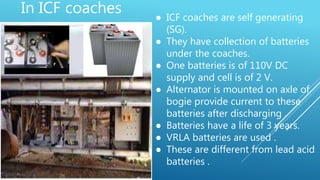
In ICF coaches ● ICF coaches are self generating
(SG).
● They have collection of batteries
under the coaches.
● One batteries is of 110V DC
supply and cell is of 2 V.
● Alternator is mounted on axle of
bogie provide current to these
batteries after discharging .
● Batteries have a life of 3 years.
● VRLA batteries are used .
● These are different from lead acid
batteries .
ICF bogie
FIAT
bogie
Bio toilet
● It has seven chamber containing
high grade bacteria.
● Waste goes from one to last
chamber is decompose by
bacterias.
● After this waste convert into
water and methane and
discharged when train is at high
speed.
● These bacterias are self
generating.
Coupling
screw coupling in
ICFcoaches
center buffer coupling in LHB
coaches
● Direct release air brake system
● Graduated release air brake system
● Types of Graduated release air brake
system
● Single pipe and
● Twin pipe
Classification of air brake
● DIRECT RELEASE SYSTEM
● Air released immediately in single pass, as soon
as releasing of brakes is initiated.
E.g.: freight trains
● GRADUATE RELEASE SYSTEM
● Brake cylinder pressure can be reduced gradually in
steps in proportion to the increase in brake pipe
pressure.
E.g.: passenger trains
● Washing line :-
■ after every 2500 km
● Sick line :-
● Schedule “A” maintenance- 1
month
● Schedule “B” maintenance- 3
months
● IOH- 9 months or 2,00,000 km
● POH- 18 months or 4,00,000 km
● Platform Train Duty:-
■ on starting & ending stations
Train maintenance
THANK YOU

railway workshop Training

  • 1.
    PRESENTATION ON PRACTICALTRAINING TAKENAT- NWR COACH CARE COMPLEX JAIPUR During :- 15 May to 30 June Presented by :- Aman Singhal 16ESKME022 SEC:- A SEM. :- 6th
  • 2.
    • History ofIndian Railway • Railway Introduction • Type Of Railway Coaches • Advantages of LHB coaches • Disadvantages of LHB coaches • Difference in bogie • Bio toilet • Coupling • Classification of brake • Train maintenance Content
  • 3.
    HISTORY OF INDIANRAILWAY ● Indian Railway founded 8 may 1845 (172 year ago) ● In 1849 GIPR(Great Indian Peninsula Railway) was established by East India Company. ● First train in Indian Railway between Mumbai to Thana on 16th April 1853. ● Now 17 Railways Zones one is NWR Jaipur and Jaipur junction established in 1875 and in 2002 it made a NWR Zone ● One of India’s most famous and luxurious train The Palace On Wheels stop at Jaipur.
  • 4.
    RAILWAY INTRODUCTION ● Ministerof Railways – Piyush Goyal. ● Indian Railway runs around 11000 trains every day of which 7000 are passenger trains. ● Presently 9 pairs of Rajdhani and 13 pairs of shatabdi Express trains run on rail tracks of India. ● Indian railway is 3th largest railway network in the world having route length of 66,687km(41,437). ● 6,909 Total stations in Indian railways.
  • 5.
    TYPES OF RAILWAYS COACHES •Mainly used in Indian railways coaches • ICF Coach • LHB coach
  • 6.
    ● Integral CoachFactory ( ICF COACH) ● The Integral Coach Factory is located in Chennai. ● Max. Speed of coach – 110km/h ● Noise level 100 decibels ● Frame is made of mild steel. ● srew coupling is used to COUPLE two coaches. ICF COACH
  • 7.
    ● Linke HofmannBusch (LHB) coaches ● that have been developed by Linke-Hofmann-Busch of Germany ● Noise level of 60 decibels ● Max. speed of coach-160 km/h ● Made of aluminum so light in Weight. ● Center buffer coupling (CBC) is two couple two coachs
  • 8.
    ADVANTAGES OF LHBCOACHS  These are formed at Kapurthala, Punjab and in Raebareli.  These are 1.7m longer than ICF coach thus inhance seating capacity.  These coaches used FIAT bogies instead of ICF bogies.  These are employed with disc brakes.  Controlled discharge toilet and bio toilet are used in these coaches.  Overall maintenance and manufacturing cost of these coaches is less than ICF coaches.
  • 9.
     ICF coachesare over climb over another and crash badly at the time of accidents so that no. of people were killed.  But LHB coaches don't climb over another, they were derail at the time if accidents, they have anti telescopic design so there is minimum chances of crashing.
  • 11.
    Disadvantages of LHBcoaches ● LHB coaches is not self generating like ICF, they are working on EOG system ( end on generation). ● It uses two generator or power cars in full rake one at each end. ● Each supplies 3 phase 750V AC power. ● This voltage is stepped down to 3 phase 400V and supply to coaches. ● It produces very loud noise.
  • 12.
    In ICF coaches● ICF coaches are self generating (SG). ● They have collection of batteries under the coaches. ● One batteries is of 110V DC supply and cell is of 2 V. ● Alternator is mounted on axle of bogie provide current to these batteries after discharging . ● Batteries have a life of 3 years. ● VRLA batteries are used . ● These are different from lead acid batteries .
  • 13.
  • 14.
    Bio toilet ● Ithas seven chamber containing high grade bacteria. ● Waste goes from one to last chamber is decompose by bacterias. ● After this waste convert into water and methane and discharged when train is at high speed. ● These bacterias are self generating.
  • 15.
    Coupling screw coupling in ICFcoaches centerbuffer coupling in LHB coaches
  • 16.
    ● Direct releaseair brake system ● Graduated release air brake system ● Types of Graduated release air brake system ● Single pipe and ● Twin pipe Classification of air brake
  • 17.
    ● DIRECT RELEASESYSTEM ● Air released immediately in single pass, as soon as releasing of brakes is initiated. E.g.: freight trains ● GRADUATE RELEASE SYSTEM ● Brake cylinder pressure can be reduced gradually in steps in proportion to the increase in brake pipe pressure. E.g.: passenger trains
  • 18.
    ● Washing line:- ■ after every 2500 km ● Sick line :- ● Schedule “A” maintenance- 1 month ● Schedule “B” maintenance- 3 months ● IOH- 9 months or 2,00,000 km ● POH- 18 months or 4,00,000 km ● Platform Train Duty:- ■ on starting & ending stations Train maintenance
  • 19.