How mobile phone networks work?By sandipbanwait
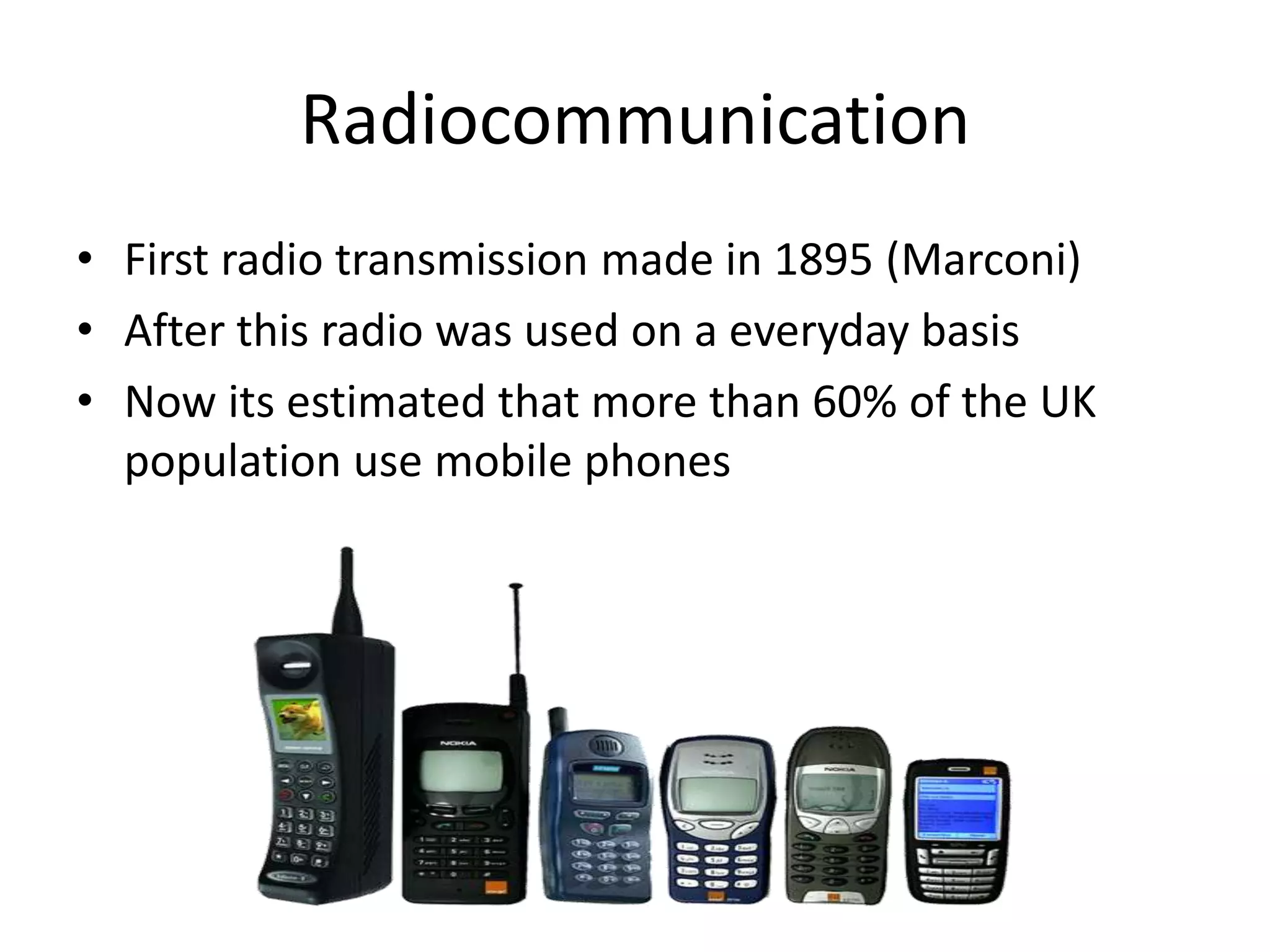
RadiocommunicationFirst radio transmission made in 1895 (Marconi)After this radio was used on a everyday basisNow its estimated that more than 60% of the UK population use mobile phones
What is a radio wave?Mobiles & their base signals gain and give out signals by using electromagnetic fieldsAll electromagnetic radiation involves of changing the electric & magnetic fields & the frequencyMost radios have a frequency range, e.g. AM radio has a frequency between  180khz and 1.6mhz, FM radio ranges from 88 to 108mhz
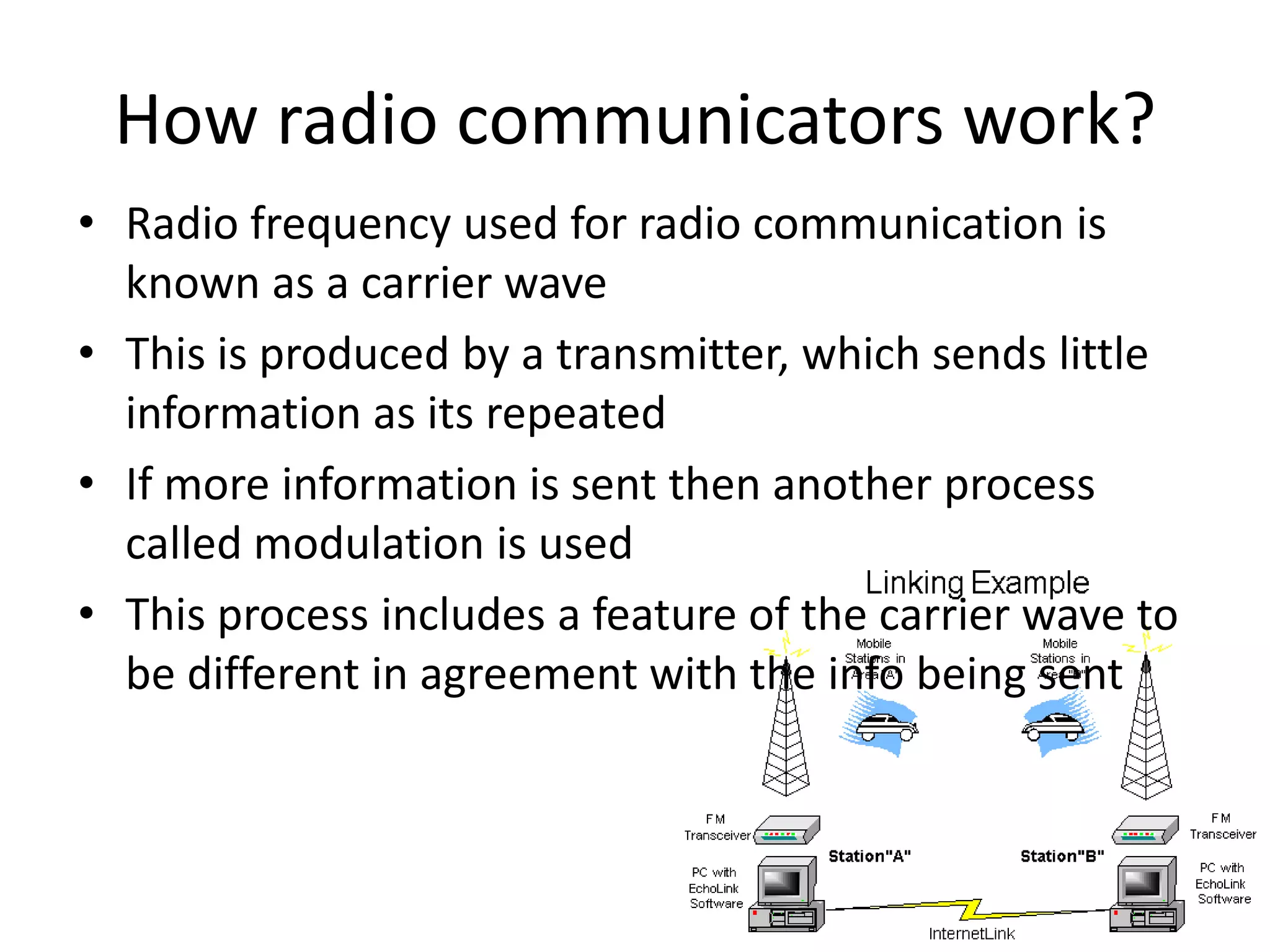
How radio communicators work?Radio frequency used for radio communication is known as a carrier waveThis is produced by a transmitter, which sends little information as its repeatedIf more information is sent then another process called modulation is usedThis process includes a feature of the carrier wave to be different in agreement with the info being sent
Base StationsMany of these are required so that it can hold a higher and stronger quality transmitted signalIf there was just the one base station then that would only allow a limited amount of calls that would be transmitted at one timeTo help the slow increasing users, other network operators need to use a limited number of radio frequencies so that there could be a higher support for the amount of mobile phone users
BibliographyLinking Example (2000) Image of how radio communicators work. Available at: http://panhandleares.org/wp-content/uploads/2010/11/LinkingExample.gif (Accessed 25/01/2011)Mobile Evolution (2011) Image of mobile phones. Available at: http://www.celtnet.org.uk/mobile-phone/img/mobile-evolution.gif(Accessed 25/01/2011)Public Telecommunication Networks Unit (2001) How mobile phone networks work (WWW) Ofcom. Available at: http://www.sitefinder.ofcom.org.uk/mobilework.htm (Accessed 25/01/2011)

Radiocommunicationpresentation

  • 1.
    How mobile phonenetworks work?By sandipbanwait
  • 2.
    RadiocommunicationFirst radio transmissionmade in 1895 (Marconi)After this radio was used on a everyday basisNow its estimated that more than 60% of the UK population use mobile phones
  • 3.
    What is aradio wave?Mobiles & their base signals gain and give out signals by using electromagnetic fieldsAll electromagnetic radiation involves of changing the electric & magnetic fields & the frequencyMost radios have a frequency range, e.g. AM radio has a frequency between 180khz and 1.6mhz, FM radio ranges from 88 to 108mhz
  • 4.
    How radio communicatorswork?Radio frequency used for radio communication is known as a carrier waveThis is produced by a transmitter, which sends little information as its repeatedIf more information is sent then another process called modulation is usedThis process includes a feature of the carrier wave to be different in agreement with the info being sent
  • 5.
    Base StationsMany ofthese are required so that it can hold a higher and stronger quality transmitted signalIf there was just the one base station then that would only allow a limited amount of calls that would be transmitted at one timeTo help the slow increasing users, other network operators need to use a limited number of radio frequencies so that there could be a higher support for the amount of mobile phone users
  • 6.
    BibliographyLinking Example (2000)Image of how radio communicators work. Available at: http://panhandleares.org/wp-content/uploads/2010/11/LinkingExample.gif (Accessed 25/01/2011)Mobile Evolution (2011) Image of mobile phones. Available at: http://www.celtnet.org.uk/mobile-phone/img/mobile-evolution.gif(Accessed 25/01/2011)Public Telecommunication Networks Unit (2001) How mobile phone networks work (WWW) Ofcom. Available at: http://www.sitefinder.ofcom.org.uk/mobilework.htm (Accessed 25/01/2011)