Radio IP
Ajeet Yadav
M.Sc (NM) 1st sem
2017
 What is IP ?
IP versions
Function of IP
Introduction to Radio IP
RoIP
Networks
Networks provider
Application of RoIP
VoIP
Reference
 An Internet Protocol address (IP address) is a
numerical label assigned to each device
connected to a computer network that uses
the Internet Protocol for communication.
 An IP address serves two principal functions:
host or network interface identification and
location addressing.
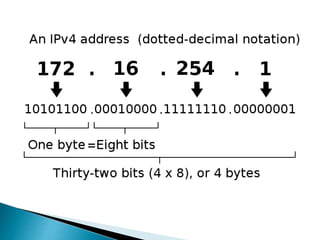
 Version 4 of the Internet Protocol (IPv4) defines
an IP address as a 32 bit number (1985).
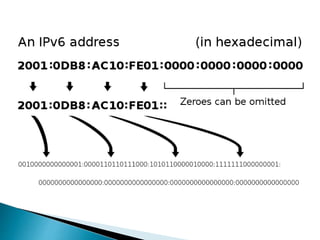
 A new version of IP (IPv6), using 128 bits for the
IP address, was developed in 1995, and
standardized as RFC 2460 in 1998.
 IPv6 deployment has been ongoing since the
mid-2000s
 IP addresses are usually written and displayed
in human-readable notations, such as
172.16.254.1 in IPv4,
 and 2001:db8:0:1234:0:567:8:1 in IPv6
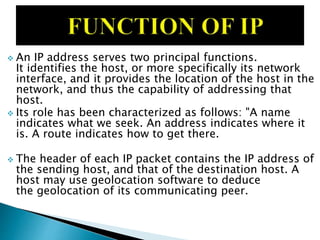
 An IP address serves two principal functions.
It identifies the host, or more specifically its network
interface, and it provides the location of the host in the
network, and thus the capability of addressing that
host.
 Its role has been characterized as follows: "A name
indicates what we seek. An address indicates where it
is. A route indicates how to get there.
 The header of each IP packet contains the IP address of
the sending host, and that of the destination host. A
host may use geolocation software to deduce
the geolocation of its communicating peer.
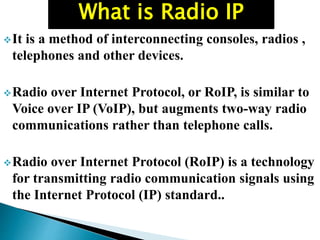
It is a method of interconnecting consoles, radios ,
telephones and other devices.
Radio over Internet Protocol, or RoIP, is similar to
Voice over IP (VoIP), but augments two-way radio
communications rather than telephone calls.
Radio over Internet Protocol (RoIP) is a technology
for transmitting radio communication signals using
the Internet Protocol (IP) standard..
What is Radio IP
 Single Organization
 Dedicated Links
 Peer-to-peer
 Includes one-to-many
Voice Over IP for Radio
Propriety Solutions
Digital Radio
IP NETWORK
 LOCALAREA NETWORKS
 WIDE AREA NETWORKS
 THE INTERNET
DSL (Digital subscriber line)
SATELITE
MICROWAVE
3G/4G MOBILE NETWORKS
 No central service provider
 Half/Full Duplex
 Push To Talk/Busy
 Remote access to Radios
 Point-to-point radio interconnection
 Radio to Dispatch console
 Radio to phone gateway
 Telephone model
 Assumes a service provider(external)
 -one-to-one calls
 -Short duration calls
 Audio only
An Example –
 Makhanlal Chaturvedi Rastriya Patrakarita
vishwavidyalaya – I Radio live
Audio lecture
 WWW.WIKIPEDIA.COM
 WWW.SLIDESHARE.COM
 WWW.MCU.AC.IN

RADIO IP

  • 1.
    Radio IP Ajeet Yadav M.Sc(NM) 1st sem 2017
  • 2.
     What isIP ? IP versions Function of IP Introduction to Radio IP RoIP Networks Networks provider Application of RoIP VoIP Reference
  • 3.
     An InternetProtocol address (IP address) is a numerical label assigned to each device connected to a computer network that uses the Internet Protocol for communication.  An IP address serves two principal functions: host or network interface identification and location addressing.
  • 4.
     Version 4of the Internet Protocol (IPv4) defines an IP address as a 32 bit number (1985).  A new version of IP (IPv6), using 128 bits for the IP address, was developed in 1995, and standardized as RFC 2460 in 1998.  IPv6 deployment has been ongoing since the mid-2000s  IP addresses are usually written and displayed in human-readable notations, such as 172.16.254.1 in IPv4,  and 2001:db8:0:1234:0:567:8:1 in IPv6
  • 7.
     An IPaddress serves two principal functions. It identifies the host, or more specifically its network interface, and it provides the location of the host in the network, and thus the capability of addressing that host.  Its role has been characterized as follows: "A name indicates what we seek. An address indicates where it is. A route indicates how to get there.  The header of each IP packet contains the IP address of the sending host, and that of the destination host. A host may use geolocation software to deduce the geolocation of its communicating peer.
  • 8.
    It is amethod of interconnecting consoles, radios , telephones and other devices. Radio over Internet Protocol, or RoIP, is similar to Voice over IP (VoIP), but augments two-way radio communications rather than telephone calls. Radio over Internet Protocol (RoIP) is a technology for transmitting radio communication signals using the Internet Protocol (IP) standard.. What is Radio IP
  • 10.
     Single Organization Dedicated Links  Peer-to-peer  Includes one-to-many
  • 11.
    Voice Over IPfor Radio Propriety Solutions Digital Radio
  • 12.
    IP NETWORK  LOCALAREANETWORKS  WIDE AREA NETWORKS  THE INTERNET
  • 13.
    DSL (Digital subscriberline) SATELITE MICROWAVE 3G/4G MOBILE NETWORKS
  • 14.
     No centralservice provider  Half/Full Duplex  Push To Talk/Busy
  • 15.
     Remote accessto Radios  Point-to-point radio interconnection  Radio to Dispatch console  Radio to phone gateway
  • 16.
     Telephone model Assumes a service provider(external)  -one-to-one calls  -Short duration calls  Audio only
  • 17.
    An Example – Makhanlal Chaturvedi Rastriya Patrakarita vishwavidyalaya – I Radio live Audio lecture
  • 18.