Tel: +60-3-89225888, Fax:+60-3-89223685
Email: noraishah@aelb.gov.my
Radiation Protection Officer Certification Scheme: Malaysian
Experience
Noraishah PUNGUT1*
, Noriah MOD ALI2
, Noraini RAZALI1
1
Atomic Energy Licensing Board (AELB), Kuala Lumpur, Malaysia, 2
SSDL, Malaysian Nuclear Agency, Bangi, 43000
Kajang, Selangor, Malaysia
Abstract
In Malaysia, the need for maintaining competency in radiation protection is emerging, focusing on the qualification of
Radiation Protection Officers (RPO). Regulation 23 of Malaysian Radiation Protection (Basic Safety Standards)
Regulations 1988, requires the applicant to employ an RPO, with the necessary knowledge, skill and training, enabling
effective protection of individuals and minimizing danger to life, property and the environment for all activities sought to
be licensed. An RPO must demonstrate the knowledge required, by attending RPO courses organised by an accredited
agency and pass the RPO certification examination. Maintaining a high level of competency is crucial for future
development of safe applications of ionising radiation. The major goal of training is to provide essential knowledge and
skills and to foster correct attitudes on radiation protection and safe use of radiation sources. Assessment of the
competency is through theoretical and practical examination. A standard criterion on the performance of the individuals
evaluated has been established and only those who meet this criterion can be accepted as certified RPO. The National
Committee for the Certification of Radiation Protection Officer (NCCRPO), comprising experts in various fields, is
responsible to review and update requirements on competency of a certified RPO. With increasing number of candidates
(i.e. 701 in 2008) and the international requirement for radioactive source security, it is incumbent upon the NCCRPO to
improve the syllabus of the certification scheme. The introduction of a Radiation Protection Advisor (RPA) to provide
service and advice to the radiation industry in Malaysia is also seriously considered.
KEYWORDS: radiation protection officer, competency, certification scheme.
I. Introduction
The development on the use of atomic energy began
with the discovery of x-ray by a scientist named Wilhem
Roentgen in Germany in the year 1895. Subsequently, x-
ray was found to have an immediate application in the
medical field. The available recorded evidence on the use
of x-ray in Malaysia (then Malaya) dated back to 3rd
February 1897 1)
, when x-ray was introduced in a hospital
in Taiping, Perak. The use of radioactive materials,
however, started much later, in the 60's, where radioiodine
and radio phosphorus were introduced in medical
diagnosis, therapy and research 2)
. Today, the application
of atomic energy has find its way to industries, especially
in the engineering field; in Malaysia the use of atomic
energy is quite extensive in areas such as ship building,
pipe construction, airline maintenance, manufacturing
industries and in medicine.
Although activities using atomic energy have
prevailed for quite some time in Malaysia, the
development in the regulatory and control aspects was
quite recent. The first legislation to control the activities
using ionising radiation in Malaysia was introduced in
1968 when the Parliament approved the Radioactive
Substances Act 1968. However, the rapid expansion of the
_______________________________________________
atomic energy activities in Malaysia needs for more
effective control over these activities. Realising the needs
for an effective control on the use of atomic energy the
Radioactive Substances Act 1968 was repealed and a new
Bill called Atomic Energy Licensing Bill was drafted by
the Government. The Bill then was approved by the
Parliament in April 1984 and gazetted on the June 28th
1984 as Act 304 that is the Atomic Energy Licensing Act.
The enforcing authority of this Act is the Atomic Energy
Licensing Board (AELB). There were four regulations
made under this Act, namely;
a. Radiation Protection (Licensing) Regulations 1986;
b. Radiation Protection (Basic Safety Standard)
Regulations 1988;
c. Radiation Protection (Transport) Regulations 1989;
and
d. Radiation Protection (Appeals) Regulations 1990.
Atomic Energy Society of Japan
ARTICLE
Progress in NUCLEAR SCIENCE and TECHNOLOGY, Vol. 1, p.487-493 (2011)
487
2
II. Establishment of Atomic Energy Licensing
Board
Following Section 3 of the Act, the Atomic Energy
Licensing Board (AELB) was established on 1st
February 1985 as the National Regulatory Authority to
enforce the Atomic Energy Licensing Act 19843)
. The
AELB’s main objective is to regulate and control all
activities dealing with atomic energy throughout the
country in order to ensure that such activities are being
handled safely and do not endanger the radiation
workers, members of the public, properties and
environment from radiation hazards. To achieve the
objective, the AELB is responsible for the following:
a. Authorising the activities related to radioactive
materials, nuclear materials and radiation producing
devices after appropriate review and evaluation of
proposed activity.
b. Conducting inspection (surveillance) and taking
enforcement actions to ensure radiation safety
requirements are being implemented.
c. Establishing standards and regulations for radiation
protection and safe operation pertaining to atomic
energy.
The functions of AELB as stated in the Act 304 are as
follows:
a. To enforce the Atomic Energy Licensing Act 1984;
b. To advise the Minister and the government of Malaysia
on matters relating to the Atomic Energy Licensing Act
1984 and developments pertaining thereto with
particular reference to the implications of such
developments for Malaysia;
c. To exercise control and supervision over the
production, application and use of atomic energy and
matters incidental thereto;
d. To establish, maintain and develop scientific and
technical co-operation with such other bodies,
institutions or organisations in relation to nuclear
matters or atomic energy as the Board thinks fit for the
purposes of the Atomic Energy Licensing Act 1984;
e. Where so directed by the Government of Malaysia, to
perform or provide for the performance of the
obligations arising from the agreements, conventions or
treaties relating to nuclear matters or atomic energy to
which Malaysia is a party where such agreements,
conventions or treaties relate to the purposes of the
Atomic Energy Licensing Act 1984; and
f. To do such other things arising out of or consequential
to the functions of the Board under the Atomic Energy
Licensing Act 1984 which are not inconsistent with the
purposes of this Act, whether or not directed by the
Minister.
The AELB has its department to run the above
functions and objectives. The Executive Secretary
(Director General) holds the highest position in the
Department of AELB. The Department consists of six
divisions, i.e. Policy, Code and Standards, Assessment
and Licensing, Enforcement, Nuclear Installation,
Technical Support and the Administration Services. The
roles of this division are as follows:
a. The Policy, Code and Standards Division is responsible
for the development of laws and subsidiary legislations
and providing advisory and information services on the
implementation of the Atomic Energy Licensing Act
1984.
b. The Assessment and Licensing Division is responsible
for carrying out regulatory research, risk assessment
and evaluate license applications.
c. The Enforcement Division is responsible for inspection
to ensure compliance of license conditions, carrying out
investigation and prosecution, and emergency response
and preparedness.
d. Nuclear Installation Division is responsible for the
safeguarding of physical security and safety of
nuclear material and facility.
e. Technical Support Division is responsible for the
supervision of operations at AELB headquarters as
well as planning and co-ordinating the administration
of the regulatory research laboratory.
f. The Administration Services Division is responsible for
providing effective support services to achieve the
objectives of the AELB and in carrying out other
activities of the AELB, specifically on the management
and services, administration and finance.
III. Establishment of National Committee for the
Certification of Radiation Protection Officer
AELB on the 32nd meeting that was held on 19th
December 1995 has agreed to establish a committee
named as National Committee for the Certification of
Radiation Protection Officer (NCCRPO). The purposes
of establishment of NCCRPO are for assisting AELB in
handling matters involving certification of RPO scheme.
488
PROGRESS IN NUCLEAR SCIENCEAND TECHNOLOGY
et al.
Noraishah PUNGUT
3
NCCRPO is also responsible in managing matters with
the RPO Certification Scheme including examination.
The members of NCCRPO were appointed from
several governmental departments, semi-governmental
organizations, private organisations, professional
associations and individuals whom shall have scientific
or technical qualifications relevant to atomic energy or
other disciplines connected therewith.
The functions of NCCRPO are as follows:
a. To prepare standard and guidelines for RPO
Examinations and RPO Training Center;
b. To prepare questions, standards and guidelines
for RPO Examination;
c. To conduct, analyse, inspect and confirm the results
of RPO Examination;
d. To conduct audit on the Training Centre and
Examination Centre for RPO;
e. To evaluate and endorse applications from agencies
wishing to offer radiation protection courses and
suggest to the AELB for approval;
f. To evaluate and endorse applications from agencies
wishing to be RPO Training Centre and suggest to
the AELB for approval;
g. To evaluate and endorse applications from agencies
wishing to be RPO Examination Centre and suggest
to the AELB for approval; and
h. To look into the possibility of creating a new position
ofRadiation Protection Adviser (RPA) and their roles,
job specifications, training and examination.
IV. Radiation Protection Officer
Radiation Protection Officer (RPO) is a technically
competent person appointed by the licensee and
approved by AELB3)
in writing, to supervise the
implementation of appropriate radiation protection
regulations; measures and procedures including the
radiation protection programme. Regulation 23 of
Malaysian Radiation Protection (Basic Safety Standards)
Regulations 1988, requires the licensee to employ an
RPO, with the necessary knowledge, skill and training,
enabling effective protection of individuals and
minimizing danger to life, property and the environment
for all activities sought to be licensed.
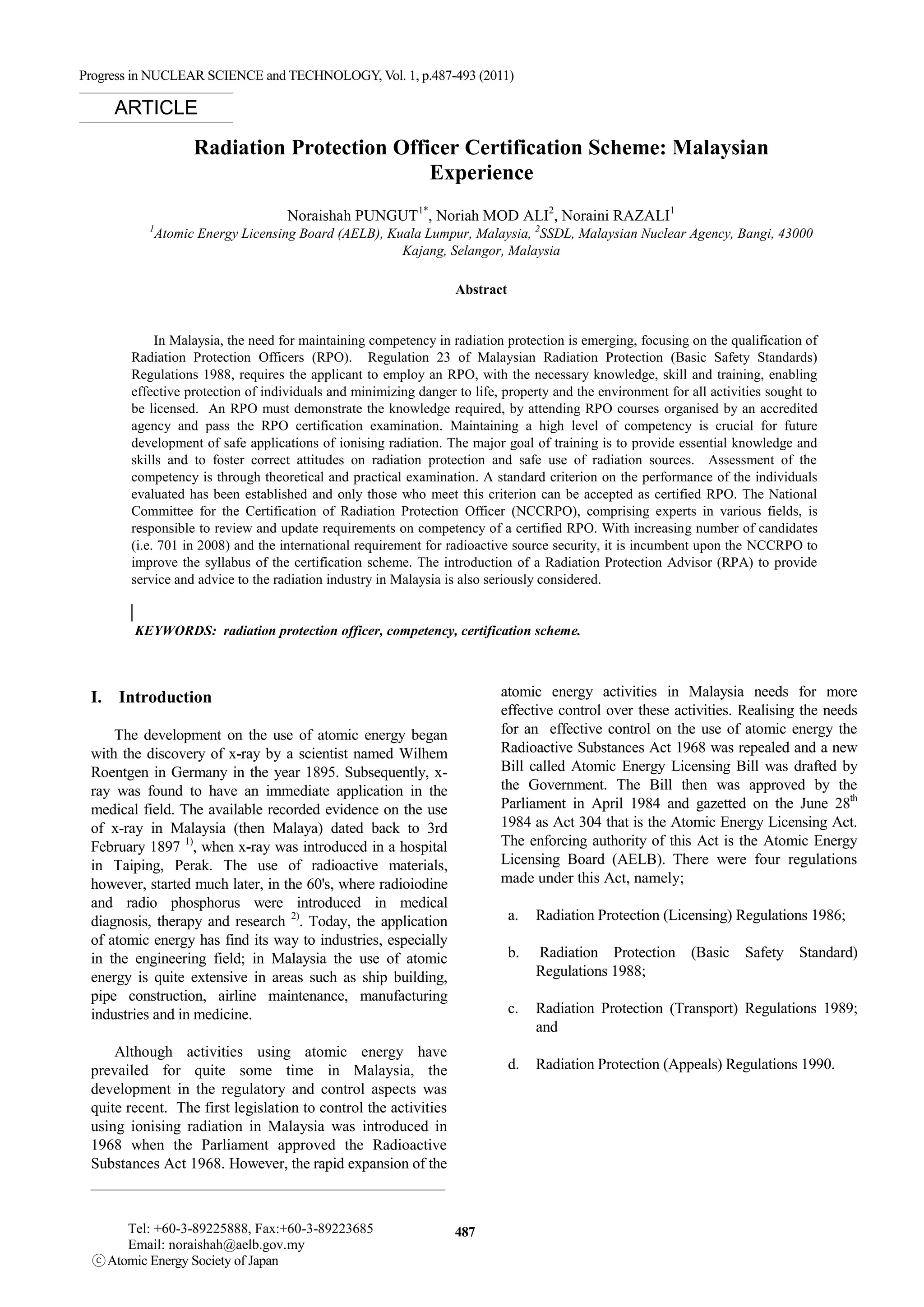
Figure 1 shows the licensee’s organizational
structure pertaining to radiation protection. It shows
that RPO plays major roles to ensure effective of
Radiation Protection Programme (RPP) in accordance
with the requirements of the regulation dealing with
radiation safety and security activities. In general,
responsibilities of the RPO are as follows:
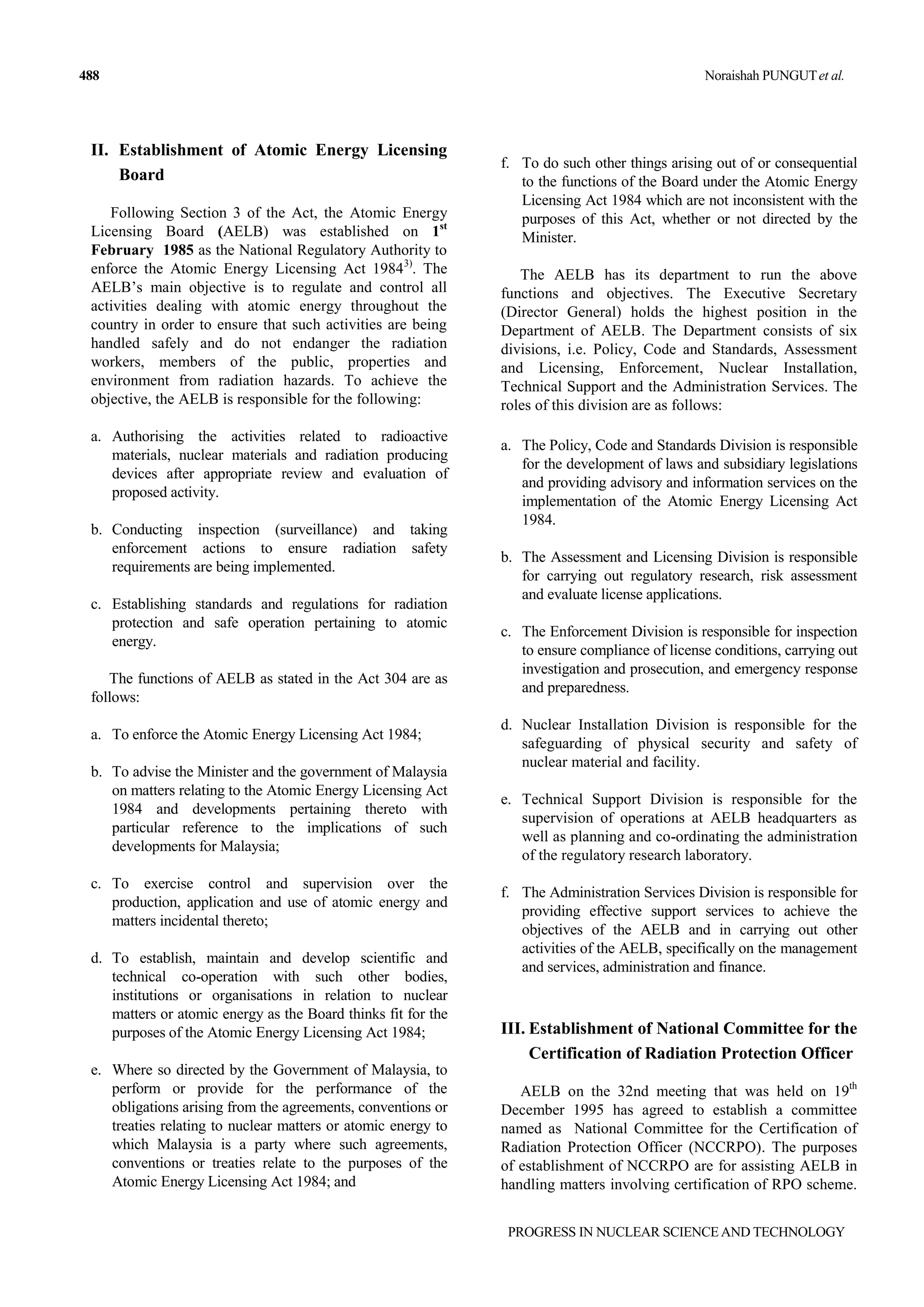
a. Implement a radiation protection programme as
specified in Figure 2;
b. Implement secure and safe working procedures for
normal operation, storage, disposal, transportation
and abnormal situations;
c. Supervise the implementation of appropriate
radiation protection regulations, measures and
procedures.
To ensure effective implementation of RPP, the RPO
must demonstrate the knowledge and skill required. It is
mandatory for them to attend intensive RPO courses
organised by a certified agency and pass the RPO
certification examination. The major goal of training is
to provide essential knowledge and skills and to foster
correct attitudes on radiation protection, secure and safe
use of radiation sources. They need to be appointed by
their employer before being certified as RPO by the
regulatory authority, AELB.
V. Qualification to Sit for Examination
Certification of RPO is through sitting for
examinations set by AELB. RPO examination is open to
candidates with at least one of the following
qualifications:
Licensee
RPO
Radiation Protection Supervisor (RPS)
Operator
Person Responsible to the Licence
Fig.1 Organisation Structure of Licensee
Vol. 1, FEBRUARY 2011
489
Radiation Protection Officer Certification Scheme: Malaysian Experience
4
a. Age at least above 18 year old on the date of
application;
b. Have attended RPO training course at the training
agency approved by AELB;
c. Have a certificate or diploma or degree; and
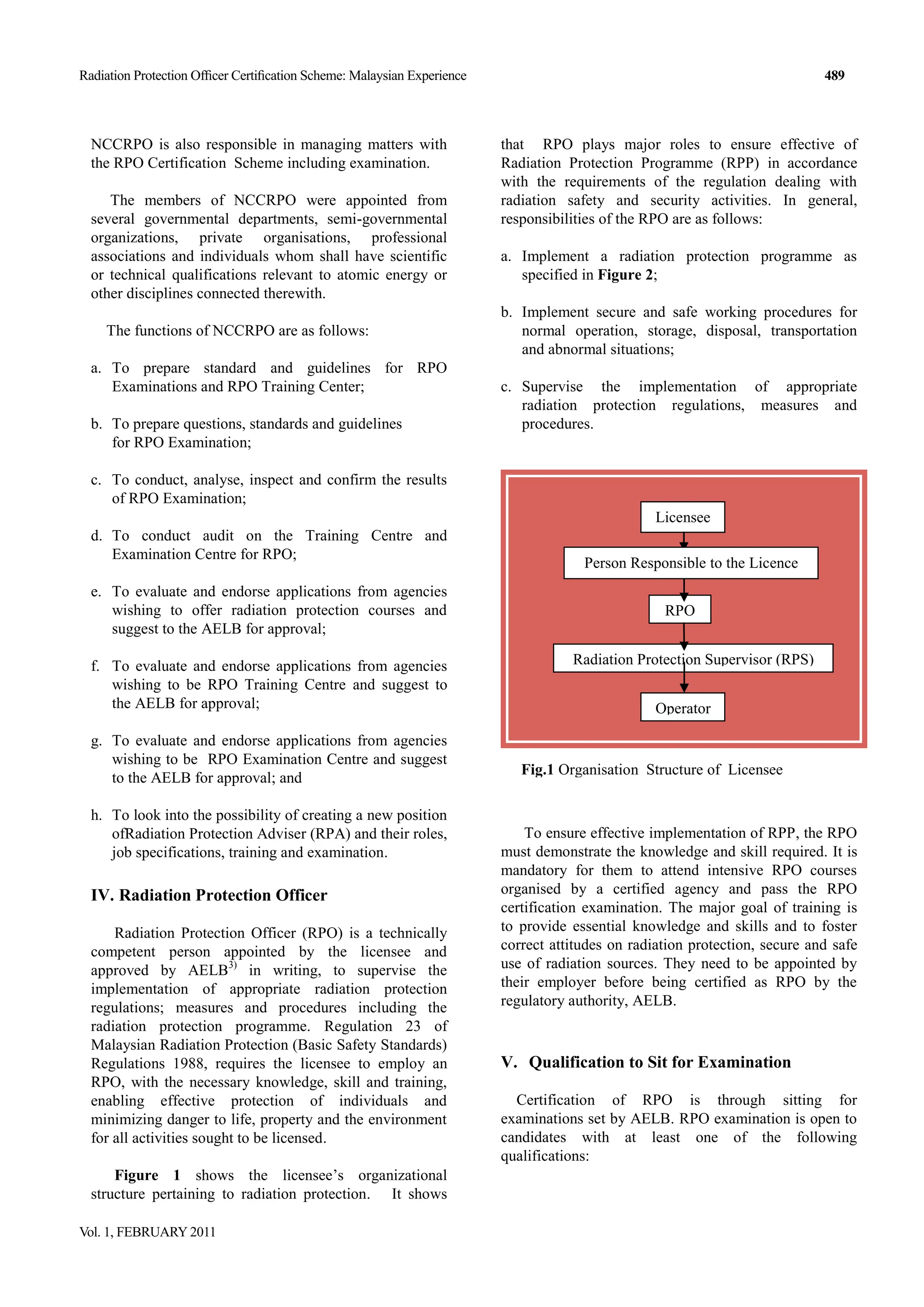
d. Have working experience in a particular activity as
stipulated in Table 1.
Fig. 2 Outline of Establishment and Implementation of a
Radiation Protection Programme
VI. Training Duration and Syllabus
With increasing number of candidates and the
international requirement for radioactive source security,
it is incumbent upon the NCCRPO to improve the
training duration and syllabus of the RPO certification
scheme. Based on their activities, the RPO must attend a
minimum training duration (hours) as shown in Table 2.
Training duration for a certificate holder is lengthier than
for a diploma or degree holder. This is to ensure that the
certificate holders are competent and have adequate
knowledge, skill and attitude on radiation protection and
security of radioactive sources. General and specific
technical topic to be covered in the training is as follows:
Table 1 Academic qualification and minimum experience
duration (month)
General
Basic mathematic (2hr)
Fundamentals of ionising radiation (3hr)
Biological effects of radiation (2hr)
Radiation protection principles (6 hr)
Instrumentations and methods in radiological measuring and
monitoring (9 hr)
Transportation of radioactive materials (2 hr)
Radioactive waste management (1 hr)
Acts and regulations regulating the safe use of atomic energy in
Malaysia (2 hr)
Management system of radiation safety and security of
radioactive sources (3 hr)
Safety in maintenance (1 hr)
Security of radioactive sources (3 hr)
Minimum
Academic
Qualification
Experience duration for each activity* (month)
R
I
T P
P
N P
J
P
S
R
T
P
N
R
P
K
N
Degree
(engineering,
science or
medical)
6 6 6 6 6 6 6 6 6 6
Diploma
(engineering or
science )
1
2
6 1
2
12 6 1
2
- - 1
2
-
Certificate
(SPM, STPM,
polytechnic) or
equivalent
3
6
2
4
3
6
36 2
4
3
6
- - - -
*Activity:
Category 1:KN – Nuclear Facility
PS – Radiation Processing
RT - Radiotherapy
Category 2:RI – Industrial Radiography
Category 3:TN – Nuclear Gauges
PJ – Sales (other than radioactive sources
Category 1 and 2)
PP – Research and Teaching
NT – Activity involving NORM/TENORM
PN – Nuclear Medicine
RP – Medical Radiography
Radiation Protection Programme
Establishment of programme
which include the following:
a.The organisational structure
pertaining to radiation
protection & security of
radioactive sources;
b.The medical surveillance of
workers;
c.The personnel monitoring;
d.The area monitoring;
e.The operational limit;
f.The classification of
working area;
g. The normal working
procedures;
h.The procedures under
abnormal situations;
i.The procedures for
transportations of a package
containing sealed source;
j.The training of a worker;
and
k.The procedures for keeping
and maintenance of
records/documents.
Implementation of
the programme
which include the
following:
a.Employment of
radiation workers
b.Arrangement for
the services of a
approved registered
medical practitioner
(ARMP).
490
PROGRESS IN NUCLEAR SCIENCEAND TECHNOLOGY
et al.
Noraishah PUNGUT
5
Specific for Industrial Sector
Safety and security in Category 3 (7 hr)
Planning and emergency procedures in Category 3 (5 hr)
Safety and security in Category 2 (8 hr)
Planning and emergency procedures in Category 2 (5 hr)
Safety and security in Category 1 (10 hr)
Planning and emergency procedures in Category 1 (7 hr)
Specific for Medical Sector
Safety and security in Category 3 (7 hr)
Planning and emergency procedures in Category 3 (4 hr)
Safety and security in Category 2 (10 hr)
Planning and emergency procedures in Category 2 (7 hr)
Safety and security in Category 1 (10 hr)
Planning and emergency procedures in Category 1 (7 hr)
Table2 Minimum Training Duration (Hour) For Each Activity*
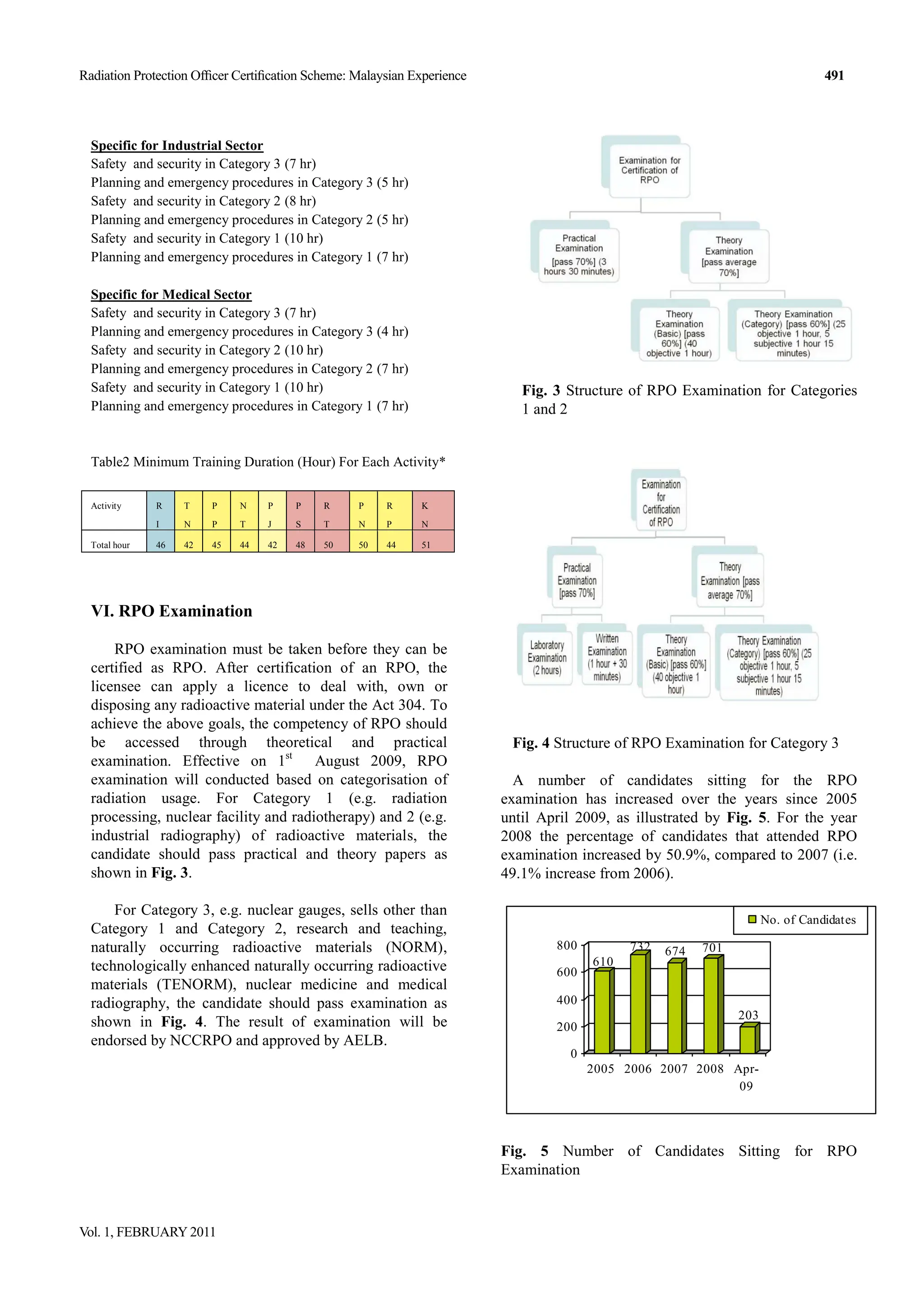
VI. RPO Examination
RPO examination must be taken before they can be
certified as RPO. After certification of an RPO, the
licensee can apply a licence to deal with, own or
disposing any radioactive material under the Act 304. To
achieve the above goals, the competency of RPO should
be accessed through theoretical and practical
examination. Effective on 1st
August 2009, RPO
examination will conducted based on categorisation of
radiation usage. For Category 1 (e.g. radiation
processing, nuclear facility and radiotherapy) and 2 (e.g.
industrial radiography) of radioactive materials, the
candidate should pass practical and theory papers as
shown in Fig. 3.
For Category 3, e.g. nuclear gauges, sells other than
Category 1 and Category 2, research and teaching,
naturally occurring radioactive materials (NORM),
technologically enhanced naturally occurring radioactive
materials (TENORM), nuclear medicine and medical
radiography, the candidate should pass examination as
shown in Fig. 4. The result of examination will be
endorsed by NCCRPO and approved by AELB.
Fig. 3 Structure of RPO Examination for Categories
1 and 2
Fig. 4 Structure of RPO Examination for Category 3
A number of candidates sitting for the RPO
examination has increased over the years since 2005
until April 2009, as illustrated by Fig. 5. For the year
2008 the percentage of candidates that attended RPO
examination increased by 50.9%, compared to 2007 (i.e.
49.1% increase from 2006).
610
732 674 701
203
0
200
400
600
800
2005 2006 2007 2008 Apr-
09
No. of Candidates
Fig. 5 Number of Candidates Sitting for RPO
Examination
Activity R
I
T
N
P
P
N
T
P
J
P
S
R
T
P
N
R
P
K
N
Total hour 46 42 45 44 42 48 50 50 44 51
Vol. 1, FEBRUARY 2011
491
Radiation Protection Officer Certification Scheme: Malaysian Experience
6
The lower passing mark of the examination was then
analysed by NCCRPO, on whether there is a significant
effect in terms of academic qualification and experience
of the candidate to the examination passing percentage.
The statistics shows that academic qualification had
significant effect on an RPO’s examination result for all
activities except industrial radiography, as illustrated in
Fig. 6. For gauging, more than 90% candidates with a
degree of science passed RPO examination as compared
with diploma (>25%) and certificate (>20%) candidates.
Fig.6 Theory Examinations Pass Percentage According
To Academic Qualifications
On the other hand, Fig. 7 shows that working
experience had no significant effect on an RPO’s
examination result for all activities (i.e. more than 35%
one year experience candidate passes RPO examination
compared to three years experience candidate (7.5%) in
gauging activities).
Fig.7 Theory Examination Pass Percentage According
To Working Experience
V. Certified RPO and RPA
An RPO is a person having competency in carrying
out a radiation protection programme and security of
radioactive sources within their organisation to ensure
workers, members of the public, property and the
environment are safe from radiation hazard or exposure.
Therefore, an RPO needs to be certified by the AELB
based on the following criteria:
a. Age at least above 18 years;
b. Fit to work as Radiation Worker as approved by
Approved Registered Medical Practitioner;
c. Possesses RPO course certificate/s;
d. Passed RPO examination; and
e. Registered as radiation worker with AELB.
For the period of 1st
January 2006 until 31th
December 2008, the total number of RPO that had been
certified by AELB was 1674 (Fig. 9). Number of RPO
that had been certified in 2007 increased (570) as
compared to 2006 (563). Unfortunately, the number of
RPO certified in 2008 decreased (541) compared to 2007
(570) due to economic problems in the global
environment.
Fig. 9 Number of Certified RPO Issued 2006 -2008
On January 2009, AELB introduced a new post, the
Radiation Protection Advisor ( RPA)4)
to provide service
and advice to the radiation and nuclear industry in
Malaysia. The criteria of an RPA are more stringent than
RPO, as shown in the following:
a. Possesses RPO course certificate/s;
b. Possesses RPO examination certificate/s;
P<1 – Experience less than 1 year
1<P<3 – Experience between 1 and 3 years
P>3 – Experience more than 3 years
563 570 541
1674
0
500
1000
1500
2000
Number
of
Certified
RPO
2006 2007 2008 Total
Y e a r
492
PROGRESS IN NUCLEAR SCIENCEAND TECHNOLOGY
et al.
Noraishah PUNGUT
7
c. Possesses at least a Master Degree in Science;
d. Registered as radiation worker with AELB;
e. Have submitted a full curriculum vitae;
f. Fit to work as radiation worker as approved by
Approved Registered Medical Practitioner;
g. Have at least 15 years experience in radiation
protection;
h. Have deep knowledge , expertise and experience in
Atomic Energy Licensing Act 1984 (Act 304) and
regulations related;
i. Have deep knowledge , expertise and experience in
quality, environmental and safety management
system; and
j. Have a record as a member of AELB committee or
as a radiation protection expert at national and
international level or providing advise on radiation
protection and regulatory requirements as an expert
to at least 5 companies.
VI. Conclusion
Since the establishment of AELB, according to
Section 3 of Atomic Energy Licensing Act 1984, the
RPO Certification Scheme in Malaysia has improved.
The competency of RPO has been upgraded and
maintained from time to time through examination and
RPO courses in line with national and international
requirements. RPO and RPA with excellent
competency need to be nominated by the licensee and
certified by the AELB to ensure workers, public,
properties and the environment are safe from radiation
hazards.
References
1) Hj Idris Hj Hussin, Journal of the Malaysian Society
of Radiographers, December 1979.
2) Wharton, R.H. Medical Journal Malaysia 17, 1,
1962.
3) Atomic Energy Licensing Act 1984 (Act 304).
4) Abdul Aziz Tajuddin, RPO Competency in
Malaysia, Radiation Protection Conference and
Workshop, Kota Kinabalu, 9-10 June 2009.
Vol. 1, FEBRUARY 2011
493
Radiation Protection Officer Certification Scheme: Malaysian Experience

radiation protection officer certification for reference

  • 1.
    Tel: +60-3-89225888, Fax:+60-3-89223685 Email:noraishah@aelb.gov.my Radiation Protection Officer Certification Scheme: Malaysian Experience Noraishah PUNGUT1* , Noriah MOD ALI2 , Noraini RAZALI1 1 Atomic Energy Licensing Board (AELB), Kuala Lumpur, Malaysia, 2 SSDL, Malaysian Nuclear Agency, Bangi, 43000 Kajang, Selangor, Malaysia Abstract In Malaysia, the need for maintaining competency in radiation protection is emerging, focusing on the qualification of Radiation Protection Officers (RPO). Regulation 23 of Malaysian Radiation Protection (Basic Safety Standards) Regulations 1988, requires the applicant to employ an RPO, with the necessary knowledge, skill and training, enabling effective protection of individuals and minimizing danger to life, property and the environment for all activities sought to be licensed. An RPO must demonstrate the knowledge required, by attending RPO courses organised by an accredited agency and pass the RPO certification examination. Maintaining a high level of competency is crucial for future development of safe applications of ionising radiation. The major goal of training is to provide essential knowledge and skills and to foster correct attitudes on radiation protection and safe use of radiation sources. Assessment of the competency is through theoretical and practical examination. A standard criterion on the performance of the individuals evaluated has been established and only those who meet this criterion can be accepted as certified RPO. The National Committee for the Certification of Radiation Protection Officer (NCCRPO), comprising experts in various fields, is responsible to review and update requirements on competency of a certified RPO. With increasing number of candidates (i.e. 701 in 2008) and the international requirement for radioactive source security, it is incumbent upon the NCCRPO to improve the syllabus of the certification scheme. The introduction of a Radiation Protection Advisor (RPA) to provide service and advice to the radiation industry in Malaysia is also seriously considered. KEYWORDS: radiation protection officer, competency, certification scheme. I. Introduction The development on the use of atomic energy began with the discovery of x-ray by a scientist named Wilhem Roentgen in Germany in the year 1895. Subsequently, x- ray was found to have an immediate application in the medical field. The available recorded evidence on the use of x-ray in Malaysia (then Malaya) dated back to 3rd February 1897 1) , when x-ray was introduced in a hospital in Taiping, Perak. The use of radioactive materials, however, started much later, in the 60's, where radioiodine and radio phosphorus were introduced in medical diagnosis, therapy and research 2) . Today, the application of atomic energy has find its way to industries, especially in the engineering field; in Malaysia the use of atomic energy is quite extensive in areas such as ship building, pipe construction, airline maintenance, manufacturing industries and in medicine. Although activities using atomic energy have prevailed for quite some time in Malaysia, the development in the regulatory and control aspects was quite recent. The first legislation to control the activities using ionising radiation in Malaysia was introduced in 1968 when the Parliament approved the Radioactive Substances Act 1968. However, the rapid expansion of the _______________________________________________ atomic energy activities in Malaysia needs for more effective control over these activities. Realising the needs for an effective control on the use of atomic energy the Radioactive Substances Act 1968 was repealed and a new Bill called Atomic Energy Licensing Bill was drafted by the Government. The Bill then was approved by the Parliament in April 1984 and gazetted on the June 28th 1984 as Act 304 that is the Atomic Energy Licensing Act. The enforcing authority of this Act is the Atomic Energy Licensing Board (AELB). There were four regulations made under this Act, namely; a. Radiation Protection (Licensing) Regulations 1986; b. Radiation Protection (Basic Safety Standard) Regulations 1988; c. Radiation Protection (Transport) Regulations 1989; and d. Radiation Protection (Appeals) Regulations 1990. Atomic Energy Society of Japan ARTICLE Progress in NUCLEAR SCIENCE and TECHNOLOGY, Vol. 1, p.487-493 (2011) 487
  • 2.
    2 II. Establishment ofAtomic Energy Licensing Board Following Section 3 of the Act, the Atomic Energy Licensing Board (AELB) was established on 1st February 1985 as the National Regulatory Authority to enforce the Atomic Energy Licensing Act 19843) . The AELB’s main objective is to regulate and control all activities dealing with atomic energy throughout the country in order to ensure that such activities are being handled safely and do not endanger the radiation workers, members of the public, properties and environment from radiation hazards. To achieve the objective, the AELB is responsible for the following: a. Authorising the activities related to radioactive materials, nuclear materials and radiation producing devices after appropriate review and evaluation of proposed activity. b. Conducting inspection (surveillance) and taking enforcement actions to ensure radiation safety requirements are being implemented. c. Establishing standards and regulations for radiation protection and safe operation pertaining to atomic energy. The functions of AELB as stated in the Act 304 are as follows: a. To enforce the Atomic Energy Licensing Act 1984; b. To advise the Minister and the government of Malaysia on matters relating to the Atomic Energy Licensing Act 1984 and developments pertaining thereto with particular reference to the implications of such developments for Malaysia; c. To exercise control and supervision over the production, application and use of atomic energy and matters incidental thereto; d. To establish, maintain and develop scientific and technical co-operation with such other bodies, institutions or organisations in relation to nuclear matters or atomic energy as the Board thinks fit for the purposes of the Atomic Energy Licensing Act 1984; e. Where so directed by the Government of Malaysia, to perform or provide for the performance of the obligations arising from the agreements, conventions or treaties relating to nuclear matters or atomic energy to which Malaysia is a party where such agreements, conventions or treaties relate to the purposes of the Atomic Energy Licensing Act 1984; and f. To do such other things arising out of or consequential to the functions of the Board under the Atomic Energy Licensing Act 1984 which are not inconsistent with the purposes of this Act, whether or not directed by the Minister. The AELB has its department to run the above functions and objectives. The Executive Secretary (Director General) holds the highest position in the Department of AELB. The Department consists of six divisions, i.e. Policy, Code and Standards, Assessment and Licensing, Enforcement, Nuclear Installation, Technical Support and the Administration Services. The roles of this division are as follows: a. The Policy, Code and Standards Division is responsible for the development of laws and subsidiary legislations and providing advisory and information services on the implementation of the Atomic Energy Licensing Act 1984. b. The Assessment and Licensing Division is responsible for carrying out regulatory research, risk assessment and evaluate license applications. c. The Enforcement Division is responsible for inspection to ensure compliance of license conditions, carrying out investigation and prosecution, and emergency response and preparedness. d. Nuclear Installation Division is responsible for the safeguarding of physical security and safety of nuclear material and facility. e. Technical Support Division is responsible for the supervision of operations at AELB headquarters as well as planning and co-ordinating the administration of the regulatory research laboratory. f. The Administration Services Division is responsible for providing effective support services to achieve the objectives of the AELB and in carrying out other activities of the AELB, specifically on the management and services, administration and finance. III. Establishment of National Committee for the Certification of Radiation Protection Officer AELB on the 32nd meeting that was held on 19th December 1995 has agreed to establish a committee named as National Committee for the Certification of Radiation Protection Officer (NCCRPO). The purposes of establishment of NCCRPO are for assisting AELB in handling matters involving certification of RPO scheme. 488 PROGRESS IN NUCLEAR SCIENCEAND TECHNOLOGY et al. Noraishah PUNGUT
  • 3.
    3 NCCRPO is alsoresponsible in managing matters with the RPO Certification Scheme including examination. The members of NCCRPO were appointed from several governmental departments, semi-governmental organizations, private organisations, professional associations and individuals whom shall have scientific or technical qualifications relevant to atomic energy or other disciplines connected therewith. The functions of NCCRPO are as follows: a. To prepare standard and guidelines for RPO Examinations and RPO Training Center; b. To prepare questions, standards and guidelines for RPO Examination; c. To conduct, analyse, inspect and confirm the results of RPO Examination; d. To conduct audit on the Training Centre and Examination Centre for RPO; e. To evaluate and endorse applications from agencies wishing to offer radiation protection courses and suggest to the AELB for approval; f. To evaluate and endorse applications from agencies wishing to be RPO Training Centre and suggest to the AELB for approval; g. To evaluate and endorse applications from agencies wishing to be RPO Examination Centre and suggest to the AELB for approval; and h. To look into the possibility of creating a new position ofRadiation Protection Adviser (RPA) and their roles, job specifications, training and examination. IV. Radiation Protection Officer Radiation Protection Officer (RPO) is a technically competent person appointed by the licensee and approved by AELB3) in writing, to supervise the implementation of appropriate radiation protection regulations; measures and procedures including the radiation protection programme. Regulation 23 of Malaysian Radiation Protection (Basic Safety Standards) Regulations 1988, requires the licensee to employ an RPO, with the necessary knowledge, skill and training, enabling effective protection of individuals and minimizing danger to life, property and the environment for all activities sought to be licensed. Figure 1 shows the licensee’s organizational structure pertaining to radiation protection. It shows that RPO plays major roles to ensure effective of Radiation Protection Programme (RPP) in accordance with the requirements of the regulation dealing with radiation safety and security activities. In general, responsibilities of the RPO are as follows: a. Implement a radiation protection programme as specified in Figure 2; b. Implement secure and safe working procedures for normal operation, storage, disposal, transportation and abnormal situations; c. Supervise the implementation of appropriate radiation protection regulations, measures and procedures. To ensure effective implementation of RPP, the RPO must demonstrate the knowledge and skill required. It is mandatory for them to attend intensive RPO courses organised by a certified agency and pass the RPO certification examination. The major goal of training is to provide essential knowledge and skills and to foster correct attitudes on radiation protection, secure and safe use of radiation sources. They need to be appointed by their employer before being certified as RPO by the regulatory authority, AELB. V. Qualification to Sit for Examination Certification of RPO is through sitting for examinations set by AELB. RPO examination is open to candidates with at least one of the following qualifications: Licensee RPO Radiation Protection Supervisor (RPS) Operator Person Responsible to the Licence Fig.1 Organisation Structure of Licensee Vol. 1, FEBRUARY 2011 489 Radiation Protection Officer Certification Scheme: Malaysian Experience
  • 4.
    4 a. Age atleast above 18 year old on the date of application; b. Have attended RPO training course at the training agency approved by AELB; c. Have a certificate or diploma or degree; and d. Have working experience in a particular activity as stipulated in Table 1. Fig. 2 Outline of Establishment and Implementation of a Radiation Protection Programme VI. Training Duration and Syllabus With increasing number of candidates and the international requirement for radioactive source security, it is incumbent upon the NCCRPO to improve the training duration and syllabus of the RPO certification scheme. Based on their activities, the RPO must attend a minimum training duration (hours) as shown in Table 2. Training duration for a certificate holder is lengthier than for a diploma or degree holder. This is to ensure that the certificate holders are competent and have adequate knowledge, skill and attitude on radiation protection and security of radioactive sources. General and specific technical topic to be covered in the training is as follows: Table 1 Academic qualification and minimum experience duration (month) General Basic mathematic (2hr) Fundamentals of ionising radiation (3hr) Biological effects of radiation (2hr) Radiation protection principles (6 hr) Instrumentations and methods in radiological measuring and monitoring (9 hr) Transportation of radioactive materials (2 hr) Radioactive waste management (1 hr) Acts and regulations regulating the safe use of atomic energy in Malaysia (2 hr) Management system of radiation safety and security of radioactive sources (3 hr) Safety in maintenance (1 hr) Security of radioactive sources (3 hr) Minimum Academic Qualification Experience duration for each activity* (month) R I T P P N P J P S R T P N R P K N Degree (engineering, science or medical) 6 6 6 6 6 6 6 6 6 6 Diploma (engineering or science ) 1 2 6 1 2 12 6 1 2 - - 1 2 - Certificate (SPM, STPM, polytechnic) or equivalent 3 6 2 4 3 6 36 2 4 3 6 - - - - *Activity: Category 1:KN – Nuclear Facility PS – Radiation Processing RT - Radiotherapy Category 2:RI – Industrial Radiography Category 3:TN – Nuclear Gauges PJ – Sales (other than radioactive sources Category 1 and 2) PP – Research and Teaching NT – Activity involving NORM/TENORM PN – Nuclear Medicine RP – Medical Radiography Radiation Protection Programme Establishment of programme which include the following: a.The organisational structure pertaining to radiation protection & security of radioactive sources; b.The medical surveillance of workers; c.The personnel monitoring; d.The area monitoring; e.The operational limit; f.The classification of working area; g. The normal working procedures; h.The procedures under abnormal situations; i.The procedures for transportations of a package containing sealed source; j.The training of a worker; and k.The procedures for keeping and maintenance of records/documents. Implementation of the programme which include the following: a.Employment of radiation workers b.Arrangement for the services of a approved registered medical practitioner (ARMP). 490 PROGRESS IN NUCLEAR SCIENCEAND TECHNOLOGY et al. Noraishah PUNGUT
  • 5.
    5 Specific for IndustrialSector Safety and security in Category 3 (7 hr) Planning and emergency procedures in Category 3 (5 hr) Safety and security in Category 2 (8 hr) Planning and emergency procedures in Category 2 (5 hr) Safety and security in Category 1 (10 hr) Planning and emergency procedures in Category 1 (7 hr) Specific for Medical Sector Safety and security in Category 3 (7 hr) Planning and emergency procedures in Category 3 (4 hr) Safety and security in Category 2 (10 hr) Planning and emergency procedures in Category 2 (7 hr) Safety and security in Category 1 (10 hr) Planning and emergency procedures in Category 1 (7 hr) Table2 Minimum Training Duration (Hour) For Each Activity* VI. RPO Examination RPO examination must be taken before they can be certified as RPO. After certification of an RPO, the licensee can apply a licence to deal with, own or disposing any radioactive material under the Act 304. To achieve the above goals, the competency of RPO should be accessed through theoretical and practical examination. Effective on 1st August 2009, RPO examination will conducted based on categorisation of radiation usage. For Category 1 (e.g. radiation processing, nuclear facility and radiotherapy) and 2 (e.g. industrial radiography) of radioactive materials, the candidate should pass practical and theory papers as shown in Fig. 3. For Category 3, e.g. nuclear gauges, sells other than Category 1 and Category 2, research and teaching, naturally occurring radioactive materials (NORM), technologically enhanced naturally occurring radioactive materials (TENORM), nuclear medicine and medical radiography, the candidate should pass examination as shown in Fig. 4. The result of examination will be endorsed by NCCRPO and approved by AELB. Fig. 3 Structure of RPO Examination for Categories 1 and 2 Fig. 4 Structure of RPO Examination for Category 3 A number of candidates sitting for the RPO examination has increased over the years since 2005 until April 2009, as illustrated by Fig. 5. For the year 2008 the percentage of candidates that attended RPO examination increased by 50.9%, compared to 2007 (i.e. 49.1% increase from 2006). 610 732 674 701 203 0 200 400 600 800 2005 2006 2007 2008 Apr- 09 No. of Candidates Fig. 5 Number of Candidates Sitting for RPO Examination Activity R I T N P P N T P J P S R T P N R P K N Total hour 46 42 45 44 42 48 50 50 44 51 Vol. 1, FEBRUARY 2011 491 Radiation Protection Officer Certification Scheme: Malaysian Experience
  • 6.
    6 The lower passingmark of the examination was then analysed by NCCRPO, on whether there is a significant effect in terms of academic qualification and experience of the candidate to the examination passing percentage. The statistics shows that academic qualification had significant effect on an RPO’s examination result for all activities except industrial radiography, as illustrated in Fig. 6. For gauging, more than 90% candidates with a degree of science passed RPO examination as compared with diploma (>25%) and certificate (>20%) candidates. Fig.6 Theory Examinations Pass Percentage According To Academic Qualifications On the other hand, Fig. 7 shows that working experience had no significant effect on an RPO’s examination result for all activities (i.e. more than 35% one year experience candidate passes RPO examination compared to three years experience candidate (7.5%) in gauging activities). Fig.7 Theory Examination Pass Percentage According To Working Experience V. Certified RPO and RPA An RPO is a person having competency in carrying out a radiation protection programme and security of radioactive sources within their organisation to ensure workers, members of the public, property and the environment are safe from radiation hazard or exposure. Therefore, an RPO needs to be certified by the AELB based on the following criteria: a. Age at least above 18 years; b. Fit to work as Radiation Worker as approved by Approved Registered Medical Practitioner; c. Possesses RPO course certificate/s; d. Passed RPO examination; and e. Registered as radiation worker with AELB. For the period of 1st January 2006 until 31th December 2008, the total number of RPO that had been certified by AELB was 1674 (Fig. 9). Number of RPO that had been certified in 2007 increased (570) as compared to 2006 (563). Unfortunately, the number of RPO certified in 2008 decreased (541) compared to 2007 (570) due to economic problems in the global environment. Fig. 9 Number of Certified RPO Issued 2006 -2008 On January 2009, AELB introduced a new post, the Radiation Protection Advisor ( RPA)4) to provide service and advice to the radiation and nuclear industry in Malaysia. The criteria of an RPA are more stringent than RPO, as shown in the following: a. Possesses RPO course certificate/s; b. Possesses RPO examination certificate/s; P<1 – Experience less than 1 year 1<P<3 – Experience between 1 and 3 years P>3 – Experience more than 3 years 563 570 541 1674 0 500 1000 1500 2000 Number of Certified RPO 2006 2007 2008 Total Y e a r 492 PROGRESS IN NUCLEAR SCIENCEAND TECHNOLOGY et al. Noraishah PUNGUT
  • 7.
    7 c. Possesses atleast a Master Degree in Science; d. Registered as radiation worker with AELB; e. Have submitted a full curriculum vitae; f. Fit to work as radiation worker as approved by Approved Registered Medical Practitioner; g. Have at least 15 years experience in radiation protection; h. Have deep knowledge , expertise and experience in Atomic Energy Licensing Act 1984 (Act 304) and regulations related; i. Have deep knowledge , expertise and experience in quality, environmental and safety management system; and j. Have a record as a member of AELB committee or as a radiation protection expert at national and international level or providing advise on radiation protection and regulatory requirements as an expert to at least 5 companies. VI. Conclusion Since the establishment of AELB, according to Section 3 of Atomic Energy Licensing Act 1984, the RPO Certification Scheme in Malaysia has improved. The competency of RPO has been upgraded and maintained from time to time through examination and RPO courses in line with national and international requirements. RPO and RPA with excellent competency need to be nominated by the licensee and certified by the AELB to ensure workers, public, properties and the environment are safe from radiation hazards. References 1) Hj Idris Hj Hussin, Journal of the Malaysian Society of Radiographers, December 1979. 2) Wharton, R.H. Medical Journal Malaysia 17, 1, 1962. 3) Atomic Energy Licensing Act 1984 (Act 304). 4) Abdul Aziz Tajuddin, RPO Competency in Malaysia, Radiation Protection Conference and Workshop, Kota Kinabalu, 9-10 June 2009. Vol. 1, FEBRUARY 2011 493 Radiation Protection Officer Certification Scheme: Malaysian Experience