RADIATION EXPOSURE IN
PRACTICING
PRACTICING
ANAESTHESIOLOGISTS
ANAESTHESIOLOGISTS
DR SANTOSH KR SHARMA
ASSISTANT PROFFESOR
ASSISTANT PROFFESOR
DEPT OF ANAESTHESIOLOGY
BRD MEDICAL COLLEGE
BRD MEDICAL COLLEGE
GORAKHPUR
GORAKHPUR
UNDERSTANDING RADIATION
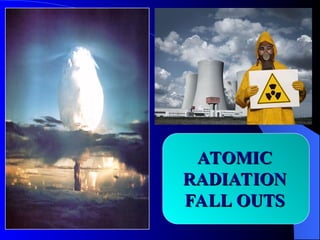
ATOMIC
ATOMIC
RADIATION
RADIATION
FALL OUTS
FALL OUTS
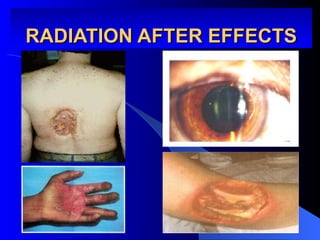
RADIATION AFTER EFFECTS
OUTLINE
OUTLINE
1. Characteristics of radiation
2. Units and Quantities
3. Biological Effects of Ionizing Radiation
4. Safe Maximal Radiation Doses
5. Minimizing Radiation Exposure - ALARA
6. Radiation Safety Measures
7. Monitoring
THE PROBLEM
THE PROBLEM
 Radiation extensively being used for diagnostic and
therapeutic procedures
 Approx. 3.3 billion of 5 billion imaging examinations
worldwide use ionizing radiation
 There is increased patient visits and patients with
multiple challenging co-morbidities for which
anesthesiologists are increasingly being required
 Fluoroscopic procedures are the largest source of
occupational radiation exposure in medicine including
anaesthesia
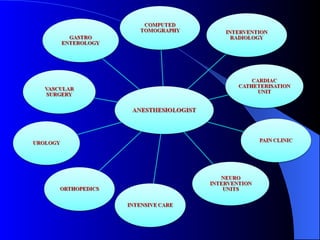
POINTS OF RADIATION
POINTS OF RADIATION
EXPOSURE IN
EXPOSURE IN
ANAESTHESIOLOGISTS
ANAESTHESIOLOGISTS
EVIDENCES AND FACTS OF
RADIATION EXPOSURE IN
ANAESTHESIOLOGISTS
ANAESTHESIOLOGISTS
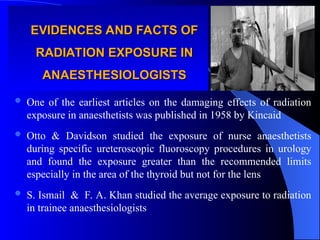
 One of the earliest articles on the damaging effects of radiation
exposure in anaesthetists was published in 1958 by Kincaid
 Otto & Davidson studied the exposure of nurse anaesthetists
during specific ureteroscopic fluoroscopy procedures in urology
and found the exposure greater than the recommended limits
especially in the area of the thyroid but not for the lens
 S. Ismail & F. A. Khan studied the average exposure to radiation
in trainee anaesthesiologists
EVIDENCES AND FACTS OF
RADIATION EXPOSURE IN
ANAESTHESIOLOGISTS
ANAESTHESIOLOGISTS
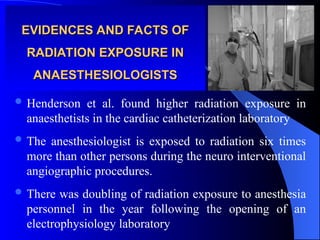
 Henderson et al. found higher radiation exposure in
anaesthetists in the cardiac catheterization laboratory
 The anesthesiologist is exposed to radiation six times
more than other persons during the neuro interventional
angiographic procedures.
 There was doubling of radiation exposure to anesthesia
personnel in the year following the opening of an
electrophysiology laboratory
EVIDENCES AND FACTS OF
EXPOSURE IN
EXPOSURE IN
ANAESTHESIOLOGISTS
ANAESTHESIOLOGISTS
 Anastasian et. al. demonstrated that the eye may be most sensitive
to radiation damage and dose to anesthesiologist’s eye can be upto
3 times greater than that to the radiologist.
 Anaesthetists can’t distance from young children and sicker
patients when anaesthesia is being administered.
 Anesthesiologist are sometimes a part of disaster management
such as the Chernobyl and Fukushima nuclear hazard
 The workload and complexity of procedures have increased over
the years, meaning a larger cumulative exposure during ones
carrier.
RADIATION EXPOSURE
RADIATION EXPOSURE
HAS BECOME A
HAS BECOME A
POTENTIAL HAZARD
POTENTIAL HAZARD
FOR
FOR
ANAESTHESIOLOGISTS
ANAESTHESIOLOGISTS
THE KNOWLEDGE GAP
THE KNOWLEDGE GAP
Few can recall specific risks,
dosages, or radiation safety
practices.
Fewer are taught or can recall
being taught these basics as
part of their core curriculum
in anesthesia education
THE KNOWLEDGE GAP ?
THE KNOWLEDGE GAP ?
 Anaesthesiologists should not rely on allied medical
professionals to protect themselves and their patients from
harm and should
 be aware of, and comply with the regulations
 understand the physical principles
 make the most effective use of the equipment
 acknowledge that the effects of radiation exposure are
cumulative and permanent
 ensure exposure is kept as low as reasonably acceptable
(ALARA philosphy)
 know methods to minimize the deleterious effects of exposure
CHARACTERISTICS
CHARACTERISTICS
OF RADIATION
OF RADIATION
16
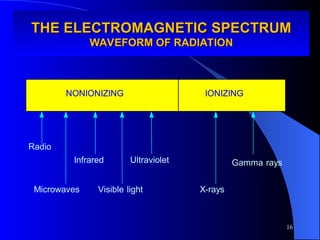
THE ELECTROMAGNETIC SPECTRUM
WAVEFORM OF RADIATION
NONIONIZING IONIZING
Radio
Microwaves
Infrared
Visible light
Ultraviolet
X-rays
Gamma rays
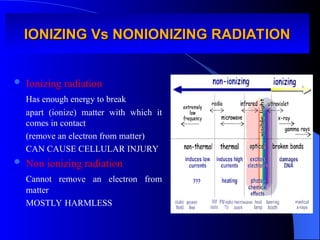
IONIZING Vs NONIONIZING RADIATION
 Ionizing radiation
Has enough energy to break
apart (ionize) matter with which it
comes in contact
(remove an electron from matter)
CAN CAUSE CELLULAR INJURY
 Non ionizing radiation
Cannot remove an electron from
matter
MOSTLY HARMLESS
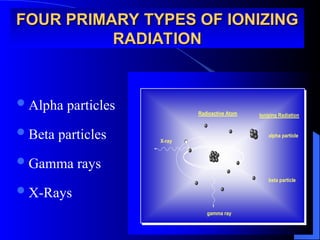
FOUR PRIMARY TYPES OF IONIZING
RADIATION
RADIATION
Alpha particles
Beta particles
Gamma rays
X-Rays
Ionizing Radiation
alpha particle
beta particle
Radioactive Atom
X-ray
gamma ray
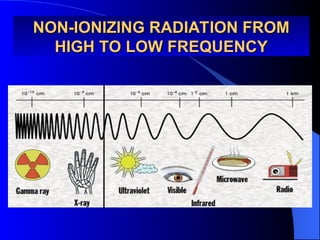
NON-IONIZING RADIATION FROM
HIGH TO LOW FREQUENCY
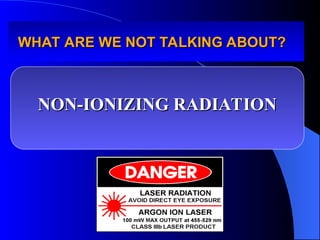
WHAT ARE WE NOT TALKING ABOUT?
NON-IONIZING RADIATION
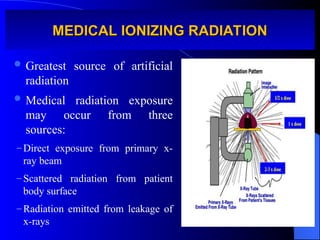
MEDICAL IONIZING RADIATION
 Greatest source of artificial
radiation
 Medical radiation exposure
may occur from three
sources:
– Direct exposure from primary x-
ray beam
– Scattered radiation from patient
body surface
– Radiation emitted from leakage of
x-rays
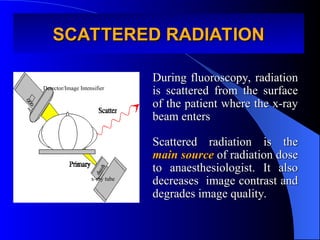
SCATTERED RADIATION
SCATTERED RADIATION
During fluoroscopy, radiation
is scattered from the surface
of the patient where the x-ray
beam enters
beam enters
Scattered radiation is the
main source
main source of radiation dose
of radiation dose
to anaesthesiologist. It also
decreases image contrast and
degrades image quality.
x-ray tube
Detector/Image Intensifier
RADIATION UNITS
RADIATION UNITS
Units are Cool
DEFINITIONS
DEFINITIONS
 Exposure R (roentgen): Amount of charge produced per unit mass
of air from x-rays and gamma rays.
 Absorbed Dose (rad): Amount of Energy deposited per unit mass
of material. 1Gy = 100 rad.
 Dose Equivalent (rem): Risk adjusted absorbed dose. The
absorbed dose is weighted by the radiation type and tissue
susceptibility to biological damage. 1 Sv = 100 rem.
 Equivalent Dose = Absorbed Dose × wR
 Radiation weighting factors: alpha(20), beta(1), n(10).
 Tissue weighting factors: lung(0.12), thyroid(0.03), and
gonads(0.25)
For whole body x or gamma-ray exposure 1 R  1 rad
 1 rem
RADIATION BIOLOGY
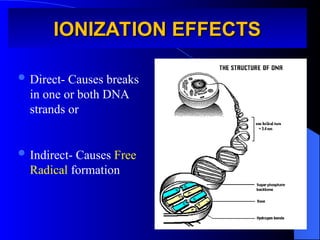
IONIZATION EFFECTS
IONIZATION EFFECTS
 Direct- Causes breaks
in one or both DNA
strands or
 Indirect- Causes Free
Radical formation
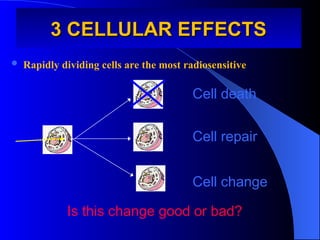
3 CELLULAR EFFECTS
3 CELLULAR EFFECTS
 Rapidly dividing cells are the most radiosensitive
Cell death
Cell repair
Cell change
Is this change good or bad?
BIOLOGICAL EFFECTS
BIOLOGICAL EFFECTS
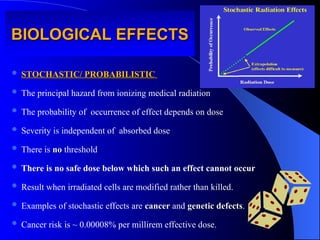
 STOCHASTIC/ PROBABILISTIC
STOCHASTIC/ PROBABILISTIC
 The principal hazard from ionizing medical radiation
 The probability of occurrence of effect depends on dose
 Severity is independent of absorbed dose
 There is no
no threshold
 There is no safe dose below which such an effect cannot occur
 Result when irradiated cells are modified rather than killed.
 Examples of stochastic effects are cancer
cancer and genetic defects
genetic defects.
 Cancer risk is ~ 0.00008% per millirem effective dose.
BIOLOGICAL EFFECTS
BIOLOGICAL EFFECTS
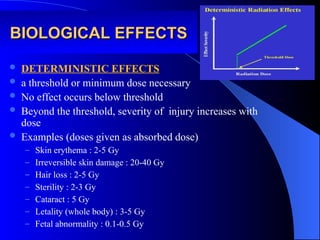
 DETERMINISTIC EFFECTS
 a threshold or minimum dose necessary
 No effect occurs below threshold
 Beyond the threshold, severity of injury increases with
dose
 Examples (doses given as absorbed dose)
– Skin erythema : 2-5 Gy
– Irreversible skin damage : 20-40 Gy
– Hair loss : 2-5 Gy
– Sterility : 2-3 Gy
– Cataract : 5 Gy
– Letality (whole body) : 3-5 Gy
– Fetal abnormality : 0.1-0.5 Gy
GENETIC DEFECTS
GENETIC DEFECTS
 No direct evidence of
radiation-induced genetic
effects in humans, even at
high doses.
 Rate of genetic disorders
produced in humans is
expected to be extremely low
MAXIMUM SAFE DOSE
MAXIMUM SAFE DOSE
LIMITS
LIMITS
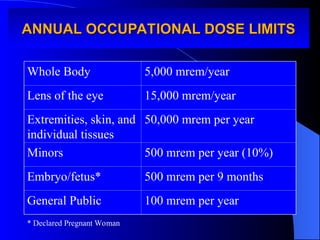
ANNUAL OCCUPATIONAL DOSE LIMITS
Whole Body 5,000 mrem/year
Lens of the eye 15,000 mrem/year
Extremities, skin, and
individual tissues
50,000 mrem per year
Minors 500 mrem per year (10%)
Embryo/fetus* 500 mrem per 9 months
General Public 100 mrem per year
* Declared Pregnant Woman
RADIATION SAFETY
RADIATION SAFETY
RADIATION PROTECTION STANDARDS
 These standards are laid down globally by the International
Commission on Radiological Protection (ICRP)
 In USA guidelines are based on the National Council on
Radiation Protection and Measurements (NCRP)
 In India, Radiation Protection Rule (RPR) specify general
principles and criteria for radiation protection in handling
radiation sources.
 Atomic Energy Regulatory Board (AERB) issues
guidelines on radiological protection and controlling
radiological safety issues
ALARA
ALARA
AS LOW AS REASONABLY ACHIEVABLE
 means making every reasonable effort to maintain exposures to
radiation as far below the dose limits as is practicable consistent
with the purpose for which the licensed activity is undertaken,
 taking into account the state of technology,
 the economics of improvements in relation to the state of
technology,
 the economics of improvements in relation to benefits to the
public health and safety,
 and other societal and socioeconomic considerations,
 and in relation to utilization of nuclear energy and licensed
materials in the public interest
RADIATION GOSPEL
RADIATION GOSPEL
Although clinician radiation dose is much
lower than the patient dose, it is proportional
to patient dose.
to patient dose.
Higher patient doses will usually lead to
higher operator and staff doses.
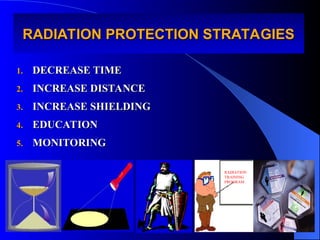
RADIATION PROTECTION STRATAGIES
1.
1. DECREASE TIME
DECREASE TIME
2.
2. INCREASE DISTANCE
INCREASE DISTANCE
3.
3. INCREASE SHIELDING
INCREASE SHIELDING
4.
4. EDUCATION
EDUCATION
5.
5. MONITORING
MONITORING
RADIATION
TRAINING
PROGRAM
TIME
TIME
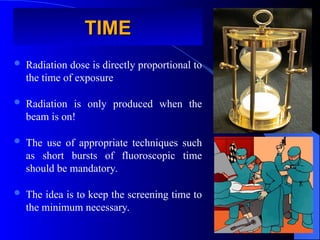
 Radiation dose is directly proportional to
the time of exposure
 Radiation is only produced when the
beam is on!
 The use of appropriate techniques such
as short bursts of fluoroscopic time
should be mandatory.
 The idea is to keep the screening time to
the minimum necessary.
TIME
TIME
 It remains a challenge for teaching
institutions to reduce the fluoroscopic
time while maintaining the quality of
education.
 One of the possible solutions may be
to prepare the trainees before they are
allowed to perform a procedure in
simulated situations.
DISTANCE
DISTANCE
DISTANCE
DISTANCE
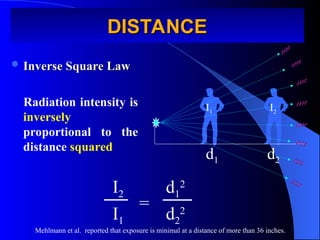
 Inverse Square Law
Inverse Square Law
Radiation intensity is
inversely
proportional to the
distance squared
d1 d2
I1 I2
I1
I2
d2
2
d1
2
=
Mehlmann et al. reported that exposure is minimal at a distance of more than 36 inches.
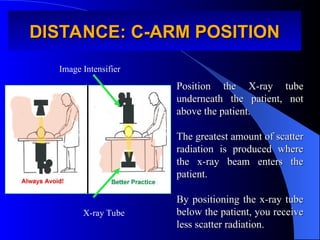
DISTANCE: C-ARM POSITION
Position the X-ray tube
underneath the patient, not
above the patient.
above the patient.
The greatest amount of scatter
radiation is produced where
the x-ray beam enters the
patient.
patient.
By positioning the x-ray tube
below the patient, you receive
less scatter radiation.
X-ray Tube
Image Intensifier
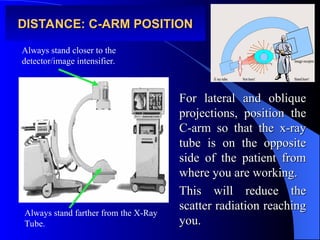
DISTANCE: C-ARM POSITION
For lateral and oblique
projections, position the
C-arm so that the x-ray
tube is on the opposite
side of the patient from
where you are working.
This will reduce the
scatter radiation reaching
you.
you.
Always stand closer to the
detector/image intensifier.
Always stand farther from the X-Ray
Tube.
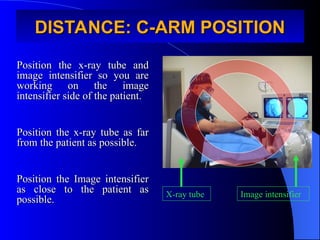
DISTANCE: C-ARM POSITION
Position the x-ray tube and
image intensifier so you are
working on the image
intensifier side of the patient.
Position the x-ray tube as far
from the patient as possible.
Position the Image intensifier
as close to the patient as
possible.
possible.
X-ray tube Image intensifier
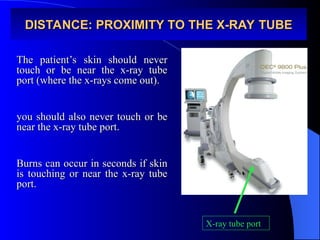
DISTANCE: PROXIMITY TO THE X-RAY TUBE
The patient’s skin should never
touch or be near the x-ray tube
port (where the x-rays come out).
you should also never touch or be
near the x-ray tube port.
Burns can occur in seconds if skin
is touching or near the x-ray tube
port.
port.
X-ray tube port
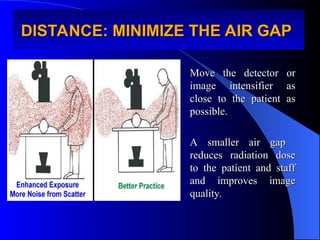
DISTANCE: MINIMIZE THE AIR GAP
Move the detector or
image intensifier as
close to the patient as
possible.
possible.
A smaller air gap
A smaller air gap
reduces radiation dose
to the patient and staff
and improves image
and improves image
quality.
quality.
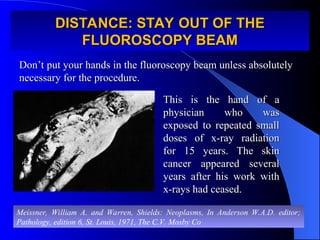
DISTANCE: STAY OUT OF THE
FLUOROSCOPY BEAM
FLUOROSCOPY BEAM
Don’t put your hands in the fluoroscopy beam unless absolutely
necessary for the procedure.
This is the hand of a
physician who was
physician who was
exposed to repeated small
doses of x-ray radiation
for 15 years. The skin
cancer appeared several
years after his work with
x-rays had ceased.
x-rays had ceased.
Meissner, William A. and Warren, Shields: Neoplasms, In Anderson W.A.D. editor;
Pathology, edition 6, St. Louis, 1971, The C.V. Mosby Co
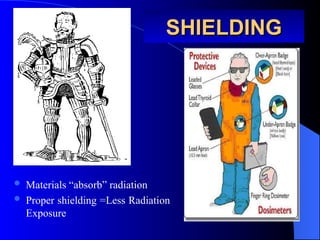
SHIELDING
SHIELDING
 Materials “absorb” radiation
 Proper shielding =Less Radiation
Exposure
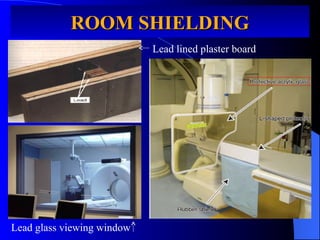
ROOM SHIELDING
ROOM SHIELDING
Lead lined plaster board
Lead glass viewing window
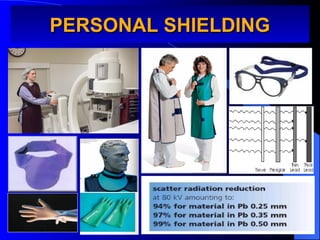
PERSONAL SHIELDING
PERSONAL SHIELDING
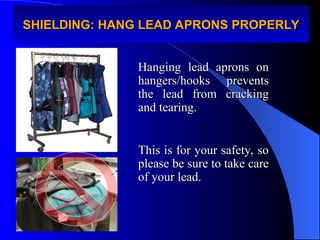
SHIELDING: HANG LEAD APRONS PROPERLY
Hanging lead aprons on
hangers/hooks prevents
the lead from cracking
and tearing.
and tearing.
This is for your safety, so
please be sure to take care
of your lead.
of your lead.
RADIATION MONITORING
METHODS
METHODS
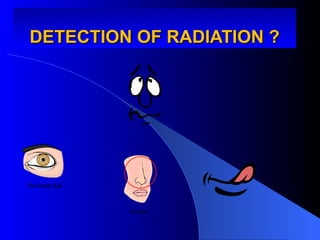
DETECTION OF RADIATION ?
PERSONAL MONITORING METHODS
(DOSIMETRY)
(DOSIMETRY)
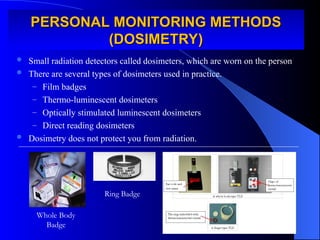
 Small radiation detectors called dosimeters, which are worn on the person
 There are several types of dosimeters used in practice.
– Film badges
– Thermo-luminescent dosimeters
– Optically stimulated luminescent dosimeters
– Direct reading dosimeters
 Dosimetry does not protect you from radiation.
Whole Body
Badge
Ring Badge
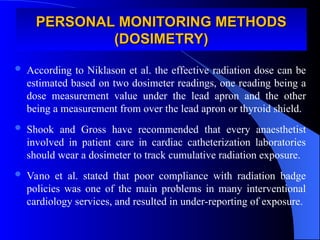
 According to Niklason et al. the effective radiation dose can be
estimated based on two dosimeter readings, one reading being a
dose measurement value under the lead apron and the other
being a measurement from over the lead apron or thyroid shield.
 Shook and Gross have recommended that every anaesthetist
involved in patient care in cardiac catheterization laboratories
should wear a dosimeter to track cumulative radiation exposure.
 Vano et al. stated that poor compliance with radiation badge
policies was one of the main problems in many interventional
cardiology services, and resulted in under-reporting of exposure.
PERSONAL MONITORING METHODS
(DOSIMETRY)
(DOSIMETRY)
DOSIMETRY BADGES
DOSIMETRY BADGES
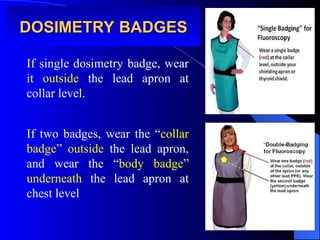
If single dosimetry badge, wear
it outside the lead apron at
collar level.
If two badges, wear the “collar
badge” outside the lead apron,
and wear the “body badge”
underneath the lead apron at
chest level
SUMMARY
SUMMARY
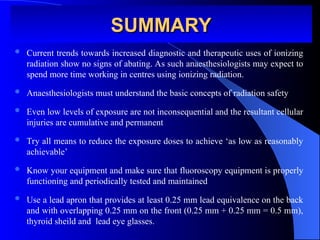
 Current trends towards increased diagnostic and therapeutic uses of ionizing
radiation show no signs of abating. As such anaesthesiologists may expect to
spend more time working in centres using ionizing radiation.
 Anaesthesiologists must understand the basic concepts of radiation safety
 Even low levels of exposure are not inconsequential and the resultant cellular
injuries are cumulative and permanent
 Try all means to reduce the exposure doses to achieve ‘as low as reasonably
achievable’
 Know your equipment and make sure that fluoroscopy equipment is properly
functioning and periodically tested and maintained
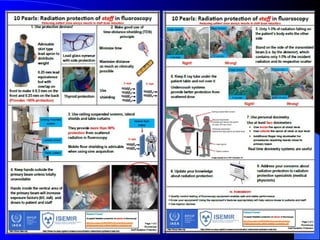
 Use a lead apron that provides at least 0.25 mm lead equivalence on the back
and with overlapping 0.25 mm on the front (0.25 mm + 0.25 mm = 0.5 mm),
thyroid sheild and lead eye glasses.
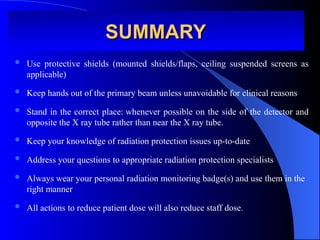
 Use protective shields (mounted shields/flaps, ceiling suspended screens as
applicable)
 Keep hands out of the primary beam unless unavoidable for clinical reasons
 Stand in the correct place: whenever possible on the side of the detector and
opposite the X ray tube rather than near the X ray tube.
 Keep your knowledge of radiation protection issues up-to-date
 Address your questions to appropriate radiation protection specialists
 Always wear your personal radiation monitoring badge(s) and use them in the
right manner
 All actions to reduce patient dose will also reduce staff dose.
SUMMARY
SUMMARY
THE END
THE END
radiation exposure in practicing anesthesiologists

radiation exposure in practicing anesthesiologists

  • 1.
    RADIATION EXPOSURE IN RADIATIONEXPOSURE IN PRACTICING PRACTICING ANAESTHESIOLOGISTS ANAESTHESIOLOGISTS DR SANTOSH KR SHARMA DR SANTOSH KR SHARMA ASSISTANT PROFFESOR ASSISTANT PROFFESOR DEPT OF ANAESTHESIOLOGY DEPT OF ANAESTHESIOLOGY BRD MEDICAL COLLEGE BRD MEDICAL COLLEGE GORAKHPUR GORAKHPUR
  • 2.
  • 3.
  • 4.
  • 5.
    OUTLINE OUTLINE 1. Characteristics ofradiation 2. Units and Quantities 3. Biological Effects of Ionizing Radiation 4. Safe Maximal Radiation Doses 5. Minimizing Radiation Exposure - ALARA 6. Radiation Safety Measures 7. Monitoring
  • 6.
    THE PROBLEM THE PROBLEM Radiation extensively being used for diagnostic and therapeutic procedures  Approx. 3.3 billion of 5 billion imaging examinations worldwide use ionizing radiation  There is increased patient visits and patients with multiple challenging co-morbidities for which anesthesiologists are increasingly being required  Fluoroscopic procedures are the largest source of occupational radiation exposure in medicine including anaesthesia
  • 7.
    POINTS OF RADIATION POINTSOF RADIATION EXPOSURE IN EXPOSURE IN ANAESTHESIOLOGISTS ANAESTHESIOLOGISTS
  • 9.
    EVIDENCES AND FACTSOF EVIDENCES AND FACTS OF RADIATION EXPOSURE IN RADIATION EXPOSURE IN ANAESTHESIOLOGISTS ANAESTHESIOLOGISTS  One of the earliest articles on the damaging effects of radiation exposure in anaesthetists was published in 1958 by Kincaid  Otto & Davidson studied the exposure of nurse anaesthetists during specific ureteroscopic fluoroscopy procedures in urology and found the exposure greater than the recommended limits especially in the area of the thyroid but not for the lens  S. Ismail & F. A. Khan studied the average exposure to radiation in trainee anaesthesiologists
  • 10.
    EVIDENCES AND FACTSOF EVIDENCES AND FACTS OF RADIATION EXPOSURE IN RADIATION EXPOSURE IN ANAESTHESIOLOGISTS ANAESTHESIOLOGISTS  Henderson et al. found higher radiation exposure in anaesthetists in the cardiac catheterization laboratory  The anesthesiologist is exposed to radiation six times more than other persons during the neuro interventional angiographic procedures.  There was doubling of radiation exposure to anesthesia personnel in the year following the opening of an electrophysiology laboratory
  • 11.
    EVIDENCES AND FACTSOF EVIDENCES AND FACTS OF EXPOSURE IN EXPOSURE IN ANAESTHESIOLOGISTS ANAESTHESIOLOGISTS  Anastasian et. al. demonstrated that the eye may be most sensitive to radiation damage and dose to anesthesiologist’s eye can be upto 3 times greater than that to the radiologist.  Anaesthetists can’t distance from young children and sicker patients when anaesthesia is being administered.  Anesthesiologist are sometimes a part of disaster management such as the Chernobyl and Fukushima nuclear hazard  The workload and complexity of procedures have increased over the years, meaning a larger cumulative exposure during ones carrier.
  • 12.
    RADIATION EXPOSURE RADIATION EXPOSURE HASBECOME A HAS BECOME A POTENTIAL HAZARD POTENTIAL HAZARD FOR FOR ANAESTHESIOLOGISTS ANAESTHESIOLOGISTS
  • 13.
    THE KNOWLEDGE GAP THEKNOWLEDGE GAP Few can recall specific risks, dosages, or radiation safety practices. Fewer are taught or can recall being taught these basics as part of their core curriculum in anesthesia education
  • 14.
    THE KNOWLEDGE GAP? THE KNOWLEDGE GAP ?  Anaesthesiologists should not rely on allied medical professionals to protect themselves and their patients from harm and should  be aware of, and comply with the regulations  understand the physical principles  make the most effective use of the equipment  acknowledge that the effects of radiation exposure are cumulative and permanent  ensure exposure is kept as low as reasonably acceptable (ALARA philosphy)  know methods to minimize the deleterious effects of exposure
  • 15.
  • 16.
    16 THE ELECTROMAGNETIC SPECTRUM THEELECTROMAGNETIC SPECTRUM WAVEFORM OF RADIATION WAVEFORM OF RADIATION NONIONIZING IONIZING Radio Microwaves Infrared Visible light Ultraviolet X-rays Gamma rays
  • 17.
    IONIZING Vs NONIONIZINGRADIATION IONIZING Vs NONIONIZING RADIATION  Ionizing radiation Has enough energy to break apart (ionize) matter with which it comes in contact (remove an electron from matter) CAN CAUSE CELLULAR INJURY  Non ionizing radiation Cannot remove an electron from matter MOSTLY HARMLESS
  • 18.
    FOUR PRIMARY TYPESOF IONIZING FOUR PRIMARY TYPES OF IONIZING RADIATION RADIATION Alpha particles Beta particles Gamma rays X-Rays Ionizing Radiation alpha particle beta particle Radioactive Atom X-ray gamma ray
  • 19.
    NON-IONIZING RADIATION FROM NON-IONIZINGRADIATION FROM HIGH TO LOW FREQUENCY HIGH TO LOW FREQUENCY
  • 20.
    WHAT ARE WENOT TALKING ABOUT? WHAT ARE WE NOT TALKING ABOUT? NON-IONIZING RADIATION NON-IONIZING RADIATION
  • 21.
    MEDICAL IONIZING RADIATION MEDICALIONIZING RADIATION  Greatest source of artificial radiation  Medical radiation exposure may occur from three sources: – Direct exposure from primary x- ray beam – Scattered radiation from patient body surface – Radiation emitted from leakage of x-rays
  • 22.
    SCATTERED RADIATION SCATTERED RADIATION Duringfluoroscopy, radiation During fluoroscopy, radiation is scattered from the surface is scattered from the surface of the patient where the x-ray of the patient where the x-ray beam enters beam enters Scattered radiation is the Scattered radiation is the main source main source of radiation dose of radiation dose to anaesthesiologist. It also to anaesthesiologist. It also decreases image contrast and decreases image contrast and degrades image quality. degrades image quality. x-ray tube Detector/Image Intensifier
  • 23.
  • 24.
    DEFINITIONS DEFINITIONS  Exposure R(roentgen): Amount of charge produced per unit mass of air from x-rays and gamma rays.  Absorbed Dose (rad): Amount of Energy deposited per unit mass of material. 1Gy = 100 rad.  Dose Equivalent (rem): Risk adjusted absorbed dose. The absorbed dose is weighted by the radiation type and tissue susceptibility to biological damage. 1 Sv = 100 rem.  Equivalent Dose = Absorbed Dose × wR  Radiation weighting factors: alpha(20), beta(1), n(10).  Tissue weighting factors: lung(0.12), thyroid(0.03), and gonads(0.25) For whole body x or gamma-ray exposure 1 R  1 rad  1 rem
  • 25.
  • 26.
    IONIZATION EFFECTS IONIZATION EFFECTS Direct- Causes breaks in one or both DNA strands or  Indirect- Causes Free Radical formation
  • 27.
    3 CELLULAR EFFECTS 3CELLULAR EFFECTS  Rapidly dividing cells are the most radiosensitive Cell death Cell repair Cell change Is this change good or bad?
  • 28.
    BIOLOGICAL EFFECTS BIOLOGICAL EFFECTS STOCHASTIC/ PROBABILISTIC STOCHASTIC/ PROBABILISTIC  The principal hazard from ionizing medical radiation  The probability of occurrence of effect depends on dose  Severity is independent of absorbed dose  There is no no threshold  There is no safe dose below which such an effect cannot occur  Result when irradiated cells are modified rather than killed.  Examples of stochastic effects are cancer cancer and genetic defects genetic defects.  Cancer risk is ~ 0.00008% per millirem effective dose.
  • 29.
    BIOLOGICAL EFFECTS BIOLOGICAL EFFECTS DETERMINISTIC EFFECTS  a threshold or minimum dose necessary  No effect occurs below threshold  Beyond the threshold, severity of injury increases with dose  Examples (doses given as absorbed dose) – Skin erythema : 2-5 Gy – Irreversible skin damage : 20-40 Gy – Hair loss : 2-5 Gy – Sterility : 2-3 Gy – Cataract : 5 Gy – Letality (whole body) : 3-5 Gy – Fetal abnormality : 0.1-0.5 Gy
  • 30.
    GENETIC DEFECTS GENETIC DEFECTS No direct evidence of radiation-induced genetic effects in humans, even at high doses.  Rate of genetic disorders produced in humans is expected to be extremely low
  • 31.
    MAXIMUM SAFE DOSE MAXIMUMSAFE DOSE LIMITS LIMITS
  • 32.
    ANNUAL OCCUPATIONAL DOSELIMITS ANNUAL OCCUPATIONAL DOSE LIMITS Whole Body 5,000 mrem/year Lens of the eye 15,000 mrem/year Extremities, skin, and individual tissues 50,000 mrem per year Minors 500 mrem per year (10%) Embryo/fetus* 500 mrem per 9 months General Public 100 mrem per year * Declared Pregnant Woman
  • 33.
  • 34.
    RADIATION PROTECTION STANDARDS RADIATIONPROTECTION STANDARDS  These standards are laid down globally by the International Commission on Radiological Protection (ICRP)  In USA guidelines are based on the National Council on Radiation Protection and Measurements (NCRP)  In India, Radiation Protection Rule (RPR) specify general principles and criteria for radiation protection in handling radiation sources.  Atomic Energy Regulatory Board (AERB) issues guidelines on radiological protection and controlling radiological safety issues
  • 35.
    ALARA ALARA AS LOW ASREASONABLY ACHIEVABLE AS LOW AS REASONABLY ACHIEVABLE  means making every reasonable effort to maintain exposures to radiation as far below the dose limits as is practicable consistent with the purpose for which the licensed activity is undertaken,  taking into account the state of technology,  the economics of improvements in relation to the state of technology,  the economics of improvements in relation to benefits to the public health and safety,  and other societal and socioeconomic considerations,  and in relation to utilization of nuclear energy and licensed materials in the public interest
  • 36.
    RADIATION GOSPEL RADIATION GOSPEL Althoughclinician radiation dose is much Although clinician radiation dose is much lower than the patient dose, it is proportional lower than the patient dose, it is proportional to patient dose. to patient dose. Higher patient doses will usually lead to Higher patient doses will usually lead to higher operator and staff doses. higher operator and staff doses.
  • 37.
    RADIATION PROTECTION STRATAGIES RADIATIONPROTECTION STRATAGIES 1. 1. DECREASE TIME DECREASE TIME 2. 2. INCREASE DISTANCE INCREASE DISTANCE 3. 3. INCREASE SHIELDING INCREASE SHIELDING 4. 4. EDUCATION EDUCATION 5. 5. MONITORING MONITORING RADIATION TRAINING PROGRAM
  • 38.
    TIME TIME  Radiation doseis directly proportional to the time of exposure  Radiation is only produced when the beam is on!  The use of appropriate techniques such as short bursts of fluoroscopic time should be mandatory.  The idea is to keep the screening time to the minimum necessary.
  • 39.
    TIME TIME  It remainsa challenge for teaching institutions to reduce the fluoroscopic time while maintaining the quality of education.  One of the possible solutions may be to prepare the trainees before they are allowed to perform a procedure in simulated situations.
  • 40.
  • 41.
    DISTANCE DISTANCE  Inverse SquareLaw Inverse Square Law Radiation intensity is inversely proportional to the distance squared d1 d2 I1 I2 I1 I2 d2 2 d1 2 = Mehlmann et al. reported that exposure is minimal at a distance of more than 36 inches.
  • 42.
    DISTANCE: C-ARM POSITION DISTANCE:C-ARM POSITION Position the X-ray tube Position the X-ray tube underneath the patient, not underneath the patient, not above the patient. above the patient. The greatest amount of scatter The greatest amount of scatter radiation is produced where radiation is produced where the x-ray beam enters the the x-ray beam enters the patient. patient. By positioning the x-ray tube By positioning the x-ray tube below the patient, you receive below the patient, you receive less scatter radiation. less scatter radiation. X-ray Tube Image Intensifier
  • 43.
    DISTANCE: C-ARM POSITION DISTANCE:C-ARM POSITION For lateral and oblique For lateral and oblique projections, position the projections, position the C-arm so that the x-ray C-arm so that the x-ray tube is on the opposite tube is on the opposite side of the patient from side of the patient from where you are working. where you are working. This will reduce the This will reduce the scatter radiation reaching scatter radiation reaching you. you. Always stand closer to the detector/image intensifier. Always stand farther from the X-Ray Tube.
  • 45.
    DISTANCE: C-ARM POSITION DISTANCE:C-ARM POSITION Position the x-ray tube and Position the x-ray tube and image intensifier so you are image intensifier so you are working on the image working on the image intensifier side of the patient. intensifier side of the patient. Position the x-ray tube as far Position the x-ray tube as far from the patient as possible. from the patient as possible. Position the Image intensifier Position the Image intensifier as close to the patient as as close to the patient as possible. possible. X-ray tube Image intensifier
  • 46.
    DISTANCE: PROXIMITY TOTHE X-RAY TUBE DISTANCE: PROXIMITY TO THE X-RAY TUBE The patient’s skin should never The patient’s skin should never touch or be near the x-ray tube touch or be near the x-ray tube port (where the x-rays come out). port (where the x-rays come out). you should also never touch or be you should also never touch or be near the x-ray tube port. near the x-ray tube port. Burns can occur in seconds if skin Burns can occur in seconds if skin is touching or near the x-ray tube is touching or near the x-ray tube port. port. X-ray tube port
  • 47.
    DISTANCE: MINIMIZE THEAIR GAP DISTANCE: MINIMIZE THE AIR GAP Move the detector or Move the detector or image intensifier as image intensifier as close to the patient as close to the patient as possible. possible. A smaller air gap A smaller air gap reduces radiation dose reduces radiation dose to the patient and staff to the patient and staff and improves image and improves image quality. quality.
  • 48.
    DISTANCE: STAY OUTOF THE DISTANCE: STAY OUT OF THE FLUOROSCOPY BEAM FLUOROSCOPY BEAM Don’t put your hands in the fluoroscopy beam unless absolutely Don’t put your hands in the fluoroscopy beam unless absolutely necessary for the procedure. necessary for the procedure. This is the hand of a This is the hand of a physician who was physician who was exposed to repeated small exposed to repeated small doses of x-ray radiation doses of x-ray radiation for 15 years. The skin for 15 years. The skin cancer appeared several cancer appeared several years after his work with years after his work with x-rays had ceased. x-rays had ceased. Meissner, William A. and Warren, Shields: Neoplasms, In Anderson W.A.D. editor; Pathology, edition 6, St. Louis, 1971, The C.V. Mosby Co
  • 49.
    SHIELDING SHIELDING  Materials “absorb”radiation  Proper shielding =Less Radiation Exposure
  • 50.
    ROOM SHIELDING ROOM SHIELDING Leadlined plaster board Lead glass viewing window
  • 51.
  • 52.
    SHIELDING: HANG LEADAPRONS PROPERLY SHIELDING: HANG LEAD APRONS PROPERLY Hanging lead aprons on Hanging lead aprons on hangers/hooks prevents hangers/hooks prevents the lead from cracking the lead from cracking and tearing. and tearing. This is for your safety, so This is for your safety, so please be sure to take care please be sure to take care of your lead. of your lead.
  • 53.
  • 54.
    DETECTION OF RADIATION? DETECTION OF RADIATION ?
  • 55.
    PERSONAL MONITORING METHODS PERSONALMONITORING METHODS (DOSIMETRY) (DOSIMETRY)  Small radiation detectors called dosimeters, which are worn on the person  There are several types of dosimeters used in practice. – Film badges – Thermo-luminescent dosimeters – Optically stimulated luminescent dosimeters – Direct reading dosimeters  Dosimetry does not protect you from radiation. Whole Body Badge Ring Badge
  • 56.
     According toNiklason et al. the effective radiation dose can be estimated based on two dosimeter readings, one reading being a dose measurement value under the lead apron and the other being a measurement from over the lead apron or thyroid shield.  Shook and Gross have recommended that every anaesthetist involved in patient care in cardiac catheterization laboratories should wear a dosimeter to track cumulative radiation exposure.  Vano et al. stated that poor compliance with radiation badge policies was one of the main problems in many interventional cardiology services, and resulted in under-reporting of exposure. PERSONAL MONITORING METHODS PERSONAL MONITORING METHODS (DOSIMETRY) (DOSIMETRY)
  • 57.
    DOSIMETRY BADGES DOSIMETRY BADGES Ifsingle dosimetry badge, wear it outside the lead apron at collar level. If two badges, wear the “collar badge” outside the lead apron, and wear the “body badge” underneath the lead apron at chest level
  • 58.
    SUMMARY SUMMARY  Current trendstowards increased diagnostic and therapeutic uses of ionizing radiation show no signs of abating. As such anaesthesiologists may expect to spend more time working in centres using ionizing radiation.  Anaesthesiologists must understand the basic concepts of radiation safety  Even low levels of exposure are not inconsequential and the resultant cellular injuries are cumulative and permanent  Try all means to reduce the exposure doses to achieve ‘as low as reasonably achievable’  Know your equipment and make sure that fluoroscopy equipment is properly functioning and periodically tested and maintained  Use a lead apron that provides at least 0.25 mm lead equivalence on the back and with overlapping 0.25 mm on the front (0.25 mm + 0.25 mm = 0.5 mm), thyroid sheild and lead eye glasses.
  • 59.
     Use protectiveshields (mounted shields/flaps, ceiling suspended screens as applicable)  Keep hands out of the primary beam unless unavoidable for clinical reasons  Stand in the correct place: whenever possible on the side of the detector and opposite the X ray tube rather than near the X ray tube.  Keep your knowledge of radiation protection issues up-to-date  Address your questions to appropriate radiation protection specialists  Always wear your personal radiation monitoring badge(s) and use them in the right manner  All actions to reduce patient dose will also reduce staff dose. SUMMARY SUMMARY
  • 61.