RacemizationANDISOMERISATION
M.ARUN LAKSHMI
Racemization
Racemization is a process where an optically active compound is
converted to a mixture of enantiomers with zero optical activity.
Tris chelate complex
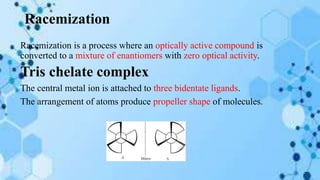
The central metal ion is attached to three bidentate ligands.
The arrangement of atoms produce propeller shape of molecules.
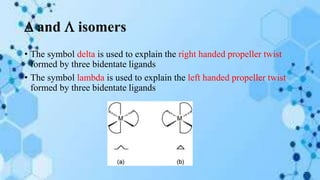
 and  isomers
• The symbol delta is used to explain the right handed propeller twist
formed by three bidentate ligands
• The symbol lambda is used to explain the left handed propeller twist
formed by three bidentate ligands
Mechanisms of racemization
Involving complete dissociation of a ligand
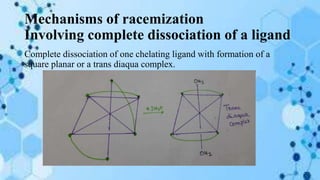
Complete dissociation of one chelating ligand with formation of a
square planar or a trans diaqua complex.
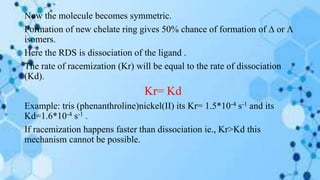
Now the molecule becomes symmetric.
Formation of new chelate ring gives 50% chance of formation of  or 
isomers.
Here the RDS is dissociation of the ligand .
The rate of racemization (Kr) will be equal to the rate of dissociation
(Kd).
Kr= Kd
Example: tris (phenanthroline)nickel(II) its Kr= 1.5*10-4 s-1 and its
Kd=1.6*10-4 s-1 .
If racemization happens faster than dissociation ie., Kr>Kd this
mechanism cannot be possible.
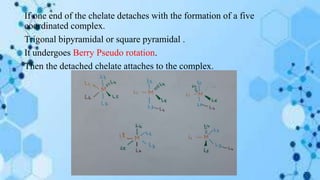
If one end of the chelate detaches with the formation of a five
coordinated complex.
Trigonal bipyramidal or square pyramidal .
It undergoes Berry Pseudo rotation.
Then the detached chelate attaches to the complex.
Racemization without bond rupture
There are four mechanisms for this
For complexes where Kr>Kd
Push through mechanism
Cross over mechanism
Bailor twist mechanism
Ray Dutt twist mechanism
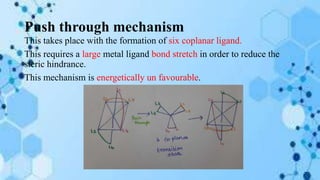
Push through mechanism
This takes place with the formation of six coplanar ligand.
This requires a large metal ligand bond stretch in order to reduce the
steric hindrance.
This mechanism is energetically un favourable.
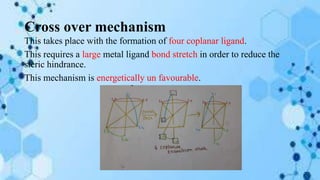
Cross over mechanism
This takes place with the formation of four coplanar ligand.
This requires a large metal ligand bond stretch in order to reduce the
steric hindrance.
This mechanism is energetically un favourable.
Twist mechanisms
They have less bond stretches.
These are energetically favourable and account for racemization.
Ray Dutt twist.
Bailor twist.
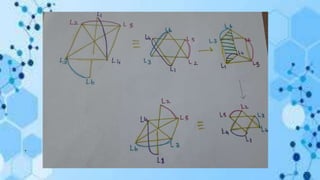
Ray Dutt twist
This is a rhombic twist.
It takes place with the formation of C2v transition state.
.
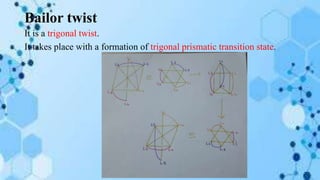
Bailor twist
It is a trigonal twist.
It takes place with a formation of trigonal prismatic transition state.
Rigid chelates and complexes with small bite angles prefer Bailor twist.
Complexes with large bite angles prefer Ray Dutt twist.
THANKYOU

RACEMIzATION AND ISOMERISATION completed.pptx

  • 1.
  • 2.
    Racemization Racemization is aprocess where an optically active compound is converted to a mixture of enantiomers with zero optical activity. Tris chelate complex The central metal ion is attached to three bidentate ligands. The arrangement of atoms produce propeller shape of molecules.
  • 3.
     and isomers • The symbol delta is used to explain the right handed propeller twist formed by three bidentate ligands • The symbol lambda is used to explain the left handed propeller twist formed by three bidentate ligands
  • 4.
    Mechanisms of racemization Involvingcomplete dissociation of a ligand Complete dissociation of one chelating ligand with formation of a square planar or a trans diaqua complex.
  • 5.
    Now the moleculebecomes symmetric. Formation of new chelate ring gives 50% chance of formation of  or  isomers. Here the RDS is dissociation of the ligand . The rate of racemization (Kr) will be equal to the rate of dissociation (Kd). Kr= Kd Example: tris (phenanthroline)nickel(II) its Kr= 1.5*10-4 s-1 and its Kd=1.6*10-4 s-1 . If racemization happens faster than dissociation ie., Kr>Kd this mechanism cannot be possible.
  • 6.
    If one endof the chelate detaches with the formation of a five coordinated complex. Trigonal bipyramidal or square pyramidal . It undergoes Berry Pseudo rotation. Then the detached chelate attaches to the complex.
  • 7.
    Racemization without bondrupture There are four mechanisms for this For complexes where Kr>Kd Push through mechanism Cross over mechanism Bailor twist mechanism Ray Dutt twist mechanism
  • 8.
    Push through mechanism Thistakes place with the formation of six coplanar ligand. This requires a large metal ligand bond stretch in order to reduce the steric hindrance. This mechanism is energetically un favourable.
  • 9.
    Cross over mechanism Thistakes place with the formation of four coplanar ligand. This requires a large metal ligand bond stretch in order to reduce the steric hindrance. This mechanism is energetically un favourable.
  • 10.
    Twist mechanisms They haveless bond stretches. These are energetically favourable and account for racemization. Ray Dutt twist. Bailor twist.
  • 11.
    Ray Dutt twist Thisis a rhombic twist. It takes place with the formation of C2v transition state.
  • 12.
  • 13.
    Bailor twist It isa trigonal twist. It takes place with a formation of trigonal prismatic transition state.
  • 14.
    Rigid chelates andcomplexes with small bite angles prefer Bailor twist. Complexes with large bite angles prefer Ray Dutt twist.
  • 15.