SPRINT EVENTS
BY: SIR. CHRSITIAN N. INDICO
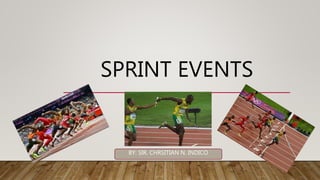
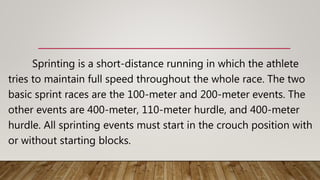
Sprinting is a short-distance running in which the athlete
tries to maintain full speed throughout the whole race. The two
basic sprint races are the 100-meter and 200-meter events. The
other events are 400-meter, 110-meter hurdle, and 400-meter
hurdle. All sprinting events must start in the crouch position with
or without starting blocks.
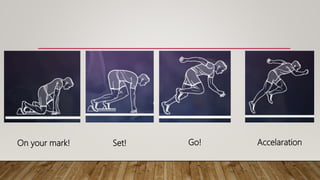
THE CROUCH POSITION
On
your
mark!
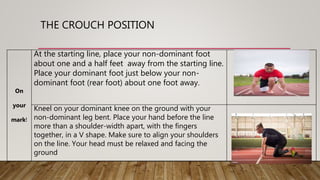
At the starting line, place your non-dominant foot
about one and a half feet away from the starting line.
Place your dominant foot just below your non-
dominant foot (rear foot) about one foot away.
Kneel on your dominant knee on the ground with your
non-dominant leg bent. Place your hand before the line
more than a shoulder-width apart, with the fingers
together, in a V shape. Make sure to align your shoulders
on the line. Your head must be relaxed and facing the
ground
Set!
Go!
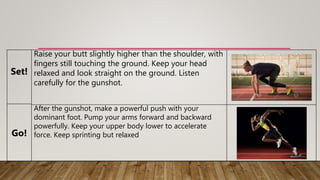
Raise your butt slightly higher than the shoulder, with
fingers still touching the ground. Keep your head
relaxed and look straight on the ground. Listen
carefully for the gunshot.
After the gunshot, make a powerful push with your
dominant foot. Pump your arms forward and backward
powerfully. Keep your upper body lower to accelerate
force. Keep sprinting but relaxed
Set!
On your mark! Go! Accelaration
PROPER RUNNING POSITION
In running, specially in sprinting events, athletes must
maintain the proper and correct running position.
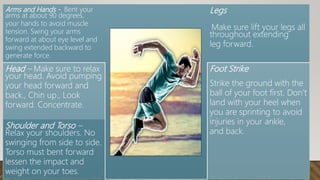
Arms and Hands - Bent your
arms at about 90 degrees.
your hands to avoid muscle
tension. Swing your arms
forward at about eye level and
swing extended backward to
generate force.
Legs
Make sure lift your legs all
throughout extending
leg forward.
Head – Make sure to relax
your head. Avoid pumping
your head forward and
back., Chin up., Look
forward. Concentrate.
Foot Strike
Strike the ground with the
ball of your foot first. Don’t
land with your heel when
you are sprinting to avoid
injuries in your ankle,
and back.
Shoulder and Torso –
Relax your shoulders. No
swinging from side to side.
Torso must bent forward
lessen the impact and
weight on your toes.
THE 100 – METER SPRINT EVENT
THE RACE- The 100-meter sprint is a set test of pure speed over a
straight distance. The eight runners with the best times in the qualifying
heats or preliminary races run in the final event.
This event has become the start event of the Olympics, with the
winners of the men's and women’s races recognized as the fastest
human beings in the world.
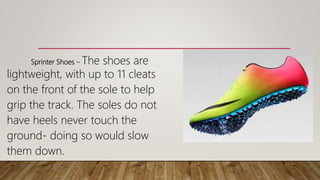
Sprinter Shoes – The shoes are
lightweight, with up to 11 cleats
on the front of the sole to help
grip the track. The soles do not
have heels never touch the
ground- doing so would slow
them down.
THE 200-METER AND 400-METER SPRINT EVENTS
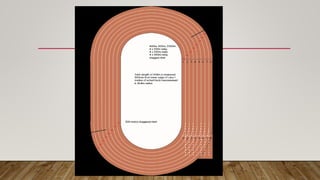
Both the 200-meter and 400-meter events are
classified as long sprints. Both male and female athletes
start out fast and use long strides. Runners start in
staggered positions along the track, with those toward
the inside lanes starting farther back.
The 200m and 400m sprint event required more strength
and agility than the 100m events. Because the races start on the
curved part of the track, runners are forced into a leaning
position. This increase the risk of injury. It is impossible for
athletes to maintain their maximum speed all the way to the
finish line. They must concentrate on keeping their speed
constant.
SPRINT HURDLES
The 100m, 110m, 400m hurdle events are races in which athletes
alternate between sprinting and jumping over obstacles, called hurdle.
There are 10 hurdles in a race. Runners can touch or knock down hurdles
accidently without penalty, but are disqualified if they deliberately knock
one down or put a leg or foot outside the hurdle. The hurdle are made of
metal and wood. A counterweight at the base keeps it from falling over
too easy. The men’s hurdles are slightly higher than the women’s.
The shoes – Shoes worn for hurdles look like
sprinters’ shoes but the cheats in the front are
shorter so that they don’t get caught on the hurdle.
The heels are reinforced to absorb the shock of
landing.
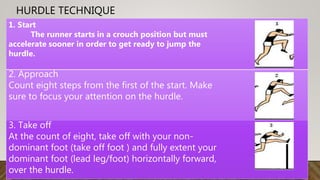
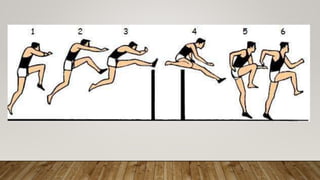
HURDLE TECHNIQUE
1. Start
The runner starts in a crouch position but must
accelerate sooner in order to get ready to jump the
hurdle.
2. Approach
Count eight steps from the first of the start. Make
sure to focus your attention on the hurdle.
3. Take off
At the count of eight, take off with your non-
dominant foot (take off foot ) and fully extent your
dominant foot (lead leg/foot) horizontally forward,
over the hurdle.
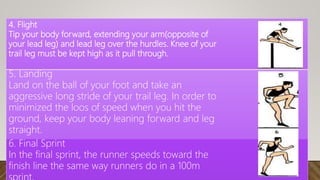
4. Flight
Tip your body forward, extending your arm(opposite of
your lead leg) and lead leg over the hurdles. Knee of your
trail leg must be kept high as it pull through.
5. Landing
Land on the ball of your foot and take an
aggressive long stride of your trail leg. In order to
minimized the loos of speed when you hit the
ground, keep your body leaning forward and leg
straight.
6. Final Sprint
In the final sprint, the runner speeds toward the
finish line the same way runners do in a 100m
RELAYS
Relay teams are made up of four athletes, who each take a turn running
as quickly as possible while carrying a baton. Eight teams compete in the
final event. In a relay race it is a baton, and not the runner, which is timed.
The baton must passed quickly and carefully – if it is dropped, the runner
must pick up before continuing. There are two kinds of relay events: the
4x100m and 4x400m relays.
RELAY TECHNIQUES
In both relays, the first runners is usually known for his quick
start, while the athlete known for a strong finish is the last
runner. In the 4x100m, team members must remain in their
lanes so they don’t get the way of the other runners. In the
4x400m, speed is slower and passing the baton less risky. Only
the first lap and the first turn of the second lap are run in lanes.
PASSING ZONES
1. 4x100m relay – In the run-up zone, the receiver takes 6 to 8 strides,
beginning when the passer has crossed the marker placed 6 to 9m
before the run-up zone.
In the passing zone, the passer shouts to the receiver that he is
about to pass the baton to him, then puts it into his hand. The receiver
continues running without looking at the baton or changing stride. This
is called a “blind pass”.
2. 4x400m relay – In this race, the team mates watch each other
during the exchange of the baton. Because this longest event,
the passer is more tired and his speed may vary. This makes a
“blind pass” too risky.

Sprint events

  • 1.
    SPRINT EVENTS BY: SIR.CHRSITIAN N. INDICO
  • 2.
    Sprinting is ashort-distance running in which the athlete tries to maintain full speed throughout the whole race. The two basic sprint races are the 100-meter and 200-meter events. The other events are 400-meter, 110-meter hurdle, and 400-meter hurdle. All sprinting events must start in the crouch position with or without starting blocks.
  • 3.
    THE CROUCH POSITION On your mark! Atthe starting line, place your non-dominant foot about one and a half feet away from the starting line. Place your dominant foot just below your non- dominant foot (rear foot) about one foot away. Kneel on your dominant knee on the ground with your non-dominant leg bent. Place your hand before the line more than a shoulder-width apart, with the fingers together, in a V shape. Make sure to align your shoulders on the line. Your head must be relaxed and facing the ground
  • 4.
    Set! Go! Raise your buttslightly higher than the shoulder, with fingers still touching the ground. Keep your head relaxed and look straight on the ground. Listen carefully for the gunshot. After the gunshot, make a powerful push with your dominant foot. Pump your arms forward and backward powerfully. Keep your upper body lower to accelerate force. Keep sprinting but relaxed
  • 5.
    Set! On your mark!Go! Accelaration
  • 6.
    PROPER RUNNING POSITION Inrunning, specially in sprinting events, athletes must maintain the proper and correct running position.
  • 7.
    Arms and Hands- Bent your arms at about 90 degrees. your hands to avoid muscle tension. Swing your arms forward at about eye level and swing extended backward to generate force. Legs Make sure lift your legs all throughout extending leg forward. Head – Make sure to relax your head. Avoid pumping your head forward and back., Chin up., Look forward. Concentrate. Foot Strike Strike the ground with the ball of your foot first. Don’t land with your heel when you are sprinting to avoid injuries in your ankle, and back. Shoulder and Torso – Relax your shoulders. No swinging from side to side. Torso must bent forward lessen the impact and weight on your toes.
  • 8.
    THE 100 –METER SPRINT EVENT THE RACE- The 100-meter sprint is a set test of pure speed over a straight distance. The eight runners with the best times in the qualifying heats or preliminary races run in the final event. This event has become the start event of the Olympics, with the winners of the men's and women’s races recognized as the fastest human beings in the world.
  • 9.
    Sprinter Shoes –The shoes are lightweight, with up to 11 cleats on the front of the sole to help grip the track. The soles do not have heels never touch the ground- doing so would slow them down.
  • 10.
    THE 200-METER AND400-METER SPRINT EVENTS Both the 200-meter and 400-meter events are classified as long sprints. Both male and female athletes start out fast and use long strides. Runners start in staggered positions along the track, with those toward the inside lanes starting farther back.
  • 12.
    The 200m and400m sprint event required more strength and agility than the 100m events. Because the races start on the curved part of the track, runners are forced into a leaning position. This increase the risk of injury. It is impossible for athletes to maintain their maximum speed all the way to the finish line. They must concentrate on keeping their speed constant.
  • 13.
    SPRINT HURDLES The 100m,110m, 400m hurdle events are races in which athletes alternate between sprinting and jumping over obstacles, called hurdle. There are 10 hurdles in a race. Runners can touch or knock down hurdles accidently without penalty, but are disqualified if they deliberately knock one down or put a leg or foot outside the hurdle. The hurdle are made of metal and wood. A counterweight at the base keeps it from falling over too easy. The men’s hurdles are slightly higher than the women’s.
  • 14.
    The shoes –Shoes worn for hurdles look like sprinters’ shoes but the cheats in the front are shorter so that they don’t get caught on the hurdle. The heels are reinforced to absorb the shock of landing.
  • 15.
    HURDLE TECHNIQUE 1. Start Therunner starts in a crouch position but must accelerate sooner in order to get ready to jump the hurdle. 2. Approach Count eight steps from the first of the start. Make sure to focus your attention on the hurdle. 3. Take off At the count of eight, take off with your non- dominant foot (take off foot ) and fully extent your dominant foot (lead leg/foot) horizontally forward, over the hurdle.
  • 16.
    4. Flight Tip yourbody forward, extending your arm(opposite of your lead leg) and lead leg over the hurdles. Knee of your trail leg must be kept high as it pull through. 5. Landing Land on the ball of your foot and take an aggressive long stride of your trail leg. In order to minimized the loos of speed when you hit the ground, keep your body leaning forward and leg straight. 6. Final Sprint In the final sprint, the runner speeds toward the finish line the same way runners do in a 100m
  • 18.
    RELAYS Relay teams aremade up of four athletes, who each take a turn running as quickly as possible while carrying a baton. Eight teams compete in the final event. In a relay race it is a baton, and not the runner, which is timed. The baton must passed quickly and carefully – if it is dropped, the runner must pick up before continuing. There are two kinds of relay events: the 4x100m and 4x400m relays.
  • 19.
    RELAY TECHNIQUES In bothrelays, the first runners is usually known for his quick start, while the athlete known for a strong finish is the last runner. In the 4x100m, team members must remain in their lanes so they don’t get the way of the other runners. In the 4x400m, speed is slower and passing the baton less risky. Only the first lap and the first turn of the second lap are run in lanes.
  • 20.
    PASSING ZONES 1. 4x100mrelay – In the run-up zone, the receiver takes 6 to 8 strides, beginning when the passer has crossed the marker placed 6 to 9m before the run-up zone. In the passing zone, the passer shouts to the receiver that he is about to pass the baton to him, then puts it into his hand. The receiver continues running without looking at the baton or changing stride. This is called a “blind pass”.
  • 21.
    2. 4x400m relay– In this race, the team mates watch each other during the exchange of the baton. Because this longest event, the passer is more tired and his speed may vary. This makes a “blind pass” too risky.