Indian English Literature – (Pre-
Independence)
Rabindranath Tagore :Nation’s Fame
Nanditaba Chudasama
Semester : 3
Enrollment no – 306920642000006
Roll no :12
Batch : 2020 – 2022
S. B Gardi Department of English Bhavnagar
University
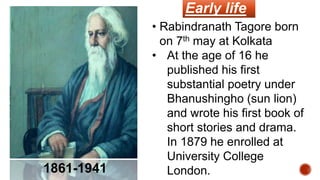
• Rabindranath Tagore born
on 7th may at Kolkata
• At the age of 16 he
published his first
substantial poetry under
Bhanushingho (sun lion)
and wrote his first book of
short stories and drama.
In 1879 he enrolled at
University College
London.
1861-1941
Early life
Fame & International
Recognition
• In 1901 he moved to Shantiniketan
where he composed ‘Naivedya’ and
'kheya’ .By then he gained immense
popularity among Bengali readers.
• In 1912 he went to England and toom a
shef of his translated works with
him.There he introduced his works to
some of the prominent writers including
william buttler yeats,Ezra pound,Rbert
Bridges.
Political Opinion
• He criticized Swadeshi movement by Mahatma Gandhi
in his essay The Cult of the Chakra.He believed in the
coexistence of the British and Indians and stated that
British rule in India was political symptom.
• He supported the Indian independence movement and
following Jallianwala Bagh massacre,he even renounced
his Knighthood on 30 may 1919
• On the whole ,his vision of a free India was based not on
its independence from the foreign rule,but on liberty of
thought,action and conscience of its citizens.
Major works • Gitanjali
• Jana Gana Mana
• Aamaar Sonaar Banglaa
• Sonar Tari (The Golden Boat)
• Manasi (The Ideal One)
• Gitimalya (wreath of songs)
• Balaka (A Flight of Swans)
• Ghare Daire (The Hone and
The World)
• Guru
Awards & Achievements
• For his momentous and literary works,Tagore
was honored with the Noble prize in literature
on14 November 1913.
• He was also conferred Knighthood in
1915,which he renounced in 1919 after the
Jallianwala Bagh carnage.
• In 1940, Oxford University awarded him with
a Doctorate of Literature in a special
ceremony arranged at Shantiniketan.
His philosophy
• As a Vedantist
• As an Individualist
• As a Naturalist
• As an Idealisti
• As an spiritualist
• As an Humanist
• Tagore’s Internationalism : He was an
ardent prophet of world unity.He believed
in world brotherhood.
Edward John, Rabindranath
Tagore : Poet and Dramatist. –
London : Oxford University
Press, 1948
Rothenstein, William, Six
Portraits of Rabindranath
Tagore. – London, 1915
Ghose, Sisirkumar, The Later
Poems of Tagore. – London,
1961
Citations
 'Rabindranath tagore.pptx sem3

'Rabindranath tagore.pptx sem3

  • 1.
    Indian English Literature– (Pre- Independence) Rabindranath Tagore :Nation’s Fame Nanditaba Chudasama Semester : 3 Enrollment no – 306920642000006 Roll no :12 Batch : 2020 – 2022 S. B Gardi Department of English Bhavnagar University
  • 2.
    • Rabindranath Tagoreborn on 7th may at Kolkata • At the age of 16 he published his first substantial poetry under Bhanushingho (sun lion) and wrote his first book of short stories and drama. In 1879 he enrolled at University College London. 1861-1941 Early life
  • 3.
    Fame & International Recognition •In 1901 he moved to Shantiniketan where he composed ‘Naivedya’ and 'kheya’ .By then he gained immense popularity among Bengali readers. • In 1912 he went to England and toom a shef of his translated works with him.There he introduced his works to some of the prominent writers including william buttler yeats,Ezra pound,Rbert Bridges.
  • 4.
    Political Opinion • Hecriticized Swadeshi movement by Mahatma Gandhi in his essay The Cult of the Chakra.He believed in the coexistence of the British and Indians and stated that British rule in India was political symptom. • He supported the Indian independence movement and following Jallianwala Bagh massacre,he even renounced his Knighthood on 30 may 1919 • On the whole ,his vision of a free India was based not on its independence from the foreign rule,but on liberty of thought,action and conscience of its citizens.
  • 5.
    Major works •Gitanjali • Jana Gana Mana • Aamaar Sonaar Banglaa • Sonar Tari (The Golden Boat) • Manasi (The Ideal One) • Gitimalya (wreath of songs) • Balaka (A Flight of Swans) • Ghare Daire (The Hone and The World) • Guru
  • 6.
    Awards & Achievements •For his momentous and literary works,Tagore was honored with the Noble prize in literature on14 November 1913. • He was also conferred Knighthood in 1915,which he renounced in 1919 after the Jallianwala Bagh carnage. • In 1940, Oxford University awarded him with a Doctorate of Literature in a special ceremony arranged at Shantiniketan.
  • 7.
    His philosophy • Asa Vedantist • As an Individualist • As a Naturalist • As an Idealisti • As an spiritualist • As an Humanist • Tagore’s Internationalism : He was an ardent prophet of world unity.He believed in world brotherhood.
  • 8.
    Edward John, Rabindranath Tagore: Poet and Dramatist. – London : Oxford University Press, 1948 Rothenstein, William, Six Portraits of Rabindranath Tagore. – London, 1915 Ghose, Sisirkumar, The Later Poems of Tagore. – London, 1961 Citations