Rabindranath Tagore
Name : Kunal More
Subject : English
Submitted by:
Introduction
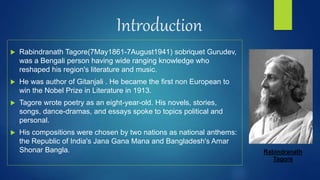
 Rabindranath Tagore(7May1861-7August1941) sobriquet Gurudev,
was a Bengali person having wide ranging knowledge who
reshaped his region's literature and music.
 He was author of Gitanjali . He became the first non European to
win the Nobel Prize in Literature in 1913.
 Tagore wrote poetry as an eight-year-old. His novels, stories,
songs, dance-dramas, and essays spoke to topics political and
personal.
 His compositions were chosen by two nations as national anthems:
the Republic of India's Jana Gana Mana and Bangladesh's Amar
Shonar Bangla. Rabindranath
Tagore
School and college life
 Tagore received his education at home.
 He was taught in Bengali, with English lessons in the afternoon.
 He read Bengali poems at his early age and began writing poetry
himself by the age of 8.
 At the age of 16, he published his first substantial poetry under the
pseudonym- Bhanushingho [Sun Lion] and wrote his first book of
short stories and dramas.
 His father wanted him to become a Barrister and he was sent to
England for this reason.
 In 1879, he enrolled at University College, London, but was called
back by his father to return to India in 1880.
 He read law at University College.
Major works
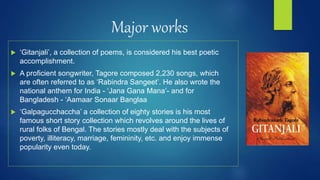
 ‘Gitanjali’, a collection of poems, is considered his best poetic
accomplishment.
 A proficient songwriter, Tagore composed 2,230 songs, which
are often referred to as ‘Rabindra Sangeet’. He also wrote the
national anthem for India - ‘Jana Gana Mana’- and for
Bangladesh - ‘Aamaar Sonaar Banglaa
 ‘Galpagucchaccha’ a collection of eighty stories is his most
famous short story collection which revolves around the lives of
rural folks of Bengal. The stories mostly deal with the subjects of
poverty, illiteracy, marriage, femininity, etc. and enjoy immense
popularity even today.
Awards and Achievements
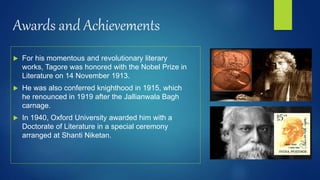
 For his momentous and revolutionary literary
works, Tagore was honored with the Nobel Prize in
Literature on 14 November 1913.
 He was also conferred knighthood in 1915, which
he renounced in 1919 after the Jallianwala Bagh
carnage.
 In 1940, Oxford University awarded him with a
Doctorate of Literature in a special ceremony
arranged at Shanti Niketan.
Music & Arts
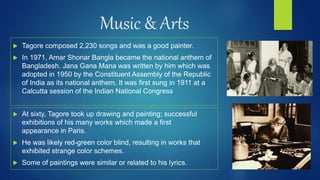
 At sixty, Tagore took up drawing and painting; successful
exhibitions of his many works which made a first
appearance in Paris.
 He was likely red-green color blind, resulting in works that
exhibited strange color schemes.
 Some of paintings were similar or related to his lyrics.
 Tagore composed 2,230 songs and was a good painter.
 In 1971, Amar Shonar Bangla became the national anthem of
Bangladesh. Jana Gana Mana was written by him which was
adopted in 1950 by the Constituent Assembly of the Republic
of India as its national anthem. It was first sung in 1911 at a
Calcutta session of the Indian National Congress
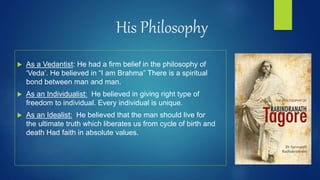
His Philosophy
 As a Vedantist: He had a firm belief in the philosophy of
‘Veda’. He believed in “I am Brahma” There is a spiritual
bond between man and man.
 As an Individualist: He believed in giving right type of
freedom to individual. Every individual is unique.
 As an Idealist: He believed that the man should live for
the ultimate truth which liberates us from cycle of birth and
death Had faith in absolute values.
 As a Spiritualist: He believed that every individual should try to
attain spiritual perfection.
 As a Humanist: He preached human brotherhood, having faith
in fundamental unity of mankind. He remarked that ”even God
depends upon man for perfecting his Universe.”
 As a Naturalist: He considered nature as a great teacher. God
revealed himself through various forms, colors and rhythm of
nature.
 Tagore’s Internationalism: He was an ardent prophet of world
unity. He believed in world brotherhood.
Famous Poetries
 Although Tagore wrote successfully in all literary genres, he
was first of all a poet. Among his fifty and odd volumes of
poetry, some of them are:
• Manasi (1890) [The Ideal One]
• Sonar Tari (1894) [The Golden Boat]
• Gitanjali (1910) [Song Offerings]
• Gitimalya (1914) [Wreath of Songs]
• Balaka (1916) [A Flight of Swans]
Thank you !

Rabindranath Tagore Lifestyle (Presentation)

  • 1.
    Rabindranath Tagore Name :Kunal More Subject : English Submitted by:
  • 2.
    Introduction  Rabindranath Tagore(7May1861-7August1941)sobriquet Gurudev, was a Bengali person having wide ranging knowledge who reshaped his region's literature and music.  He was author of Gitanjali . He became the first non European to win the Nobel Prize in Literature in 1913.  Tagore wrote poetry as an eight-year-old. His novels, stories, songs, dance-dramas, and essays spoke to topics political and personal.  His compositions were chosen by two nations as national anthems: the Republic of India's Jana Gana Mana and Bangladesh's Amar Shonar Bangla. Rabindranath Tagore
  • 3.
    School and collegelife  Tagore received his education at home.  He was taught in Bengali, with English lessons in the afternoon.  He read Bengali poems at his early age and began writing poetry himself by the age of 8.  At the age of 16, he published his first substantial poetry under the pseudonym- Bhanushingho [Sun Lion] and wrote his first book of short stories and dramas.  His father wanted him to become a Barrister and he was sent to England for this reason.  In 1879, he enrolled at University College, London, but was called back by his father to return to India in 1880.  He read law at University College.
  • 4.
    Major works  ‘Gitanjali’,a collection of poems, is considered his best poetic accomplishment.  A proficient songwriter, Tagore composed 2,230 songs, which are often referred to as ‘Rabindra Sangeet’. He also wrote the national anthem for India - ‘Jana Gana Mana’- and for Bangladesh - ‘Aamaar Sonaar Banglaa  ‘Galpagucchaccha’ a collection of eighty stories is his most famous short story collection which revolves around the lives of rural folks of Bengal. The stories mostly deal with the subjects of poverty, illiteracy, marriage, femininity, etc. and enjoy immense popularity even today.
  • 5.
    Awards and Achievements For his momentous and revolutionary literary works, Tagore was honored with the Nobel Prize in Literature on 14 November 1913.  He was also conferred knighthood in 1915, which he renounced in 1919 after the Jallianwala Bagh carnage.  In 1940, Oxford University awarded him with a Doctorate of Literature in a special ceremony arranged at Shanti Niketan.
  • 6.
    Music & Arts At sixty, Tagore took up drawing and painting; successful exhibitions of his many works which made a first appearance in Paris.  He was likely red-green color blind, resulting in works that exhibited strange color schemes.  Some of paintings were similar or related to his lyrics.  Tagore composed 2,230 songs and was a good painter.  In 1971, Amar Shonar Bangla became the national anthem of Bangladesh. Jana Gana Mana was written by him which was adopted in 1950 by the Constituent Assembly of the Republic of India as its national anthem. It was first sung in 1911 at a Calcutta session of the Indian National Congress
  • 7.
    His Philosophy  Asa Vedantist: He had a firm belief in the philosophy of ‘Veda’. He believed in “I am Brahma” There is a spiritual bond between man and man.  As an Individualist: He believed in giving right type of freedom to individual. Every individual is unique.  As an Idealist: He believed that the man should live for the ultimate truth which liberates us from cycle of birth and death Had faith in absolute values.
  • 8.
     As aSpiritualist: He believed that every individual should try to attain spiritual perfection.  As a Humanist: He preached human brotherhood, having faith in fundamental unity of mankind. He remarked that ”even God depends upon man for perfecting his Universe.”  As a Naturalist: He considered nature as a great teacher. God revealed himself through various forms, colors and rhythm of nature.  Tagore’s Internationalism: He was an ardent prophet of world unity. He believed in world brotherhood.
  • 9.
    Famous Poetries  AlthoughTagore wrote successfully in all literary genres, he was first of all a poet. Among his fifty and odd volumes of poetry, some of them are: • Manasi (1890) [The Ideal One] • Sonar Tari (1894) [The Golden Boat] • Gitanjali (1910) [Song Offerings] • Gitimalya (1914) [Wreath of Songs] • Balaka (1916) [A Flight of Swans]
  • 10.