Common
laboratory
animal
MARTIN JACOB
1ST YR M.PHARM
Department of pharmacology
Shree devi college of pharmacy
manglore
Introduction
 Laboratory animals are used for different
studies
 It may include bioassay, preclinical studies etc.
 Healthy and well being of lab. animal entirely
depend almost entirely on
a. the care
b. humanity
c. watchfulness of the staff of the animal house.
1. Fluid
2. Diet
3. Cleanliness
4. Litter
5. Cages
6. Labelling of the cages
7. Ventilation
8. Temperature and Humidity
9. Handling
10. Breeding
11. Marking animals
12. The detection of signs of disease in animals
RABBIT
Rectal temperature:- 38.7 C-39.1 C
Normal respiratory rate:- 55 per minute
Pulse rate:- 135 per min
Gestation period:- 28-31 days
Weaning age:- 6-8 weeks
Mating age:- 6-9 months
Litters:- 4 yearly ; average 4 litter
Room temp:- 15.5-18.5
Humidity:- 40 -45 percent
Weight – adult:- 0.9-6.75 kg
Cages(Rabbit)
 Cages are best made of galvanized iron.
 The minimum size for a medium sized rabbit
is 2×2×1(1/2)ft.,
 Young rabbits up to 3 months of age may be
housed together but after that time sex should
be separated.
 From 8 -10 young rabbits may be kept together
in pen similar to that used for guinea pigs.
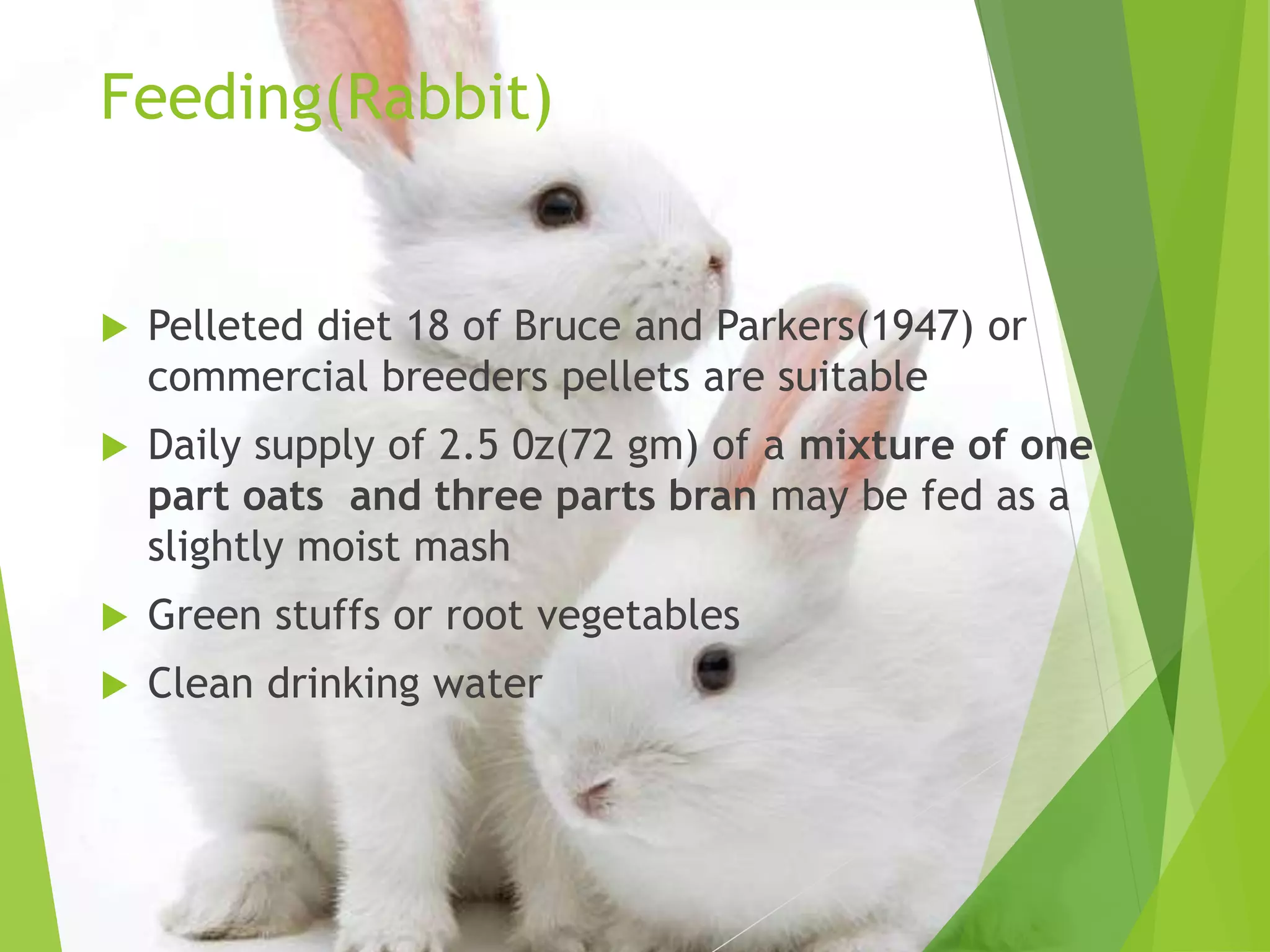
Feeding(Rabbit)
 Pelleted diet 18 of Bruce and Parkers(1947) or
commercial breeders pellets are suitable
 Daily supply of 2.5 0z(72 gm) of a mixture of one
part oats and three parts bran may be fed as a
slightly moist mash
 Green stuffs or root vegetables
 Clean drinking water
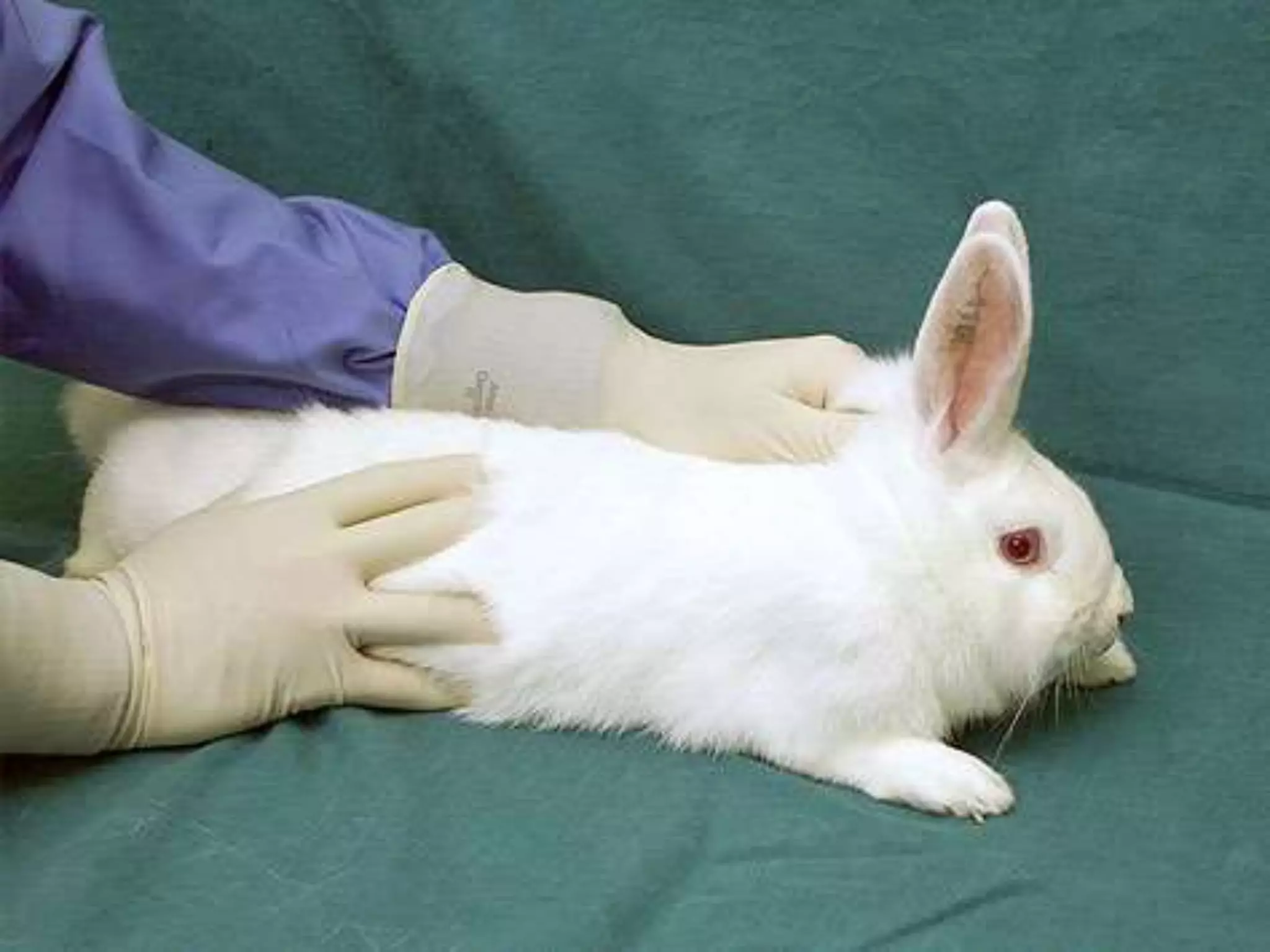
Handling(Rabbit)
 Smooth ear of the rabbit back
 pick up the ears and loose skin at the back of the
neck with one hand in a firm grip
 place the other hand under the hind quarter to
support the weight and lift gently.
 Never be lifted by ear alone
 Should be placed on a non-slippery surface
 If restraint is required during anesthesia or
inoculation , should be wrapped in a roller towel or
placed in a special box.
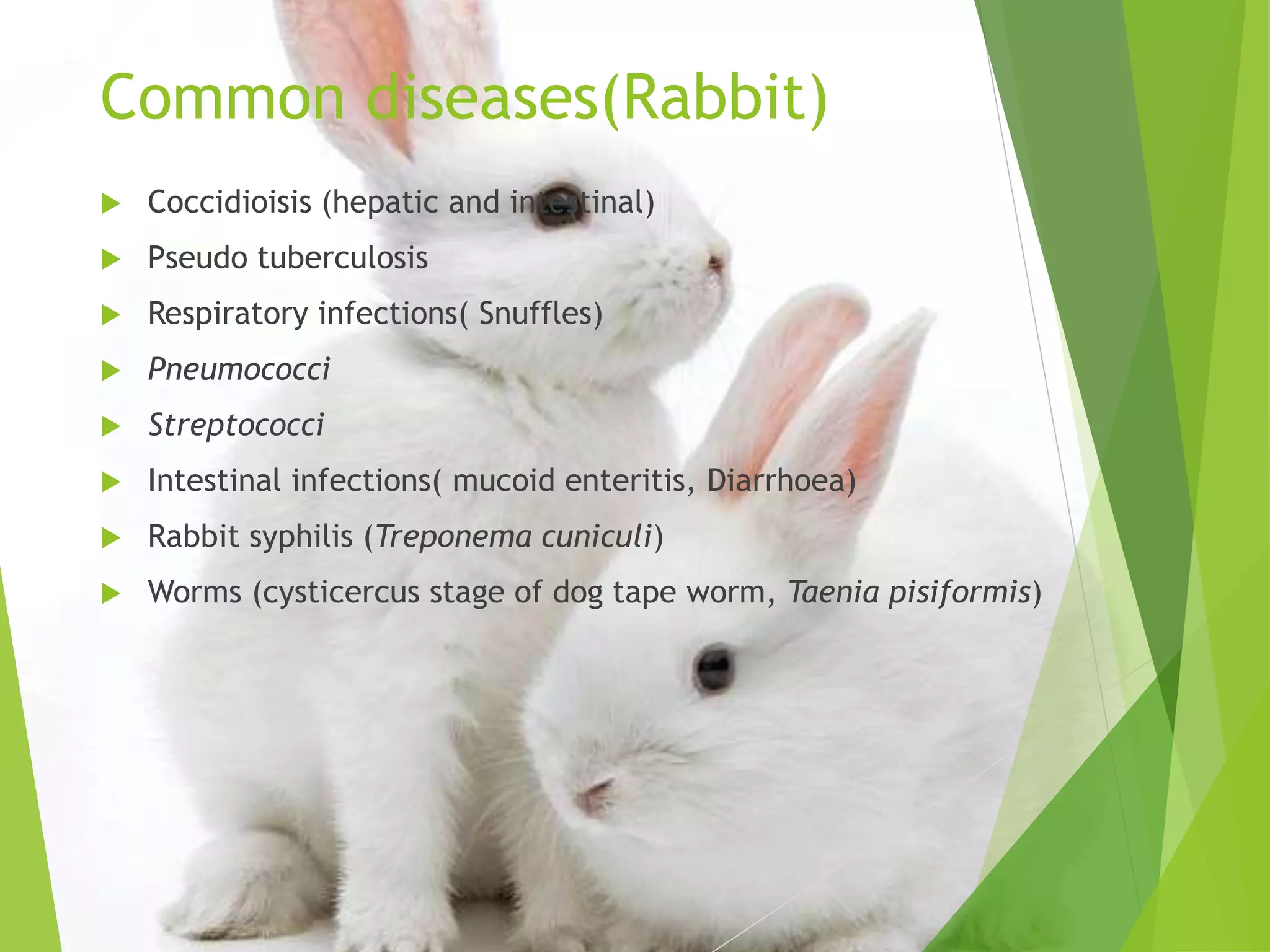
Common diseases(Rabbit)
 Coccidioisis (hepatic and intestinal)
 Pseudo tuberculosis
 Respiratory infections( Snuffles)
 Pneumococci
 Streptococci
 Intestinal infections( mucoid enteritis, Diarrhoea)
 Rabbit syphilis (Treponema cuniculi)
 Worms (cysticercus stage of dog tape worm, Taenia pisiformis)
Experimental
procedure(Rabbit)
 Antisera
 Anesthesia
 Scarification
 Subcutaneous inoculation
 Intra-venous inoculation
 Intra-peritoneal inoculation
 Intra-cerebral inoculation
 Intra-testicular
 Ophthalmic
 Collection of blood
Application
 Rabbits are commonly used for toxicity and safety testing
of substances such as drugs, chemicals and medical
devices.
 They are used in skin and eye irritation studies, such as
the archaic and painful Draize tests for cosmetics,
personal care, household products and other chemicals.
 A number of rabbit models have been developed to study
human diseases, the most common being cardiovascular
disease, cancer and AIDS. They have also been used as
bioreactors for the production of pharmaceutical proteins.
 The rabbit is the breed of choice for polyclonal antibody
production, tools commonly used in a variety of research
methodologies.
Guinea pig
 Rectal temp.:- 37.6-38.9
 Normal respiration rate:- 80 per minute
 Pulse rate:- 150 per minute
 Gestation period:- 59-72 days( avg. 63 days)
 Weaning age:- 14-21 days
 Mating age:- 12-30 weeks
 Litters:- 3 yearly ;average litter,3
 Room temp:- 18.5- 21
 Humidity:- 45%
 Weight –weaning :- 120g, adult:- 200-1000g
Cage (Guinea pig)
 Stock runs should be abt. 4×6 ft. and 1 ft. 8 in high
 One square foot of space should be allowed for each
animal
 not more than 25 animals should not be kept in any
one pen.
 For expt. Animals galvanized iron cages are
recommended and sterilized.
 A convenient size of 14×9×8 in fitting in a tray 1.5 in
deep
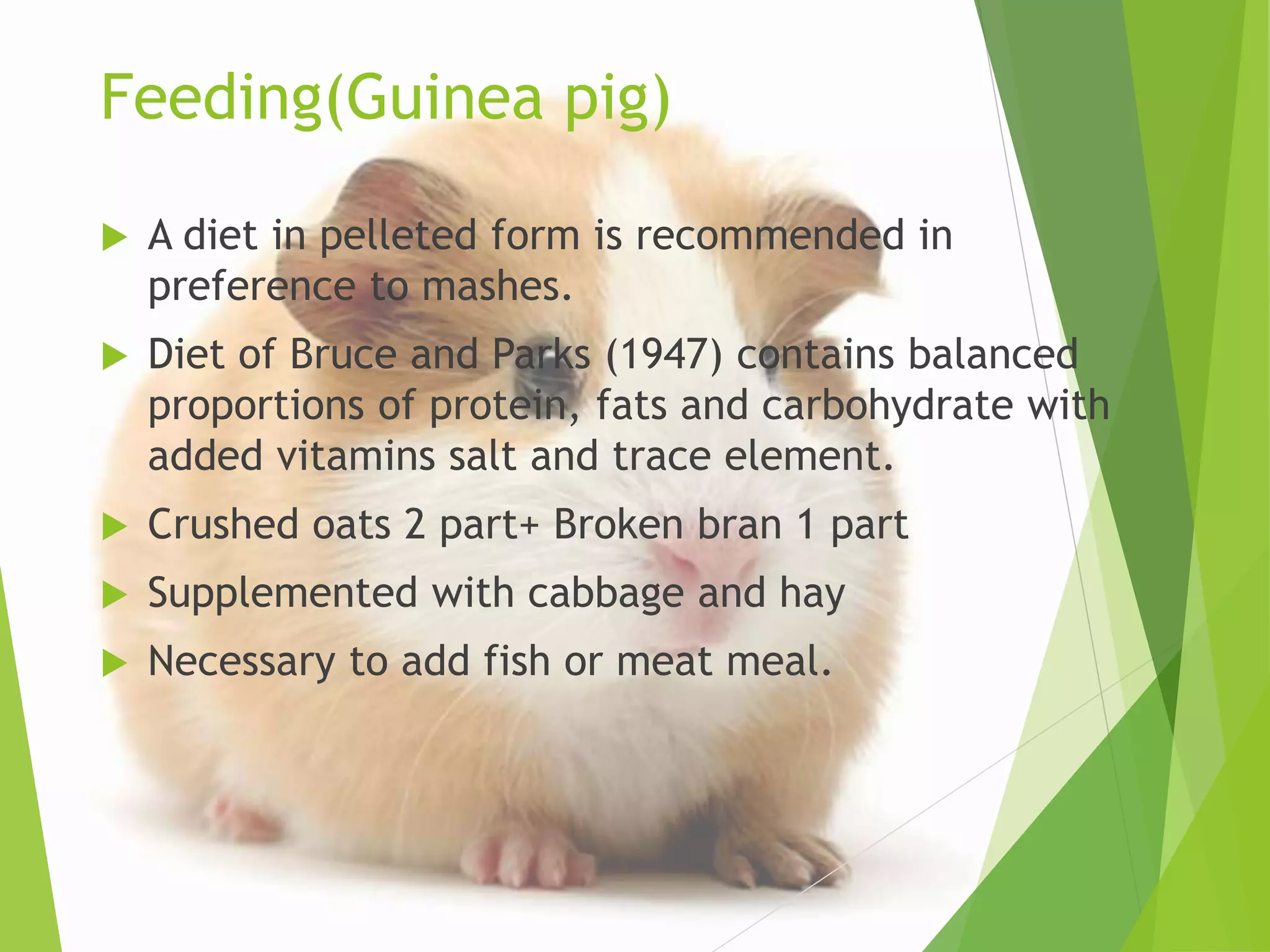
Feeding(Guinea pig)
 A diet in pelleted form is recommended in
preference to mashes.
 Diet of Bruce and Parks (1947) contains balanced
proportions of protein, fats and carbohydrate with
added vitamins salt and trace element.
 Crushed oats 2 part+ Broken bran 1 part
 Supplemented with cabbage and hay
 Necessary to add fish or meat meal.
Handling
 Place one hand across the back of the animal with
thumb behind the shoulder and the other fingers well
forward on the opposite side
 Lift the animal gently and support its weight with
other hand placed palm uppermost under the hind
quarters.
Common diseases(Guinea pig)
 Pseudo tuberculosis (acute or chronic)
 Abscesses in lymphatic glands
 Respiratory tract infections
 Intestinal infections
 Protozoan disease( Coccidioisis, Toxoplasmosis)
 Viral disease
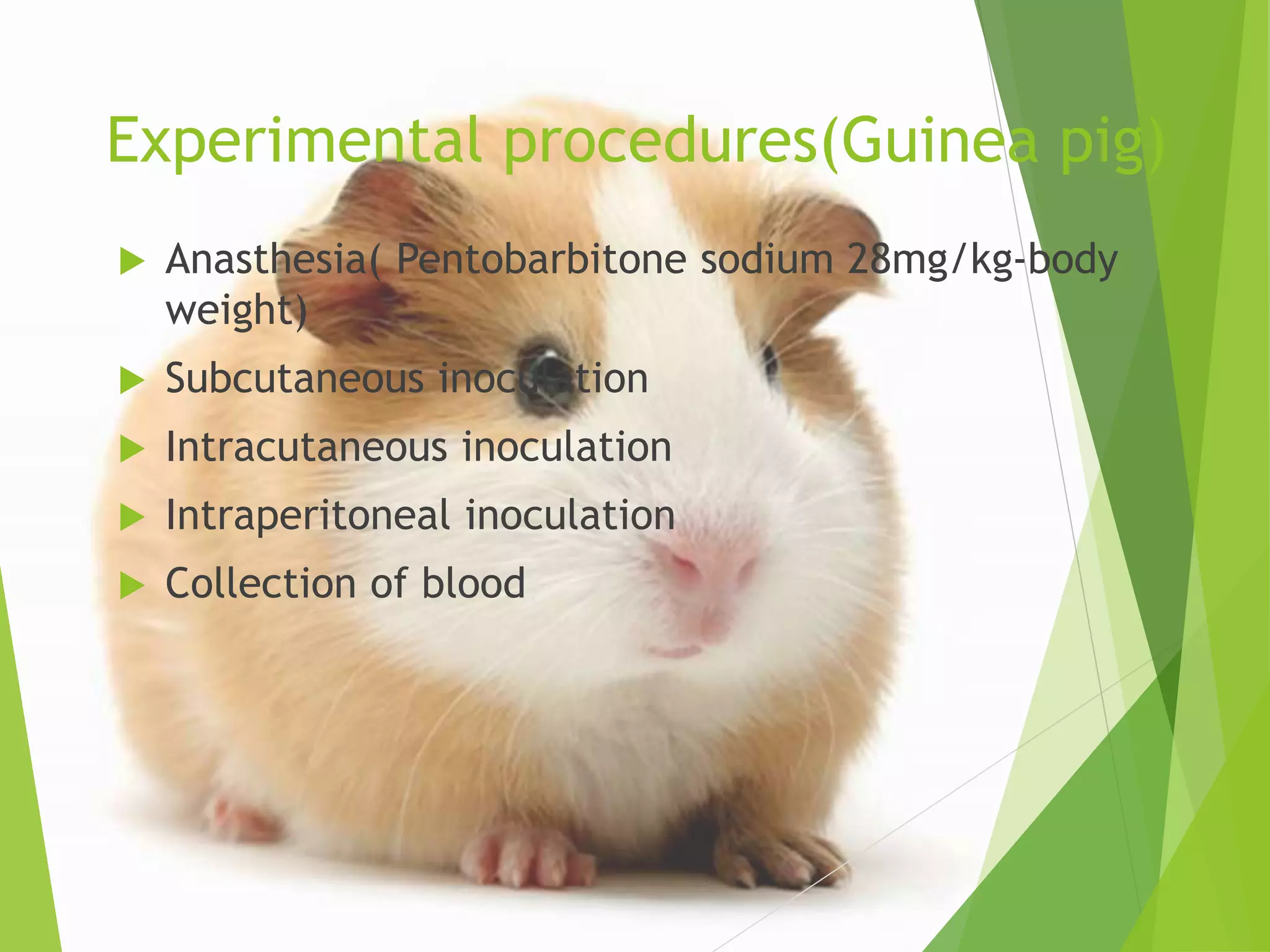
Experimental procedures(Guinea pig)
 Anasthesia( Pentobarbitone sodium 28mg/kg-body
weight)
 Subcutaneous inoculation
 Intracutaneous inoculation
 Intraperitoneal inoculation
 Collection of blood
Applicaton
 Highly sensitive to histamine, therefor,used in
experimental asthma to study bronchodilators
 In study of LA
Mice
Mice
 Normal temperature:- 37.4
 Pulse rate:- 120
 Estrous cycle:- 4-5 days
 Gestation period:- 19-21 days
 Weaning age:- 19-21 days
 Mating age:- 6-8 weeks
 Litters:- 8-12 yearly; average litter, 7-8
 Room temp.:- 20-21
 Humidity:- 50-60 %
 Weight- weaning : 7g ,adult:- 25-28 g
Cage(Mouse)
 Many different designs of mouse and no one pattern is
the standard
 Aluminium box approx. 6×12×6 in deep with tapering
side to facilitate stacking .
 The lids are made of steel sheet or of strong wire mesh
and are designed so that hopper is built into them and
accommodation provided to hold the drinking bottle.
 The cages are light, durable and easily sterilized by dry
or moist heat.
Feeding(Mouse)
 Pelleted diets such as diet 86 of Howie(1952) or
diet 41 of Bruce (1950) are satisfactory
 Fresh water in drinking bottles must be provided
Handling(Mouse)
 An assistant takes a grip on the middle of tail of the animal with the left
hand and gently raises the hind limbs floor of the cage
 A mouse held in the position cannot turn around the bite.
 Then with the right finger and thumb a fold of skin is taken up as close as
possible to the head.
 The animal can now be lifted into convenient position for the operator to
carry out simple inoculation procedures.
 Place the animal on a rough surface and hold it by its tail with right hand,
 then pick up loose skin at the base of neck with the left forefinger and
thumb,
 lift and turn the left hand palm uppermost at the same time catching the
tail and pressing it against the palm with the left little finger.
 The right hand is free to pick up the syringe
Common diseases(Mouse)
 Salmonellosis
 Ectromelia ( mouse pox)
 Streptobacillus moniliformis infection
 Miscellaneous virus infection
 Worms( Taenia taenia- formis)
Experimental procedures(Mouse)
 Anasthesia
short acting : Ether
Long acting: Pentobarbitone sodium
 Subcutaneous inoculation
 Intraperitoneal inoculation
 Intracerebral inoculation
 Intravenous inoculation
 Intranasal inoculation
 Collection of blood
Application (mouse)
 rodents are small, easily housed and maintained, and
adapt well to new surroundings.
 They also reproduce quickly and have a short lifespan
of two to three years, so several generations of mice
can be observed in a relatively short period of time.
 Used in toxicity study , bioassay(insulin), testing
analgesics, cns active drugs
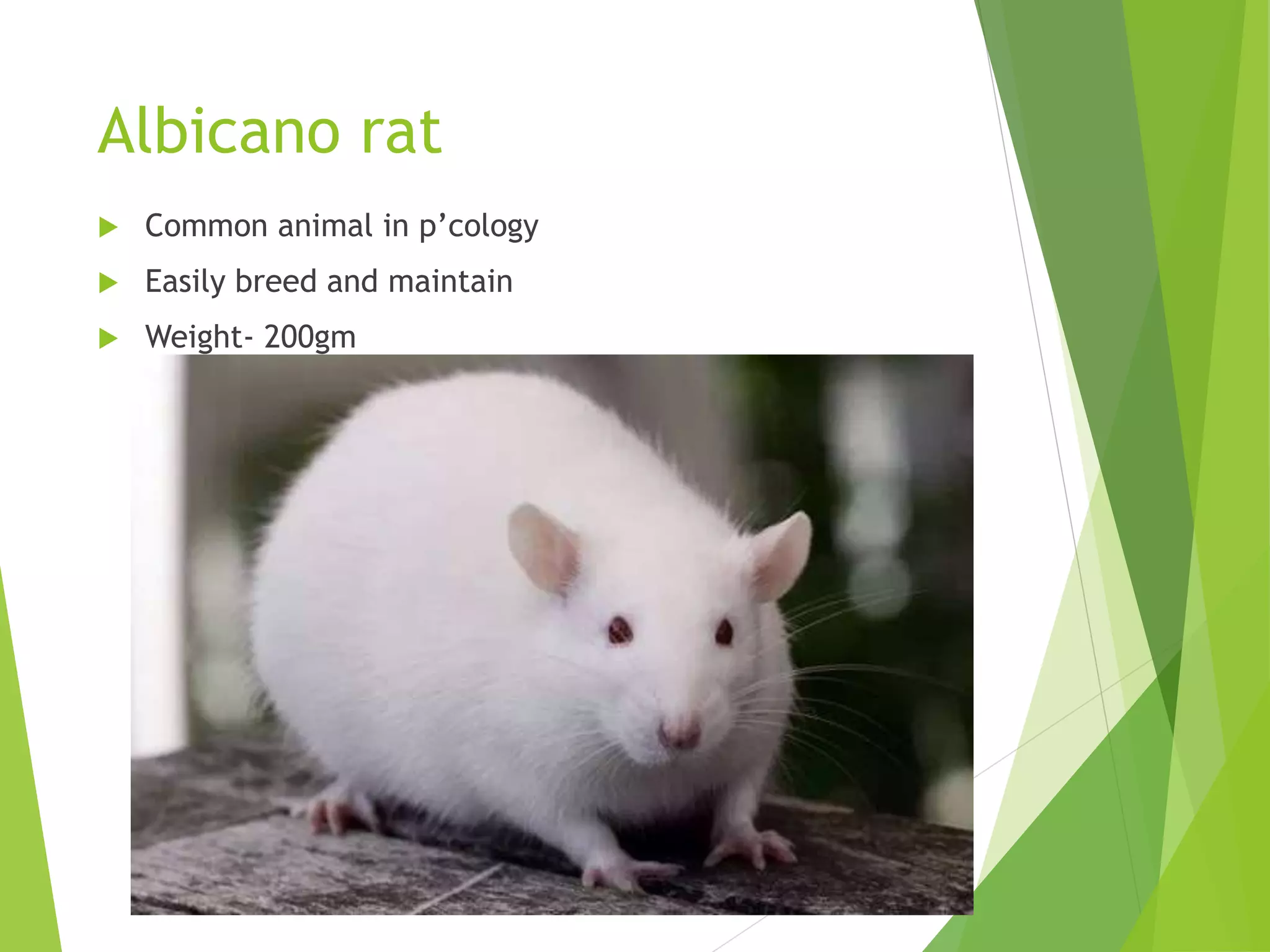
Albicano rat
 Common animal in p’cology
 Easily breed and maintain
 Weight- 200gm
Application
 Resembles man in several organ function
and nutrition
 Sensitive to most of drugs; makes very
usefull experimental animals
 Donot have vomiting centre (cant study
about emetics)
Frog
 Used in experimental p’cology
 Weight –(150-200g)
Application
 Isolated frog heart, rectus abdominis
muscle prepn
 Study of muscle nerve preparation and
ciliary movements of some organs
 Study of nerve block type of anaesthesia.
 It is inexpensive and easily available
laboratory animals

laboratory animals

  • 1.
    Common laboratory animal MARTIN JACOB 1ST YRM.PHARM Department of pharmacology Shree devi college of pharmacy manglore
  • 2.
    Introduction  Laboratory animalsare used for different studies  It may include bioassay, preclinical studies etc.  Healthy and well being of lab. animal entirely depend almost entirely on a. the care b. humanity c. watchfulness of the staff of the animal house.
  • 3.
    1. Fluid 2. Diet 3.Cleanliness 4. Litter 5. Cages 6. Labelling of the cages 7. Ventilation 8. Temperature and Humidity 9. Handling 10. Breeding 11. Marking animals 12. The detection of signs of disease in animals
  • 5.
    RABBIT Rectal temperature:- 38.7C-39.1 C Normal respiratory rate:- 55 per minute Pulse rate:- 135 per min Gestation period:- 28-31 days Weaning age:- 6-8 weeks Mating age:- 6-9 months Litters:- 4 yearly ; average 4 litter Room temp:- 15.5-18.5 Humidity:- 40 -45 percent Weight – adult:- 0.9-6.75 kg
  • 6.
    Cages(Rabbit)  Cages arebest made of galvanized iron.  The minimum size for a medium sized rabbit is 2×2×1(1/2)ft.,  Young rabbits up to 3 months of age may be housed together but after that time sex should be separated.  From 8 -10 young rabbits may be kept together in pen similar to that used for guinea pigs.
  • 7.
    Feeding(Rabbit)  Pelleted diet18 of Bruce and Parkers(1947) or commercial breeders pellets are suitable  Daily supply of 2.5 0z(72 gm) of a mixture of one part oats and three parts bran may be fed as a slightly moist mash  Green stuffs or root vegetables  Clean drinking water
  • 8.
    Handling(Rabbit)  Smooth earof the rabbit back  pick up the ears and loose skin at the back of the neck with one hand in a firm grip  place the other hand under the hind quarter to support the weight and lift gently.  Never be lifted by ear alone  Should be placed on a non-slippery surface  If restraint is required during anesthesia or inoculation , should be wrapped in a roller towel or placed in a special box.
  • 10.
    Common diseases(Rabbit)  Coccidioisis(hepatic and intestinal)  Pseudo tuberculosis  Respiratory infections( Snuffles)  Pneumococci  Streptococci  Intestinal infections( mucoid enteritis, Diarrhoea)  Rabbit syphilis (Treponema cuniculi)  Worms (cysticercus stage of dog tape worm, Taenia pisiformis)
  • 11.
    Experimental procedure(Rabbit)  Antisera  Anesthesia Scarification  Subcutaneous inoculation  Intra-venous inoculation  Intra-peritoneal inoculation  Intra-cerebral inoculation  Intra-testicular  Ophthalmic  Collection of blood
  • 12.
    Application  Rabbits arecommonly used for toxicity and safety testing of substances such as drugs, chemicals and medical devices.  They are used in skin and eye irritation studies, such as the archaic and painful Draize tests for cosmetics, personal care, household products and other chemicals.  A number of rabbit models have been developed to study human diseases, the most common being cardiovascular disease, cancer and AIDS. They have also been used as bioreactors for the production of pharmaceutical proteins.  The rabbit is the breed of choice for polyclonal antibody production, tools commonly used in a variety of research methodologies.
  • 13.
    Guinea pig  Rectaltemp.:- 37.6-38.9  Normal respiration rate:- 80 per minute  Pulse rate:- 150 per minute  Gestation period:- 59-72 days( avg. 63 days)  Weaning age:- 14-21 days  Mating age:- 12-30 weeks  Litters:- 3 yearly ;average litter,3  Room temp:- 18.5- 21  Humidity:- 45%  Weight –weaning :- 120g, adult:- 200-1000g
  • 15.
    Cage (Guinea pig) Stock runs should be abt. 4×6 ft. and 1 ft. 8 in high  One square foot of space should be allowed for each animal  not more than 25 animals should not be kept in any one pen.  For expt. Animals galvanized iron cages are recommended and sterilized.  A convenient size of 14×9×8 in fitting in a tray 1.5 in deep
  • 16.
    Feeding(Guinea pig)  Adiet in pelleted form is recommended in preference to mashes.  Diet of Bruce and Parks (1947) contains balanced proportions of protein, fats and carbohydrate with added vitamins salt and trace element.  Crushed oats 2 part+ Broken bran 1 part  Supplemented with cabbage and hay  Necessary to add fish or meat meal.
  • 17.
    Handling  Place onehand across the back of the animal with thumb behind the shoulder and the other fingers well forward on the opposite side  Lift the animal gently and support its weight with other hand placed palm uppermost under the hind quarters.
  • 18.
    Common diseases(Guinea pig) Pseudo tuberculosis (acute or chronic)  Abscesses in lymphatic glands  Respiratory tract infections  Intestinal infections  Protozoan disease( Coccidioisis, Toxoplasmosis)  Viral disease
  • 19.
    Experimental procedures(Guinea pig) Anasthesia( Pentobarbitone sodium 28mg/kg-body weight)  Subcutaneous inoculation  Intracutaneous inoculation  Intraperitoneal inoculation  Collection of blood
  • 20.
    Applicaton  Highly sensitiveto histamine, therefor,used in experimental asthma to study bronchodilators  In study of LA
  • 21.
  • 22.
    Mice  Normal temperature:-37.4  Pulse rate:- 120  Estrous cycle:- 4-5 days  Gestation period:- 19-21 days  Weaning age:- 19-21 days  Mating age:- 6-8 weeks  Litters:- 8-12 yearly; average litter, 7-8  Room temp.:- 20-21  Humidity:- 50-60 %  Weight- weaning : 7g ,adult:- 25-28 g
  • 23.
    Cage(Mouse)  Many differentdesigns of mouse and no one pattern is the standard  Aluminium box approx. 6×12×6 in deep with tapering side to facilitate stacking .  The lids are made of steel sheet or of strong wire mesh and are designed so that hopper is built into them and accommodation provided to hold the drinking bottle.  The cages are light, durable and easily sterilized by dry or moist heat.
  • 24.
    Feeding(Mouse)  Pelleted dietssuch as diet 86 of Howie(1952) or diet 41 of Bruce (1950) are satisfactory  Fresh water in drinking bottles must be provided
  • 25.
    Handling(Mouse)  An assistanttakes a grip on the middle of tail of the animal with the left hand and gently raises the hind limbs floor of the cage  A mouse held in the position cannot turn around the bite.  Then with the right finger and thumb a fold of skin is taken up as close as possible to the head.  The animal can now be lifted into convenient position for the operator to carry out simple inoculation procedures.  Place the animal on a rough surface and hold it by its tail with right hand,  then pick up loose skin at the base of neck with the left forefinger and thumb,  lift and turn the left hand palm uppermost at the same time catching the tail and pressing it against the palm with the left little finger.  The right hand is free to pick up the syringe
  • 27.
    Common diseases(Mouse)  Salmonellosis Ectromelia ( mouse pox)  Streptobacillus moniliformis infection  Miscellaneous virus infection  Worms( Taenia taenia- formis)
  • 28.
    Experimental procedures(Mouse)  Anasthesia shortacting : Ether Long acting: Pentobarbitone sodium  Subcutaneous inoculation  Intraperitoneal inoculation  Intracerebral inoculation  Intravenous inoculation  Intranasal inoculation  Collection of blood
  • 29.
    Application (mouse)  rodentsare small, easily housed and maintained, and adapt well to new surroundings.  They also reproduce quickly and have a short lifespan of two to three years, so several generations of mice can be observed in a relatively short period of time.  Used in toxicity study , bioassay(insulin), testing analgesics, cns active drugs
  • 30.
    Albicano rat  Commonanimal in p’cology  Easily breed and maintain  Weight- 200gm
  • 31.
    Application  Resembles manin several organ function and nutrition  Sensitive to most of drugs; makes very usefull experimental animals  Donot have vomiting centre (cant study about emetics)
  • 32.
    Frog  Used inexperimental p’cology  Weight –(150-200g)
  • 33.
    Application  Isolated frogheart, rectus abdominis muscle prepn  Study of muscle nerve preparation and ciliary movements of some organs  Study of nerve block type of anaesthesia.  It is inexpensive and easily available