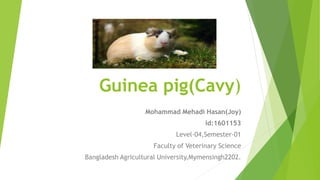
Guinea pig(Cavy)
Mohammad Mehadi Hasan(Joy)
Id:1601153
Level-04,Semester-01
Faculty of Veterinary Science
Bangladesh Agricultural University,Mymensingh2202.
Contents
 Introduction
 Taxonomic Classification 0f Guinea pig
 History of Guinea Pig
 Uses for Guinea Pig
 Common Guinea Pig Varieties
 Anatomic Features of Guinea Pig
 Physiology of Guinea Pig
 Identification of Male & Female Guinea pig
 Guinea Pig Reproduction
Contents
 Guinea Pig Housing
 Basics of Guinea Pig Feeding
 Unique Behavior of Guinea Pig
 Danger Potential of Guinea Pig
 Basic Care of Guinea Pig
 Handing Methods for Guinea Pig
 Blood collection site of Ginea Pig
 Different diseases of guinea pig
Introduction
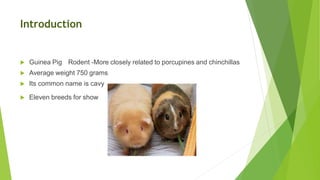
 Guinea Pig Rodent -More closely related to porcupines and chinchillas
 Average weight 750 grams
 Its common name is cavy
 Eleven breeds for show
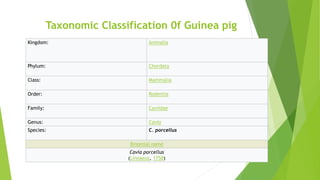
Taxonomic Classification 0f Guinea pig
Kingdom: Animalia
Phylum: Chordata
Class: Mammalia
Order: Rodentia
Family: Caviidae
Genus: Cavia
Species: C. porcellus
Binomial name
Cavia porcellus
(Linnaeus, 1758)
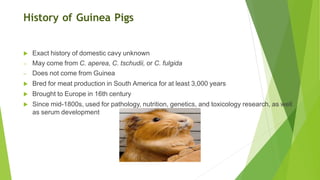
History of Guinea Pigs
 Exact history of domestic cavy unknown
– May come from C. aperea, C. tschudii, or C. fulgida
– Does not come from Guinea
 Bred for meat production in South America for at least 3,000 years
 Brought to Europe in 16th century
 Since mid-1800s, used for pathology, nutrition, genetics, and toxicology research, as well
as serum development
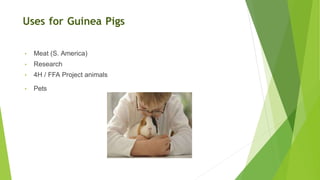
Uses for Guinea Pigs
• Meat (S. America)
• Research
• 4H / FFA Project animals
• Pets
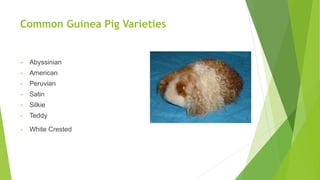
Common Guinea Pig Varieties
• Abyssinian
• American
• Peruvian
• Satin
• Silkie
• Teddy
• White Crested
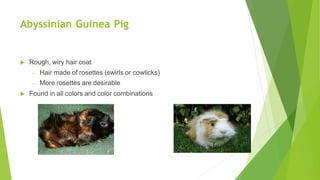
Abyssinian Guinea Pig
 Rough, wiry hair coat
– Hair made of rosettes (swirls or cowlicks)
– More rosettes are desirable
 Found in all colors and color combinations
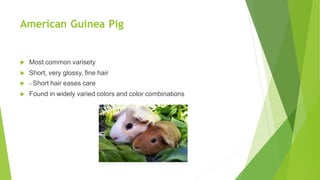
American Guinea Pig
 Most common varisety
 Short, very glossy, fine hair
 – Short hair eases care
 Found in widely varied colors and color combinations
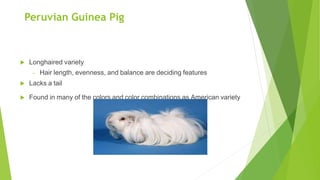
Peruvian Guinea Pig
 Longhaired variety
– Hair length, evenness, and balance are deciding features
 Lacks a tail
 Found in many of the colors and color combinations as American variety
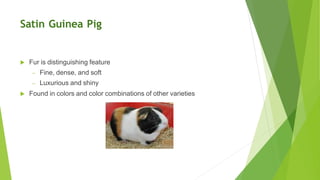
Satin Guinea Pig
 Fur is distinguishing feature
– Fine, dense, and soft
– Luxurious and shiny
 Found in colors and color combinations of other varieties
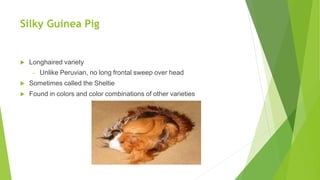
Silky Guinea Pig
 Longhaired variety
– Unlike Peruvian, no long frontal sweep over head
 Sometimes called the Sheltie
 Found in colors and color combinations of other varieties
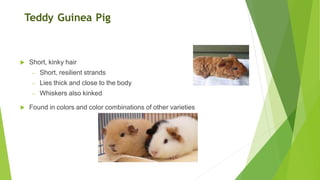
Teddy Guinea Pig
 Short, kinky hair
– Short, resilient strands
– Lies thick and close to the body
– Whiskers also kinked
 Found in colors and color combinations of other varieties
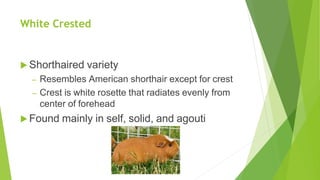
White Crested
 Shorthaired variety
– Resembles American shorthair except for crest
– Crest is white rosette that radiates evenly from
center of forehead
 Found mainly in self, solid, and agouti
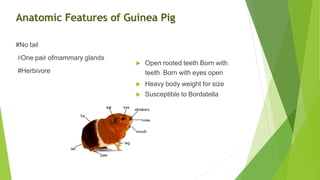
Anatomic Features of Guinea Pig
#No tail
#One pair ofmammary glands
#Herbivore
 Open rooted teeth Born with
teeth Born with eyes open
 Heavy body weight for size
 Susceptible to Bordatella
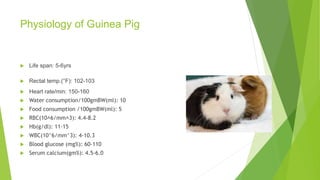
Physiology of Guinea Pig
 Life span: 5-6yrs
 Rectal temp.(°F): 102-103
 Heart rate/min: 150-160
 Water consumption/100gmBW(ml): 10
 Food consumption /100gmBW(ml): 5
 RBC(10˄6/mm˄3): 4.4-8.2
 Hb(g/dl): 11-15
 WBC(10^6/mm^3): 4-10.3
 Blood glucose (mg%): 60-110
 Serum calcium(gm%): 4.5-6.0
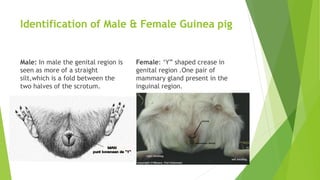
Identification of Male & Female Guinea pig
Male: In male the genital region is
seen as more of a straight
silt,which is a fold between the
two halves of the scrotum.
Female: ‘Y” shaped crease in
genital region .One pair of
mammary gland present in the
inguinal region.
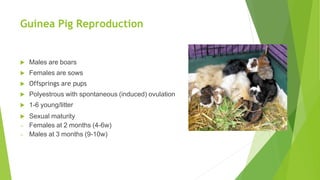
Guinea Pig Reproduction
 Males are boars
 Females are sows
 Offsprings are pups
 Polyestrous with spontaneous (induced) ovulation
 1-6 young/litter
 Sexual maturity
– Females at 2 months (4-6w)
– Males at 3 months (9-10w)
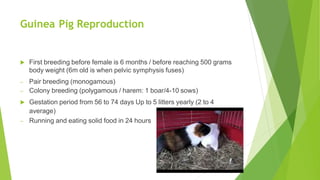
Guinea Pig Reproduction
 First breeding before female is 6 months / before reaching 500 grams
body weight (6m old is when pelvic symphysis fuses)
– Pair breeding (monogamous)
– Colony breeding (polygamous / harem: 1 boar/4-10 sows)
 Gestation period from 56 to 74 days Up to 5 litters yearly (2 to 4
average)
– Running and eating solid food in 24 hours
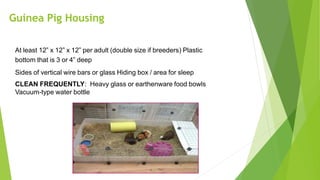
Guinea Pig Housing
At least 12” x 12” x 12” per adult (double size if breeders) Plastic
bottom that is 3 or 4” deep
Sides of vertical wire bars or glass Hiding box / area for sleep
CLEAN FREQUENTLY: Heavy glass or earthenware food bowls
Vacuum-type water bottle
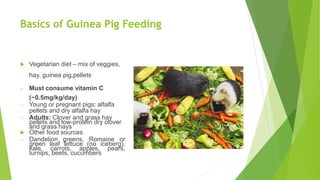
Basics of Guinea Pig Feeding
 Vegetarian diet – mix of veggies,
hay, guinea pig,pellets
– Must consume vitamin C
(~0.5mg/kg/day)
– Young or pregnant pigs: alfalfa
pellets and dry alfalfa hay
– Adults: Clover and grass hay
pellets and low-protein dry clover
and grass hays
 Other food sources
– Dandelion greens, Romaine or
green leaf lettuce (no iceberg),
kale, carrots, apples, pears,
turnips, beets, cucumbers
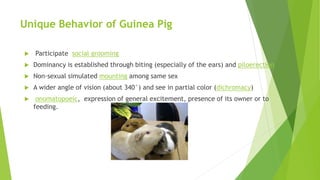
Unique Behavior of Guinea Pig
 Participate social grooming
 Dominancy is established through biting (especially of the ears) and piloerection
 Non-sexual simulated mounting among same sex
 A wider angle of vision (about 340°) and see in partial color (dichromacy)
 onomatopoeic, expression of general excitement, presence of its owner or to
feeding.
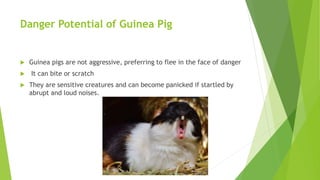
Danger Potential of Guinea Pig
 Guinea pigs are not aggressive, preferring to flee in the face of danger
 It can bite or scratch
 They are sensitive creatures and can become panicked if startled by
abrupt and loud noises.
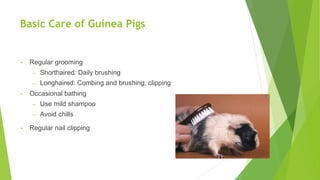
Basic Care of Guinea Pigs
• Regular grooming
– Shorthaired: Daily brushing
– Longhaired: Combing and brushing, clipping
• Occasional bathing
– Use mild shampoo
– Avoid chills
• Regular nail clipping
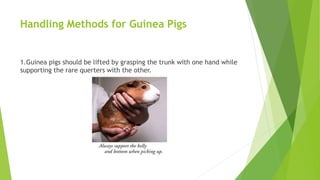
Handling Methods for Guinea Pigs
1.Guinea pigs should be lifted by grasping the trunk with one hand while
supporting the rare querters with the other.
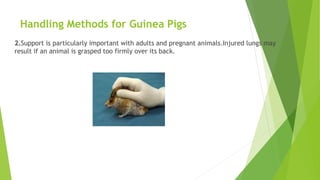
Handling Methods for Guinea Pigs
2.Support is particularly important with adults and pregnant animals.Injured lungs may
result if an animal is grasped too firmly over its back.
Handling Methods for Guinea Pigs
3.Wrapping the guinea pig in a towel is also possible.
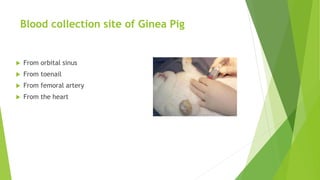
Blood collection site of Ginea Pig
 From orbital sinus
 From toenail
 From femoral artery
 From the heart
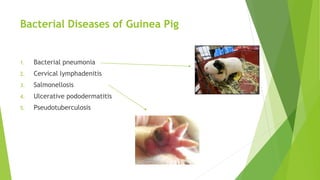
Bacterial Diseases of Guinea Pig
1. Bacterial pneumonia
2. Cervical lymphadenitis
3. Salmonellosis
4. Ulcerative pododermatitis
5. Pseudotuberculosis
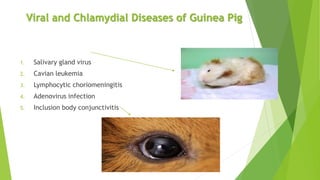
Viral and Chlamydial Diseases of Guinea Pig
1. Salivary gland virus
2. Cavian leukemia
3. Lymphocytic choriomeningitis
4. Adenovirus infection
5. Inclusion body conjunctivitis
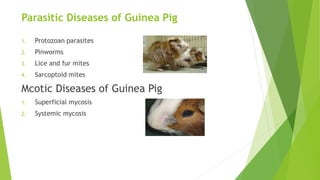
Parasitic Diseases of Guinea Pig
1. Protozoan parasites
2. Pinworms
3. Lice and fur mites
4. Sarcoptoid mites
Mcotic Diseases of Guinea Pig
1. Superficial mycosis
2. Systemic mycosis
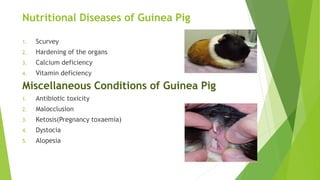
Nutritional Diseases of Guinea Pig
1. Scurvey
2. Hardening of the organs
3. Calcium deficiency
4. Vitamin deficiency
Miscellaneous Conditions of Guinea Pig
1. Antibiotic toxicity
2. Malocclusion
3. Ketosis(Pregnancy toxaemia)
4. Dystocia
5. Alopesia
Miscellaneous Conditions of Guinea Pig
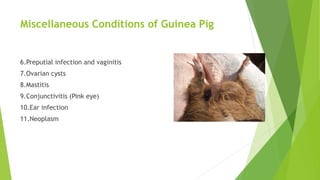
6.Preputial infection and vaginitis
7.Ovarian cysts
8.Mastitis
9.Conjunctivitis (Pink eye)
10.Ear infection
11.Neoplasm
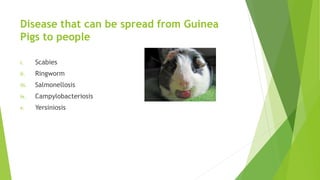
Disease that can be spread from Guinea
Pigs to people
i. Scabies
ii. Ringworm
iii. Salmonellosis
iv. Campylobacteriosis
v. Yersiniosis
Guinea pig (cavy)

Guinea pig (cavy)

  • 1.
    Guinea pig(Cavy) Mohammad MehadiHasan(Joy) Id:1601153 Level-04,Semester-01 Faculty of Veterinary Science Bangladesh Agricultural University,Mymensingh2202.
  • 2.
    Contents  Introduction  TaxonomicClassification 0f Guinea pig  History of Guinea Pig  Uses for Guinea Pig  Common Guinea Pig Varieties  Anatomic Features of Guinea Pig  Physiology of Guinea Pig  Identification of Male & Female Guinea pig  Guinea Pig Reproduction
  • 3.
    Contents  Guinea PigHousing  Basics of Guinea Pig Feeding  Unique Behavior of Guinea Pig  Danger Potential of Guinea Pig  Basic Care of Guinea Pig  Handing Methods for Guinea Pig  Blood collection site of Ginea Pig  Different diseases of guinea pig
  • 4.
    Introduction  Guinea PigRodent -More closely related to porcupines and chinchillas  Average weight 750 grams  Its common name is cavy  Eleven breeds for show
  • 5.
    Taxonomic Classification 0fGuinea pig Kingdom: Animalia Phylum: Chordata Class: Mammalia Order: Rodentia Family: Caviidae Genus: Cavia Species: C. porcellus Binomial name Cavia porcellus (Linnaeus, 1758)
  • 6.
    History of GuineaPigs  Exact history of domestic cavy unknown – May come from C. aperea, C. tschudii, or C. fulgida – Does not come from Guinea  Bred for meat production in South America for at least 3,000 years  Brought to Europe in 16th century  Since mid-1800s, used for pathology, nutrition, genetics, and toxicology research, as well as serum development
  • 7.
    Uses for GuineaPigs • Meat (S. America) • Research • 4H / FFA Project animals • Pets
  • 8.
    Common Guinea PigVarieties • Abyssinian • American • Peruvian • Satin • Silkie • Teddy • White Crested
  • 9.
    Abyssinian Guinea Pig Rough, wiry hair coat – Hair made of rosettes (swirls or cowlicks) – More rosettes are desirable  Found in all colors and color combinations
  • 10.
    American Guinea Pig Most common varisety  Short, very glossy, fine hair  – Short hair eases care  Found in widely varied colors and color combinations
  • 11.
    Peruvian Guinea Pig Longhaired variety – Hair length, evenness, and balance are deciding features  Lacks a tail  Found in many of the colors and color combinations as American variety
  • 12.
    Satin Guinea Pig Fur is distinguishing feature – Fine, dense, and soft – Luxurious and shiny  Found in colors and color combinations of other varieties
  • 13.
    Silky Guinea Pig Longhaired variety – Unlike Peruvian, no long frontal sweep over head  Sometimes called the Sheltie  Found in colors and color combinations of other varieties

  • 14.
    Teddy Guinea Pig Short, kinky hair – Short, resilient strands – Lies thick and close to the body – Whiskers also kinked  Found in colors and color combinations of other varieties
  • 15.
    White Crested  Shorthairedvariety – Resembles American shorthair except for crest – Crest is white rosette that radiates evenly from center of forehead  Found mainly in self, solid, and agouti
  • 16.
    Anatomic Features ofGuinea Pig #No tail #One pair ofmammary glands #Herbivore  Open rooted teeth Born with teeth Born with eyes open  Heavy body weight for size  Susceptible to Bordatella
  • 17.
    Physiology of GuineaPig  Life span: 5-6yrs  Rectal temp.(°F): 102-103  Heart rate/min: 150-160  Water consumption/100gmBW(ml): 10  Food consumption /100gmBW(ml): 5  RBC(10˄6/mm˄3): 4.4-8.2  Hb(g/dl): 11-15  WBC(10^6/mm^3): 4-10.3  Blood glucose (mg%): 60-110  Serum calcium(gm%): 4.5-6.0
  • 18.
    Identification of Male& Female Guinea pig Male: In male the genital region is seen as more of a straight silt,which is a fold between the two halves of the scrotum. Female: ‘Y” shaped crease in genital region .One pair of mammary gland present in the inguinal region.
  • 19.
    Guinea Pig Reproduction Males are boars  Females are sows  Offsprings are pups  Polyestrous with spontaneous (induced) ovulation  1-6 young/litter  Sexual maturity – Females at 2 months (4-6w) – Males at 3 months (9-10w)
  • 20.
    Guinea Pig Reproduction First breeding before female is 6 months / before reaching 500 grams body weight (6m old is when pelvic symphysis fuses) – Pair breeding (monogamous) – Colony breeding (polygamous / harem: 1 boar/4-10 sows)  Gestation period from 56 to 74 days Up to 5 litters yearly (2 to 4 average) – Running and eating solid food in 24 hours
  • 21.
    Guinea Pig Housing Atleast 12” x 12” x 12” per adult (double size if breeders) Plastic bottom that is 3 or 4” deep Sides of vertical wire bars or glass Hiding box / area for sleep CLEAN FREQUENTLY: Heavy glass or earthenware food bowls Vacuum-type water bottle
  • 22.
    Basics of GuineaPig Feeding  Vegetarian diet – mix of veggies, hay, guinea pig,pellets – Must consume vitamin C (~0.5mg/kg/day) – Young or pregnant pigs: alfalfa pellets and dry alfalfa hay – Adults: Clover and grass hay pellets and low-protein dry clover and grass hays  Other food sources – Dandelion greens, Romaine or green leaf lettuce (no iceberg), kale, carrots, apples, pears, turnips, beets, cucumbers
  • 23.
    Unique Behavior ofGuinea Pig  Participate social grooming  Dominancy is established through biting (especially of the ears) and piloerection  Non-sexual simulated mounting among same sex  A wider angle of vision (about 340°) and see in partial color (dichromacy)  onomatopoeic, expression of general excitement, presence of its owner or to feeding.
  • 24.
    Danger Potential ofGuinea Pig  Guinea pigs are not aggressive, preferring to flee in the face of danger  It can bite or scratch  They are sensitive creatures and can become panicked if startled by abrupt and loud noises.
  • 25.
    Basic Care ofGuinea Pigs • Regular grooming – Shorthaired: Daily brushing – Longhaired: Combing and brushing, clipping • Occasional bathing – Use mild shampoo – Avoid chills • Regular nail clipping
  • 26.
    Handling Methods forGuinea Pigs 1.Guinea pigs should be lifted by grasping the trunk with one hand while supporting the rare querters with the other.
  • 27.
    Handling Methods forGuinea Pigs 2.Support is particularly important with adults and pregnant animals.Injured lungs may result if an animal is grasped too firmly over its back.
  • 28.
    Handling Methods forGuinea Pigs 3.Wrapping the guinea pig in a towel is also possible.
  • 29.
    Blood collection siteof Ginea Pig  From orbital sinus  From toenail  From femoral artery  From the heart
  • 30.
    Bacterial Diseases ofGuinea Pig 1. Bacterial pneumonia 2. Cervical lymphadenitis 3. Salmonellosis 4. Ulcerative pododermatitis 5. Pseudotuberculosis
  • 31.
    Viral and ChlamydialDiseases of Guinea Pig 1. Salivary gland virus 2. Cavian leukemia 3. Lymphocytic choriomeningitis 4. Adenovirus infection 5. Inclusion body conjunctivitis
  • 32.
    Parasitic Diseases ofGuinea Pig 1. Protozoan parasites 2. Pinworms 3. Lice and fur mites 4. Sarcoptoid mites Mcotic Diseases of Guinea Pig 1. Superficial mycosis 2. Systemic mycosis
  • 33.
    Nutritional Diseases ofGuinea Pig 1. Scurvey 2. Hardening of the organs 3. Calcium deficiency 4. Vitamin deficiency Miscellaneous Conditions of Guinea Pig 1. Antibiotic toxicity 2. Malocclusion 3. Ketosis(Pregnancy toxaemia) 4. Dystocia 5. Alopesia
  • 34.
    Miscellaneous Conditions ofGuinea Pig 6.Preputial infection and vaginitis 7.Ovarian cysts 8.Mastitis 9.Conjunctivitis (Pink eye) 10.Ear infection 11.Neoplasm
  • 35.
    Disease that canbe spread from Guinea Pigs to people i. Scabies ii. Ringworm iii. Salmonellosis iv. Campylobacteriosis v. Yersiniosis