Data Structures &
Algorithm Analysis
Stacks and Queues
Reading: Chap.3 Weiss
objects: a finite ordered list with zero or more elements.
methods:
for all stack ∈ Stack, item ∈ element, max_stack_size
∈ positive integer
Stack createS(max_stack_size) ::=
create an empty stack whose maximum size is
max_stack_size
Boolean isFull(stack, max_stack_size) ::=
if (number of elements in stack == max_stack_size)
return TRUE
else return FALSE
Stack push(stack, item) ::=
if (IsFull(stack)) stack_full
else insert item into top of stack and return
Stack ADT
Boolean isEmpty(stack) ::=
if(stack == CreateS(max_stack_size))
return TRUE
else return FALSE
Element pop(stack) ::=
if(IsEmpty(stack)) return
else remove and return the item on the top
of the stack.
Stack ADT (cont’d)
Array-based Stack
Implementation
Allocate an array of some size (pre-defined)
Maximum N elements in stack
Bottom stack element stored at element 0
last index in the array is the top
Increment top when one element is pushed,
decrement after pop
Stack createS(max_stack_size) ::=
#define MAX_STACK_SIZE 100 /* maximum stack size */
typedef struct {
int key;
/* other fields */
} element;
element stack[MAX_STACK_SIZE];
int top = -1;
Boolean isEmpty(Stack) ::= top< 0;
Boolean isFull(Stack) ::= top >= MAX_STACK_SIZE-1;
Stack Implementation:
CreateS, isEmpty, isFull
void push(int *top, element item)
{
/* add an item to the global stack */
if (*top >= MAX_STACK_SIZE-1) {
stack_full( );
return;
}
stack[++*top] = item;
}
Push
element pop(int *top)
{
/* return the top element from the stack */
if (*top == -1)
return stack_empty( ); /* returns and error key */
return stack[(*top)--];
}
Pop
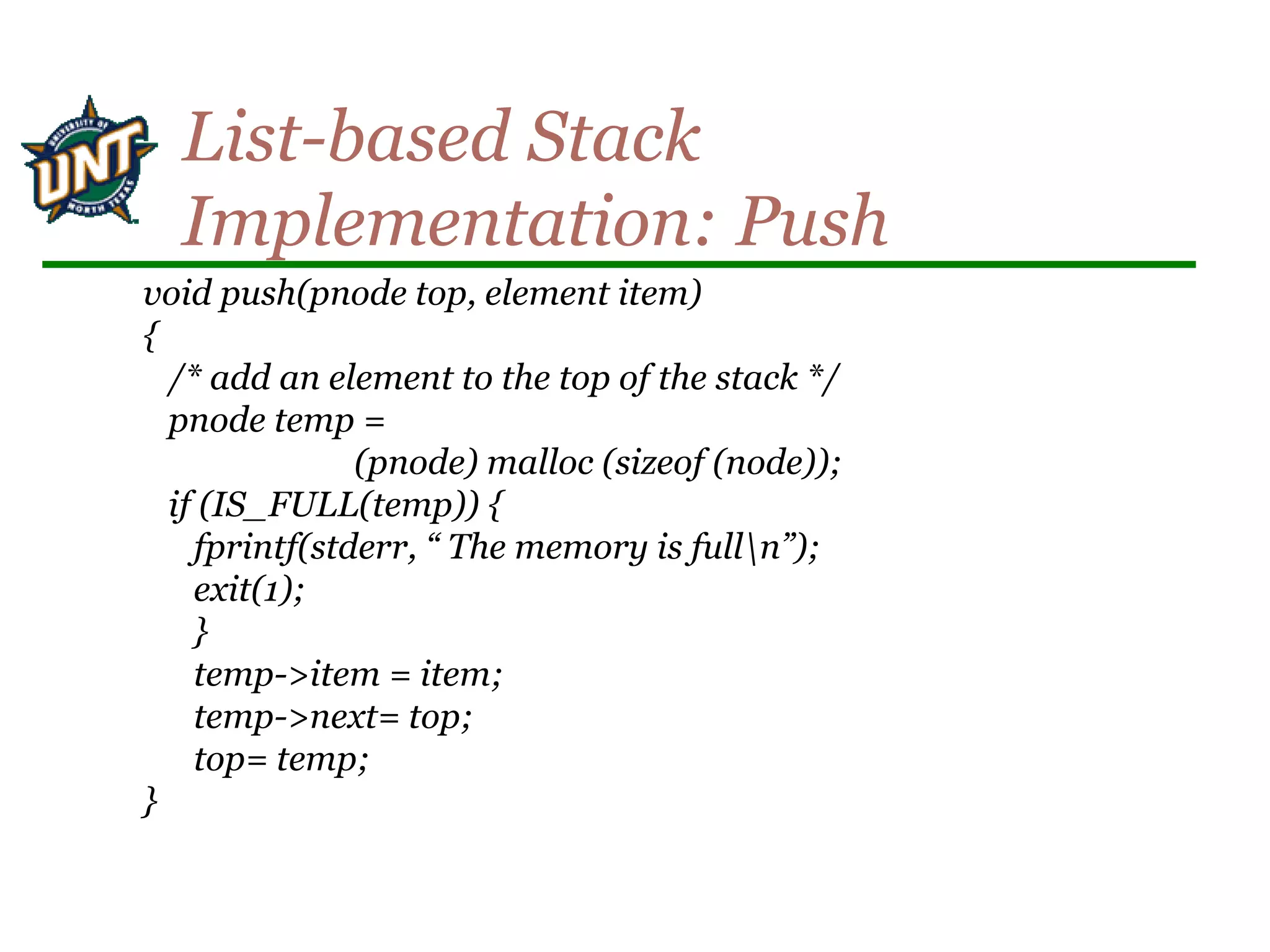
void push(pnode top, element item)
{
/* add an element to the top of the stack */
pnode temp =
(pnode) malloc (sizeof (node));
if (IS_FULL(temp)) {
fprintf(stderr, “ The memory is fulln”);
exit(1);
}
temp->item = item;
temp->next= top;
top= temp;
}
List-based Stack
Implementation: Push
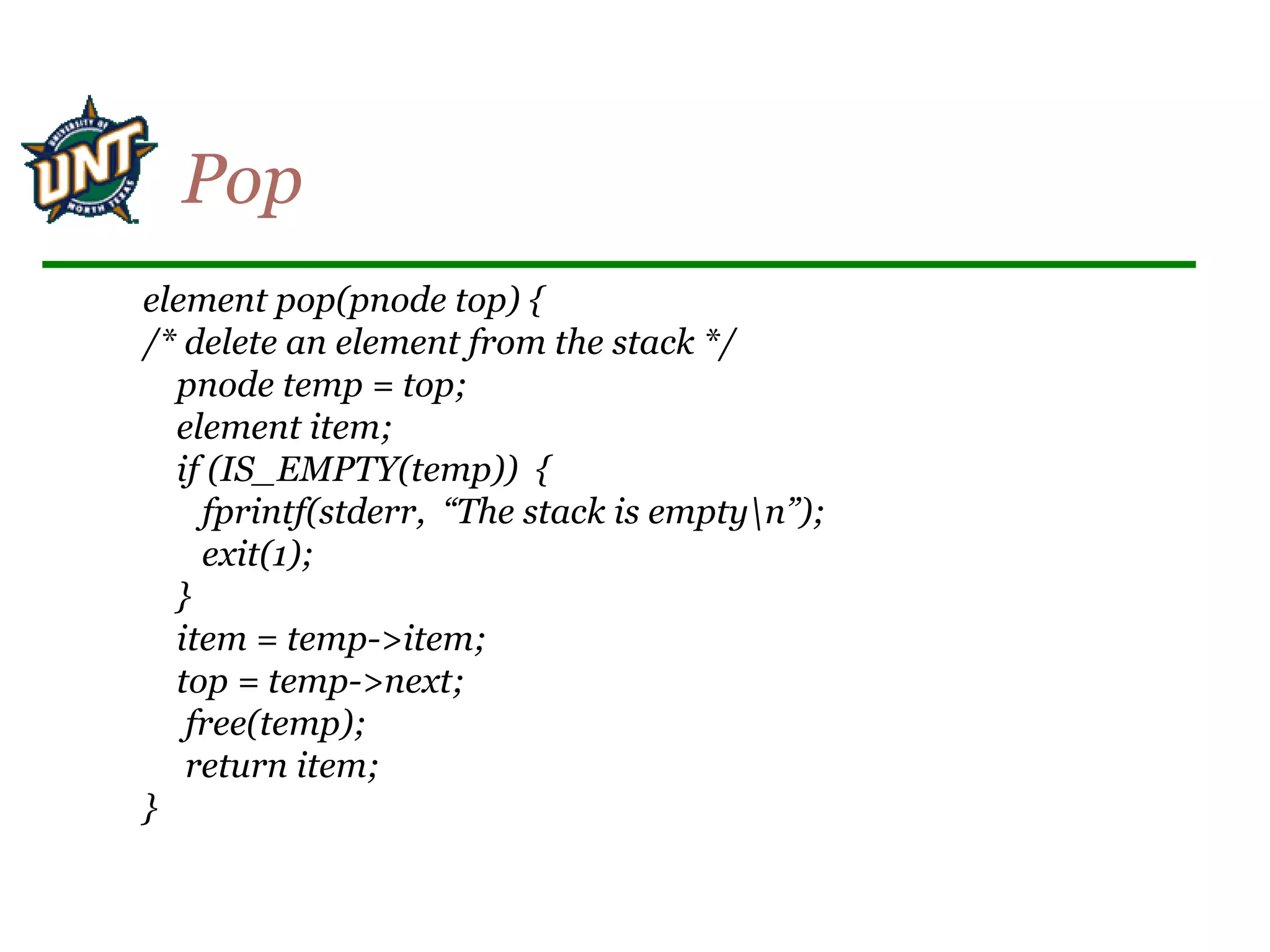
element pop(pnode top) {
/* delete an element from the stack */
pnode temp = top;
element item;
if (IS_EMPTY(temp)) {
fprintf(stderr, “The stack is emptyn”);
exit(1);
}
item = temp->item;
top = temp->next;
free(temp);
return item;
}
Pop
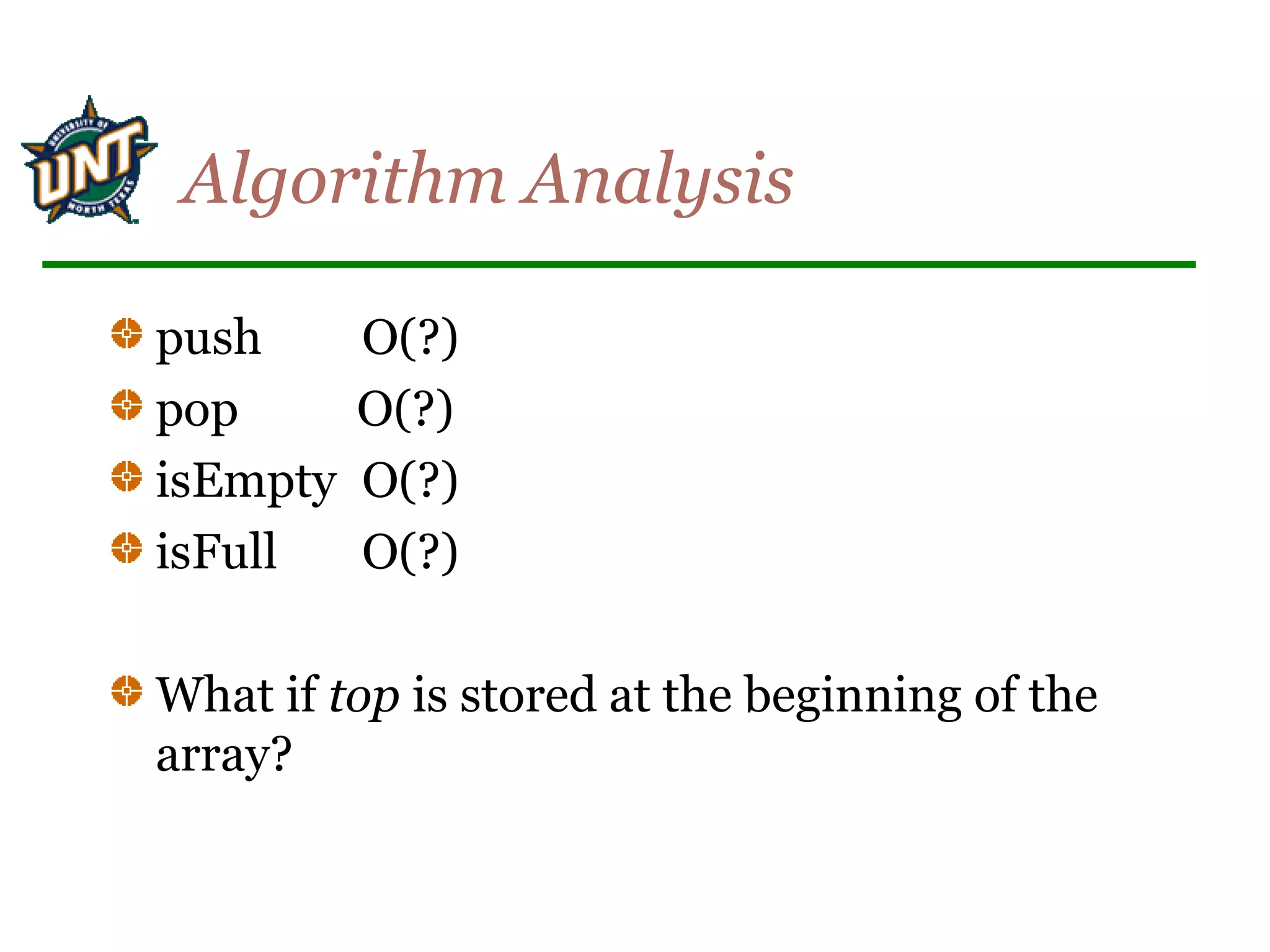
Algorithm Analysis
push O(?)
pop O(?)
isEmpty O(?)
isFull O(?)
What if top is stored at the beginning of the
array?
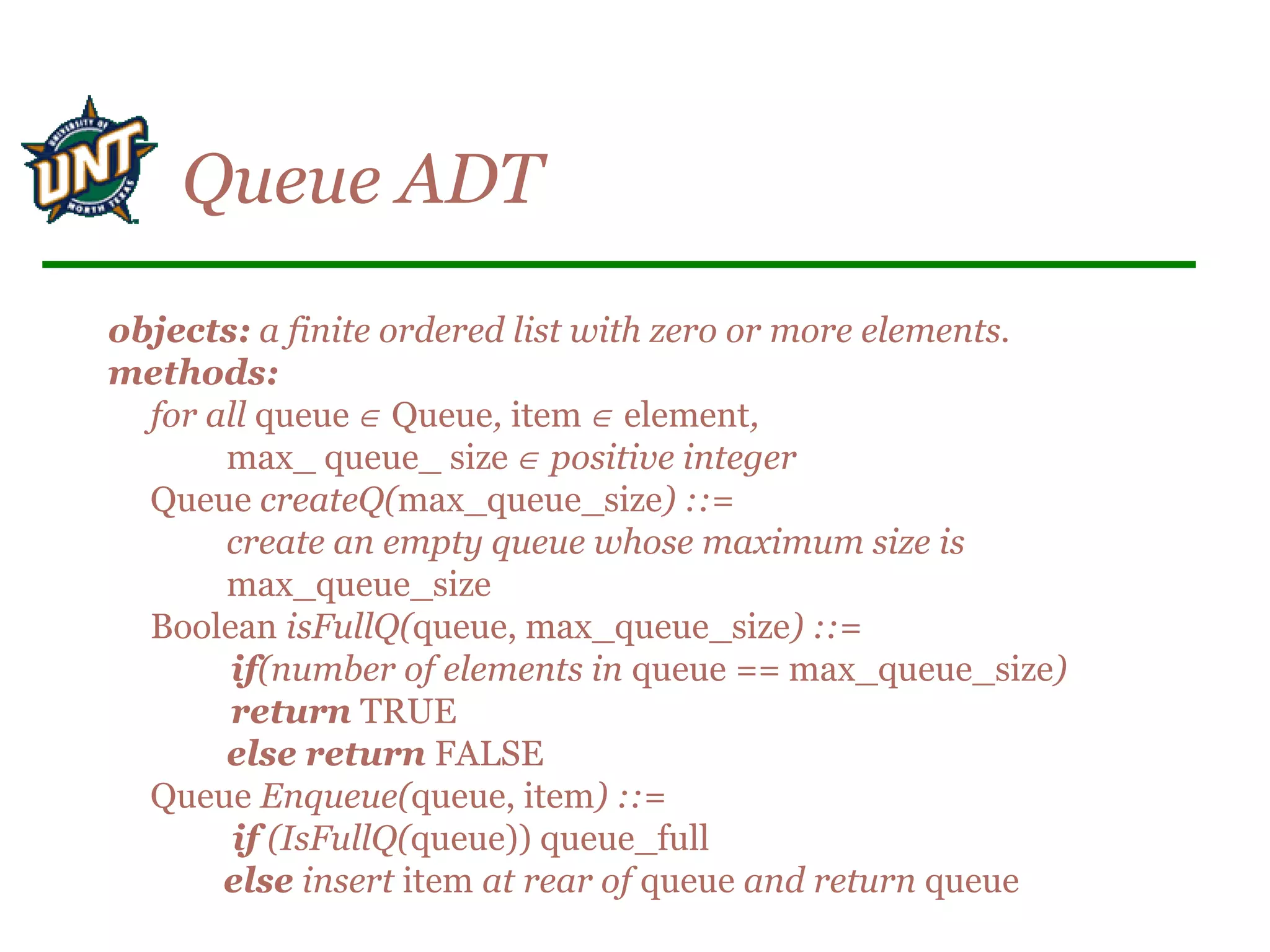
objects: a finite ordered list with zero or more elements.
methods:
for all queue ∈ Queue, item ∈ element,
max_ queue_ size ∈ positive integer
Queue createQ(max_queue_size) ::=
create an empty queue whose maximum size is
max_queue_size
Boolean isFullQ(queue, max_queue_size) ::=
if(number of elements in queue == max_queue_size)
return TRUE
else return FALSE
Queue Enqueue(queue, item) ::=
if (IsFullQ(queue)) queue_full
else insert item at rear of queue and return queue
Queue ADT
Boolean isEmptyQ(queue) ::=
if (queue ==CreateQ(max_queue_size))
return TRUE
else return FALSE
Element dequeue(queue) ::=
if (IsEmptyQ(queue)) return
else remove and return the item at front of queue.
Queue ADT (cont’d)
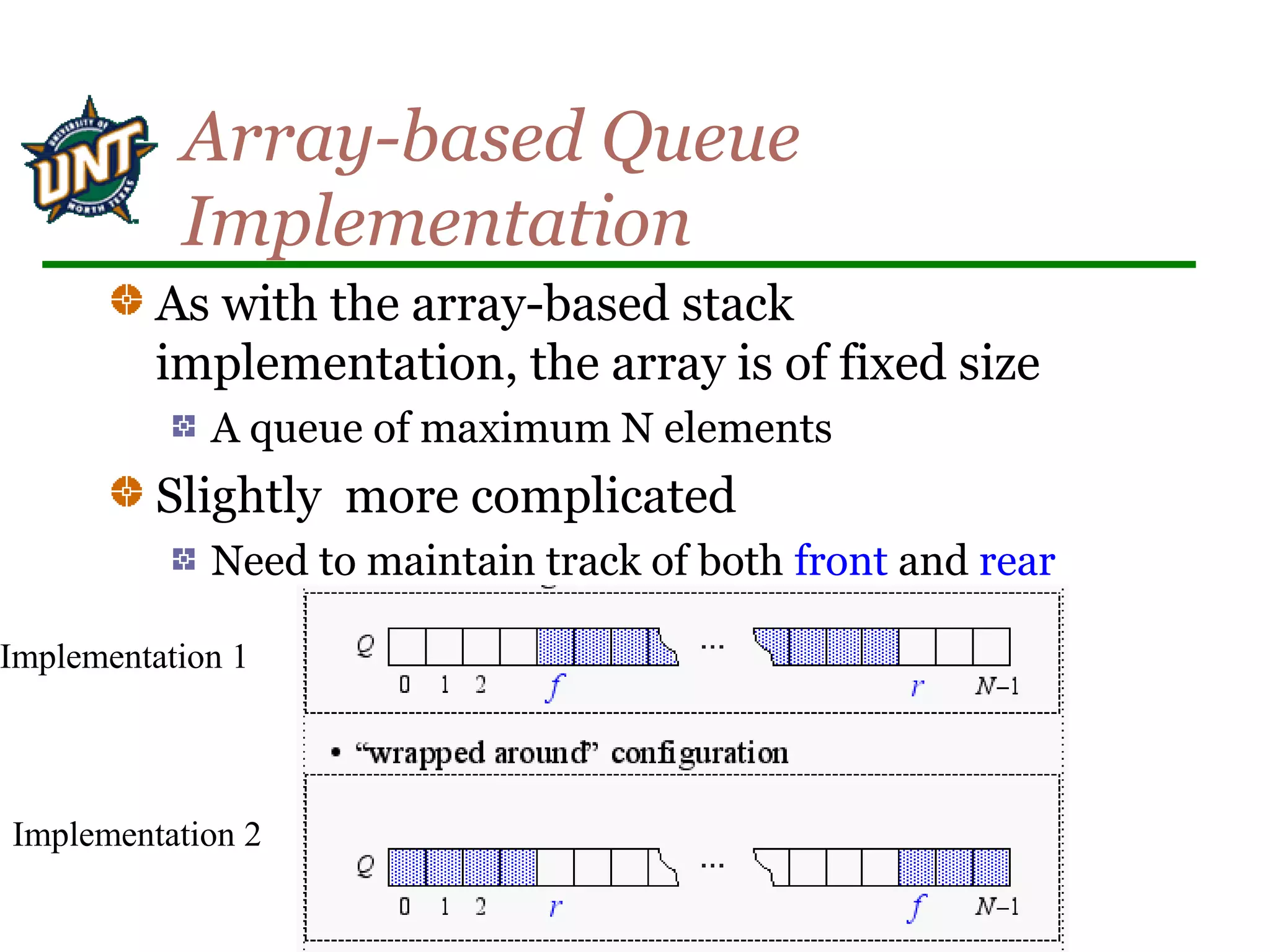
Array-based Queue
Implementation
As with the array-based stack
implementation, the array is of fixed size
A queue of maximum N elements
Slightly more complicated
Need to maintain track of both front and rear
Implementation 1
Implementation 2
Queue createQ(max_queue_size) ::=
# define MAX_QUEUE_SIZE 100/* Maximum queue size */
typedef struct {
int key;
/* other fields */
} element;
element queue[MAX_QUEUE_SIZE];
int rear = -1;
int front = -1;
Boolean isEmpty(queue) ::= front == rear
Boolean isFullQ(queue) ::= rear == MAX_QUEUE_SIZE-1
Implementation 1:
createQ, isEmptyQ, isFullQ
void enqueue(int *rear, element item)
{
/* add an item to the queue */
if (*rear == MAX_QUEUE_SIZE_1) {
queue_full( );
return;
}
queue [++*rear] = item;
}
Implementation 1:
enqueue
element dequeue(int *front, int rear)
{
/* remove element at the front of the queue */
if ( *front == rear)
return queue_empty( ); /* return an error key */
return queue [++ *front];
}
Implementation 1:
dequeue
EMPTY QUEUE
[2] [3] [2] [3]
[1] [4] [1] [4]
[0] [5] [0] [5]
front = 0 front = 0
rear = 0 rear = 3
J2
J1
J3
Implementation 2:
Wrapped Configuration
Can be seen as a circular queue
FULL QUEUE FULL QUEUE
[2] [3] [2] [3]
[1] [4][1] [4]
[0] [5] [0] [5]
front =0
rear = 5
front =4
rear =3
J2 J3
J1 J4
J5 J6 J5
J7
J8 J9
Leave one empty space when queue is full
Why?
How to test when queue is empty?
How to test when queue is full?
void enqueue(int front, int *rear, element item)
{
/* add an item to the queue */
*rear = (*rear +1) % MAX_QUEUE_SIZE;
if (front == *rear) /* reset rear and print error */
return;
}
queue[*rear] = item;
}
Enqueue in a Circular Queue
element dequeue(int* front, int rear)
{
element item;
/* remove front element from the queue and put it in item */
if (*front == rear)
return queue_empty( );
/* queue_empty returns an error key */
*front = (*front+1) % MAX_QUEUE_SIZE;
return queue[*front];
}
Dequeue from Circular Queue
void enqueue(pnode &front, pnode rear, element item)
{ /* add an element to the rear of the queue */
pnode temp =
(pnode) malloc(sizeof (queue));
if (IS_FULL(temp)) {
fprintf(stderr, “ The memory is fulln”);
exit(1);
}
temp->item = item;
temp->next= NULL;
if (front) { (rear) -> next= temp;}
else front = temp;
rear = temp; }
List-based Queue
Implementation: Enqueue
element dequeue(pnode &front) {
/* delete an element from the queue */
pnode temp = front;
element item;
if (IS_EMPTY(front)) {
fprintf(stderr, “The queue is
emptyn”);
exit(1);
}
item = temp->item;
front = temp->next;
free(temp);
return item;
Dequeue
Algorithm Analysis
enqueue O(?)
dequeue O(?)
size O(?)
isEmpty O(?)
isFull O(?)
What if I want the first element to be always
at Q[0] ?

Stacks queues

  • 1.
    Data Structures & AlgorithmAnalysis Stacks and Queues Reading: Chap.3 Weiss
  • 2.
    objects: a finiteordered list with zero or more elements. methods: for all stack ∈ Stack, item ∈ element, max_stack_size ∈ positive integer Stack createS(max_stack_size) ::= create an empty stack whose maximum size is max_stack_size Boolean isFull(stack, max_stack_size) ::= if (number of elements in stack == max_stack_size) return TRUE else return FALSE Stack push(stack, item) ::= if (IsFull(stack)) stack_full else insert item into top of stack and return Stack ADT
  • 3.
    Boolean isEmpty(stack) ::= if(stack== CreateS(max_stack_size)) return TRUE else return FALSE Element pop(stack) ::= if(IsEmpty(stack)) return else remove and return the item on the top of the stack. Stack ADT (cont’d)
  • 4.
    Array-based Stack Implementation Allocate anarray of some size (pre-defined) Maximum N elements in stack Bottom stack element stored at element 0 last index in the array is the top Increment top when one element is pushed, decrement after pop
  • 5.
    Stack createS(max_stack_size) ::= #defineMAX_STACK_SIZE 100 /* maximum stack size */ typedef struct { int key; /* other fields */ } element; element stack[MAX_STACK_SIZE]; int top = -1; Boolean isEmpty(Stack) ::= top< 0; Boolean isFull(Stack) ::= top >= MAX_STACK_SIZE-1; Stack Implementation: CreateS, isEmpty, isFull
  • 6.
    void push(int *top,element item) { /* add an item to the global stack */ if (*top >= MAX_STACK_SIZE-1) { stack_full( ); return; } stack[++*top] = item; } Push
  • 7.
    element pop(int *top) { /*return the top element from the stack */ if (*top == -1) return stack_empty( ); /* returns and error key */ return stack[(*top)--]; } Pop
  • 8.
    void push(pnode top,element item) { /* add an element to the top of the stack */ pnode temp = (pnode) malloc (sizeof (node)); if (IS_FULL(temp)) { fprintf(stderr, “ The memory is fulln”); exit(1); } temp->item = item; temp->next= top; top= temp; } List-based Stack Implementation: Push
  • 9.
    element pop(pnode top){ /* delete an element from the stack */ pnode temp = top; element item; if (IS_EMPTY(temp)) { fprintf(stderr, “The stack is emptyn”); exit(1); } item = temp->item; top = temp->next; free(temp); return item; } Pop
  • 10.
    Algorithm Analysis push O(?) popO(?) isEmpty O(?) isFull O(?) What if top is stored at the beginning of the array?
  • 11.
    objects: a finiteordered list with zero or more elements. methods: for all queue ∈ Queue, item ∈ element, max_ queue_ size ∈ positive integer Queue createQ(max_queue_size) ::= create an empty queue whose maximum size is max_queue_size Boolean isFullQ(queue, max_queue_size) ::= if(number of elements in queue == max_queue_size) return TRUE else return FALSE Queue Enqueue(queue, item) ::= if (IsFullQ(queue)) queue_full else insert item at rear of queue and return queue Queue ADT
  • 12.
    Boolean isEmptyQ(queue) ::= if(queue ==CreateQ(max_queue_size)) return TRUE else return FALSE Element dequeue(queue) ::= if (IsEmptyQ(queue)) return else remove and return the item at front of queue. Queue ADT (cont’d)
  • 13.
    Array-based Queue Implementation As withthe array-based stack implementation, the array is of fixed size A queue of maximum N elements Slightly more complicated Need to maintain track of both front and rear Implementation 1 Implementation 2
  • 14.
    Queue createQ(max_queue_size) ::= #define MAX_QUEUE_SIZE 100/* Maximum queue size */ typedef struct { int key; /* other fields */ } element; element queue[MAX_QUEUE_SIZE]; int rear = -1; int front = -1; Boolean isEmpty(queue) ::= front == rear Boolean isFullQ(queue) ::= rear == MAX_QUEUE_SIZE-1 Implementation 1: createQ, isEmptyQ, isFullQ
  • 15.
    void enqueue(int *rear,element item) { /* add an item to the queue */ if (*rear == MAX_QUEUE_SIZE_1) { queue_full( ); return; } queue [++*rear] = item; } Implementation 1: enqueue
  • 16.
    element dequeue(int *front,int rear) { /* remove element at the front of the queue */ if ( *front == rear) return queue_empty( ); /* return an error key */ return queue [++ *front]; } Implementation 1: dequeue
  • 17.
    EMPTY QUEUE [2] [3][2] [3] [1] [4] [1] [4] [0] [5] [0] [5] front = 0 front = 0 rear = 0 rear = 3 J2 J1 J3 Implementation 2: Wrapped Configuration Can be seen as a circular queue
  • 18.
    FULL QUEUE FULLQUEUE [2] [3] [2] [3] [1] [4][1] [4] [0] [5] [0] [5] front =0 rear = 5 front =4 rear =3 J2 J3 J1 J4 J5 J6 J5 J7 J8 J9 Leave one empty space when queue is full Why? How to test when queue is empty? How to test when queue is full?
  • 19.
    void enqueue(int front,int *rear, element item) { /* add an item to the queue */ *rear = (*rear +1) % MAX_QUEUE_SIZE; if (front == *rear) /* reset rear and print error */ return; } queue[*rear] = item; } Enqueue in a Circular Queue
  • 20.
    element dequeue(int* front,int rear) { element item; /* remove front element from the queue and put it in item */ if (*front == rear) return queue_empty( ); /* queue_empty returns an error key */ *front = (*front+1) % MAX_QUEUE_SIZE; return queue[*front]; } Dequeue from Circular Queue
  • 21.
    void enqueue(pnode &front,pnode rear, element item) { /* add an element to the rear of the queue */ pnode temp = (pnode) malloc(sizeof (queue)); if (IS_FULL(temp)) { fprintf(stderr, “ The memory is fulln”); exit(1); } temp->item = item; temp->next= NULL; if (front) { (rear) -> next= temp;} else front = temp; rear = temp; } List-based Queue Implementation: Enqueue
  • 22.
    element dequeue(pnode &front){ /* delete an element from the queue */ pnode temp = front; element item; if (IS_EMPTY(front)) { fprintf(stderr, “The queue is emptyn”); exit(1); } item = temp->item; front = temp->next; free(temp); return item; Dequeue
  • 23.
    Algorithm Analysis enqueue O(?) dequeueO(?) size O(?) isEmpty O(?) isFull O(?) What if I want the first element to be always at Q[0] ?