Question 7:: Looking back at
your preliminary task, what
do you feel you have learnt in
the progression from it to full
product?
The preliminary task
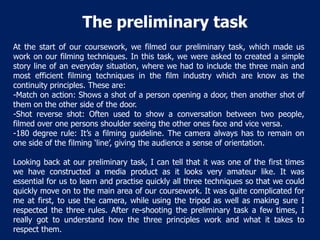
At the start of our coursework, we filmed our preliminary task, which made us
work on our filming techniques. In this task, we were asked to created a simple
story line of an everyday situation, where we had to include the three main and
most efficient filming techniques in the film industry which are know as the
continuity principles. These are:
-Match on action: Shows a shot of a person opening a door, then another shot of
them on the other side of the door.
-Shot reverse shot: Often used to show a conversation between two people,
filmed over one persons shoulder seeing the other ones face and vice versa.
-180 degree rule: It’s a filming guideline. The camera always has to remain on
one side of the filming ‘line’, giving the audience a sense of orientation.
Looking back at our preliminary task, I can tell that it was one of the first times
we have constructed a media product as it looks very amateur like. It was
essential for us to learn and practise quickly all three techniques so that we could
quickly move on to the main area of our coursework. It was quite complicated for
me at first, to use the camera, while using the tripod as well as making sure I
respected the three rules. After re-shooting the preliminary task a few times, I
really got to understand how the three principles work and what it takes to
respect them.
Match on action

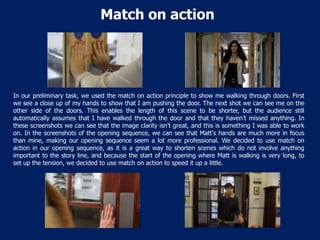
In our preliminary task, we used the match on action principle to show me walking through doors. First
we see a close up of my hands to show that I am pushing the door. The next shot we can see me on the
other side of the doors. This enables the length of this scene to be shorter, but the audience still
automatically assumes that I have walked through the door and that they haven’t missed anything. In
these screenshots we can see that the image clarity isn’t great, and this is something I was able to work
on. In the screenshots of the opening sequence, we can see that Matt's hands are much more in focus
than mine, making our opening sequence seem a lot more professional. We decided to use match on
action in our opening sequence, as it is a great way to shorten scenes which do not involve anything
important to the story line, and because the start of the opening where Matt is walking is very long, to
set up the tension, we decided to use match on action to speed it up a little.
180 rule & shot reverse shot

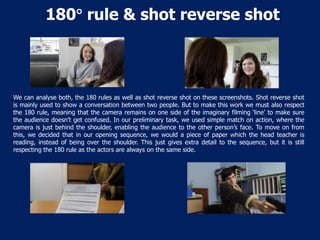
We can analyse both, the 180 rules as well as shot reverse shot on these screenshots. Shot reverse shot
is mainly used to show a conversation between two people. But to make this work we must also respect
the 180 rule, meaning that the camera remains on one side of the imaginary filming ‘line’ to make sure
the audience doesn’t get confused. In our preliminary task, we used simple match on action, where the
camera is just behind the shoulder, enabling the audience to the other person’s face. To move on from
this, we decided that in our opening sequence, we would a piece of paper which the head teacher is
reading, instead of being over the shoulder. This just gives extra detail to the sequence, but it is still
respecting the 180 rule as the actors are always on the same side.

Question 7 Sophie Tizit

  • 1.
    Question 7:: Lookingback at your preliminary task, what do you feel you have learnt in the progression from it to full product?
  • 2.
    The preliminary task Atthe start of our coursework, we filmed our preliminary task, which made us work on our filming techniques. In this task, we were asked to created a simple story line of an everyday situation, where we had to include the three main and most efficient filming techniques in the film industry which are know as the continuity principles. These are: -Match on action: Shows a shot of a person opening a door, then another shot of them on the other side of the door. -Shot reverse shot: Often used to show a conversation between two people, filmed over one persons shoulder seeing the other ones face and vice versa. -180 degree rule: It’s a filming guideline. The camera always has to remain on one side of the filming ‘line’, giving the audience a sense of orientation. Looking back at our preliminary task, I can tell that it was one of the first times we have constructed a media product as it looks very amateur like. It was essential for us to learn and practise quickly all three techniques so that we could quickly move on to the main area of our coursework. It was quite complicated for me at first, to use the camera, while using the tripod as well as making sure I respected the three rules. After re-shooting the preliminary task a few times, I really got to understand how the three principles work and what it takes to respect them.
  • 3.
    Match on action Inour preliminary task, we used the match on action principle to show me walking through doors. First we see a close up of my hands to show that I am pushing the door. The next shot we can see me on the other side of the doors. This enables the length of this scene to be shorter, but the audience still automatically assumes that I have walked through the door and that they haven’t missed anything. In these screenshots we can see that the image clarity isn’t great, and this is something I was able to work on. In the screenshots of the opening sequence, we can see that Matt's hands are much more in focus than mine, making our opening sequence seem a lot more professional. We decided to use match on action in our opening sequence, as it is a great way to shorten scenes which do not involve anything important to the story line, and because the start of the opening where Matt is walking is very long, to set up the tension, we decided to use match on action to speed it up a little.
  • 4.
    180 rule &shot reverse shot We can analyse both, the 180 rules as well as shot reverse shot on these screenshots. Shot reverse shot is mainly used to show a conversation between two people. But to make this work we must also respect the 180 rule, meaning that the camera remains on one side of the imaginary filming ‘line’ to make sure the audience doesn’t get confused. In our preliminary task, we used simple match on action, where the camera is just behind the shoulder, enabling the audience to the other person’s face. To move on from this, we decided that in our opening sequence, we would a piece of paper which the head teacher is reading, instead of being over the shoulder. This just gives extra detail to the sequence, but it is still respecting the 180 rule as the actors are always on the same side.