180° Rule Match on Action Shot/Reverse shot Tom Sutherland MEDIA STUDIES  DM
What is the 180° Rule? Line of Action / Axis Line NEVER VIOLATE OR  DIE   (unless for “effect”, obviously) Breaking the rule can disorient/confuse viewers So as a result, they’ll miss your film while trying to figure things out! Especially important in scenes with action or traces where a subject moves from A to B to avoid continuity errors
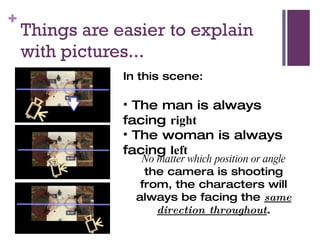
Things are easier to explain with pictures... In this scene: The man is always facing  right The woman is always facing  left No matter which position or angle  the camera is shooting from, the characters will always be facing the  same direction throughout .
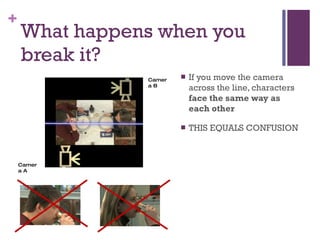
What happens when you break it? If you move the camera across the line, characters  face the same way as each other THIS EQUALS CONFUSION Camera A Camera B
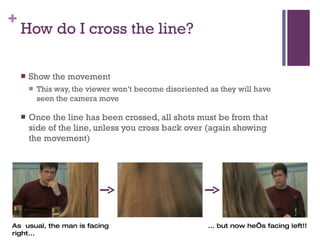
How do I cross the line? Show the movement This way, the viewer won’t become disoriented as they will have seen the camera move Once the line has been crossed, all shots must be from that side of the line, unless you cross back over (again showing the movement) As  usual, the man is facing right... ... but now he’s facing left!!
Video Examples
Match on Action Cut that connects two different views of the same action at the same moment It makes the motion seem uninterrupted Usually just multiple shots of the same action (low budget films especially) So the mise-en-scene must be the same in every take to avoid continuity errors Used to emphasize spatial relationships
Shot/Reverse Shot Classicly used in filming dialogue The shot frames the speaker (usually MCU) as (s)he says his/her line Often, there will be part of the listener in shot, slightly out of focus for example, the shoulder slightly out of focus.

180deg Rule

  • 1.
    180° Rule Matchon Action Shot/Reverse shot Tom Sutherland MEDIA STUDIES DM
  • 2.
    What is the180° Rule? Line of Action / Axis Line NEVER VIOLATE OR DIE (unless for “effect”, obviously) Breaking the rule can disorient/confuse viewers So as a result, they’ll miss your film while trying to figure things out! Especially important in scenes with action or traces where a subject moves from A to B to avoid continuity errors
  • 3.
    Things are easierto explain with pictures... In this scene: The man is always facing right The woman is always facing left No matter which position or angle the camera is shooting from, the characters will always be facing the same direction throughout .
  • 4.
    What happens whenyou break it? If you move the camera across the line, characters face the same way as each other THIS EQUALS CONFUSION Camera A Camera B
  • 5.
    How do Icross the line? Show the movement This way, the viewer won’t become disoriented as they will have seen the camera move Once the line has been crossed, all shots must be from that side of the line, unless you cross back over (again showing the movement) As usual, the man is facing right... ... but now he’s facing left!!
  • 6.
  • 7.
    Match on ActionCut that connects two different views of the same action at the same moment It makes the motion seem uninterrupted Usually just multiple shots of the same action (low budget films especially) So the mise-en-scene must be the same in every take to avoid continuity errors Used to emphasize spatial relationships
  • 8.
    Shot/Reverse Shot Classiclyused in filming dialogue The shot frames the speaker (usually MCU) as (s)he says his/her line Often, there will be part of the listener in shot, slightly out of focus for example, the shoulder slightly out of focus.