Evaluation – question 1
In what ways does your media
product use, develop or challenge
forms and conventions of real
media products?
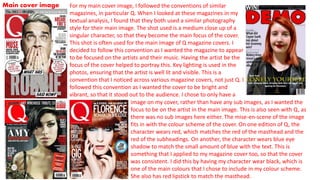
Main cover image
image on my cover, rather than have any sub images, as I wanted the
focus to be on the artist in the main image. This is also seen with Q, as
there was no sub images here either. The mise-en-scene of the image
fits in with the colour scheme of the cover. On one edition of Q, the
character wears red, which matches the red of the masthead and the
red of the subheadings. On another, the character wears blue eye
shadow to match the small amount of blue with the text. This is
something that I applied to my magazine cover too, so that the cover
was consistent. I did this by having my character wear black, which is
one of the main colours that I chose to include in my colour scheme.
She also has red lipstick to match the masthead.
For my main cover image, I followed the conventions of similar
magazines, in particular Q. When I looked at these magazines in my
textual analysis, I found that they both used a similar photography
style for their main image. The shot used is a medium close up of a
singular character, so that they become the main focus of the cover.
This shot is often used for the main image of Q magazine covers. I
decided to follow this convention as I wanted the magazine to appear
to be focused on the artists and their music. Having the artist be the
focus of the cover helped to portray this. Key lighting is used in the
photos, ensuring that the artist is well lit and visible. This is a
convention that I noticed across various magazine covers, not just Q. I
followed this convention as I wanted the cover to be bright and
vibrant, so that it stood out to the audience. I chose to only have a
main
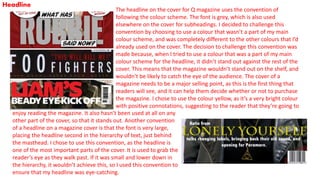
Headline
The headline on the cover for Q magazine uses the convention of
following the colour scheme. The font is grey, which is also used
elsewhere on the cover for subheadings. I decided to challenge this
convention by choosing to use a colour that wasn’t a part of my main
colour scheme, and was completely different to the other colours that I’d
already used on the cover. The decision to challenge this convention was
made because, when I tried to use a colour that was a part of my main
colour scheme for the headline, it didn’t stand out against the rest of the
cover. This means that the magazine wouldn’t stand out on the shelf, and
wouldn’t be likely to catch the eye of the audience. The cover of a
magazine needs to be a major selling point, as this is the first thing that
readers will see, and it can help them decide whether or not to purchase
the magazine. I chose to use the colour yellow, as it’s a very bright colour
with positive connotations, suggesting to the reader that they’re going to
enjoy reading the magazine. It also hasn’t been used at all on any
other part of the cover, so that it stands out. Another convention
of a headline on a magazine cover is that the font is very large,
placing the headline second in the hierarchy of text, just behind
the masthead. I chose to use this convention, as the headline is
one of the most important parts of the cover. It is used to grab the
reader’s eye as they walk past. If it was small and lower down in
the hierarchy, it wouldn’t achieve this, so I used this convention to
ensure that my headline was eye-catching.
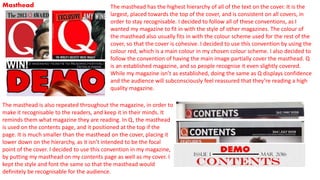
Masthead The masthead has the highest hierarchy of all of the text on the cover. It is the
largest, placed towards the top of the cover, and is consistent on all covers, in
order to stay recognisable. I decided to follow all of these conventions, as I
wanted my magazine to fit in with the style of other magazines. The colour of
the masthead also usually fits in with the colour scheme used for the rest of the
cover, so that the cover is cohesive. I decided to use this convention by using the
colour red, which is a main colour in my chosen colour scheme. I also decided to
follow the convention of having the main image partially cover the masthead. Q
is an established magazine, and so people recognise it even slightly covered.
While my magazine isn’t as established, doing the same as Q displays confidence
and the audience will subconsciously feel reassured that they’re reading a high
quality magazine.
The masthead is also repeated throughout the magazine, in order to
make it recognisable to the readers, and keep it in their minds. It
reminds them what magazine they are reading. In Q, the masthead
is used on the contents page, and it positioned at the top if the
page. It is much smaller than the masthead on the cover, placing it
lower down on the hierarchy, as it isn’t intended to be the focal
point of the cover. I decided to use this convention in my magazine,
by putting my masthead on my contents page as well as my cover. I
kept the style and font the same so that the masthead would
definitely be recognisable for the audience.
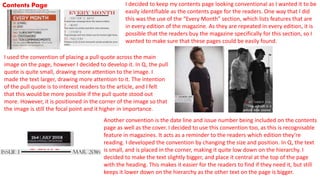
Contents Page I decided to keep my contents page looking conventional as I wanted it to be
easily identifiable as the contents page for the readers. One way that I did
this was the use of the “Every Month” section, which lists features that are
in every edition of the magazine. As they are repeated in every edition, it is
possible that the readers buy the magazine specifically for this section, so I
wanted to make sure that these pages could be easily found.
I used the convention of placing a pull quote across the main
image on the page, however I decided to develop it. In Q, the pull
quote is quite small, drawing more attention to the image. I
made the text larger, drawing more attention to it. The intention
of the pull quote is to interest readers to the article, and I felt
that this would be more possible if the pull quote stood out
more. However, it is positioned in the corner of the image so that
the image is still the focal point and it higher in importance.
Another convention is the date line and issue number being included on the contents
page as well as the cover. I decided to use this convention too, as this is recognisable
feature in magazines. It acts as a reminder to the readers which edition they’re
reading. I developed the convention by changing the size and position. In Q, the text
is small, and is placed in the corner, making it quite low down on the hierarchy. I
decided to make the text slightly bigger, and place it central at the top of the page
with the heading. This makes it easier for the readers to find if they need it, but still
keeps it lower down on the hierarchy as the other text on the page is bigger.
Contents Page
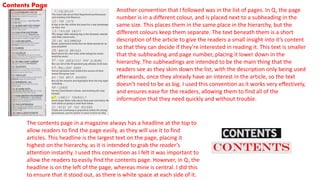
Another convention that I followed was in the list of pages. In Q, the page
number is in a different colour, and is placed next to a subheading in the
same size. This places them in the same place in the hierarchy, but the
different colours keep them separate. The text beneath them is a short
description of the article to give the readers a small insight into it’s content
so that they can decide if they’re interested in reading it. This text is smaller
that the subheading and page number, placing it lower down in the
hierarchy. The subheadings are intended to be the main thing that the
readers see as they skim down the list, with the description only being used
afterwards, once they already have an interest in the article, so the text
doesn’t need to be as big. I used this convention as it works very effectively,
and ensures ease for the readers, allowing them to find all of the
information that they need quickly and without trouble.
The contents page in a magazine always has a headline at the top to
allow readers to find the page easily, as they will use it to find
articles. This headline is the largest text on the page, placing it
highest on the hierarchy, as it is intended to grab the reader’s
attention instantly. I used this convention as I felt it was important to
allow the readers to easily find the contents page. However, in Q, the
headline is on the left of the page, whereas mine is central. I did this
to ensure that it stood out, as there is white space at each side of it.
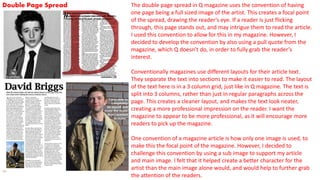
Double Page Spread The double page spread in Q magazine uses the convention of having
one page being a full sized image of the artist. This creates a focal point
of the spread, drawing the reader’s eye. If a reader is just flicking
through, this page stands out, and may intrigue them to read the article.
I used this convention to allow for this in my magazine. However, I
decided to develop the convention by also using a pull quote from the
magazine, which Q doesn’t do, in order to fully grab the reader’s
interest.
Conventionally magazines use different layouts for their article text.
They separate the text into sections to make it easier to read. The layout
of the text here is in a 3 column grid, just like in Q magazine. The text is
split into 3 columns, rather than just in regular paragraphs across the
page. This creates a cleaner layout, and makes the text look neater,
creating a more professional impression on the reader. I want the
magazine to appear to be more professional, as it will encourage more
readers to pick up the magazine.
One convention of a magazine article is how only one image is used, to
make this the focal point of the magazine. However, I decided to
challenge this convention by using a sub image to support my article
and main image. I felt that it helped create a better character for the
artist than the main image alone would, and would help to further grab
the attention of the readers.
Double Page Spread
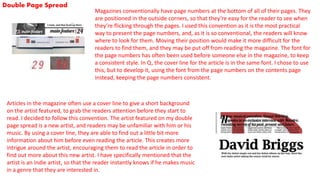
Magazines conventionally have page numbers at the bottom of all of their pages. They
are positioned in the outside corners, so that they’re easy for the reader to see when
they’re flicking through the pages. I used this convention as it is the most practical
way to present the page numbers, and, as it is so conventional, the readers will know
where to look for them. Moving their position would make it more difficult for the
readers to find them, and they may be put off from reading the magazine. The font for
the page numbers has often been used before someone else in the magazine, to keep
a consistent style. In Q, the cover line for the article is in the same font. I chose to use
this, but to develop it, using the font from the page numbers on the contents page
instead, keeping the page numbers consistent.
Articles in the magazine often use a cover line to give a short background
on the artist featured, to grab the readers attention before they start to
read. I decided to follow this convention. The artist featured on my double
page spread is a new artist, and readers may be unfamiliar with him or his
music. By using a cover line, they are able to find out a little bit more
information about him before even reading the article. This creates more
intrigue around the artist, encouraging them to read the article in order to
find out more about this new artist. I have specifically mentioned that the
artist is an indie artist, so that the reader instantly knows if he makes music
in a genre that they are interested in.

Question 1

  • 1.
    Evaluation – question1 In what ways does your media product use, develop or challenge forms and conventions of real media products?
  • 2.
    Main cover image imageon my cover, rather than have any sub images, as I wanted the focus to be on the artist in the main image. This is also seen with Q, as there was no sub images here either. The mise-en-scene of the image fits in with the colour scheme of the cover. On one edition of Q, the character wears red, which matches the red of the masthead and the red of the subheadings. On another, the character wears blue eye shadow to match the small amount of blue with the text. This is something that I applied to my magazine cover too, so that the cover was consistent. I did this by having my character wear black, which is one of the main colours that I chose to include in my colour scheme. She also has red lipstick to match the masthead. For my main cover image, I followed the conventions of similar magazines, in particular Q. When I looked at these magazines in my textual analysis, I found that they both used a similar photography style for their main image. The shot used is a medium close up of a singular character, so that they become the main focus of the cover. This shot is often used for the main image of Q magazine covers. I decided to follow this convention as I wanted the magazine to appear to be focused on the artists and their music. Having the artist be the focus of the cover helped to portray this. Key lighting is used in the photos, ensuring that the artist is well lit and visible. This is a convention that I noticed across various magazine covers, not just Q. I followed this convention as I wanted the cover to be bright and vibrant, so that it stood out to the audience. I chose to only have a main
  • 3.
    Headline The headline onthe cover for Q magazine uses the convention of following the colour scheme. The font is grey, which is also used elsewhere on the cover for subheadings. I decided to challenge this convention by choosing to use a colour that wasn’t a part of my main colour scheme, and was completely different to the other colours that I’d already used on the cover. The decision to challenge this convention was made because, when I tried to use a colour that was a part of my main colour scheme for the headline, it didn’t stand out against the rest of the cover. This means that the magazine wouldn’t stand out on the shelf, and wouldn’t be likely to catch the eye of the audience. The cover of a magazine needs to be a major selling point, as this is the first thing that readers will see, and it can help them decide whether or not to purchase the magazine. I chose to use the colour yellow, as it’s a very bright colour with positive connotations, suggesting to the reader that they’re going to enjoy reading the magazine. It also hasn’t been used at all on any other part of the cover, so that it stands out. Another convention of a headline on a magazine cover is that the font is very large, placing the headline second in the hierarchy of text, just behind the masthead. I chose to use this convention, as the headline is one of the most important parts of the cover. It is used to grab the reader’s eye as they walk past. If it was small and lower down in the hierarchy, it wouldn’t achieve this, so I used this convention to ensure that my headline was eye-catching.
  • 4.
    Masthead The mastheadhas the highest hierarchy of all of the text on the cover. It is the largest, placed towards the top of the cover, and is consistent on all covers, in order to stay recognisable. I decided to follow all of these conventions, as I wanted my magazine to fit in with the style of other magazines. The colour of the masthead also usually fits in with the colour scheme used for the rest of the cover, so that the cover is cohesive. I decided to use this convention by using the colour red, which is a main colour in my chosen colour scheme. I also decided to follow the convention of having the main image partially cover the masthead. Q is an established magazine, and so people recognise it even slightly covered. While my magazine isn’t as established, doing the same as Q displays confidence and the audience will subconsciously feel reassured that they’re reading a high quality magazine. The masthead is also repeated throughout the magazine, in order to make it recognisable to the readers, and keep it in their minds. It reminds them what magazine they are reading. In Q, the masthead is used on the contents page, and it positioned at the top if the page. It is much smaller than the masthead on the cover, placing it lower down on the hierarchy, as it isn’t intended to be the focal point of the cover. I decided to use this convention in my magazine, by putting my masthead on my contents page as well as my cover. I kept the style and font the same so that the masthead would definitely be recognisable for the audience.
  • 5.
    Contents Page Idecided to keep my contents page looking conventional as I wanted it to be easily identifiable as the contents page for the readers. One way that I did this was the use of the “Every Month” section, which lists features that are in every edition of the magazine. As they are repeated in every edition, it is possible that the readers buy the magazine specifically for this section, so I wanted to make sure that these pages could be easily found. I used the convention of placing a pull quote across the main image on the page, however I decided to develop it. In Q, the pull quote is quite small, drawing more attention to the image. I made the text larger, drawing more attention to it. The intention of the pull quote is to interest readers to the article, and I felt that this would be more possible if the pull quote stood out more. However, it is positioned in the corner of the image so that the image is still the focal point and it higher in importance. Another convention is the date line and issue number being included on the contents page as well as the cover. I decided to use this convention too, as this is recognisable feature in magazines. It acts as a reminder to the readers which edition they’re reading. I developed the convention by changing the size and position. In Q, the text is small, and is placed in the corner, making it quite low down on the hierarchy. I decided to make the text slightly bigger, and place it central at the top of the page with the heading. This makes it easier for the readers to find if they need it, but still keeps it lower down on the hierarchy as the other text on the page is bigger.
  • 6.
    Contents Page Another conventionthat I followed was in the list of pages. In Q, the page number is in a different colour, and is placed next to a subheading in the same size. This places them in the same place in the hierarchy, but the different colours keep them separate. The text beneath them is a short description of the article to give the readers a small insight into it’s content so that they can decide if they’re interested in reading it. This text is smaller that the subheading and page number, placing it lower down in the hierarchy. The subheadings are intended to be the main thing that the readers see as they skim down the list, with the description only being used afterwards, once they already have an interest in the article, so the text doesn’t need to be as big. I used this convention as it works very effectively, and ensures ease for the readers, allowing them to find all of the information that they need quickly and without trouble. The contents page in a magazine always has a headline at the top to allow readers to find the page easily, as they will use it to find articles. This headline is the largest text on the page, placing it highest on the hierarchy, as it is intended to grab the reader’s attention instantly. I used this convention as I felt it was important to allow the readers to easily find the contents page. However, in Q, the headline is on the left of the page, whereas mine is central. I did this to ensure that it stood out, as there is white space at each side of it.
  • 7.
    Double Page SpreadThe double page spread in Q magazine uses the convention of having one page being a full sized image of the artist. This creates a focal point of the spread, drawing the reader’s eye. If a reader is just flicking through, this page stands out, and may intrigue them to read the article. I used this convention to allow for this in my magazine. However, I decided to develop the convention by also using a pull quote from the magazine, which Q doesn’t do, in order to fully grab the reader’s interest. Conventionally magazines use different layouts for their article text. They separate the text into sections to make it easier to read. The layout of the text here is in a 3 column grid, just like in Q magazine. The text is split into 3 columns, rather than just in regular paragraphs across the page. This creates a cleaner layout, and makes the text look neater, creating a more professional impression on the reader. I want the magazine to appear to be more professional, as it will encourage more readers to pick up the magazine. One convention of a magazine article is how only one image is used, to make this the focal point of the magazine. However, I decided to challenge this convention by using a sub image to support my article and main image. I felt that it helped create a better character for the artist than the main image alone would, and would help to further grab the attention of the readers.
  • 8.
    Double Page Spread Magazinesconventionally have page numbers at the bottom of all of their pages. They are positioned in the outside corners, so that they’re easy for the reader to see when they’re flicking through the pages. I used this convention as it is the most practical way to present the page numbers, and, as it is so conventional, the readers will know where to look for them. Moving their position would make it more difficult for the readers to find them, and they may be put off from reading the magazine. The font for the page numbers has often been used before someone else in the magazine, to keep a consistent style. In Q, the cover line for the article is in the same font. I chose to use this, but to develop it, using the font from the page numbers on the contents page instead, keeping the page numbers consistent. Articles in the magazine often use a cover line to give a short background on the artist featured, to grab the readers attention before they start to read. I decided to follow this convention. The artist featured on my double page spread is a new artist, and readers may be unfamiliar with him or his music. By using a cover line, they are able to find out a little bit more information about him before even reading the article. This creates more intrigue around the artist, encouraging them to read the article in order to find out more about this new artist. I have specifically mentioned that the artist is an indie artist, so that the reader instantly knows if he makes music in a genre that they are interested in.