Claims of Fact,
Claims Of Value
and Claims of Policy
Group 3 Report
Claims of Fact
In your Own
Understanding.
What is Claims?
-Ms. Marian
Claims of Fact
What is Fact for you?
-Ms. Angie
Claims of Fact
Asserts that a condition has existed, exists, or will
exist.
Based on facts or data that the audience will accept
as being objectively verifiable.
Other ways to support:
-Statistics
-Examples
-Testimonies
Facts are non negotiable
-Atlas
-maps
-Reference book
-Telephone directories
-Data from scientific sources
Claims of Fact
Remember!
 Not all claims are neatly stated .
- there are exceptions to generalizations
 Qualify claims:
- generally
-Usually
-probably
-as a rule
Claims of Fact
Claims of Fact
Inference
- is a statement about the unknown on the
basis of the known.
-Difference between fact and inference is
that interference is an interpretation, or an
opinion reached after informed evaluation of
evidence
Claims of Fact
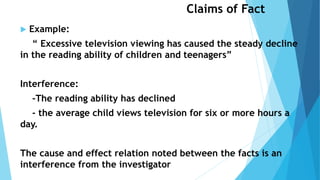
 Example:
“ Excessive television viewing has caused the steady decline
in the reading ability of children and teenagers”
Interference:
-The reading ability has declined
- the average child views television for six or more hours a
day.
The cause and effect relation noted between the facts is an
interference from the investigator
Claims of Fact
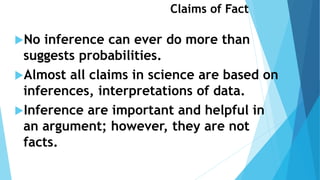
No inference can ever do more than
suggests probabilities.
Almost all claims in science are based on
inferences, interpretations of data.
Inference are important and helpful in
an argument; however, they are not
facts.
Any Question
About the
Topic?
Claims of Value
In your own
perception what is
claims of Value?
-Ms. Ariana
Claims of Value
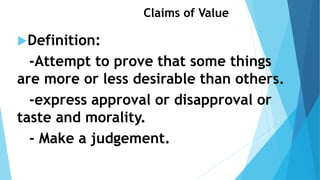
Definition:
-Attempt to prove that some things
are more or less desirable than others.
-express approval or disapproval or
taste and morality.
- Make a judgement.
Claims of Value
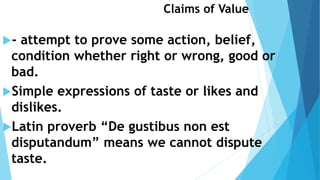
- attempt to prove some action, belief,
condition whether right or wrong, good or
bad.
Simple expressions of taste or likes and
dislikes.
Latin proverb “De gustibus non est
disputandum” means we cannot dispute
taste.
Claims of Value
Can be attacked or defended on
basis of standards that measure
worth of an action, belief or object.
Our likes and dislikes should be
supported by reference.
Analysis will be the same of all areas
of human experience.
Claims of Value
Two general areas in which
people most often disagree
about matters of value:
-aesthetics
-morality
Claims of Value
Aesthetics
- study of beauty and the fine arts
-controversies over works of art rage
fiercely among experts and laypeople
alike.
-the Rogerian approach to conflict
resolution can be useful in resolving
disagreements over the standards of
judging.
Claims of Value
Morality
-value claims about morality that expresses
judgments about the rightness or wrongness of
conduct or belief.
-disagreements are as wide and deep as in the
arts, and more significant.
-Although a writer and their reader may share
many values, there are still many others they may
disagree on.
Claims of Value
- In formulating value claims, you should be
prepared to ask and answer questions
about the way in which your value claims
and those of others have been arrived at.
- Although you cannot make someone
believe that you believe, you can give
good reasons to express your opinion.
Any Question
About The
Topic?
Claims of Policy
What is Claims of
Policy for you?
-Mr. Alvin
Claims of Policy
Defintion:
-asserts that specific plans of courses of
action should be instituted as a solutions
to problems.
-almost always “should” or “ought to” or
“must” is expressed or implied in the
claim.
Claims of Policy
In defending a claim of policy, have to do a
few steps:
-make a factual claim.
-refer to values that support claim.
-then introduce policy to show why your
solution will solve the problem.
-If using Rogerian approach, you will point
out the pros and cons of the solution.
Claims of Policy
A major mistake made is ignoring the
opinions of others.
- you can only support your own
idea if you can acknowledge the other
persons perspective.
Claims of Policy
Remember!
-Keep audience in mind
-Must consider what the audience can do about the
situation.
-hope to accomplish to get the readers to consider the
situation or problem from your perspective.
-continue to think about “what do I want my readers
to do or think?”
Any question
about the
topic?
THANK YOU FOR
LISTENING AND GOD
BLESS

Claims-of-Fact-Value-Policy.pptx

  • 1.
    Claims of Fact, ClaimsOf Value and Claims of Policy Group 3 Report
  • 2.
    Claims of Fact Inyour Own Understanding. What is Claims? -Ms. Marian
  • 3.
    Claims of Fact Whatis Fact for you? -Ms. Angie
  • 4.
    Claims of Fact Assertsthat a condition has existed, exists, or will exist. Based on facts or data that the audience will accept as being objectively verifiable. Other ways to support: -Statistics -Examples -Testimonies
  • 5.
    Facts are nonnegotiable -Atlas -maps -Reference book -Telephone directories -Data from scientific sources Claims of Fact
  • 6.
    Remember!  Not allclaims are neatly stated . - there are exceptions to generalizations  Qualify claims: - generally -Usually -probably -as a rule Claims of Fact
  • 7.
    Claims of Fact Inference -is a statement about the unknown on the basis of the known. -Difference between fact and inference is that interference is an interpretation, or an opinion reached after informed evaluation of evidence
  • 8.
    Claims of Fact Example: “ Excessive television viewing has caused the steady decline in the reading ability of children and teenagers” Interference: -The reading ability has declined - the average child views television for six or more hours a day. The cause and effect relation noted between the facts is an interference from the investigator
  • 9.
    Claims of Fact Noinference can ever do more than suggests probabilities. Almost all claims in science are based on inferences, interpretations of data. Inference are important and helpful in an argument; however, they are not facts.
  • 10.
  • 11.
    Claims of Value Inyour own perception what is claims of Value? -Ms. Ariana
  • 12.
    Claims of Value Definition: -Attemptto prove that some things are more or less desirable than others. -express approval or disapproval or taste and morality. - Make a judgement.
  • 13.
    Claims of Value -attempt to prove some action, belief, condition whether right or wrong, good or bad. Simple expressions of taste or likes and dislikes. Latin proverb “De gustibus non est disputandum” means we cannot dispute taste.
  • 14.
    Claims of Value Canbe attacked or defended on basis of standards that measure worth of an action, belief or object. Our likes and dislikes should be supported by reference. Analysis will be the same of all areas of human experience.
  • 15.
    Claims of Value Twogeneral areas in which people most often disagree about matters of value: -aesthetics -morality
  • 16.
    Claims of Value Aesthetics -study of beauty and the fine arts -controversies over works of art rage fiercely among experts and laypeople alike. -the Rogerian approach to conflict resolution can be useful in resolving disagreements over the standards of judging.
  • 17.
    Claims of Value Morality -valueclaims about morality that expresses judgments about the rightness or wrongness of conduct or belief. -disagreements are as wide and deep as in the arts, and more significant. -Although a writer and their reader may share many values, there are still many others they may disagree on.
  • 18.
    Claims of Value -In formulating value claims, you should be prepared to ask and answer questions about the way in which your value claims and those of others have been arrived at. - Although you cannot make someone believe that you believe, you can give good reasons to express your opinion.
  • 19.
  • 20.
    Claims of Policy Whatis Claims of Policy for you? -Mr. Alvin
  • 21.
    Claims of Policy Defintion: -assertsthat specific plans of courses of action should be instituted as a solutions to problems. -almost always “should” or “ought to” or “must” is expressed or implied in the claim.
  • 22.
    Claims of Policy Indefending a claim of policy, have to do a few steps: -make a factual claim. -refer to values that support claim. -then introduce policy to show why your solution will solve the problem. -If using Rogerian approach, you will point out the pros and cons of the solution.
  • 23.
    Claims of Policy Amajor mistake made is ignoring the opinions of others. - you can only support your own idea if you can acknowledge the other persons perspective.
  • 24.
    Claims of Policy Remember! -Keepaudience in mind -Must consider what the audience can do about the situation. -hope to accomplish to get the readers to consider the situation or problem from your perspective. -continue to think about “what do I want my readers to do or think?”
  • 25.
  • 26.