QUARTER 2, LESSON 1
“PREPARE VEGETABLE
DISHES”
Vegetables are the plants or
parts of plants like leave, fruits,
tubers, roots, bulb, stems,
shoots, and flower used in a dish
either raw or cooked.
Vegetables give color color,
texture and flavor to our meals.
They also give vitamins and
minerals.
Vegetables provides nutrients
vital for health and maintenance
of our body.
Vegetables are important
sources of many nutrients,
including potassium, dietary
fiber, folate (folic acid), vitamin
A, and vitamin C.
CLASSIFICATION OF
VEGETABLES
Vegetables are a category of
food which can be obtained from
any part of plant which is
edible. The edible parts can be
stem, leaves, flowers, roots,
tubers and sometimes fruits.
1. Stem Vegetables
It is an edible part of the plant which shoots
from the roots or bulb and it always grows
above the ground unlike roots or bulb.
Examples are Artichoke, Asparagus, Celery,
Fennel, Bamboo shoots
2. Leaves Vegetables Vegetables that are
leafy belong in this category such as
spinach, cabbage, water cress, lettuce, bok
choy, gai lan, choy sum, brussels sprouts,
witloof, silverbeet, radicchio, kale, collard
leaves, Swiss chard, mustard leaves, and
fenugreek leaves .
3. Flower Vegetables Plants that has flowers
is used as vegetables in the culinary world.
They are seasonal and abundant during a
particular season of the year. Such plants
are only grown for their flower buds.
Examples of these are cauliflower, broccoli,
courgette flowers, squash blossoms,
artichoke, agati (dok kae, Thailand), banana
flower, and lotus.
4. Stalk or Bulb Vegetables This is the part
of the plant which grows just below the
ground and is the portion which is in
between the stem and the root, the root
actually comes out from the bottom of the
bulb. Bulbs are generally in layers of skin
and they are very strong in flavour.
Examples are onion, garlic, spring onion,
leek, kohlrabi, fennel and shallots.
5. Seed Vegetables (Beans) This category
includes legumes which is used as food, it is
actually the fruit of the plant of which the
seed is eaten, sometimes its peeled like
green peas. Some examples are mungbean,
garbanzos, cowpea, kidney bean, soy bean
and white bean.
6. Root Vegetables This category includes
plants of which roots are edible and is used
as vegetables. Usually long, round, and
swollen taproot. Some examples of root
vegetables are beet, carrot, radish,
horseradish, turnip, celeriac, daikon, enset,
jicama, konjac, maca, arrowroot, Chinese
water chestnut, taro, and etc.
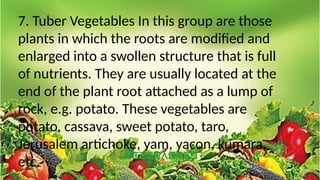
7. Tuber Vegetables In this group are those
plants in which the roots are modified and
enlarged into a swollen structure that is full
of nutrients. They are usually located at the

end of the plant root attached as a lump of
rock, e.g. potato. These vegetables are
potato, cassava, sweet potato, taro,
Jerusalem artichoke, yam, yacon, kumara,
etc.
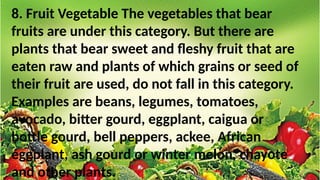
8. Fruit Vegetable The vegetables that bear
fruits are under this category. But there are
plants that bear sweet and fleshy fruit that are
eaten raw and plants of which grains or seed of
their fruit are used, do not fall in this category.
Examples are beans, legumes, tomatoes,
avocado, bitter gourd, eggplant, caigua or
bottle gourd, bell peppers, ackee, African
eggplant, ash gourd or winter melon, chayote
and other plants.
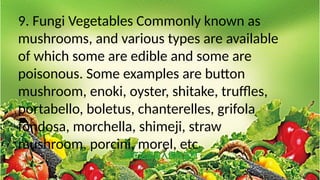
9. Fungi Vegetables Commonly known as
mushrooms, and various types are available
of which some are edible and some are
poisonous. Some examples are button
mushroom, enoki, oyster, shitake, truffles,
portabello, boletus, chanterelles, grifola
fondosa, morchella, shimeji, straw
mushroom, porcini, morel, etc
THANK YOU FOR
LISTENING!
PREPARING FRESH
VEGETABLES
1. Washing
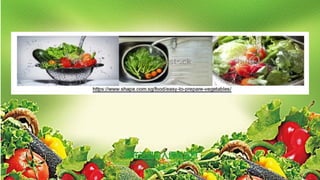
 Wash all vegetables thoroughly
 Scrub well unpeeled vegetables, like potatoes for baking
 Wash green leafy vegetables in several changes of cold
water
 After washing, drain well and refrigerate lightly covered
to prevent drying.
2. Soaking
 Do not soak vegetables for long periods to prevent flavor
and nutrient loss.
 Cabbage, broccoli, cauliflower may be soaked for 30
minutes in cold salted water to eliminate insects.
 Limp vegetables can be soaked briefly in cold water to
restore crispness.
3. Peeling and Cutting
 Peel vegetables as thinly as possible.
 Cut vegetables into uniform pieces for even cooking
 Treat vegetables that brown easily with acid (potatoes,
eggplants, sweet potato) or hold under water until ready
to use.
 Save edible trim for soups, stocks and purees.
4. Serving
 Fresh produce should be placed unrefrigerated on the
table not longer than two hours.
 Use a cooler with ice or ice gel packs to transport or
store cut fresh vegetables at picnics or other summer
events. Keep raw meats in a separate cooler.
Answer the
following:
1. Fresh produce should be placed _____________on the
table not longer than two hours.
2. Scrub well ________________, like potatoes for baking.
3. Peel vegetables as ___________ as possible.
4. Do not soak vegetables for __________to prevent flavor
and nutrient loss.
5. Cabbage, broccoli, cauliflower may be soaked for
_________ in cold salted water to eliminate insects.
THANK YOU FOR
LISTENING!

Quarter 2 TLE 10 WEE 1 MODULE 1 VEGETABLES.pptx

  • 1.
    QUARTER 2, LESSON1 “PREPARE VEGETABLE DISHES”
  • 2.
    Vegetables are theplants or parts of plants like leave, fruits, tubers, roots, bulb, stems, shoots, and flower used in a dish either raw or cooked.
  • 3.
    Vegetables give colorcolor, texture and flavor to our meals. They also give vitamins and minerals.
  • 4.
    Vegetables provides nutrients vitalfor health and maintenance of our body.
  • 5.
    Vegetables are important sourcesof many nutrients, including potassium, dietary fiber, folate (folic acid), vitamin A, and vitamin C.
  • 6.
  • 7.
    Vegetables are acategory of food which can be obtained from any part of plant which is edible. The edible parts can be stem, leaves, flowers, roots, tubers and sometimes fruits.
  • 8.
    1. Stem Vegetables Itis an edible part of the plant which shoots from the roots or bulb and it always grows above the ground unlike roots or bulb. Examples are Artichoke, Asparagus, Celery, Fennel, Bamboo shoots
  • 9.
    2. Leaves VegetablesVegetables that are leafy belong in this category such as spinach, cabbage, water cress, lettuce, bok choy, gai lan, choy sum, brussels sprouts, witloof, silverbeet, radicchio, kale, collard leaves, Swiss chard, mustard leaves, and fenugreek leaves .
  • 10.
    3. Flower VegetablesPlants that has flowers is used as vegetables in the culinary world. They are seasonal and abundant during a particular season of the year. Such plants are only grown for their flower buds. Examples of these are cauliflower, broccoli, courgette flowers, squash blossoms, artichoke, agati (dok kae, Thailand), banana flower, and lotus.
  • 11.
    4. Stalk orBulb Vegetables This is the part of the plant which grows just below the ground and is the portion which is in between the stem and the root, the root actually comes out from the bottom of the bulb. Bulbs are generally in layers of skin and they are very strong in flavour. Examples are onion, garlic, spring onion, leek, kohlrabi, fennel and shallots.
  • 12.
    5. Seed Vegetables(Beans) This category includes legumes which is used as food, it is actually the fruit of the plant of which the seed is eaten, sometimes its peeled like green peas. Some examples are mungbean, garbanzos, cowpea, kidney bean, soy bean and white bean.
  • 13.
    6. Root VegetablesThis category includes plants of which roots are edible and is used as vegetables. Usually long, round, and swollen taproot. Some examples of root vegetables are beet, carrot, radish, horseradish, turnip, celeriac, daikon, enset, jicama, konjac, maca, arrowroot, Chinese water chestnut, taro, and etc.
  • 14.
    7. Tuber VegetablesIn this group are those plants in which the roots are modified and enlarged into a swollen structure that is full of nutrients. They are usually located at the end of the plant root attached as a lump of rock, e.g. potato. These vegetables are potato, cassava, sweet potato, taro, Jerusalem artichoke, yam, yacon, kumara, etc.
  • 15.
    8. Fruit VegetableThe vegetables that bear fruits are under this category. But there are plants that bear sweet and fleshy fruit that are eaten raw and plants of which grains or seed of their fruit are used, do not fall in this category. Examples are beans, legumes, tomatoes, avocado, bitter gourd, eggplant, caigua or bottle gourd, bell peppers, ackee, African eggplant, ash gourd or winter melon, chayote and other plants.
  • 16.
    9. Fungi VegetablesCommonly known as mushrooms, and various types are available of which some are edible and some are poisonous. Some examples are button mushroom, enoki, oyster, shitake, truffles, portabello, boletus, chanterelles, grifola fondosa, morchella, shimeji, straw mushroom, porcini, morel, etc
  • 18.
  • 19.
  • 20.
    1. Washing  Washall vegetables thoroughly  Scrub well unpeeled vegetables, like potatoes for baking  Wash green leafy vegetables in several changes of cold water  After washing, drain well and refrigerate lightly covered to prevent drying.
  • 22.
    2. Soaking  Donot soak vegetables for long periods to prevent flavor and nutrient loss.  Cabbage, broccoli, cauliflower may be soaked for 30 minutes in cold salted water to eliminate insects.  Limp vegetables can be soaked briefly in cold water to restore crispness.
  • 24.
    3. Peeling andCutting  Peel vegetables as thinly as possible.  Cut vegetables into uniform pieces for even cooking  Treat vegetables that brown easily with acid (potatoes, eggplants, sweet potato) or hold under water until ready to use.  Save edible trim for soups, stocks and purees.
  • 26.
    4. Serving  Freshproduce should be placed unrefrigerated on the table not longer than two hours.  Use a cooler with ice or ice gel packs to transport or store cut fresh vegetables at picnics or other summer events. Keep raw meats in a separate cooler.
  • 27.
    Answer the following: 1. Freshproduce should be placed _____________on the table not longer than two hours. 2. Scrub well ________________, like potatoes for baking. 3. Peel vegetables as ___________ as possible. 4. Do not soak vegetables for __________to prevent flavor and nutrient loss. 5. Cabbage, broccoli, cauliflower may be soaked for _________ in cold salted water to eliminate insects.
  • 28.