Modals Verbs
(should, must, might)
and Modal Adverbs
Those who have less in life must have more
in law.
Ramon Magsaysay
If you don’t know where you are going, you
might wind up someplace else.
Yogi Berra
The higher we are placed, the more humbly
we should walk.
Marcus Tullius Cicero
Modal verbs or modals are special kinds
of helping verbs that help writers express
the strength of their opinion about a
statement.
Modals show different possibilities such
as obligation, giving and asking for
permission, ability, possibility, and so
on.
Can, could, may, might, shall, should,
will, would, and must are modal verb
forms.
Should indicates:
A. obligation: Filipinos should care for
the environment.
B. expectation: You should be able to
apply what you have
learned in class to your
daily life.
C. advice: Martha should study more or
she will fail the exam.
You should stop eating fast food.
He should go to the pharmacy first thing
in the morning.
You should try to focus more on your
writing skills.
You should have understood the text by
now.
Must indicates
A.necessity: One must work hard in order
to succeed.
B. assumption: He must have been
stranded that is why he has not arrived it.
C. prohibition: You must not smoke.
D. order: You must stay at home.
E. advice: You must eat healthy foods.
You must keep your room tidy.
You must be back before ten.
I must pick up my sister from school.
She must be here for a dentist appointment.
You must attend classes regularly.
You must present your ID before entering the
school.
You must listen to your parents.
Might denotes:
A.very weak possibility: We might have
classes on Saturdays.
B. permission: Might I ask you not to be
so late next time?
C. polite request: Might I have a glass of
cold water?
I might go to Japan for a month to study Japanese.
The dog might bark when we pass by the gate.
Might I interrupt you for a moment?
You might like to try one of our wonderful desserts
.
Might I see your credit card, please?
Might I recommend the grilled swordfish?
Might I remind you that this is a library?
Modal verbs are used to show how likely
things are to happen. This can be called
expressing degrees of possibility.
Examples:
1. It might rain today.
2. The parcel should arrive tomorrow.
3. Kevin’s brother must come first in the
race - he’s such a fast runner!
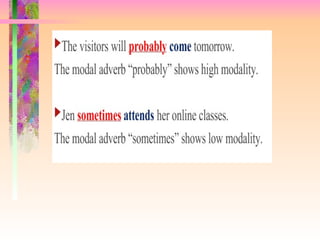
Some adverbs can also be used to express
degrees of possibility.
Examples:
1. Perhaps it rained last night.
2. The parcel probably arrived yesterday.
3. Kevin’s brother certainly has a good
chance of winning the race - he’s such a
fast runner.
Sometimes both modal verbs and adverbs
of possibility can be used in the same
sentence for emphasis.
Examples:
1.He promised that he might occasionally
visit the farm.
2. The man on the street must definitely be
very old.
3. The ship should probably be leaving
earlier.
Therefore, when an adverb is added to a
modal verb to add meaning or emphasis
it becomes a modal adverb.
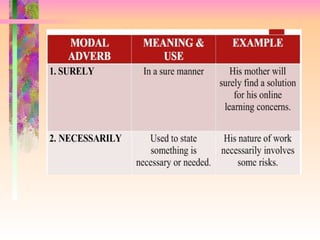
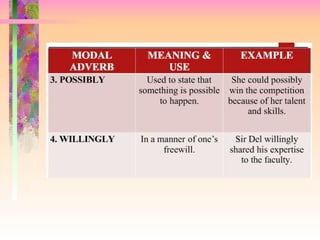
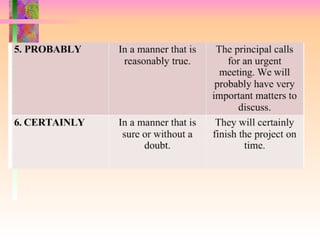
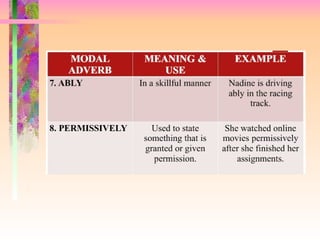
Here are a few examples of the modal
adverbs included:
•Certainly
•Absolutely
•Probably
•Mostly
•Surely
•Crucially
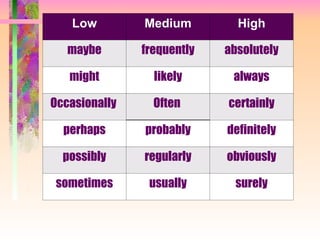
Low Medium High
maybe frequently absolutely
might likely always
Occasionally Often certainly
perhaps probably definitely
possibly regularly obviously
sometimes usually surely
My mother is possibly coming home
today.
I am certainly joyful that my family is
always with me.
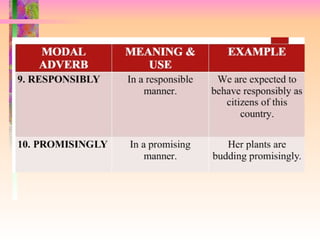
1. I'm certainly going to clean my room.
2. She did her duty as the leader
responsibly.
3. His first day of working began
promisingly.
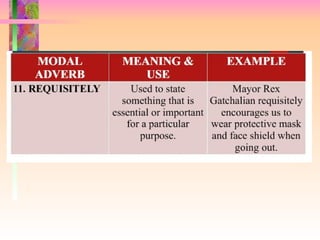
4. I do not think that we necessarily
change the idea.
5. They would possibly change their
mind after knowing the fact.
What have you observed with the modal
adverbs? Are they similar to modal verbs and
modal nouns? If yes, how are they similar? If
not, how are they different?

In the given sample sentences, the
underlined words are the modal adverbs and
the italicized words are the words they
describe. Most of the modal adverbs describe
how something is done and how someone feels
about something.
 Modal Adverbs are similar to Modal Verbs and
Nouns because they all express modality.
They only differ in form and the way they are
used in sentences.
 Most modal adverbs have an equivalent
modal noun forms like the following:
certainly-certainty, possibly-possibility
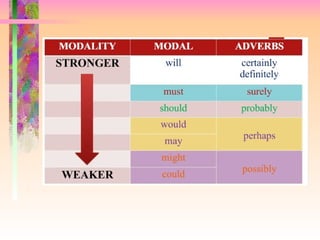
 Modal adverbs suggest a range strong to
weak modality
 The choice and use of modal adverbs
depend on the modality that you want to
suggest in the statement to modify the
certainty (*whether certain or uncertain) to
describe how something is done.
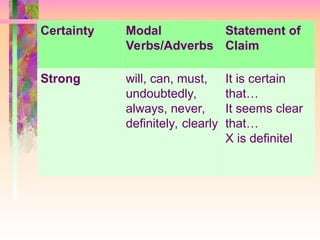
Certainty Modal
Verbs/Adverbs
Statement of
Claim
Strong will, can, must,
undoubtedly,
always, never,
definitely, clearly
It is certain
that…
It seems clear
that…
X is definitel
Certainty Modal
Verbs/Adverbs
Statement of
Claim
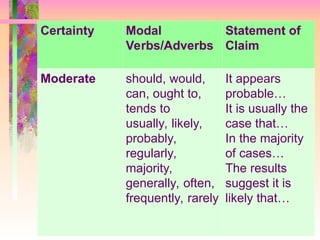
Moderate should, would,
can, ought to,
tends to
usually, likely,
probably,
regularly,
majority,
generally, often,
frequently, rarely
It appears
probable…
It is usually the
case that…
In the majority
of cases…
The results
suggest it is
likely that…
Certainty Modal
Verbs/Adverbs
Statement of
Claim
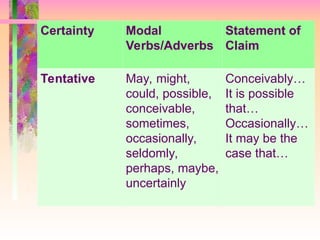
Tentative May, might,
could, possible,
conceivable,
sometimes,
occasionally,
seldomly,
perhaps, maybe,
uncertainly
Conceivably…
It is possible
that…
Occasionally…
It may be the
case that…
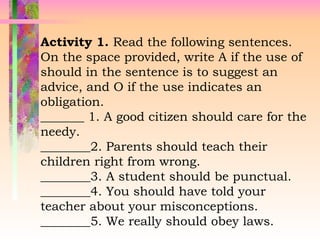
Activity 1. Read the following sentences.
On the space provided, write A if the use of
should in the sentence is to suggest an
advice, and O if the use indicates an
obligation.
_______ 1. A good citizen should care for the
needy.
________2. Parents should teach their
children right from wrong.
________3. A student should be punctual.
________4. You should have told your
teacher about your misconceptions.
________5. We really should obey laws.
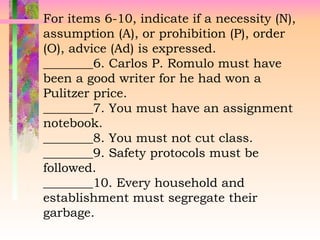
For items 6-10, indicate if a necessity (N),
assumption (A), or prohibition (P), order
(O), advice (Ad) is expressed.
________6. Carlos P. Romulo must have
been a good writer for he had won a
Pulitzer price.
________7. You must have an assignment
notebook.
________8. You must not cut class.
________9. Safety protocols must be
followed.
________10. Every household and
establishment must segregate their
garbage.
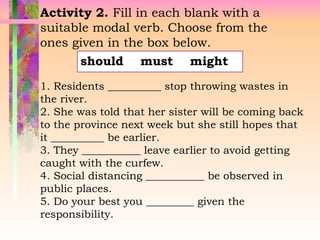
Activity 2. Fill in each blank with a
suitable modal verb. Choose from the
ones given in the box below.
should must might
1. Residents __________ stop throwing wastes in
the river.
2. She was told that her sister will be coming back
to the province next week but she still hopes that
it __________ be earlier.
3. They ___________ leave earlier to avoid getting
caught with the curfew.
4. Social distancing ___________ be observed in
public places.
5. Do your best you _________ given the
responsibility.
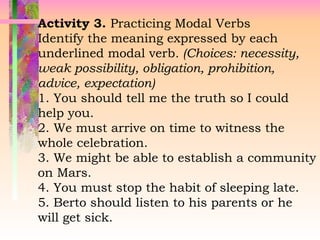
Activity 3. Practicing Modal Verbs
Identify the meaning expressed by each
underlined modal verb. (Choices: necessity,
weak possibility, obligation, prohibition,
advice, expectation)
1. You should tell me the truth so I could
help you.
2. We must arrive on time to witness the
whole celebration.
3. We might be able to establish a community
on Mars.
4. You must stop the habit of sleeping late.
5. Berto should listen to his parents or he
will get sick.
Activity 3. Practicing Modal Verbs
Identify the meaning expressed by each
underlined modal verb. (Choices: necessity,
weak possibility, obligation, prohibition,
advice, expectation)
6. We must think of the good of others too
and not only of ourselves.
7. The guests might be more than we expect.
8. You should respect others.
9. Mike might join the club.
10. She should apologize before sundown.
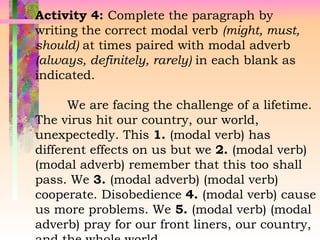
Activity 4: Complete the paragraph by
writing the correct modal verb (might, must,
should) at times paired with modal adverb
(always, definitely, rarely) in each blank as
indicated.
We are facing the challenge of a lifetime.
The virus hit our country, our world,
unexpectedly. This 1. (modal verb) has
different effects on us but we 2. (modal verb)
(modal adverb) remember that this too shall
pass. We 3. (modal adverb) (modal verb)
cooperate. Disobedience 4. (modal verb) cause
us more problems. We 5. (modal verb) (modal
adverb) pray for our front liners, our country,
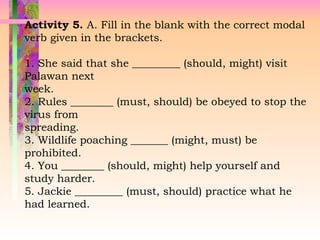
Activity 5. A. Fill in the blank with the correct modal
verb given in the brackets.
1. She said that she _________ (should, might) visit
Palawan next
week.
2. Rules ________ (must, should) be obeyed to stop the
virus from
spreading.
3. Wildlife poaching _______ (might, must) be
prohibited.
4. You ________ (should, might) help yourself and
study harder.
5. Jackie _________ (must, should) practice what he
had learned.
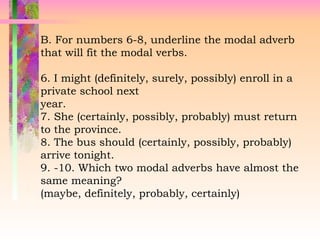
B. For numbers 6-8, underline the modal adverb
that will fit the modal verbs.
6. I might (definitely, surely, possibly) enroll in a
private school next
year.
7. She (certainly, possibly, probably) must return
to the province.
8. The bus should (certainly, possibly, probably)
arrive tonight.
9. -10. Which two modal adverbs have almost the
same meaning?
(maybe, definitely, probably, certainly)
Directions:
A. In the first sentence underline the MODAL
VERB. Remember, modal verbs are made ‘negative’
by adding the word ‘not’.
In the second sentence underline the MODAL
ADVERB.
1. You can’t have said that to her!
2. Surely you can’t have said that to her!
1. I might tell you all about it.
2. I might just tell you all about it.
1.You shouldn’t have gone to so much
trouble.
2. You really shouldn’t have gone to so
much trouble.
1. I will call you tomorrow.
2. I will definitely call you tomorrow.
1. You can’t be serious!
2. You can’t possibly be serious!
1. She must have forgotten it.
2. She obviously must have forgotten it.
1. He could help us a lot.
2. He could probably help us a lot.
1. I can’t remember when I first met her.
2. I can’t exactly remember when I first
met her.
1. You should take up that course.
2. You should absolutely take up that
course

Quarter 2 Lesson 3 MODAL VERB topic S.ppt

  • 1.
    Modals Verbs (should, must,might) and Modal Adverbs
  • 2.
    Those who haveless in life must have more in law. Ramon Magsaysay If you don’t know where you are going, you might wind up someplace else. Yogi Berra The higher we are placed, the more humbly we should walk. Marcus Tullius Cicero
  • 3.
    Modal verbs ormodals are special kinds of helping verbs that help writers express the strength of their opinion about a statement. Modals show different possibilities such as obligation, giving and asking for permission, ability, possibility, and so on. Can, could, may, might, shall, should, will, would, and must are modal verb forms.
  • 4.
    Should indicates: A. obligation:Filipinos should care for the environment. B. expectation: You should be able to apply what you have learned in class to your daily life. C. advice: Martha should study more or she will fail the exam.
  • 5.
    You should stopeating fast food. He should go to the pharmacy first thing in the morning. You should try to focus more on your writing skills. You should have understood the text by now.
  • 6.
    Must indicates A.necessity: Onemust work hard in order to succeed. B. assumption: He must have been stranded that is why he has not arrived it. C. prohibition: You must not smoke. D. order: You must stay at home. E. advice: You must eat healthy foods.
  • 7.
    You must keepyour room tidy. You must be back before ten. I must pick up my sister from school. She must be here for a dentist appointment. You must attend classes regularly. You must present your ID before entering the school. You must listen to your parents.
  • 8.
    Might denotes: A.very weakpossibility: We might have classes on Saturdays. B. permission: Might I ask you not to be so late next time? C. polite request: Might I have a glass of cold water?
  • 9.
    I might goto Japan for a month to study Japanese. The dog might bark when we pass by the gate. Might I interrupt you for a moment? You might like to try one of our wonderful desserts . Might I see your credit card, please? Might I recommend the grilled swordfish? Might I remind you that this is a library?
  • 10.
    Modal verbs areused to show how likely things are to happen. This can be called expressing degrees of possibility. Examples: 1. It might rain today. 2. The parcel should arrive tomorrow. 3. Kevin’s brother must come first in the race - he’s such a fast runner!
  • 11.
    Some adverbs canalso be used to express degrees of possibility. Examples: 1. Perhaps it rained last night. 2. The parcel probably arrived yesterday. 3. Kevin’s brother certainly has a good chance of winning the race - he’s such a fast runner.
  • 12.
    Sometimes both modalverbs and adverbs of possibility can be used in the same sentence for emphasis. Examples: 1.He promised that he might occasionally visit the farm. 2. The man on the street must definitely be very old. 3. The ship should probably be leaving earlier.
  • 13.
    Therefore, when anadverb is added to a modal verb to add meaning or emphasis it becomes a modal adverb. Here are a few examples of the modal adverbs included: •Certainly •Absolutely •Probably •Mostly •Surely •Crucially
  • 14.
    Low Medium High maybefrequently absolutely might likely always Occasionally Often certainly perhaps probably definitely possibly regularly obviously sometimes usually surely
  • 15.
    My mother ispossibly coming home today. I am certainly joyful that my family is always with me.
  • 16.
    1. I'm certainlygoing to clean my room. 2. She did her duty as the leader responsibly. 3. His first day of working began promisingly. 4. I do not think that we necessarily change the idea. 5. They would possibly change their mind after knowing the fact.
  • 17.
    What have youobserved with the modal adverbs? Are they similar to modal verbs and modal nouns? If yes, how are they similar? If not, how are they different?  In the given sample sentences, the underlined words are the modal adverbs and the italicized words are the words they describe. Most of the modal adverbs describe how something is done and how someone feels about something.
  • 18.
     Modal Adverbsare similar to Modal Verbs and Nouns because they all express modality. They only differ in form and the way they are used in sentences.  Most modal adverbs have an equivalent modal noun forms like the following: certainly-certainty, possibly-possibility  Modal adverbs suggest a range strong to weak modality
  • 19.
     The choiceand use of modal adverbs depend on the modality that you want to suggest in the statement to modify the certainty (*whether certain or uncertain) to describe how something is done.
  • 20.
    Certainty Modal Verbs/Adverbs Statement of Claim Strongwill, can, must, undoubtedly, always, never, definitely, clearly It is certain that… It seems clear that… X is definitel
  • 21.
    Certainty Modal Verbs/Adverbs Statement of Claim Moderateshould, would, can, ought to, tends to usually, likely, probably, regularly, majority, generally, often, frequently, rarely It appears probable… It is usually the case that… In the majority of cases… The results suggest it is likely that…
  • 22.
    Certainty Modal Verbs/Adverbs Statement of Claim TentativeMay, might, could, possible, conceivable, sometimes, occasionally, seldomly, perhaps, maybe, uncertainly Conceivably… It is possible that… Occasionally… It may be the case that…
  • 33.
    Activity 1. Readthe following sentences. On the space provided, write A if the use of should in the sentence is to suggest an advice, and O if the use indicates an obligation. _______ 1. A good citizen should care for the needy. ________2. Parents should teach their children right from wrong. ________3. A student should be punctual. ________4. You should have told your teacher about your misconceptions. ________5. We really should obey laws.
  • 34.
    For items 6-10,indicate if a necessity (N), assumption (A), or prohibition (P), order (O), advice (Ad) is expressed. ________6. Carlos P. Romulo must have been a good writer for he had won a Pulitzer price. ________7. You must have an assignment notebook. ________8. You must not cut class. ________9. Safety protocols must be followed. ________10. Every household and establishment must segregate their garbage.
  • 35.
    Activity 2. Fillin each blank with a suitable modal verb. Choose from the ones given in the box below. should must might 1. Residents __________ stop throwing wastes in the river. 2. She was told that her sister will be coming back to the province next week but she still hopes that it __________ be earlier. 3. They ___________ leave earlier to avoid getting caught with the curfew. 4. Social distancing ___________ be observed in public places. 5. Do your best you _________ given the responsibility.
  • 36.
    Activity 3. PracticingModal Verbs Identify the meaning expressed by each underlined modal verb. (Choices: necessity, weak possibility, obligation, prohibition, advice, expectation) 1. You should tell me the truth so I could help you. 2. We must arrive on time to witness the whole celebration. 3. We might be able to establish a community on Mars. 4. You must stop the habit of sleeping late. 5. Berto should listen to his parents or he will get sick.
  • 37.
    Activity 3. PracticingModal Verbs Identify the meaning expressed by each underlined modal verb. (Choices: necessity, weak possibility, obligation, prohibition, advice, expectation) 6. We must think of the good of others too and not only of ourselves. 7. The guests might be more than we expect. 8. You should respect others. 9. Mike might join the club. 10. She should apologize before sundown.
  • 38.
    Activity 4: Completethe paragraph by writing the correct modal verb (might, must, should) at times paired with modal adverb (always, definitely, rarely) in each blank as indicated. We are facing the challenge of a lifetime. The virus hit our country, our world, unexpectedly. This 1. (modal verb) has different effects on us but we 2. (modal verb) (modal adverb) remember that this too shall pass. We 3. (modal adverb) (modal verb) cooperate. Disobedience 4. (modal verb) cause us more problems. We 5. (modal verb) (modal adverb) pray for our front liners, our country,
  • 39.
    Activity 5. A.Fill in the blank with the correct modal verb given in the brackets. 1. She said that she _________ (should, might) visit Palawan next week. 2. Rules ________ (must, should) be obeyed to stop the virus from spreading. 3. Wildlife poaching _______ (might, must) be prohibited. 4. You ________ (should, might) help yourself and study harder. 5. Jackie _________ (must, should) practice what he had learned.
  • 40.
    B. For numbers6-8, underline the modal adverb that will fit the modal verbs. 6. I might (definitely, surely, possibly) enroll in a private school next year. 7. She (certainly, possibly, probably) must return to the province. 8. The bus should (certainly, possibly, probably) arrive tonight. 9. -10. Which two modal adverbs have almost the same meaning? (maybe, definitely, probably, certainly)
  • 41.
    Directions: A. In thefirst sentence underline the MODAL VERB. Remember, modal verbs are made ‘negative’ by adding the word ‘not’. In the second sentence underline the MODAL ADVERB. 1. You can’t have said that to her! 2. Surely you can’t have said that to her!
  • 42.
    1. I mighttell you all about it. 2. I might just tell you all about it. 1.You shouldn’t have gone to so much trouble. 2. You really shouldn’t have gone to so much trouble. 1. I will call you tomorrow. 2. I will definitely call you tomorrow.
  • 43.
    1. You can’tbe serious! 2. You can’t possibly be serious! 1. She must have forgotten it. 2. She obviously must have forgotten it. 1. He could help us a lot. 2. He could probably help us a lot.
  • 44.
    1. I can’tremember when I first met her. 2. I can’t exactly remember when I first met her. 1. You should take up that course. 2. You should absolutely take up that course