Download to read offline
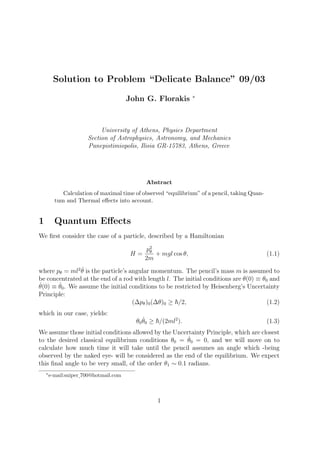
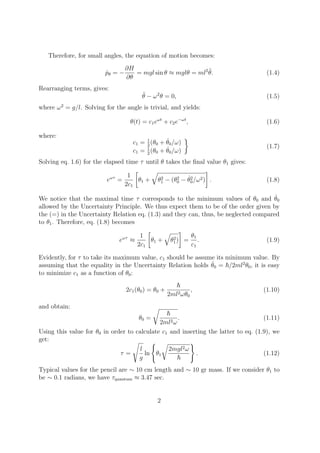
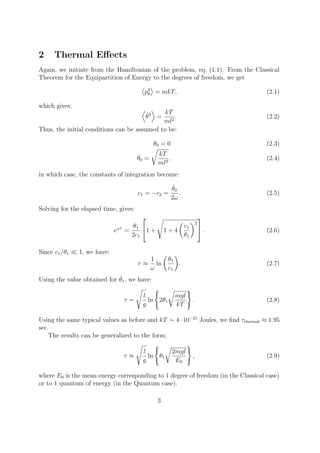
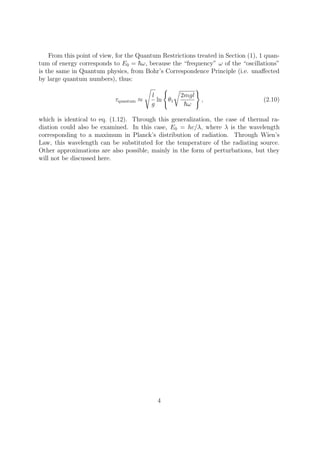

The document calculates the maximum time a pencil can remain in apparent equilibrium when accounting for quantum and thermal effects. For quantum effects, the calculation uses the Heisenberg uncertainty principle to determine the minimum possible initial conditions for the pencil's angle and angular velocity. This yields a maximum equilibrium time of about 3.47 seconds. For thermal effects, the calculation uses the classical equipartition theorem to determine initial conditions based on temperature. This yields a maximum equilibrium time of about 1.95 seconds. A general formula is presented that relates the maximum time to fundamental constants like plank's constant, Boltzmann's constant, and the system's energy corresponding to each degree of freedom.


![5G Explained! A High Level Overview [Introduction]](https://cdn.slidesharecdn.com/ss_thumbnails/5gexplainedahighleveloverview-260119165306-cc137a3e-thumbnail.jpg?width=640&height=640&fit=bounds)


