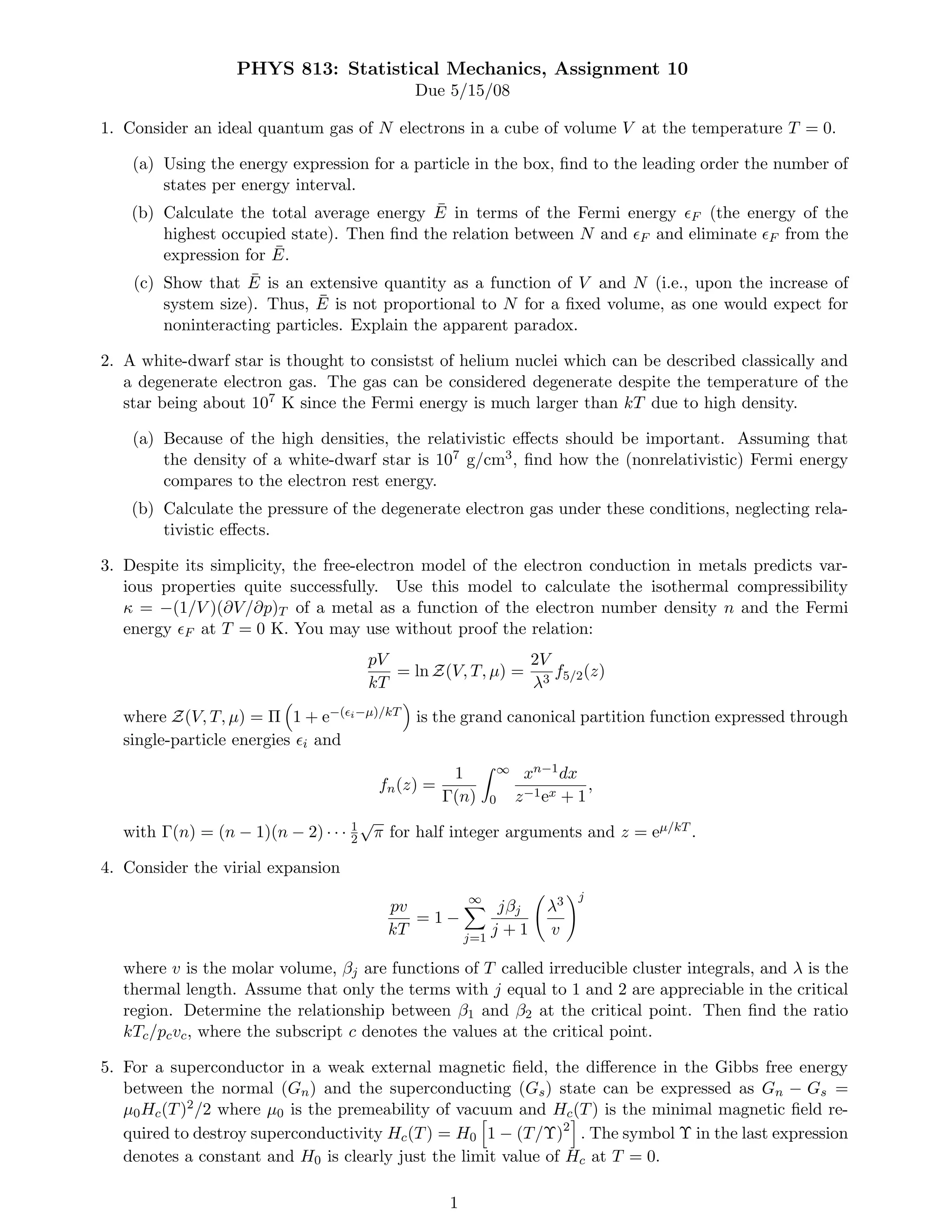
PHYS 813: Statistical Mechanics, Assignment 10
                                               Due 5/15/08

1. Consider an ideal quantum gas of N electrons in a cube of volume V at the temperature T = 0.

    (a) Using the energy expression for a particle in the box, find to the leading order the number of
        states per energy interval.
                                             ¯
    (b) Calculate the total average energy E in terms of the Fermi energy F (the energy of the
        highest occupied state). Then find the relation between N and F and eliminate F from the
                       ¯
        expression for E.
                    ¯
    (c) Show that E is an extensive quantity as a function of V and N (i.e., upon the increase of
                             ¯
        system size). Thus, E is not proportional to N for a fixed volume, as one would expect for
        noninteracting particles. Explain the apparent paradox.

2. A white-dwarf star is thought to consistst of helium nuclei which can be described classically and
   a degenerate electron gas. The gas can be considered degenerate despite the temperature of the
   star being about 107 K since the Fermi energy is much larger than kT due to high density.

    (a) Because of the high densities, the relativistic effects should be important. Assuming that
        the density of a white-dwarf star is 107 g/cm3 , find how the (nonrelativistic) Fermi energy
        compares to the electron rest energy.
    (b) Calculate the pressure of the degenerate electron gas under these conditions, neglecting rela-
        tivistic effects.

3. Despite its simplicity, the free-electron model of the electron conduction in metals predicts var-
   ious properties quite successfully. Use this model to calculate the isothermal compressibility
   κ = −(1/V )(∂V /∂p)T of a metal as a function of the electron number density n and the Fermi
   energy F at T = 0 K. You may use without proof the relation:
                                      pV                  2V
                                         = ln Z(V, T, µ) = 3 f5/2 (z)
                                      kT                  λ

   where Z(V, T, µ) = Π 1 + e−(     i −µ)/kT   is the grand canonical partition function expressed through
   single-particle energies i and
                                                    1         ∞     xn−1 dx
                                        fn (z) =                              ,
                                                   Γ(n)   0       z −1 ex + 1
                                      √
   with Γ(n) = (n − 1)(n − 2) · · · 1 π for half integer arguments and z = eµ/kT .
                                    2

4. Consider the virial expansion
                                                  ∞                         j
                                          pv          jβj              λ3
                                             =1−
                                          kT     j=1
                                                     j+1               v

   where v is the molar volume, βj are functions of T called irreducible cluster integrals, and λ is the
   thermal length. Assume that only the terms with j equal to 1 and 2 are appreciable in the critical
   region. Determine the relationship between β1 and β2 at the critical point. Then find the ratio
   kTc /pc vc , where the subscript c denotes the values at the critical point.

5. For a superconductor in a weak external magnetic field, the difference in the Gibbs free energy
   between the normal (Gn ) and the superconducting (Gs ) state can be expressed as Gn − Gs =
   µ0 Hc (T )2 /2 where µ0 is the premeability of vacuum and Hc (T ) is the minimal magnetic field re-
   quired to destroy superconductivity Hc (T ) = H0 1 − (T /Υ)2 . The symbol Υ in the last expression
   denotes a constant and H0 is clearly just the limit value of Hc at T = 0.

                                                   1
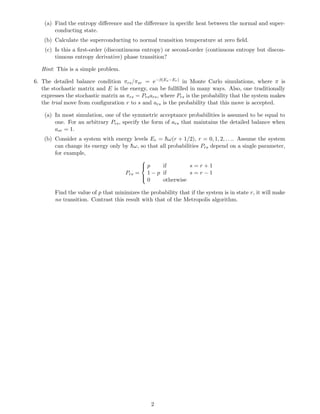
(a) Find the entropy difference and the difference in specific heat between the normal and super-
        conducting state.
    (b) Calculate the superconducting to normal transition temperature at zero field.
    (c) Is this a first-order (discontinuous entropy) or second-order (continuous entropy but discon-
        tinuous entropy derivative) phase transition?

   Hint: This is a simple problem.

6. The detailed balance condition πrs /πsr = e−β(Es −Er ) in Monte Carlo simulations, where π is
   the stochastic matrix and E is the energy, can be fullfilled in many ways. Also, one traditionally
   expresses the stochastic matrix as πrs = Prs ars , where Prs is the probability that the system makes
   the trial move from configuration r to s and ars is the probability that this move is accepted.

    (a) In most simulation, one of the symmetric acceptance probabilities is assumed to be equal to
        one. For an arbitrary Prs , specify the form of ars that maintains the detailed balance when
        asr = 1.
    (b) Consider a system with energy levels Er = ¯ ω(r + 1/2), r = 0, 1, 2, . . .. Assume the system
                                                    h
        can change its energy only by hω, so that all probabilities Prs depend on a single parameter,
                                      ¯
        for example,
                                             
                                             p
                                                    if        s=r+1
                                     Prs =     1 − p if        s=r−1
                                             
                                             0      otherwise

        Find the value of p that minimizes the probability that if the system is in state r, it will make
        no transition. Contrast this result with that of the Metropolis algorithm.


                                                  2

Sm08a10

  • 1.
    PHYS 813: StatisticalMechanics, Assignment 10 Due 5/15/08 1. Consider an ideal quantum gas of N electrons in a cube of volume V at the temperature T = 0. (a) Using the energy expression for a particle in the box, find to the leading order the number of states per energy interval. ¯ (b) Calculate the total average energy E in terms of the Fermi energy F (the energy of the highest occupied state). Then find the relation between N and F and eliminate F from the ¯ expression for E. ¯ (c) Show that E is an extensive quantity as a function of V and N (i.e., upon the increase of ¯ system size). Thus, E is not proportional to N for a fixed volume, as one would expect for noninteracting particles. Explain the apparent paradox. 2. A white-dwarf star is thought to consistst of helium nuclei which can be described classically and a degenerate electron gas. The gas can be considered degenerate despite the temperature of the star being about 107 K since the Fermi energy is much larger than kT due to high density. (a) Because of the high densities, the relativistic effects should be important. Assuming that the density of a white-dwarf star is 107 g/cm3 , find how the (nonrelativistic) Fermi energy compares to the electron rest energy. (b) Calculate the pressure of the degenerate electron gas under these conditions, neglecting rela- tivistic effects. 3. Despite its simplicity, the free-electron model of the electron conduction in metals predicts var- ious properties quite successfully. Use this model to calculate the isothermal compressibility κ = −(1/V )(∂V /∂p)T of a metal as a function of the electron number density n and the Fermi energy F at T = 0 K. You may use without proof the relation: pV 2V = ln Z(V, T, µ) = 3 f5/2 (z) kT λ where Z(V, T, µ) = Π 1 + e−( i −µ)/kT is the grand canonical partition function expressed through single-particle energies i and 1 ∞ xn−1 dx fn (z) = , Γ(n) 0 z −1 ex + 1 √ with Γ(n) = (n − 1)(n − 2) · · · 1 π for half integer arguments and z = eµ/kT . 2 4. Consider the virial expansion ∞ j pv jβj λ3 =1− kT j=1 j+1 v where v is the molar volume, βj are functions of T called irreducible cluster integrals, and λ is the thermal length. Assume that only the terms with j equal to 1 and 2 are appreciable in the critical region. Determine the relationship between β1 and β2 at the critical point. Then find the ratio kTc /pc vc , where the subscript c denotes the values at the critical point. 5. For a superconductor in a weak external magnetic field, the difference in the Gibbs free energy between the normal (Gn ) and the superconducting (Gs ) state can be expressed as Gn − Gs = µ0 Hc (T )2 /2 where µ0 is the premeability of vacuum and Hc (T ) is the minimal magnetic field re- quired to destroy superconductivity Hc (T ) = H0 1 − (T /Υ)2 . The symbol Υ in the last expression denotes a constant and H0 is clearly just the limit value of Hc at T = 0. 1
  • 2.
    (a) Find theentropy difference and the difference in specific heat between the normal and super- conducting state. (b) Calculate the superconducting to normal transition temperature at zero field. (c) Is this a first-order (discontinuous entropy) or second-order (continuous entropy but discon- tinuous entropy derivative) phase transition? Hint: This is a simple problem. 6. The detailed balance condition πrs /πsr = e−β(Es −Er ) in Monte Carlo simulations, where π is the stochastic matrix and E is the energy, can be fullfilled in many ways. Also, one traditionally expresses the stochastic matrix as πrs = Prs ars , where Prs is the probability that the system makes the trial move from configuration r to s and ars is the probability that this move is accepted. (a) In most simulation, one of the symmetric acceptance probabilities is assumed to be equal to one. For an arbitrary Prs , specify the form of ars that maintains the detailed balance when asr = 1. (b) Consider a system with energy levels Er = ¯ ω(r + 1/2), r = 0, 1, 2, . . .. Assume the system h can change its energy only by hω, so that all probabilities Prs depend on a single parameter, ¯ for example,  p  if s=r+1 Prs = 1 − p if s=r−1  0 otherwise Find the value of p that minimizes the probability that if the system is in state r, it will make no transition. Contrast this result with that of the Metropolis algorithm. 2