• Bulgarian Academy of Science: Institute for
the Study of Societies and Knowledge:
Dept. of Logical Systems and Models
vasildinev@gmail.com
10:15 - 10:45, June 29th , University of
Istanbul, Room “C”
5th Congress in Universal Logic,
University of Istanbul, Turkey, 25-30 June 2015
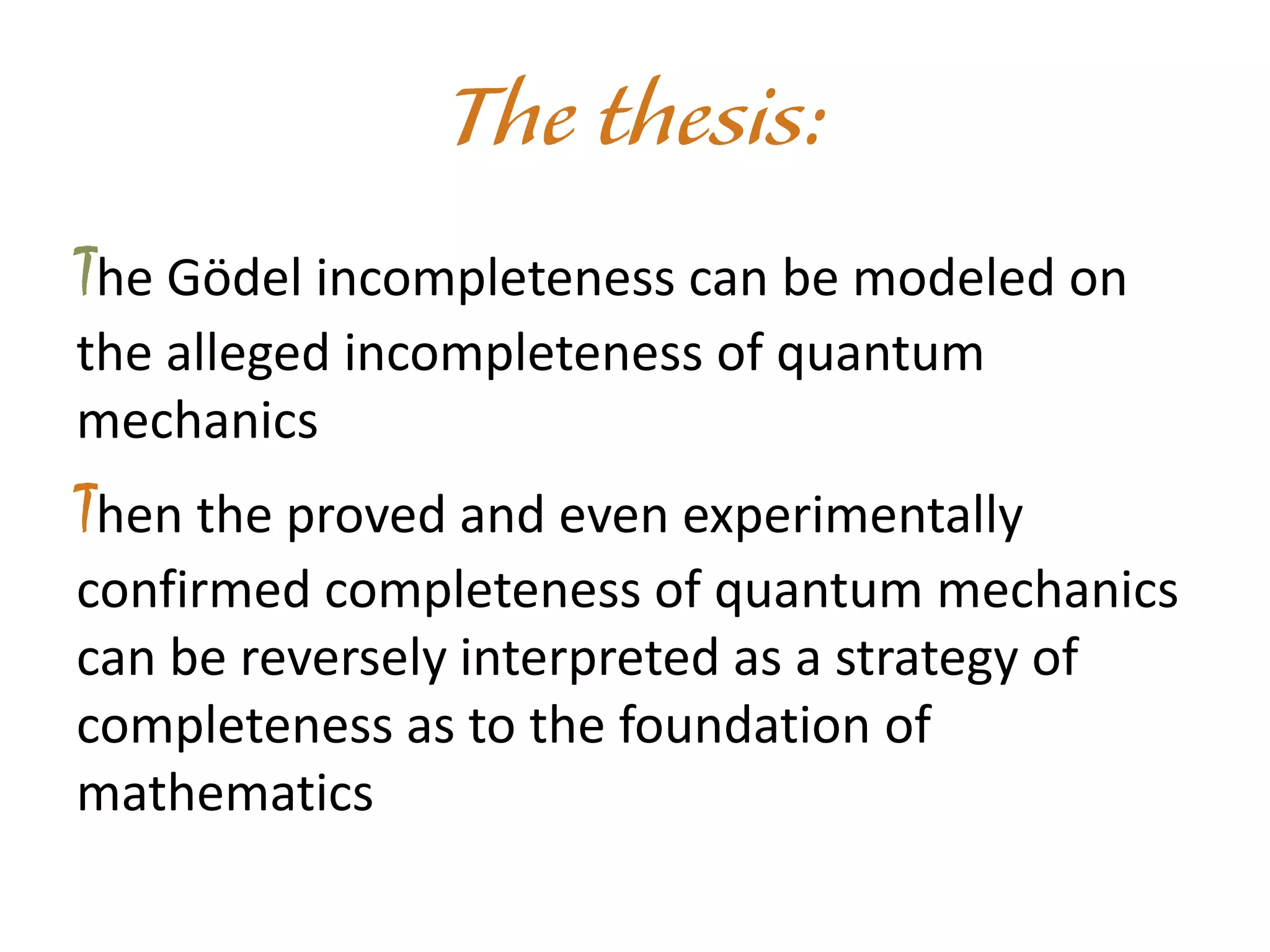
The Gödel incompleteness can be modeled on
the alleged incompleteness of quantum
mechanics
Then the proved and even experimentally
confirmed completeness of quantum mechanics
can be reversely interpreted as a strategy of
completeness as to the foundation of
mathematics
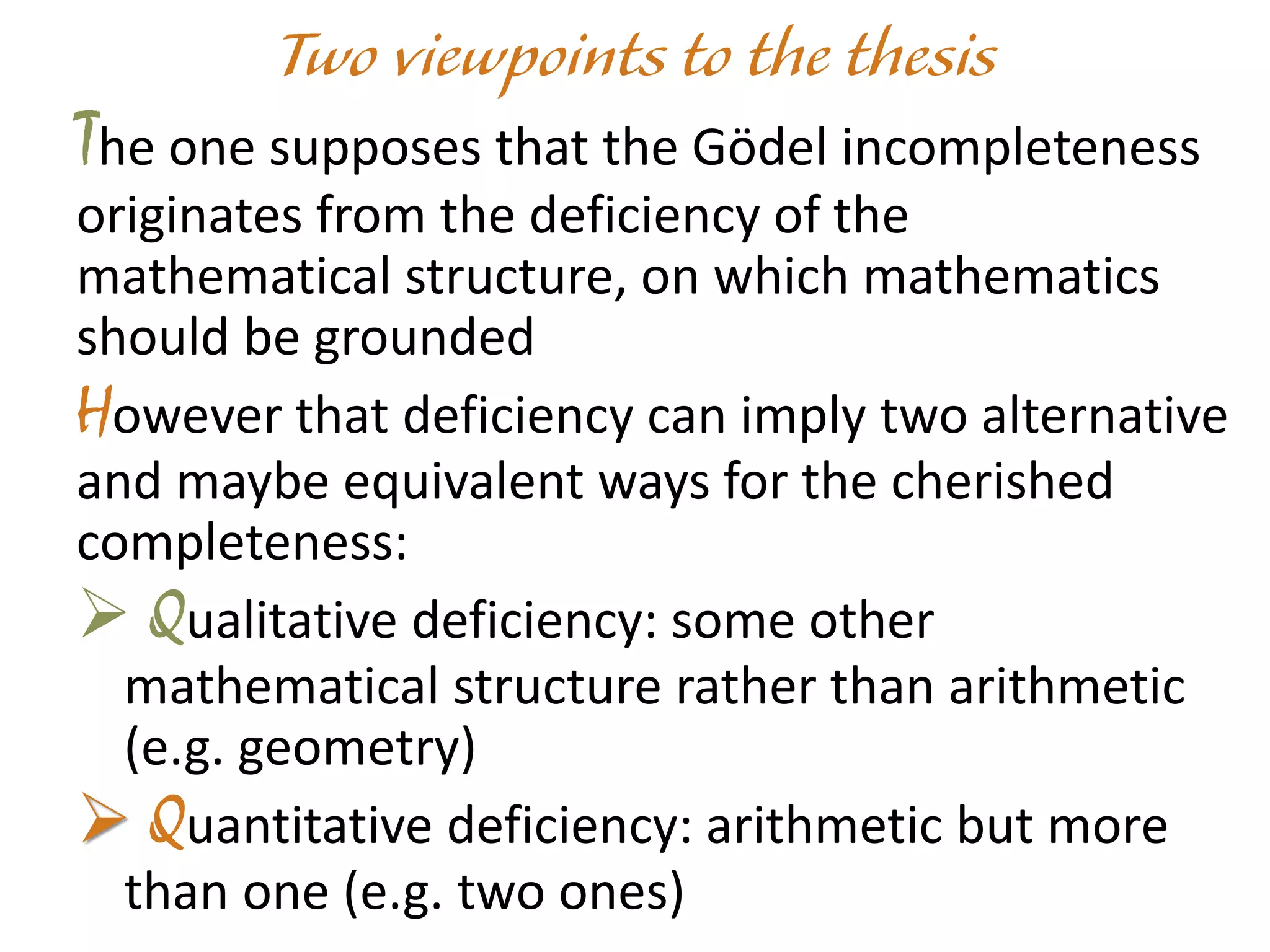
The one supposes that the Gödel incompleteness
originates from the deficiency of the
mathematical structure, on which mathematics
should be grounded
However that deficiency can imply two alternative
and maybe equivalent ways for the cherished
completeness:
 Qualitative deficiency: some other
mathematical structure rather than arithmetic
(e.g. geometry)
 Quantitative deficiency: arithmetic but more
than one (e.g. two ones)
Which is the mathematical structure, on which
completeness can be proved?
In tradition originating from Hilbert and Gödel, that
should be arithmetic, but what are the reasons for
that choice?
Indeed arithmetic seems to be the simplest one, but
whether not too simple in order to be able to be
sufficient for grounding completeness?
In fact, the Gödel incompleteness theorems means
only that it is insufficient, but nothing about some
other one eventually ...
Set theory and arithmetic were what was put as
the base of mathematics
However set theory seemed to be controversial
allowing of paradoxes such as that of Russell (1902)
unlike arithmetic
So, the Hilbert idea (1928) for grounding set theory
on arithmetic appeared
That idea has not ever been more than one
hypothesis and still less its refusing can mean
anything about the foundation of mathematics at all
In fact, there is a well-known result, that of Gentzen
(1936)
It claims the self-foundation of arithmetic and thus
of mathematics at all merely substituting induction
with transfinite induction (and even only to 𝜔 𝜔
is
what is necessary)
One can distinguish the Peano arithmetic from the
newly Gentzen one only by the axiom of induction
Then the Gentzen arithmetic would be sufficient
for the self-foundation of mathematics
However the transfinite induction seems to involve
implicitly and in advance infinity , that
controversial concept of set theory just which is
what should be to be grounded
Thus (along with his real or alleged complicity in
Nazism unlike Gödel who was a refugee from it)
Gentzen’s result has tended to be neglected in
favor of Gödel’s
In fact the real problem should be: What is
transfinite induction in comparison with the
standard, “finite” one?
Induction is the only “interesting” axiom among the
Peano ones in turn abstracted from Dedekind’s
(1888), which grounded arithmetic on set theory, and
therefore breaking the vicious circle
Transfinite induction has used to be thought as a kind
of super-induction in infinity rather than to (or until)
infinity and thus containing the usual one as a true
subset
However it can be not less well defined as a second
induction therefore a second and independent Peano
arithmetic along with the “first”, standard one
Transfinite induction can be (e.g.) defined as a second
and independent induction thus:
 Merely postulating it as such: After that the first
and second induction can be ordered
(not idempotent) or not (i.e. idempotent)
 By distinguishing the successor function as
follows:
 No one-to-one mapping of sets of 𝑛 and 𝑛 + 1
elements for the first induction (always 𝑛 ≠ 𝑛 + 1)
 There is at least a one-to-one mapping of sets of
𝜔 and 𝜔 + 1 elements for the second induction (not
Arithmetic and furthermore mathematics can be
self-founded consistently
This is able not to involve infinity either explicitly
or implicitly (which is an interpretation of
Gentzen’s finitism)
Infinity can be equally well defined as both
continuation of finiteness (continuity) and a leap
to a new dimension of finiteness (discreteness)
The concept of (quantum) information as the quantity
of choices underlies the foundation of mathematics
in fact:
Indeed the unit of information (a bit) is the choice
between two equally probable alternatives and thus
describes the mapping between a single arithmetic
(finiteness) and two ones (infinity)
The unit of quantum information (a qubit) is the
choice among an infinite set of alternatives and
describes the mapping between the “finite”
arithmetic and the “infinite” set theory
Quantum mechanics being a physical and
thus experimental science can be
nevertheless thoroughly reformulated in
terms of (quantum) information
Then quantum mechanics should be
interpreted as an empirical doctrine about
infinity after (quantum) information can
describe the relation between infinity and
finiteness quantitatively
Quantum mechanics is inherently dualistic theory for it
rests on the system of two fundamentally different
elements:
o The studied quantum entity, and
o The macroscopic apparatus measuring it
Of course both are finite, but two too different kinds of
finiteness: microscopic and macroscopic
If quantum mechanics studies eventually infinity in an
experimental way, this turns out to be possible just by
reducing infinity to a second and independent finiteness
If the first lesson repeated Gentzen’s, the
second one is unique and furthermore allows of
building a link between it and Gentzen’s
It consists in involving Hilbert space, a properly
geometric structure in its foundation and thus in
the foundation of mathematics
Indeed mathematics turns out to be able to
found itself as both two arithmetics and
geometry implicitly including arithmetic
Anyway why the arithmetic?
This turns out to be a random historical fact
appealing to intuition or to intellectual authorities
such as Cantor, Frege, Russell, Hilbert, “Nicolas
Bourbaki”, etc. rather than to any mathematical
proof
However arithmetic keeps its place in the
foundation of mathematics but forced to share it
whether with still one and independent arithmetic
or with geometry generalizing it in a sense
The so-called Gödel incompleteness theorems (1931)
demonstrated that set theory reducible to a single
arithmetic is irrelevant as the ground of mathematics
However they said nothing about some other
mathematical structures relevant for self-grounding
of mathematics
The quantum strategy allows of at least two direction
for researching those structures relevant to
completeness and still one corresponding to their
unification in terms of information as well
One can utilize an analogy to the so-called
fundamental theorem of algebra:
It needs a more general structure than the real
numbers, within which it can be proved
Analogically, the self-foundation of mathematics
needs some more general structure than the
positive integers in order to be provable
Still one key is Einstein’s failure (however
nevertheless exceptionally fruitful) to show that
quantum mechanics is incomplete
The triple article (1935) designated merely “EPR” as
well Schrödinger’s study (also 1935) forecast the
phenomena of entanglement on the base of
Hilbert space
The incompleteness of set theory and arithmetic
and the alleged incompleteness of quantum
mechanics can be linked to each other inherently ...
The close friendship of the Princeton refugees Gödel
and Einstein (Yourgrau 2006) might address that fact
However, Gödel came to Princeton in 1940
The famous triple article of Einstein, Podolsky, and
Rosen “Can Quantum-Mechanical Description of
Physical Reality Be Considered Complete?” was
published in 1935
So, there should exist a common mathematical
structure underlying both “completeness and
incompleteness”
The mathematical formalism of quantum
mechanics is based on the complex Hilbert
space featuring by a few important properties
relevant to that structure capable to underlie
mathematics:
It is a generalization of positive integers
It is both discrete and continuous (even smooth)
It is invariant to the axiom of choice
Hilbert space is a generalization of positive integers:
Thus it involves countable infinity
Indeed it can be considered as a countable series of
“empty” qubits equivalent to 3D unit balls
If one “shrinks” these unit balls to 3D points (balls
with zero radius), Hilbert space will degenerate to
Peano arithmetic
Hilbert space is both discrete and continuous
(even smooth) in a sense:
It is that mathematical structure, in which the
main problem of quantum mechanics about
uniformly describing both discrete and smooth
(continuous) motion can be resolved
Furthermore, it is discrete between any two
qubits but smooth (continuous) within each of
them
Thus it can unify arithmetic and geometry
Hilbert space is invariant to the axiom of choice in a
sense:
Indeed any point in it (a wave function in quantum
mechanics) can be interpreted both as:
o The characteristic function of a certain probability
distribution of a single coherent state before
measurement, i.e. before choice (the Born
interpretation of quantum mechanics)
o The smooth space-time trajectory of a “world”
after measurement, i.e. after choice (the many-
worlds interpretation of quantum mechanics)
This would mean the unification of:
• The externality and internality of any infinite set
• Model and reality in principle
• The probabilistic and deterministic consideration
of the modeled reality
• Along with that property of it to allow of uniformly
describing both discrete and smooth motion for
resolving the main problem of quantum mechanics
One can say that the crucial concept of all those
unifications is that of choice and thus (quantum)
information as the quantity of choices
Indeed it allows of reducing
o Two arithmetics to only one single (as bits of
information)
o Geometry to arithmetic (as qubits of quantum
information)
o And even much, much more: qubits of quantum
information to bits of information
The essence of set theory is the concept of
infinity and its link to arithmetic
Even more, that essence of set theory allows of
it to ground all mathematics though in a way yet
not consistent enough
Right the concept of information is what can
capture that core consistently
The Schrödinger equation is the most fundamental
equation in quantum mechanics
By the concept of (quantum) information, it can be
interpreted in terms of the foundation of mathematics
Then its sense would merely be that both ways for
infinity to be represented are equivalent two each
other. That is:
oA bit and a qubit can be equated energetically,
i.e. per a unit of time
oInfinity is quantitatively equivalent to a second
finiteness
One can describe that simple way for the Gödel
undecidable statements to be resolvable in two
arithmetics (besides Gentzen’s proof by transfinite
induction):
Any statement of that kind can be interpreted as if
its Gödel number coincide with that of its negation
The second dimension (for the second arithmetic)
allows the Gödel numbers of the statement and its
negation to be different always, i.e. for any
statement
Then once the Gödel incompleteness can be anyway
sidestepped, mathematics can found itself
consistently at a certain and rather surprising cost:
Mathematics turns out to be equivalent to the being
itself rather than to some true and thus limited part
of it: Of course, this might be called quantum
Pythagoreanism
Mathematics can self-ground only at the cost of
identifying with the world
Infinity is equivalent to a second and
independent finiteness
Two independent Peano arithmetics as well as
one single Hilbert space as an unification of
geometry and arithmetic are sufficient to the
self-foundation of mathematics
Quantum mechanics is inseparable from the
foundation of mathematics and thus from set
theory particularly
Dedekind, R. (1888) “Was sind und was sollen die Zahlen?“
Einstein, A., B. Podolsky, N. Rosen (1935) “Can Quantum-Mechanical
Description of Physical Reality Be Considered Complete?”
Gentzen, G. (1936) “Die Widerspruchfreiheit der reinen Zahlentheorie“
Gödel, K. (1931) “Über formal unentscheidbare Sätze der Principia
mathematica und verwandter Systeme I”
Hilbert, D. (1928) “Die Grundlagen Der Elementaren Zahlentheorie“
Russell, B. (1902) “Letter to Frege”
Schrödinger, E. (1935) “Die gegenwärtige Situation in der
Quantenmechanik”
Yourgrau, P. (2006) A World Without Time: The Forgotten Legacy of
Gödel and Einstein. New York: Perseus Books Group
Gerçekten ilginiz
için çok teşekkür
ederim

The quantum strategy of completeness

  • 2.
    • Bulgarian Academyof Science: Institute for the Study of Societies and Knowledge: Dept. of Logical Systems and Models vasildinev@gmail.com 10:15 - 10:45, June 29th , University of Istanbul, Room “C” 5th Congress in Universal Logic, University of Istanbul, Turkey, 25-30 June 2015
  • 3.
    The Gödel incompletenesscan be modeled on the alleged incompleteness of quantum mechanics Then the proved and even experimentally confirmed completeness of quantum mechanics can be reversely interpreted as a strategy of completeness as to the foundation of mathematics
  • 4.
    The one supposesthat the Gödel incompleteness originates from the deficiency of the mathematical structure, on which mathematics should be grounded However that deficiency can imply two alternative and maybe equivalent ways for the cherished completeness:  Qualitative deficiency: some other mathematical structure rather than arithmetic (e.g. geometry)  Quantitative deficiency: arithmetic but more than one (e.g. two ones)
  • 5.
    Which is themathematical structure, on which completeness can be proved? In tradition originating from Hilbert and Gödel, that should be arithmetic, but what are the reasons for that choice? Indeed arithmetic seems to be the simplest one, but whether not too simple in order to be able to be sufficient for grounding completeness? In fact, the Gödel incompleteness theorems means only that it is insufficient, but nothing about some other one eventually ...
  • 6.
    Set theory andarithmetic were what was put as the base of mathematics However set theory seemed to be controversial allowing of paradoxes such as that of Russell (1902) unlike arithmetic So, the Hilbert idea (1928) for grounding set theory on arithmetic appeared That idea has not ever been more than one hypothesis and still less its refusing can mean anything about the foundation of mathematics at all
  • 7.
    In fact, thereis a well-known result, that of Gentzen (1936) It claims the self-foundation of arithmetic and thus of mathematics at all merely substituting induction with transfinite induction (and even only to 𝜔 𝜔 is what is necessary) One can distinguish the Peano arithmetic from the newly Gentzen one only by the axiom of induction Then the Gentzen arithmetic would be sufficient for the self-foundation of mathematics
  • 8.
    However the transfiniteinduction seems to involve implicitly and in advance infinity , that controversial concept of set theory just which is what should be to be grounded Thus (along with his real or alleged complicity in Nazism unlike Gödel who was a refugee from it) Gentzen’s result has tended to be neglected in favor of Gödel’s In fact the real problem should be: What is transfinite induction in comparison with the standard, “finite” one?
  • 9.
    Induction is theonly “interesting” axiom among the Peano ones in turn abstracted from Dedekind’s (1888), which grounded arithmetic on set theory, and therefore breaking the vicious circle Transfinite induction has used to be thought as a kind of super-induction in infinity rather than to (or until) infinity and thus containing the usual one as a true subset However it can be not less well defined as a second induction therefore a second and independent Peano arithmetic along with the “first”, standard one
  • 10.
    Transfinite induction canbe (e.g.) defined as a second and independent induction thus:  Merely postulating it as such: After that the first and second induction can be ordered (not idempotent) or not (i.e. idempotent)  By distinguishing the successor function as follows:  No one-to-one mapping of sets of 𝑛 and 𝑛 + 1 elements for the first induction (always 𝑛 ≠ 𝑛 + 1)  There is at least a one-to-one mapping of sets of 𝜔 and 𝜔 + 1 elements for the second induction (not
  • 11.
    Arithmetic and furthermoremathematics can be self-founded consistently This is able not to involve infinity either explicitly or implicitly (which is an interpretation of Gentzen’s finitism) Infinity can be equally well defined as both continuation of finiteness (continuity) and a leap to a new dimension of finiteness (discreteness)
  • 12.
    The concept of(quantum) information as the quantity of choices underlies the foundation of mathematics in fact: Indeed the unit of information (a bit) is the choice between two equally probable alternatives and thus describes the mapping between a single arithmetic (finiteness) and two ones (infinity) The unit of quantum information (a qubit) is the choice among an infinite set of alternatives and describes the mapping between the “finite” arithmetic and the “infinite” set theory
  • 13.
    Quantum mechanics beinga physical and thus experimental science can be nevertheless thoroughly reformulated in terms of (quantum) information Then quantum mechanics should be interpreted as an empirical doctrine about infinity after (quantum) information can describe the relation between infinity and finiteness quantitatively
  • 14.
    Quantum mechanics isinherently dualistic theory for it rests on the system of two fundamentally different elements: o The studied quantum entity, and o The macroscopic apparatus measuring it Of course both are finite, but two too different kinds of finiteness: microscopic and macroscopic If quantum mechanics studies eventually infinity in an experimental way, this turns out to be possible just by reducing infinity to a second and independent finiteness
  • 15.
    If the firstlesson repeated Gentzen’s, the second one is unique and furthermore allows of building a link between it and Gentzen’s It consists in involving Hilbert space, a properly geometric structure in its foundation and thus in the foundation of mathematics Indeed mathematics turns out to be able to found itself as both two arithmetics and geometry implicitly including arithmetic
  • 16.
    Anyway why thearithmetic? This turns out to be a random historical fact appealing to intuition or to intellectual authorities such as Cantor, Frege, Russell, Hilbert, “Nicolas Bourbaki”, etc. rather than to any mathematical proof However arithmetic keeps its place in the foundation of mathematics but forced to share it whether with still one and independent arithmetic or with geometry generalizing it in a sense
  • 17.
    The so-called Gödelincompleteness theorems (1931) demonstrated that set theory reducible to a single arithmetic is irrelevant as the ground of mathematics However they said nothing about some other mathematical structures relevant for self-grounding of mathematics The quantum strategy allows of at least two direction for researching those structures relevant to completeness and still one corresponding to their unification in terms of information as well
  • 18.
    One can utilizean analogy to the so-called fundamental theorem of algebra: It needs a more general structure than the real numbers, within which it can be proved Analogically, the self-foundation of mathematics needs some more general structure than the positive integers in order to be provable
  • 19.
    Still one keyis Einstein’s failure (however nevertheless exceptionally fruitful) to show that quantum mechanics is incomplete The triple article (1935) designated merely “EPR” as well Schrödinger’s study (also 1935) forecast the phenomena of entanglement on the base of Hilbert space The incompleteness of set theory and arithmetic and the alleged incompleteness of quantum mechanics can be linked to each other inherently ...
  • 20.
    The close friendshipof the Princeton refugees Gödel and Einstein (Yourgrau 2006) might address that fact However, Gödel came to Princeton in 1940 The famous triple article of Einstein, Podolsky, and Rosen “Can Quantum-Mechanical Description of Physical Reality Be Considered Complete?” was published in 1935 So, there should exist a common mathematical structure underlying both “completeness and incompleteness”
  • 21.
    The mathematical formalismof quantum mechanics is based on the complex Hilbert space featuring by a few important properties relevant to that structure capable to underlie mathematics: It is a generalization of positive integers It is both discrete and continuous (even smooth) It is invariant to the axiom of choice
  • 22.
    Hilbert space isa generalization of positive integers: Thus it involves countable infinity Indeed it can be considered as a countable series of “empty” qubits equivalent to 3D unit balls If one “shrinks” these unit balls to 3D points (balls with zero radius), Hilbert space will degenerate to Peano arithmetic
  • 23.
    Hilbert space isboth discrete and continuous (even smooth) in a sense: It is that mathematical structure, in which the main problem of quantum mechanics about uniformly describing both discrete and smooth (continuous) motion can be resolved Furthermore, it is discrete between any two qubits but smooth (continuous) within each of them Thus it can unify arithmetic and geometry
  • 24.
    Hilbert space isinvariant to the axiom of choice in a sense: Indeed any point in it (a wave function in quantum mechanics) can be interpreted both as: o The characteristic function of a certain probability distribution of a single coherent state before measurement, i.e. before choice (the Born interpretation of quantum mechanics) o The smooth space-time trajectory of a “world” after measurement, i.e. after choice (the many- worlds interpretation of quantum mechanics)
  • 25.
    This would meanthe unification of: • The externality and internality of any infinite set • Model and reality in principle • The probabilistic and deterministic consideration of the modeled reality • Along with that property of it to allow of uniformly describing both discrete and smooth motion for resolving the main problem of quantum mechanics
  • 26.
    One can saythat the crucial concept of all those unifications is that of choice and thus (quantum) information as the quantity of choices Indeed it allows of reducing o Two arithmetics to only one single (as bits of information) o Geometry to arithmetic (as qubits of quantum information) o And even much, much more: qubits of quantum information to bits of information
  • 27.
    The essence ofset theory is the concept of infinity and its link to arithmetic Even more, that essence of set theory allows of it to ground all mathematics though in a way yet not consistent enough Right the concept of information is what can capture that core consistently
  • 28.
    The Schrödinger equationis the most fundamental equation in quantum mechanics By the concept of (quantum) information, it can be interpreted in terms of the foundation of mathematics Then its sense would merely be that both ways for infinity to be represented are equivalent two each other. That is: oA bit and a qubit can be equated energetically, i.e. per a unit of time oInfinity is quantitatively equivalent to a second finiteness
  • 29.
    One can describethat simple way for the Gödel undecidable statements to be resolvable in two arithmetics (besides Gentzen’s proof by transfinite induction): Any statement of that kind can be interpreted as if its Gödel number coincide with that of its negation The second dimension (for the second arithmetic) allows the Gödel numbers of the statement and its negation to be different always, i.e. for any statement
  • 30.
    Then once theGödel incompleteness can be anyway sidestepped, mathematics can found itself consistently at a certain and rather surprising cost: Mathematics turns out to be equivalent to the being itself rather than to some true and thus limited part of it: Of course, this might be called quantum Pythagoreanism Mathematics can self-ground only at the cost of identifying with the world
  • 31.
    Infinity is equivalentto a second and independent finiteness Two independent Peano arithmetics as well as one single Hilbert space as an unification of geometry and arithmetic are sufficient to the self-foundation of mathematics Quantum mechanics is inseparable from the foundation of mathematics and thus from set theory particularly
  • 32.
    Dedekind, R. (1888)“Was sind und was sollen die Zahlen?“ Einstein, A., B. Podolsky, N. Rosen (1935) “Can Quantum-Mechanical Description of Physical Reality Be Considered Complete?” Gentzen, G. (1936) “Die Widerspruchfreiheit der reinen Zahlentheorie“ Gödel, K. (1931) “Über formal unentscheidbare Sätze der Principia mathematica und verwandter Systeme I” Hilbert, D. (1928) “Die Grundlagen Der Elementaren Zahlentheorie“ Russell, B. (1902) “Letter to Frege” Schrödinger, E. (1935) “Die gegenwärtige Situation in der Quantenmechanik” Yourgrau, P. (2006) A World Without Time: The Forgotten Legacy of Gödel and Einstein. New York: Perseus Books Group
  • 33.