QUANTUM COMPUTING
IN CLOUD
Presented By:
PH. RAHUL SINGHA [DC2016MCA0026]
RAKESH TALUKDAR [DC2016MCA0028]
L ANIL KUMAR SINGHA [DC2016MCA0026]
CONTENT
• INTRODUCTION
• HISTORY
• CLASSICAL VS QUANTUM
• QUANTUM COMPUTING IN CLOUD
• APPLICATIONS OF QUANTUM COMPUTING IN CLOUD
• BENEFITS OF QUANTUM COMPUTING
• THREATS
• CONCLUSION
INTRODUCTION
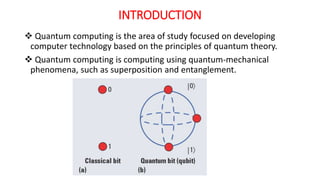
 Quantum computing is the area of study focused on developing
computer technology based on the principles of quantum theory.
 Quantum computing is computing using quantum-mechanical
phenomena, such as superposition and entanglement.
HISTORY
 1982-Feynman proposed the idea of creating machines based on the
laws of quantum mechanics instead of the laws of classical physics.
 1985-David Deutsch developed the quantum Turing machine,
showing that quantum circuits are universal.
 1994-Peter Shor came up with a quantum algorithm to factor very
large numbers in polynomial time.
 1997-Lov Grover develops a quantum search algorithm with O(√𝑁
)complexity.
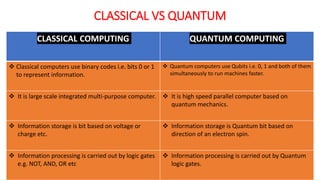
CLASSICAL COMPUTING QUANTUM COMPUTING
 Classical computers use binary codes i.e. bits 0 or 1
to represent information.
 Quantum computers use Qubits i.e. 0, 1 and both of them
simultaneously to run machines faster.
 It is large scale integrated multi-purpose computer.  It is high speed parallel computer based on
quantum mechanics.
 Information storage is bit based on voltage or
charge etc.
 Information storage is Quantum bit based on
direction of an electron spin.
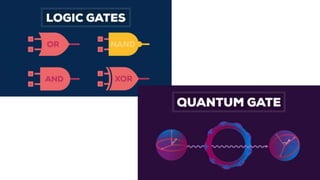
 Information processing is carried out by logic gates
e.g. NOT, AND, OR etc
 Information processing is carried out by Quantum
logic gates.
CLASSICAL VS QUANTUM
QUANTUM COMPUTING IN CLOUD
 Cloud-based quantum computing is the invocation of
quantum emulators, simulators or processors through the cloud.
 Cloud services are being looked on as the method for providing
access to quantum processing.
 Quantum computers are incredibly powerful machines that take a
new approach to processing information, they exploit complex and
fascinating laws of nature that are always there, but usually remain
hidden from view.
APPLICATIONS OF QUANTUM COMPUTING IN CLOUD
 Medicine & Materials: Untangling the complexity of molecular and
chemical interactions leading to the discovery of new medicines and
materials.
 Supply Chain & Logistics: Finding the best solutions for ultra-efficient
logistics and global supply chains, such as optimizing fleet operations for
deliveries during the holiday season.
 Financial Services: Finding new ways to model financial data and isolating
key global risk factors to make better investments.
 Artificial Intelligence: Making facets of artificial intelligence such as
machine learning much more powerful when data sets are very large, such
as in searching images or video.
Contd..
 In Teaching: Teachers can use cloud-based quantum computing to
help their students better understand quantum mechanics, as well as
implement and test quantum algorithms.
 In Research: Scientists can use cloud-based quantum resources to
test quantum information theories, perform experiments, and
compare architectures, amongst other things.
 In Games: Developers can use cloud-based quantum resources can
create quantum games to introduce people to quantum concepts.
Quantum Computing in Cloud at present
 IBM Q Experience
• The IBM Q Experience is an online platform that gives users in the general
public access to a set of IBM’s prototype quantum processors via the Cloud,
an online internet forum for discussing quantum computing relevant
topics, a set of tutorials on how to program the IBM Q devices, and other
educational material about quantum computing.
• As of May 2018, there are three processors on the IBM Q Experience: two
5-qubit processors and a 16-qubit processor. This service can be used to
run algorithms and experiments, and explore tutorials and simulations
around what might be possible with quantum computing.
• Users interact with a quantum processor through the quantum circuit
model of computation, applying quantum gates on the qubits using a GUI
called the quantum composer, writing quantum assembly language code or
through QISKit.
Contd…
 Aliyun
 Chinese ecommerce giant Alibaba, in partnership with the Chinese Academy of
Sciences, has added quantum computing to its cloud service.
 Alibaba Cloud now hosts a superconducting cloud computer offering 11
quantum bit(qubit) speed, making it the second fastest in the world
behind IBM 20-qubit cloud computer.
 Alibaba Cloud users can now access the quantum computer to run code and
conduct experiments with quantum applications in a real environment to
better understand the property and performance of the hardware, as well as
leading the way in developing quantum tools and software globally.
Benefits of Quantum Computer Cloud Service
• Quantum computers stimulate to understand the atomic and
subatomic motion, especially when making new drugs. The indirect
benefits that people can enjoy are the high quality and low rates.
• These computers can also help translation software or other small,
but for productive uses.
• It has an endless potential of doing multiple tasks from finance to
energy to economics etc.
• Most of the scientists believe that its applications are almost endless,
from improving the work of solar panels, creating medicines, to
fertilizers.
Contd..
• It is the system that will give you faster speed, lower price rate, and
other numerous applications.
• Through this advanced technology, people will be able to figure out
how to make use of experimental design.
• It can easily find answers to the set of complex problems with fewer
obstacles.
• Quantum computers will allow algorithms to complete their task of
analysis in no time.
• Quantum computers are quickly eliminating the gap between
machine and human thinking.
THREATS
 Security threats of Quantum Computing is real and it’s coming fast.
 Quantum computer maybe more of an imminent threat than AI.
 It poses a credible threat to the security of Cryptocurrency.
 Quantum Computers could even break the algorithms that are used
by New York stock exchange.
CONCLUSION
With classical computers gradually approaching their limit, the
quantum computer promises to deliver a new level of computational
power. With them comes a whole new theory of computation that
incorporates the strange effects of quantum mechanics and considers
every physical object to be some kind of quantum computer. A
quantum computer thus has the theoretical capability of simulating any
finite physical system and may even hold the key to creating an
artificially intelligent computer.
REFERENCES
 https://www.research.ibm.com/ibm-q/learn/what-is-ibm-q/
 http://www.rfwireless-world.com/Terminology/Quantum-
Computer-vs-Classical-Computer.ht
 https://en.wikipedia.org/wiki/Timeline_of_quantum_computing
 https://www.techrepublic.com/article/alibaba-puts-quantum-
computing-in-the-public-cloud-follows-intel-and-ibms-lead/
 https://techcrunch.com/2017/11/10/ibm-passes-major-milestone-
with-20-and-50-qubit-quantum-computers-as-a-service/
THANK YOU

Quantum Computing in Cloud

  • 1.
    QUANTUM COMPUTING IN CLOUD PresentedBy: PH. RAHUL SINGHA [DC2016MCA0026] RAKESH TALUKDAR [DC2016MCA0028] L ANIL KUMAR SINGHA [DC2016MCA0026]
  • 2.
    CONTENT • INTRODUCTION • HISTORY •CLASSICAL VS QUANTUM • QUANTUM COMPUTING IN CLOUD • APPLICATIONS OF QUANTUM COMPUTING IN CLOUD • BENEFITS OF QUANTUM COMPUTING • THREATS • CONCLUSION
  • 3.
    INTRODUCTION  Quantum computingis the area of study focused on developing computer technology based on the principles of quantum theory.  Quantum computing is computing using quantum-mechanical phenomena, such as superposition and entanglement.
  • 4.
    HISTORY  1982-Feynman proposedthe idea of creating machines based on the laws of quantum mechanics instead of the laws of classical physics.  1985-David Deutsch developed the quantum Turing machine, showing that quantum circuits are universal.  1994-Peter Shor came up with a quantum algorithm to factor very large numbers in polynomial time.  1997-Lov Grover develops a quantum search algorithm with O(√𝑁 )complexity.
  • 5.
    CLASSICAL COMPUTING QUANTUMCOMPUTING  Classical computers use binary codes i.e. bits 0 or 1 to represent information.  Quantum computers use Qubits i.e. 0, 1 and both of them simultaneously to run machines faster.  It is large scale integrated multi-purpose computer.  It is high speed parallel computer based on quantum mechanics.  Information storage is bit based on voltage or charge etc.  Information storage is Quantum bit based on direction of an electron spin.  Information processing is carried out by logic gates e.g. NOT, AND, OR etc  Information processing is carried out by Quantum logic gates. CLASSICAL VS QUANTUM
  • 7.
    QUANTUM COMPUTING INCLOUD  Cloud-based quantum computing is the invocation of quantum emulators, simulators or processors through the cloud.  Cloud services are being looked on as the method for providing access to quantum processing.  Quantum computers are incredibly powerful machines that take a new approach to processing information, they exploit complex and fascinating laws of nature that are always there, but usually remain hidden from view.
  • 8.
    APPLICATIONS OF QUANTUMCOMPUTING IN CLOUD  Medicine & Materials: Untangling the complexity of molecular and chemical interactions leading to the discovery of new medicines and materials.  Supply Chain & Logistics: Finding the best solutions for ultra-efficient logistics and global supply chains, such as optimizing fleet operations for deliveries during the holiday season.  Financial Services: Finding new ways to model financial data and isolating key global risk factors to make better investments.  Artificial Intelligence: Making facets of artificial intelligence such as machine learning much more powerful when data sets are very large, such as in searching images or video.
  • 9.
    Contd..  In Teaching:Teachers can use cloud-based quantum computing to help their students better understand quantum mechanics, as well as implement and test quantum algorithms.  In Research: Scientists can use cloud-based quantum resources to test quantum information theories, perform experiments, and compare architectures, amongst other things.  In Games: Developers can use cloud-based quantum resources can create quantum games to introduce people to quantum concepts.
  • 10.
    Quantum Computing inCloud at present  IBM Q Experience • The IBM Q Experience is an online platform that gives users in the general public access to a set of IBM’s prototype quantum processors via the Cloud, an online internet forum for discussing quantum computing relevant topics, a set of tutorials on how to program the IBM Q devices, and other educational material about quantum computing. • As of May 2018, there are three processors on the IBM Q Experience: two 5-qubit processors and a 16-qubit processor. This service can be used to run algorithms and experiments, and explore tutorials and simulations around what might be possible with quantum computing. • Users interact with a quantum processor through the quantum circuit model of computation, applying quantum gates on the qubits using a GUI called the quantum composer, writing quantum assembly language code or through QISKit.
  • 11.
    Contd…  Aliyun  Chineseecommerce giant Alibaba, in partnership with the Chinese Academy of Sciences, has added quantum computing to its cloud service.  Alibaba Cloud now hosts a superconducting cloud computer offering 11 quantum bit(qubit) speed, making it the second fastest in the world behind IBM 20-qubit cloud computer.  Alibaba Cloud users can now access the quantum computer to run code and conduct experiments with quantum applications in a real environment to better understand the property and performance of the hardware, as well as leading the way in developing quantum tools and software globally.
  • 12.
    Benefits of QuantumComputer Cloud Service • Quantum computers stimulate to understand the atomic and subatomic motion, especially when making new drugs. The indirect benefits that people can enjoy are the high quality and low rates. • These computers can also help translation software or other small, but for productive uses. • It has an endless potential of doing multiple tasks from finance to energy to economics etc. • Most of the scientists believe that its applications are almost endless, from improving the work of solar panels, creating medicines, to fertilizers.
  • 13.
    Contd.. • It isthe system that will give you faster speed, lower price rate, and other numerous applications. • Through this advanced technology, people will be able to figure out how to make use of experimental design. • It can easily find answers to the set of complex problems with fewer obstacles. • Quantum computers will allow algorithms to complete their task of analysis in no time. • Quantum computers are quickly eliminating the gap between machine and human thinking.
  • 14.
    THREATS  Security threatsof Quantum Computing is real and it’s coming fast.  Quantum computer maybe more of an imminent threat than AI.  It poses a credible threat to the security of Cryptocurrency.  Quantum Computers could even break the algorithms that are used by New York stock exchange.
  • 15.
    CONCLUSION With classical computersgradually approaching their limit, the quantum computer promises to deliver a new level of computational power. With them comes a whole new theory of computation that incorporates the strange effects of quantum mechanics and considers every physical object to be some kind of quantum computer. A quantum computer thus has the theoretical capability of simulating any finite physical system and may even hold the key to creating an artificially intelligent computer.
  • 16.
    REFERENCES  https://www.research.ibm.com/ibm-q/learn/what-is-ibm-q/  http://www.rfwireless-world.com/Terminology/Quantum- Computer-vs-Classical-Computer.ht https://en.wikipedia.org/wiki/Timeline_of_quantum_computing  https://www.techrepublic.com/article/alibaba-puts-quantum- computing-in-the-public-cloud-follows-intel-and-ibms-lead/  https://techcrunch.com/2017/11/10/ibm-passes-major-milestone- with-20-and-50-qubit-quantum-computers-as-a-service/
  • 17.