The Dawn of Quantum
Computing:
Revolutionizing
Technology
Quantum computing represents a significant leap forward in computing
power, harnessing the principles of quantum mechanics to solve complex
problems faster than classical computers. This emerging field has the
potential to revolutionize fields like cryptography, materials science, and
drug discovery.
AB
by Autistic Baker
Introduction to Quantum Computing
Quantum Bits (Qubits)
Qubits, the fundamental
units of quantum
information, can exist in
superposition, allowing
them to represent multiple
states simultaneously.
Quantum
Entanglement
Qubits can become
"entangled," where the
state of one qubit is
dependent on the state of
another, enabling
powerful quantum
algorithms.
Quantum Phenomena
Quantum computing
leverages the unique
properties of quantum
mechanics, such as
superposition and
entanglement, to perform
computations in ways that
are not possible with
classical computers.
Principles of Quantum Mechanics
1 Superposition
Qubits can exist in a superposition of multiple states, until they are
measured, at which point they collapse into a single state.
2 Entanglement
Qubits can become entangled, where the state of one qubit is dependent on
the state of another, even when they are physically separated.
3 Uncertainty Principle
The more precisely the position of a particle is determined, the less precisely
its momentum can be known, and vice versa.
Advantages of Quantum Computing
1 Exponential Processing Power
Quantum computers can solve
certain problems exponentially faster
than classical computers, unlocking
new possibilities in fields like
cryptography and materials science.
2 Simulating Quantum Systems
Quantum computers are well-suited
for simulating the behavior of
quantum systems, which can lead to
breakthroughs in areas like drug
discovery and materials design.
3 Unbreakable Encryption
Quantum computers can potentially
break the encryption algorithms used
to secure modern communication,
which has significant implications for
cybersecurity.
4 Quantum Sensing
Quantum sensors can measure
physical quantities with
unprecedented precision, enabling
advancements in fields like
navigation, astronomy, and medical
imaging.
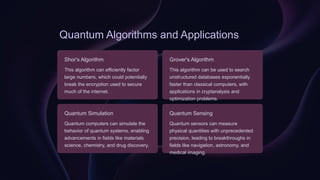
Quantum Algorithms and Applications
Shor's Algorithm
This algorithm can efficiently factor
large numbers, which could potentially
break the encryption used to secure
much of the internet.
Grover's Algorithm
This algorithm can be used to search
unstructured databases exponentially
faster than classical computers, with
applications in cryptanalysis and
optimization problems.
Quantum Simulation
Quantum computers can simulate the
behavior of quantum systems, enabling
advancements in fields like materials
science, chemistry, and drug discovery.
Quantum Sensing
Quantum sensors can measure
physical quantities with unprecedented
precision, leading to breakthroughs in
fields like navigation, astronomy, and
medical imaging.
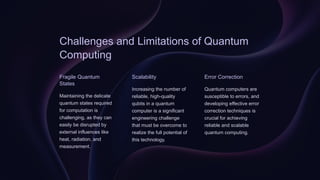
Challenges and Limitations of Quantum
Computing
Fragile Quantum
States
Maintaining the delicate
quantum states required
for computation is
challenging, as they can
easily be disrupted by
external influences like
heat, radiation, and
measurement.
Scalability
Increasing the number of
reliable, high-quality
qubits in a quantum
computer is a significant
engineering challenge
that must be overcome to
realize the full potential of
this technology.
Error Correction
Quantum computers are
susceptible to errors, and
developing effective error
correction techniques is
crucial for achieving
reliable and scalable
quantum computing.
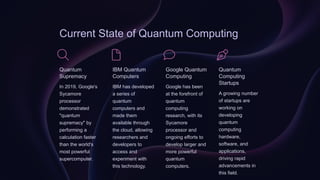
Current State of Quantum Computing
Quantum
Supremacy
In 2019, Google's
Sycamore
processor
demonstrated
"quantum
supremacy" by
performing a
calculation faster
than the world's
most powerful
supercomputer.
IBM Quantum
Computers
IBM has developed
a series of
quantum
computers and
made them
available through
the cloud, allowing
researchers and
developers to
access and
experiment with
this technology.
Google Quantum
Computing
Google has been
at the forefront of
quantum
computing
research, with its
Sycamore
processor and
ongoing efforts to
develop larger and
more powerful
quantum
computers.
Quantum
Computing
Startups
A growing number
of startups are
working on
developing
quantum
computing
hardware,
software, and
applications,
driving rapid
advancements in
this field.
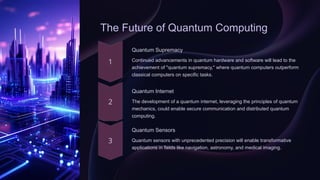
The Future of Quantum Computing
Quantum Supremacy
Continued advancements in quantum hardware and software will lead to the
achievement of "quantum supremacy," where quantum computers outperform
classical computers on specific tasks.
Quantum Internet
The development of a quantum internet, leveraging the principles of quantum
mechanics, could enable secure communication and distributed quantum
computing.
Quantum Sensors
Quantum sensors with unprecedented precision will enable transformative
applications in fields like navigation, astronomy, and medical imaging.
Conclusion and Outlook
Quantum computing represents a profound shift in the field of information technology,
promising to unlock new possibilities in fields like cryptography, materials science, and drug
discovery. As research and development in this field continues, the future of quantum
computing holds the potential to transform our world in ways we can only begin to imagine.

The Dawn of Quantum Computing: Revolutionizing Technology - PPT Presentation

  • 1.
    The Dawn ofQuantum Computing: Revolutionizing Technology Quantum computing represents a significant leap forward in computing power, harnessing the principles of quantum mechanics to solve complex problems faster than classical computers. This emerging field has the potential to revolutionize fields like cryptography, materials science, and drug discovery. AB by Autistic Baker
  • 2.
    Introduction to QuantumComputing Quantum Bits (Qubits) Qubits, the fundamental units of quantum information, can exist in superposition, allowing them to represent multiple states simultaneously. Quantum Entanglement Qubits can become "entangled," where the state of one qubit is dependent on the state of another, enabling powerful quantum algorithms. Quantum Phenomena Quantum computing leverages the unique properties of quantum mechanics, such as superposition and entanglement, to perform computations in ways that are not possible with classical computers.
  • 3.
    Principles of QuantumMechanics 1 Superposition Qubits can exist in a superposition of multiple states, until they are measured, at which point they collapse into a single state. 2 Entanglement Qubits can become entangled, where the state of one qubit is dependent on the state of another, even when they are physically separated. 3 Uncertainty Principle The more precisely the position of a particle is determined, the less precisely its momentum can be known, and vice versa.
  • 4.
    Advantages of QuantumComputing 1 Exponential Processing Power Quantum computers can solve certain problems exponentially faster than classical computers, unlocking new possibilities in fields like cryptography and materials science. 2 Simulating Quantum Systems Quantum computers are well-suited for simulating the behavior of quantum systems, which can lead to breakthroughs in areas like drug discovery and materials design. 3 Unbreakable Encryption Quantum computers can potentially break the encryption algorithms used to secure modern communication, which has significant implications for cybersecurity. 4 Quantum Sensing Quantum sensors can measure physical quantities with unprecedented precision, enabling advancements in fields like navigation, astronomy, and medical imaging.
  • 5.
    Quantum Algorithms andApplications Shor's Algorithm This algorithm can efficiently factor large numbers, which could potentially break the encryption used to secure much of the internet. Grover's Algorithm This algorithm can be used to search unstructured databases exponentially faster than classical computers, with applications in cryptanalysis and optimization problems. Quantum Simulation Quantum computers can simulate the behavior of quantum systems, enabling advancements in fields like materials science, chemistry, and drug discovery. Quantum Sensing Quantum sensors can measure physical quantities with unprecedented precision, leading to breakthroughs in fields like navigation, astronomy, and medical imaging.
  • 6.
    Challenges and Limitationsof Quantum Computing Fragile Quantum States Maintaining the delicate quantum states required for computation is challenging, as they can easily be disrupted by external influences like heat, radiation, and measurement. Scalability Increasing the number of reliable, high-quality qubits in a quantum computer is a significant engineering challenge that must be overcome to realize the full potential of this technology. Error Correction Quantum computers are susceptible to errors, and developing effective error correction techniques is crucial for achieving reliable and scalable quantum computing.
  • 7.
    Current State ofQuantum Computing Quantum Supremacy In 2019, Google's Sycamore processor demonstrated "quantum supremacy" by performing a calculation faster than the world's most powerful supercomputer. IBM Quantum Computers IBM has developed a series of quantum computers and made them available through the cloud, allowing researchers and developers to access and experiment with this technology. Google Quantum Computing Google has been at the forefront of quantum computing research, with its Sycamore processor and ongoing efforts to develop larger and more powerful quantum computers. Quantum Computing Startups A growing number of startups are working on developing quantum computing hardware, software, and applications, driving rapid advancements in this field.
  • 8.
    The Future ofQuantum Computing Quantum Supremacy Continued advancements in quantum hardware and software will lead to the achievement of "quantum supremacy," where quantum computers outperform classical computers on specific tasks. Quantum Internet The development of a quantum internet, leveraging the principles of quantum mechanics, could enable secure communication and distributed quantum computing. Quantum Sensors Quantum sensors with unprecedented precision will enable transformative applications in fields like navigation, astronomy, and medical imaging.
  • 9.
    Conclusion and Outlook Quantumcomputing represents a profound shift in the field of information technology, promising to unlock new possibilities in fields like cryptography, materials science, and drug discovery. As research and development in this field continues, the future of quantum computing holds the potential to transform our world in ways we can only begin to imagine.