Harnesses superposition,
entanglement,and quantum
tunneling.
Performs certain computations
exponentially faster than classical
systems.
Applications in cryptography , AI,
chemistry, materials science, and
optimization.
INTRODUCTION
3.
What is QUANTUM
COMPUTING?
Qubits can exist in multiple states
simultaneously(superposition).
Uses subatomic particles such as
electron or photons.
Capable of exploring many
possibilities at the same time.
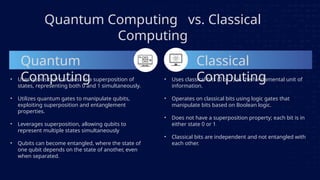
Quantum Computing vs.Classical
Computing
• Uses qubits that can exist in a superposition of
states, representing both 0 and 1 simultaneously.
• Utilizes quantum gates to manipulate qubits,
exploiting superposition and entanglement
properties.
• Leverages superposition, allowing qubits to
represent multiple states simultaneously.
• Qubits can become entangled, where the state of
one qubit depends on the state of another, even
when separated.
Quantum
Computing
Classical
Computing
• Uses classical bits (0 or 1) as the fundamental unit of
information.
• Operates on classical bits using logic gates that
manipulate bits based on Boolean logic.
• Does not have a superposition property; each bit is in
either state 0 or 1.
• Classical bits are independent and not entangled with
each other.
6.
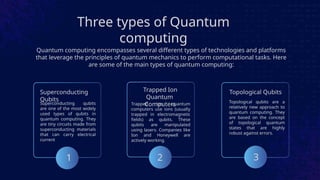
Three types ofQuantum
computing
Quantum computing encompasses several different types of technologies and platforms
that leverage the principles of quantum mechanics to perform computational tasks. Here
are some of the main types of quantum computing:
1 2 3
Superconducting
Qubits
Trapped Ion
Quantum
Computers
Topological Qubits
Superconducting qubits
are one of the most widely
used types of qubits in
quantum computing. They
are tiny circuits made from
superconducting materials
that can carry electrical
current
Trapped ion quantum
computers use ions (usually
trapped in electromagnetic
fields) as qubits. These
qubits are manipulated
using lasers. Companies like
Ion and Honeywell are
actively working.
Topological qubits are a
relatively new approach to
quantum computing. They
are based on the concept
of topological quantum
states that are highly
robust against errors.
7.
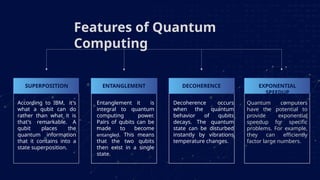
According to IBM,it's
what a qubit can do
rather than what it is
that's remarkable. A
qubit places the
quantum information
that it contains into a
state superposition.
Entanglement it is
integral to quantum
computing power.
Pairs of qubits can be
made to become
entangled. This means
that the two qubits
then exist in a single
state.
Decoherence occurs
when the quantum
behavior of qubits
decays. The quantum
state can be disturbed
instantly by vibrations
temperature changes.
Features of Quantum
Computing
Quantum computers
have the potential to
provide exponential
speedup for specific
problems. For example,
they can efficiently
factor large numbers.
SUPERPOSITION ENTANGLEMENT DECOHERENCE EXPONENTIAL
SPEEDUP
8.
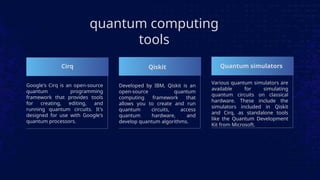
quantum computing
tools
Cirq
Google's Cirqis an open-source
quantum programming
framework that provides tools
for creating, editing, and
running quantum circuits. It's
designed for use with Google's
quantum processors.
Developed by IBM, Qiskit is an
open-source quantum
computing framework that
allows you to create and run
quantum circuits, access
quantum hardware, and
develop quantum algorithms.
Qiskit
Various quantum simulators are
available for simulating
quantum circuits on classical
hardware. These include the
simulators included in Qiskit
and Cirq, as standalone tools
like the Quantum Development
Kit from Microsoft.
Quantum simulators
1
2
3
4
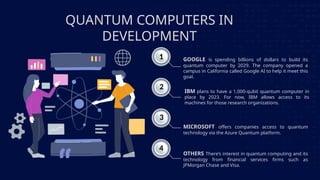
GOOGLE is spendingbillions of dollars to build its
quantum computer by 2029. The company opened a
campus in California called Google AI to help it meet this
goal.
IBM plans to have a 1,000-qubit quantum computer in
place by 2023. For now, IBM allows access to its
machines for those research organizations.
MICROSOFT offers companies access to quantum
technology via the Azure Quantum platform.
OTHERS There’s interest in quantum computing and its
technology from financial services firms such as
JPMorgan Chase and Visa.
QUANTUM COMPUTERS IN
DEVELOPMENT
11.
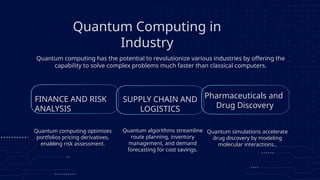
FINANCE AND RISK
ANALYSIS
SUPPLYCHAIN AND
LOGISTICS
Pharmaceuticals and
Drug Discovery
Quantum computing optimizes
portfolios pricing derivatives,
enabling risk assessment.
Quantum algorithms streamline
route planning, inventory
management, and demand
forecasting for cost savings.
Quantum simulations accelerate
drug discovery by modeling
molecular interactions..
Quantum Computing in
Industry
Quantum computing has the potential to revolutionize various industries by offering the
capability to solve complex problems much faster than classical computers.
12.
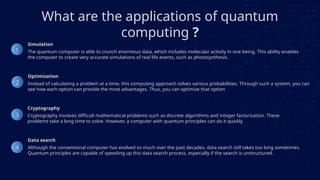
What are theapplications of quantum
computing ?
The quantum computer is able to crunch enormous data, which includes molecular activity in one being. This ability enables
the computer to create very accurate simulations of real life events, such as photosynthesis.
Instead of calculating a problem at a time, this computing approach solves various probabilities. Through such a system, you can
see how each option can provide the most advantages. Thus, you can optimize that option
Cryptography involves difficult mathematical problems such as discrete algorithms and integer factorization. These
problems take a long time to solve. However, a computer with quantum principles can do it quickly
Although the conventional computer has evolved so much over the past decades, data search still takes too long sometimes.
Quantum principles are capable of speeding up this data search process, especially if the search is unstructured.
1
2
3
4
Simulation
Optimization
Cryptography
Data search
13.
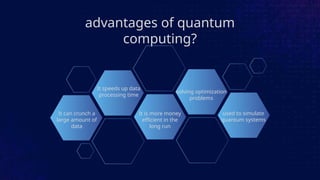
advantages of quantum
computing?
Itcan crunch a
large amount of
data
It speeds up data
processing time
It is more money
efficient in the
long run
solving optimization
problems
used to simulate
quantum systems
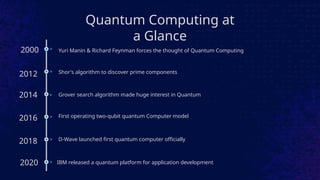
14.
Yuri Manin &Richard Feynman forces the thought of Quantum Computing
Shor's algorithm to discover prime components
Grover search algorithm made huge interest in Quantum
First operating two-qubit quantum Computer model
D-Wave launched first quantum computer officially
IBM released a quantum platform for application development
Quantum Computing at
a Glance
2000
2012
2014
2016
2018
2020
![QUANTUM_COMPUTING_AND_ITS_POTENTIAL_APPLICATIONS[2].pptx](https://image.slidesharecdn.com/quantumcomputinganditspotentialapplications2-250814011918-2632c4bc/85/QUANTUM_COMPUTING_AND_ITS_POTENTIAL_APPLICATIONS-2-pptx-15-320.jpg)


![[DSC Europe 25] Milos Belcevic - Product Professional's Journey to Full-Stack...](https://cdn.slidesharecdn.com/ss_thumbnails/1zovd6fgsycdg4wvgvls-milos-belcevic-product-professionals-journey-to-full-stack-product-developer-260123083019-d993120d-thumbnail.jpg?width=640&height=640&fit=bounds)

![[DSC Europe 25] Josip Saban - Career building for data professionals.pptx](https://cdn.slidesharecdn.com/ss_thumbnails/zroflcttkm1vmli0txea-josip-saban-career-building-for-data-professionals-260123083019-587cdb8c-thumbnail.jpg?width=640&height=640&fit=bounds)


