


PRESENTED BY
RANAJEET KUMAR BARIK
QUANTUM COMPUTING
CONTENTS
What Is Quantum Computing?
History Of Quantum Computing.
Why we need Quantum Computing?
How Quantum Computer Works?
Physical Components Of Quantum Computing.
Quantum Computing at present.
Advantages
Disadvantages
Conclusion
What is Quantum Computing
Quantum computing takes advantage of the strange ability
of subatomic particles to exist in more than one state at any
time. Due to the way the tiniest of particles behave,
operations can be done much more quickly and use less energy
than classical computers.
Definition By – Weired.co.uk
History Of Quantum Computing
 In 1981 Richard Faynman proposed a basic model for a quantum computer
that would be capable of such simulations that classical computers can’t
do.
 In 1994, Peter Shor developed his algorithm allowing quantum computers to
efficiently factorize large integers exponentially quicker than the best
classical algorithm on traditional machines.
 In 1996, Lov Grover invented a quantum database search algorithm that
presented a quadratic speedup for a variety of problems.
 In 1998, a working 2-qubit quantum computer was built and solved first
quantum algorithms such as Grover’s algorithm.
 Twenty years later, in 2017, IBM presented the first commercially usable
quantum computer, raising the race to another level.
Why we need Quantum Computing?
 Solving large number problems . For example factoring . Lets say Factor a
number into M = p*q .
 Solving chemistry problems while simulating molecule . Problem is the
number grows exponentially
 Combinational Optimisation problem . For example Travelling Salesman
problem , Cutting stock problem, Vehicle Routing and rescheduling
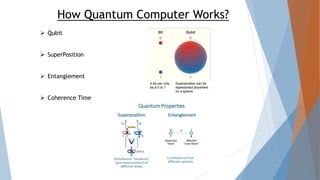
How Quantum Computer Works?
 Qubit
 SuperPosition
 Entanglement
 Coherence Time
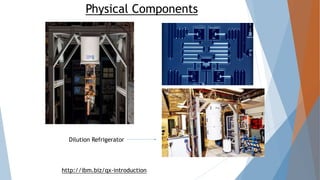
Physical Components
Dilution Refrigerator
http://ibm.biz/qx-introduction
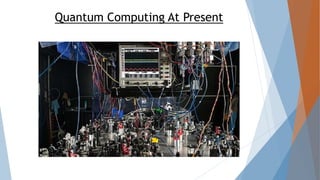
Quantum Computing At Present
Advantages
 Online Security
 Artificial Intelligence
 Medicine Development
 Weather Forecasting and Climate Change
 Traffic Control
 Financial Probelms
Disadvantages
 The biggest disadvantage is the fact that it has not been totally invented
yet, and people are still making parts and projections about what this
computer shall resemble.
 quantum processors are very unstable. Even when they first came out it
was impossible to test them without disrupting their very unstable state.
 The main problem with quantum computing is to actually develop it as a
personal computer.
 Threat to security.
Conclusion
The field of quantum computing is growing rapidly as many of today's leading
computing groups, universities, colleges, and all the leading IT vendors are
researching the topic. This pace is expected to increase as more research is turned
into practical applications.
Quantum computing
Quantum computing

Quantum computing

  • 1.
    PRESENTED BY RANAJEET KUMARBARIK QUANTUM COMPUTING
  • 2.
    CONTENTS What Is QuantumComputing? History Of Quantum Computing. Why we need Quantum Computing? How Quantum Computer Works? Physical Components Of Quantum Computing. Quantum Computing at present. Advantages Disadvantages Conclusion
  • 3.
    What is QuantumComputing Quantum computing takes advantage of the strange ability of subatomic particles to exist in more than one state at any time. Due to the way the tiniest of particles behave, operations can be done much more quickly and use less energy than classical computers. Definition By – Weired.co.uk
  • 4.
    History Of QuantumComputing  In 1981 Richard Faynman proposed a basic model for a quantum computer that would be capable of such simulations that classical computers can’t do.  In 1994, Peter Shor developed his algorithm allowing quantum computers to efficiently factorize large integers exponentially quicker than the best classical algorithm on traditional machines.  In 1996, Lov Grover invented a quantum database search algorithm that presented a quadratic speedup for a variety of problems.  In 1998, a working 2-qubit quantum computer was built and solved first quantum algorithms such as Grover’s algorithm.  Twenty years later, in 2017, IBM presented the first commercially usable quantum computer, raising the race to another level.
  • 5.
    Why we needQuantum Computing?  Solving large number problems . For example factoring . Lets say Factor a number into M = p*q .  Solving chemistry problems while simulating molecule . Problem is the number grows exponentially  Combinational Optimisation problem . For example Travelling Salesman problem , Cutting stock problem, Vehicle Routing and rescheduling
  • 6.
    How Quantum ComputerWorks?  Qubit  SuperPosition  Entanglement  Coherence Time
  • 7.
  • 8.
  • 9.
    Advantages  Online Security Artificial Intelligence  Medicine Development  Weather Forecasting and Climate Change  Traffic Control  Financial Probelms
  • 10.
    Disadvantages  The biggestdisadvantage is the fact that it has not been totally invented yet, and people are still making parts and projections about what this computer shall resemble.  quantum processors are very unstable. Even when they first came out it was impossible to test them without disrupting their very unstable state.  The main problem with quantum computing is to actually develop it as a personal computer.  Threat to security.
  • 11.
    Conclusion The field ofquantum computing is growing rapidly as many of today's leading computing groups, universities, colleges, and all the leading IT vendors are researching the topic. This pace is expected to increase as more research is turned into practical applications.