QUALITY
MAINTENANCE
24/03/2025
Presented by
Zainal Mohd Salleh
MSc, CEng, CTPEng, CWI, CSWIP, ASNT LII, Tar Ins, ISO Lead A, TTT HRDF, ToT UK
What is Quality Maintenance?
■ Quality Maintenance is a systematic approach to maintaining and
improving the quality of products and processes by preventing defects
and minimizing waste.
■ It is a key aspect of Total Productive
■ Maintenance (TPM) and focuses on enhancing equipment reliability,
workplace safety, and productivity improvement.
■ Quality Maintenance in Total Productive Maintenance: Key Principles
and Best Practices
Objectives and Benefits of Quality Maintenance
■ Reduced production costs
■ Increased efficiency and effectiveness
■ Improved customer satisfaction
■ Enhanced employee morale and involvement
■ Improved workplace safety
■ Continuous improvement and innovation
The main objectives of Quality Maintenance are to eliminate losses, improve
process quality, reduce downtime, and enhance equipment reliability.
By implementing Quality Maintenance, organizations can achieve the
benefits:
Key Principles of Quality Maintenance
■ Quality Maintenance is a critical aspect of Total Productive
Maintenance (TPM) and is essential for achieving manufacturing
excellence.
■ Quality Maintenance aims to ensure that equipment is always in a
state of optimal performance, by preventing breakdowns, reducing
downtime, and improving productivity.
■ Here are some key principles of Quality Maintenance that
organizations should keep in mind:
Continuous Improvement
■ Continuous improvement is a fundamental principle of Quality Maintenance.
■ Organizations must continually strive to improve their maintenance
processes, procedures, and practices.
■ This involves regularly reviewing maintenance data and metrics to identify
areas for improvement, and implementing changes to improve equipment
reliability and performance.
Root Cause Analysis
■ Root cause analysis is another critical principle of Quality Maintenance.
■ When equipment fails, it’s essential to identify the root cause of the failure
and take corrective action to prevent future failures.
■ Root cause analysis involves identifying the underlying causes of equipment
failures and addressing them, rather than just fixing the immediate problem.
Employee Involvement
■ Employee involvement is another critical principle of Quality Maintenance.
■ Employees at all levels should be involved in maintenance activities, from
identifying problems to implementing solutions.
■ Employee involvement can improve morale, foster a sense of ownership,
and increase productivity.
Standardization
■ Standardization is another essential principle of Quality Maintenance.
■ Standardization involves developing and implementing standardized
maintenance processes and procedures.
■ This can improve efficiency, reduce errors, and enhance consistency in
maintenance practices.
Data-Driven Decision Making
■ Data-driven decision making is another critical principle of Quality
Maintenance.
■ Organizations should rely on data and metrics to make decisions about
maintenance processes, procedures, and practices.
■ This can help identify areas for improvement and track progress towards
maintenance goals.
Quality Assurance
■ Quality assurance is another essential principle of Quality Maintenance.
■ Organizations should implement quality control measures to ensure that
maintenance processes and procedures are followed correctly.
■ Quality assurance can help prevent equipment failures, reduce downtime,
and improve productivity.
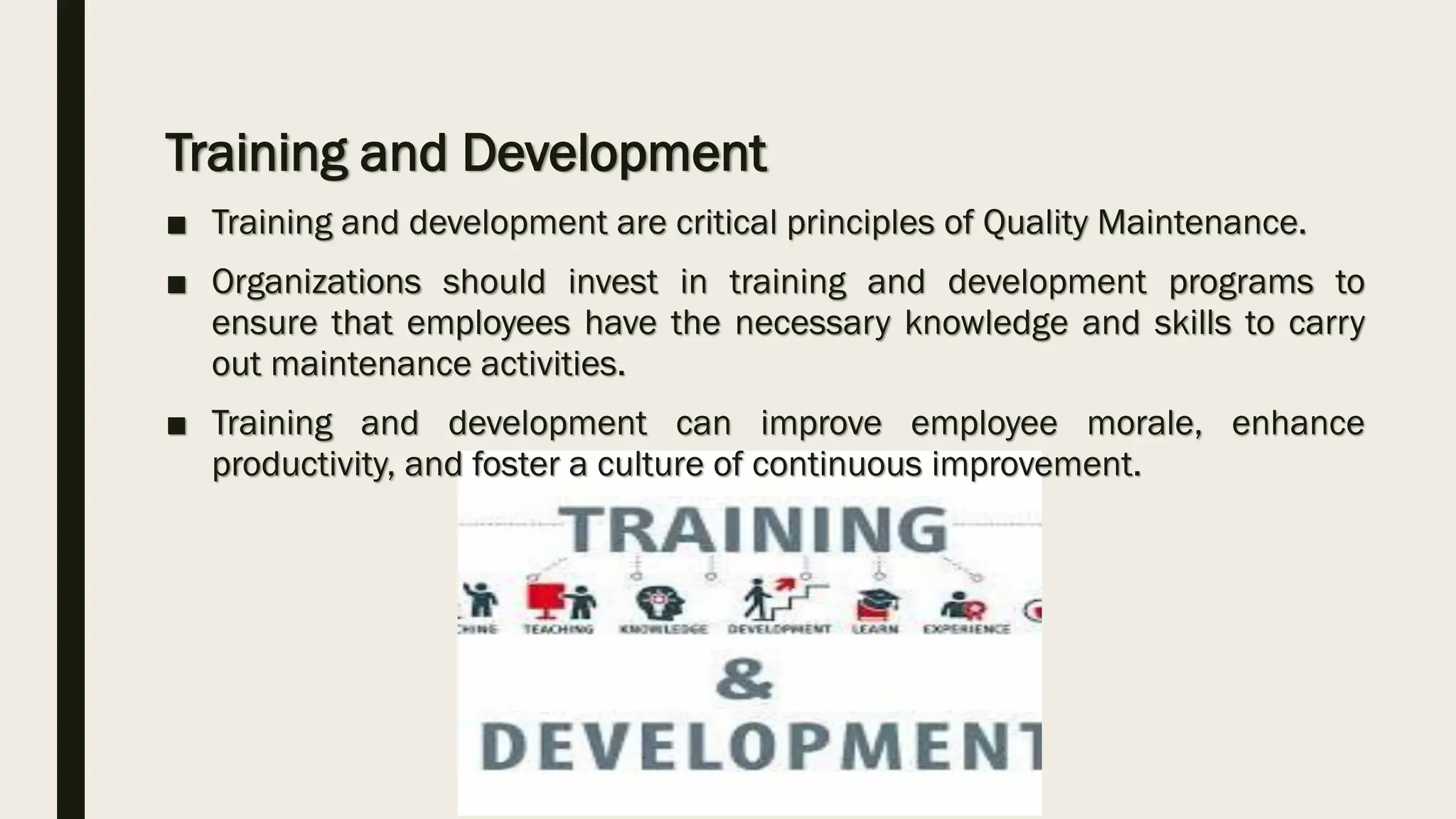
Training and Development
■ Training and development are critical principles of Quality Maintenance.
■ Organizations should invest in training and development programs to
ensure that employees have the necessary knowledge and skills to carry
out maintenance activities.
■ Training and development can improve employee morale, enhance
productivity, and foster a culture of continuous improvement.
Quality Maintenance in
Total Productive Maintenance (TPM)
■ Quality Maintenance is one of the eight pillars of Total Productive
Maintenance (TPM), which is a comprehensive approach to achieving
Manufacturing Excellence.
■ TPM is based on the principles of Lean Manufacturing and focuses on
maximizing equipment reliability, workplace safety, and productivity
improvement.
Role of Quality Maintenance in TPM
■ The role of Quality Maintenance in TPM is to ensure that equipment is
well-maintained and capable of producing high-quality products.
■ Quality Maintenance aims to prevent defects and minimize waste by
identifying and addressing the root causes of equipment failures.
Importance of Quality Maintenance for
TPM success
Quality Maintenance is essential for the success of TPM to:
■ Maximize equipment reliability
■ Improve workplace safety
■ Reduce downtime and losses
■ Enhance product quality
■ Increase customer satisfaction
Best practices for integrating Quality Maintenance
with other TPM pillars
To achieve maximum benefits from Quality Maintenance,
It is essential to integrate it with other TPM pillars, including:
■ Autonomous Maintenance
■ Planned Maintenance
■ Quality Improvement
■ Training and Development
■ Early Equipment Management
■ Administrative and Office TPM
Implementing Quality Maintenance
Steps involved in implementing Quality Maintenance
The following are the steps involved in implementing Quality Maintenance:
• Assess current processes and identify improvement opportunities
• Develop a plan for improvement and prioritize actions
• Engage employees at all levels and provide appropriate training
• Implement improvement actions and monitor results
• Continuously improve and innovate
Role of different departments in
Quality Maintenance
■ To ensure the success of Quality Maintenance, different departments in an
organization need to collaborate and work together towards common goals.
The following departments play a critical role in Quality Maintenance:
■ Production: responsible for ensuring that equipment is operated in accordance
with standard operating procedures and maintaining equipment cleanliness.
■ Maintenance: responsible for carrying out planned and unplanned maintenance
activities, identifying and addressing equipment defects, and performing root
cause analysis.
■ Quality Assurance: responsible for monitoring product quality, identifying defects,
and implementing corrective actions.
■ Engineering: responsible for designing and improving equipment and processes,
conducting equipment feasibility studies, and providing technical support.
Best practices for Quality Maintenance
implementation and sustenance
To ensure successful implementation and sustenance of Quality Maintenance,
organizations should consider the following best practices:
■ Develop a strong Quality Maintenance culture that emphasizes continuous
improvement and innovation.
■ Ensure that all employees are trained and involved in Quality Maintenance
activities.
■ Establish clear goals and objectives for Quality Maintenance and regularly
monitor progress towards these goals.
■ •Implement a system of performance metrics and key performance
indicators (KPIs) to measure the effectiveness of Quality Maintenance.
■ Ensure that Quality Maintenance is fully integrated with other TPM pillars.
S.No.
Format/ Template Focus
Area
Features Metrics Benefits
1
Equipment Maintenance
Checklist
A checklist to ensure all
maintenance tasks are
completed for each
equipment
Percentage of completed
maintenance tasks per
equipment
Reduced equipment
downtime and increased
equipment lifespan
2
Standard Operating
Procedure (SOP)
A detailed written
document that provides
step-by-step instructions
on how to perform a task
or activity
Number of deviations
from the SOP,
compliance rate
Consistent quality and
increased efficiency in
performing tasks
3
Preventive
Maintenance Schedule
A schedule that outlines
the planned
maintenance activities
for each equipment
Percentage of completed
preventive maintenance
tasks, equipment
availability
Reduced equipment
downtime, increased
equipment lifespan and
reliability
Formats and Templates used in Quality Maintenance with respect to
Total Productive Maintenance
4
Root Cause Analysis (RCA)
Template
A template used to identify
and address the root cause of
a problem or defect
Number of problems solved,
time to complete RCA process
Improved problem-solving and
decision-making capabilities
5 5S Checklist
A checklist to ensure the
workplace is clean, organized,
and efficient
Number of non-compliance
issues identified, cleanliness
and organization score
Improved workplace safety,
efficiency, and productivity
6
Visual Management Board
Template
A template to visually display
the status of the production
process, including progress,
problems, and metrics</td
Percentage of on-time
deliveries, cycle time,
production volume
Improved communication,
collaboration, and decision-
making in the production
process
7
Failure Modes and Effects
Analysis (FMEA) Template
A template to identify and
prioritize potential failures in a
process or product and the
actions to mitigate or prevent
them
Number of potential failures
identified and mitigated,
effectiveness of actions taken
Reduced risk of failures and
defects, improved product and
process quality
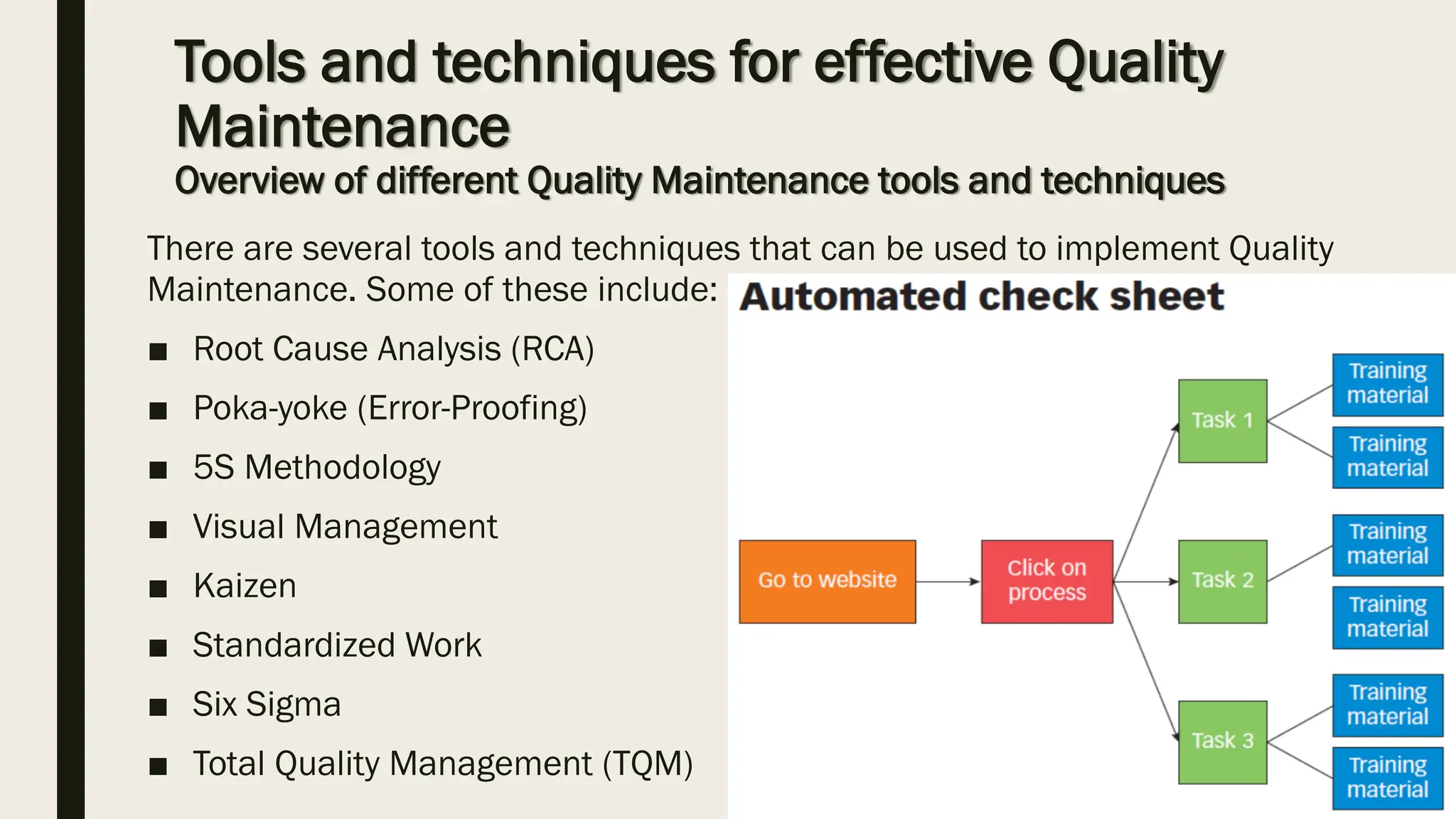
8 Check Sheet
A structured form used to
collect and analyze data on a
specific process or product
Number of defects or
occurrences of a specific
event, frequency of defects
Improved data collection and
analysis, identification of
areas for improvement
9
Process Flow Diagram
Template
A template to visualize the
steps and interactions in a
process, including inputs,
outputs, and controls
Cycle time, lead time, process
efficiency
Improved understanding and
optimization of the process,
identification of waste and
inefficiencies
10 Control Plan Template
A template to outline the
process controls and
measures to ensure the
quality of a product or service
Compliance rate, number of
defects, cost of quality
Improved product and service
quality, reduced defects and
costs
11 Quality Improvement Plan
A plan that outlines the
goals, strategies, and
actions to improve the
quality of a product or
process
Number of goals achieved,
effectiveness of strategies
and actions
Continuous improvement in
product and process
quality, increased customer
satisfaction
12
Defect Stratification by
Phenomena
A tool to categorize and
analyze the types and
causes of defects in a
product or process
Number and percentage of
defects by category,
effectiveness of defect
reduction measures
Improved understanding
and control of the causes of
defects, reduced defect
rates
13 Loss Cost Matrix
A tool to prioritize and
analyze the losses and
costs associated with
quality defects
Cost of defects by type,
effectiveness of
improvement measures
Improved identification and
prioritization of
improvement opportunities,
reduced costs and losses
14 QI Stratification
A tool to stratify and analyze
the quality improvement
opportunities based on the
level of impact and effort
Number and percentage of
improvement opportunities
by impact and effort level,
effectiveness of
improvement measures
Improved prioritization and
allocation of resources for
quality improvement,
increased efficiency and
effectiveness of
improvement efforts
Tools and techniques for effective Quality
Maintenance
Overview of different Quality Maintenance tools and techniques
There are several tools and techniques that can be used to implement Quality
Maintenance. Some of these include:
■ Root Cause Analysis (RCA)
■ Poka-yoke (Error-Proofing)
■ 5S Methodology
■ Visual Management
■ Kaizen
■ Standardized Work
■ Six Sigma
■ Total Quality Management (TQM)
THE SEVEN BASIC QUALITY TOOLS
The seven basic quality tools were first highlighted in Kaoru Ishikawa’s classic book Guide to Quality
Control. And new classics, like Nancy Tague’s The Quality Toolbox also references these tools. When
used appropriately, each tool can have a major impact on your quality improvement activities. Using
these tools in combination further multiplies their value.
Cause and effect diagram: Also known as an Ishikawa diagram or a fishbone diagram, this tool
analyzes process dispersion. It illustrates the main causes and subcauses leading to an effect.
Check sheet: Not to be confused with checklists, a check sheet is a simple data recording tool. It
consists of a list of problems and the number of occurrences indicated by tally marks.
Control chart: This is a time sequenced chart with upper and lower control limits on which values
of some statistical measure for a series of samples or subgroups are plotted. Often, the chart
shows a central line to help detect a trend of plotted values toward either control limit. Control
charts are used to study how a process changes over time and whether a process is consistent or
in control, or unpredictable and out of control.
Histogram: A histogram is used for displaying the distribution of data
graphically. The pictorial nature of a histogram helps people more easily
identify patterns that are difficult to detect in a table of numbers, as well
as understand the frequency of distributions.
Pareto chart: Based on the Pareto principle or 80/20 rule—which states
that 80% of outcomes result from 20% of causes—this chart graphically
displays the relative importance of differences among groups of data
within a set, from most to least significant.
Scatter plot or diagram: A scatter plot is a simple visual form of
graphical analysis used to analyze and identify potential relationships
between two variables plotted along the x-axis and y-axis.
Stratification: Stratification refers to breaking down data into categories
to more easily make sense of them
Formats and Templates used in Quality Maintenance
with respect to Total Productive Maintenance
■ Total Productive Maintenance is an essential component of quality
maintenance in any manufacturing or production process.
■ Formats and templates provide a structured approach to implement
TPM and continuously improve the quality of products and processes.
■ The formats and templates listed in this article can help organizations
identify improvement opportunities, optimize processes, reduce waste
and costs, and increase customer satisfaction.
Key Performance Indicators (KPIs) for
Quality Maintenance
Role of data and analytics in Quality Maintenance
Data and analytics play a critical role in Quality Maintenance because they
enable organizations to make data-driven decisions, identify improvement
opportunities, and monitor progress towards goals.
Some of the key data and analytics tools used in Quality Maintenance
include:
• Process Mapping
• Metric Analysis
• Data-Driven Decision Making
KPIs for measuring effectiveness of
Quality Maintenance
To measure the effectiveness of Quality Maintenance, organizations
should track the following KPIs:
■ • Overall Equipment Effectiveness (OEE)
■ • Downtime Reduction
■ • Asset Management
■ • Energy Efficiency
■ • Equipment Reliability
■ • Product Quality
■ • Waste Reduction
Importance of KPIs for continuous improvement
■ KPIs are essential for continuous improvement because they enable
organizations to measure their performance, identify areas for improvement,
and monitor progress towards goals.
■ By tracking KPIs, organizations can make data-driven decisions and implement
targeted improvement actions.
Role of CMMS in
Championing Quality Maintenance
■ Computerized Maintenance Management Systems (CMMS) can play a
critical role in championing Quality Maintenance because they enable
organizations to:
■ • Streamline maintenance processes
■ • Track maintenance activities and costs
■ • Monitor equipment reliability and performance
■ • Identify improvement opportunities
■ • Facilitate data-driven decision making
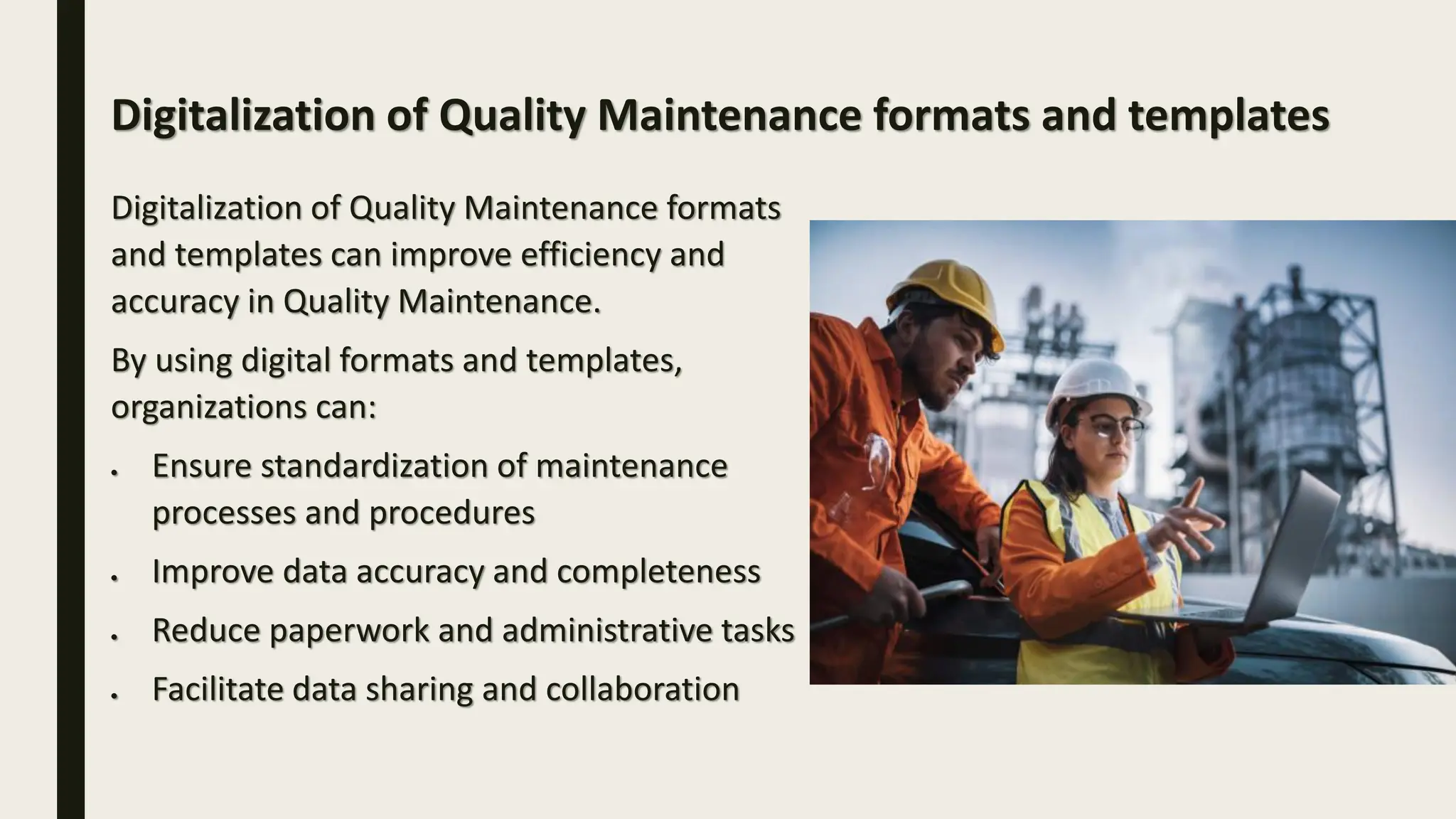
Digitalization of Quality Maintenance formats
and templates can improve efficiency and
accuracy in Quality Maintenance.
By using digital formats and templates,
organizations can:
• Ensure standardization of maintenance
processes and procedures
• Improve data accuracy and completeness
• Reduce paperwork and administrative tasks
• Facilitate data sharing and collaboration
Digitalization of Quality Maintenance formats and templates
Best practices in Quality Maintenance
implementation via CMMS
To ensure successful implementation of Quality Maintenance via CMMS,
organizations should consider the following best practices:
• Ensure that CMMS is fully integrated with other business systems
• Develop a comprehensive maintenance plan and schedule
• Ensure that data is accurate and up-to-date
• Ensure that all employees are trained and involved in CMMS activities
• Establish clear goals and objectives for CMMS and regularly monitor
progress towards these goals
■ Benefits
Benefits
Implementing Quality Maintenance with CMMS
can provide organizations with the following
benefits:
• Improved equipment reliability and
performance
• Reduced downtime and maintenance costs
• Increased productivity and efficiency
• Improved data accuracy and completeness
• Enhanced decision making and problem-
solving capabilities
Common challenges when implementing Quality
Maintenance and how to overcome them
Common challenges when implementing Quality Maintenance via CMMS
include resistance to change, lack of employee buy-in, and inadequate training.
To overcome these challenges, organizations should consider the following
strategies:
• Communicate the benefits of Quality Maintenance and CMMS to all
employees
• Engage employees at all levels in the implementation process
• Provide appropriate training and support
• Establish a strong Quality Maintenance culture that emphasizes continuous
improvement and innovation
■ Training and Development for Quality Maintenance in TPM
Importance of training and development for
successful implementation of Quality
Maintenance in TPM
Training and development are critical for the successful implementation of
Quality Maintenance in TPM.
By providing appropriate training and development, organizations can:
• Ensure that employees have the necessary knowledge and skills to carry
out Quality Maintenance activities
• Improve employee morale and involvement
• Facilitate continuous improvement and innovation
• Ensure that Quality Maintenance is fully integrated with other TPM pillars
Role of leadership in promoting a culture of
Quality Maintenance in TPM
Leadership plays a critical role in promoting a culture of Quality Maintenance in
TPM.
By providing leadership and support, organizations can:
• Ensure that Quality Maintenance is a top priority
• Facilitate employee involvement and empowerment
• Provide the necessary resources and support for Quality Maintenance
activities
• Ensure that Quality Maintenance is fully integrated with other TPM pillars
■ Future of Quality Maintenance in TPM
Predictions and trends for the future
The future of Quality Maintenance in TPM is likely to be shaped by several
trends and predictions, including:
• Increased use of technology, including the Internet of Things (IoT) and
artificial intelligence (AI), to improve maintenance processes and decision
making
• Greater emphasis on data analytics and predictive maintenance to identify
and prevent equipment failures before they occur
• Increased focus on sustainability and energy efficiency in maintenance
processes
• Greater integration of Quality Maintenance with other business systems,
such as supply chain management and customer relationship management
Role of Quality Maintenance in the evolution
of TPM and manufacturing industry
■ Quality Maintenance is expected to play a significant role in the
evolution of TPM and the manufacturing industry in general.
■ By focusing on continuous improvement and innovation,
organizations can improve their competitiveness, reduce costs, and
enhance customer satisfaction.
■ Opportunities and challenges for Quality Maintenance in TPM in
the future
Some of the key opportunities and challenges for Quality Maintenance in TPM in
the future include:
Opportunities:
• Greater use of technology to improve maintenance processes and decision
making
• Increased focus on sustainability and energy efficiency in maintenance
processes
• Greater integration of Quality Maintenance with other business systems,
such as supply chain management and customer relationship management
Challenges:
• Resistance to change
• Skills and knowledge gaps
• Cost and resource constraints
Conclusion
Quality Maintenance is a critical aspect of Total Productive
Maintenance and is essential for achieving manufacturing excellence.
By focusing on continuous improvement and innovation, organizations
can improve their competitiveness, reduce costs, and enhance customer
satisfaction.
Tools and techniques such as CMMS, KPIs, and data analytics,
organizations can improve their equipment reliability and performance,
reduce downtime and maintenance costs.
Finally, by investing in training and development and promoting a
culture of Quality Maintenance, organizations can ensure that they are
well-positioned to meet the challenges and opportunities of the future.
24/03/2025
By: Zainal Mohd Salleh
MSc, CEng, CTPEng, CWI, CSWIP, ASNT LII, Tar Ins, ISO Lead A, TTT HRDF, ToT UK

Quality Maintenance slides one.pdf........

  • 1.
    QUALITY MAINTENANCE 24/03/2025 Presented by Zainal MohdSalleh MSc, CEng, CTPEng, CWI, CSWIP, ASNT LII, Tar Ins, ISO Lead A, TTT HRDF, ToT UK
  • 2.
    What is QualityMaintenance? ■ Quality Maintenance is a systematic approach to maintaining and improving the quality of products and processes by preventing defects and minimizing waste. ■ It is a key aspect of Total Productive ■ Maintenance (TPM) and focuses on enhancing equipment reliability, workplace safety, and productivity improvement. ■ Quality Maintenance in Total Productive Maintenance: Key Principles and Best Practices
  • 3.
    Objectives and Benefitsof Quality Maintenance ■ Reduced production costs ■ Increased efficiency and effectiveness ■ Improved customer satisfaction ■ Enhanced employee morale and involvement ■ Improved workplace safety ■ Continuous improvement and innovation The main objectives of Quality Maintenance are to eliminate losses, improve process quality, reduce downtime, and enhance equipment reliability. By implementing Quality Maintenance, organizations can achieve the benefits:
  • 4.
    Key Principles ofQuality Maintenance ■ Quality Maintenance is a critical aspect of Total Productive Maintenance (TPM) and is essential for achieving manufacturing excellence. ■ Quality Maintenance aims to ensure that equipment is always in a state of optimal performance, by preventing breakdowns, reducing downtime, and improving productivity. ■ Here are some key principles of Quality Maintenance that organizations should keep in mind:
  • 5.
    Continuous Improvement ■ Continuousimprovement is a fundamental principle of Quality Maintenance. ■ Organizations must continually strive to improve their maintenance processes, procedures, and practices. ■ This involves regularly reviewing maintenance data and metrics to identify areas for improvement, and implementing changes to improve equipment reliability and performance. Root Cause Analysis ■ Root cause analysis is another critical principle of Quality Maintenance. ■ When equipment fails, it’s essential to identify the root cause of the failure and take corrective action to prevent future failures. ■ Root cause analysis involves identifying the underlying causes of equipment failures and addressing them, rather than just fixing the immediate problem.
  • 6.
    Employee Involvement ■ Employeeinvolvement is another critical principle of Quality Maintenance. ■ Employees at all levels should be involved in maintenance activities, from identifying problems to implementing solutions. ■ Employee involvement can improve morale, foster a sense of ownership, and increase productivity. Standardization ■ Standardization is another essential principle of Quality Maintenance. ■ Standardization involves developing and implementing standardized maintenance processes and procedures. ■ This can improve efficiency, reduce errors, and enhance consistency in maintenance practices.
  • 7.
    Data-Driven Decision Making ■Data-driven decision making is another critical principle of Quality Maintenance. ■ Organizations should rely on data and metrics to make decisions about maintenance processes, procedures, and practices. ■ This can help identify areas for improvement and track progress towards maintenance goals. Quality Assurance ■ Quality assurance is another essential principle of Quality Maintenance. ■ Organizations should implement quality control measures to ensure that maintenance processes and procedures are followed correctly. ■ Quality assurance can help prevent equipment failures, reduce downtime, and improve productivity.
  • 8.
    Training and Development ■Training and development are critical principles of Quality Maintenance. ■ Organizations should invest in training and development programs to ensure that employees have the necessary knowledge and skills to carry out maintenance activities. ■ Training and development can improve employee morale, enhance productivity, and foster a culture of continuous improvement.
  • 9.
    Quality Maintenance in TotalProductive Maintenance (TPM) ■ Quality Maintenance is one of the eight pillars of Total Productive Maintenance (TPM), which is a comprehensive approach to achieving Manufacturing Excellence. ■ TPM is based on the principles of Lean Manufacturing and focuses on maximizing equipment reliability, workplace safety, and productivity improvement.
  • 10.
    Role of QualityMaintenance in TPM ■ The role of Quality Maintenance in TPM is to ensure that equipment is well-maintained and capable of producing high-quality products. ■ Quality Maintenance aims to prevent defects and minimize waste by identifying and addressing the root causes of equipment failures.
  • 11.
    Importance of QualityMaintenance for TPM success Quality Maintenance is essential for the success of TPM to: ■ Maximize equipment reliability ■ Improve workplace safety ■ Reduce downtime and losses ■ Enhance product quality ■ Increase customer satisfaction
  • 12.
    Best practices forintegrating Quality Maintenance with other TPM pillars To achieve maximum benefits from Quality Maintenance, It is essential to integrate it with other TPM pillars, including: ■ Autonomous Maintenance ■ Planned Maintenance ■ Quality Improvement ■ Training and Development ■ Early Equipment Management ■ Administrative and Office TPM
  • 13.
    Implementing Quality Maintenance Stepsinvolved in implementing Quality Maintenance The following are the steps involved in implementing Quality Maintenance: • Assess current processes and identify improvement opportunities • Develop a plan for improvement and prioritize actions • Engage employees at all levels and provide appropriate training • Implement improvement actions and monitor results • Continuously improve and innovate
  • 14.
    Role of differentdepartments in Quality Maintenance ■ To ensure the success of Quality Maintenance, different departments in an organization need to collaborate and work together towards common goals. The following departments play a critical role in Quality Maintenance: ■ Production: responsible for ensuring that equipment is operated in accordance with standard operating procedures and maintaining equipment cleanliness. ■ Maintenance: responsible for carrying out planned and unplanned maintenance activities, identifying and addressing equipment defects, and performing root cause analysis. ■ Quality Assurance: responsible for monitoring product quality, identifying defects, and implementing corrective actions. ■ Engineering: responsible for designing and improving equipment and processes, conducting equipment feasibility studies, and providing technical support.
  • 15.
    Best practices forQuality Maintenance implementation and sustenance To ensure successful implementation and sustenance of Quality Maintenance, organizations should consider the following best practices: ■ Develop a strong Quality Maintenance culture that emphasizes continuous improvement and innovation. ■ Ensure that all employees are trained and involved in Quality Maintenance activities. ■ Establish clear goals and objectives for Quality Maintenance and regularly monitor progress towards these goals. ■ •Implement a system of performance metrics and key performance indicators (KPIs) to measure the effectiveness of Quality Maintenance. ■ Ensure that Quality Maintenance is fully integrated with other TPM pillars.
  • 16.
    S.No. Format/ Template Focus Area FeaturesMetrics Benefits 1 Equipment Maintenance Checklist A checklist to ensure all maintenance tasks are completed for each equipment Percentage of completed maintenance tasks per equipment Reduced equipment downtime and increased equipment lifespan 2 Standard Operating Procedure (SOP) A detailed written document that provides step-by-step instructions on how to perform a task or activity Number of deviations from the SOP, compliance rate Consistent quality and increased efficiency in performing tasks 3 Preventive Maintenance Schedule A schedule that outlines the planned maintenance activities for each equipment Percentage of completed preventive maintenance tasks, equipment availability Reduced equipment downtime, increased equipment lifespan and reliability Formats and Templates used in Quality Maintenance with respect to Total Productive Maintenance
  • 17.
    4 Root Cause Analysis(RCA) Template A template used to identify and address the root cause of a problem or defect Number of problems solved, time to complete RCA process Improved problem-solving and decision-making capabilities 5 5S Checklist A checklist to ensure the workplace is clean, organized, and efficient Number of non-compliance issues identified, cleanliness and organization score Improved workplace safety, efficiency, and productivity 6 Visual Management Board Template A template to visually display the status of the production process, including progress, problems, and metrics</td Percentage of on-time deliveries, cycle time, production volume Improved communication, collaboration, and decision- making in the production process 7 Failure Modes and Effects Analysis (FMEA) Template A template to identify and prioritize potential failures in a process or product and the actions to mitigate or prevent them Number of potential failures identified and mitigated, effectiveness of actions taken Reduced risk of failures and defects, improved product and process quality 8 Check Sheet A structured form used to collect and analyze data on a specific process or product Number of defects or occurrences of a specific event, frequency of defects Improved data collection and analysis, identification of areas for improvement 9 Process Flow Diagram Template A template to visualize the steps and interactions in a process, including inputs, outputs, and controls Cycle time, lead time, process efficiency Improved understanding and optimization of the process, identification of waste and inefficiencies 10 Control Plan Template A template to outline the process controls and measures to ensure the quality of a product or service Compliance rate, number of defects, cost of quality Improved product and service quality, reduced defects and costs
  • 18.
    11 Quality ImprovementPlan A plan that outlines the goals, strategies, and actions to improve the quality of a product or process Number of goals achieved, effectiveness of strategies and actions Continuous improvement in product and process quality, increased customer satisfaction 12 Defect Stratification by Phenomena A tool to categorize and analyze the types and causes of defects in a product or process Number and percentage of defects by category, effectiveness of defect reduction measures Improved understanding and control of the causes of defects, reduced defect rates 13 Loss Cost Matrix A tool to prioritize and analyze the losses and costs associated with quality defects Cost of defects by type, effectiveness of improvement measures Improved identification and prioritization of improvement opportunities, reduced costs and losses 14 QI Stratification A tool to stratify and analyze the quality improvement opportunities based on the level of impact and effort Number and percentage of improvement opportunities by impact and effort level, effectiveness of improvement measures Improved prioritization and allocation of resources for quality improvement, increased efficiency and effectiveness of improvement efforts
  • 19.
    Tools and techniquesfor effective Quality Maintenance Overview of different Quality Maintenance tools and techniques There are several tools and techniques that can be used to implement Quality Maintenance. Some of these include: ■ Root Cause Analysis (RCA) ■ Poka-yoke (Error-Proofing) ■ 5S Methodology ■ Visual Management ■ Kaizen ■ Standardized Work ■ Six Sigma ■ Total Quality Management (TQM)
  • 20.
    THE SEVEN BASICQUALITY TOOLS The seven basic quality tools were first highlighted in Kaoru Ishikawa’s classic book Guide to Quality Control. And new classics, like Nancy Tague’s The Quality Toolbox also references these tools. When used appropriately, each tool can have a major impact on your quality improvement activities. Using these tools in combination further multiplies their value. Cause and effect diagram: Also known as an Ishikawa diagram or a fishbone diagram, this tool analyzes process dispersion. It illustrates the main causes and subcauses leading to an effect. Check sheet: Not to be confused with checklists, a check sheet is a simple data recording tool. It consists of a list of problems and the number of occurrences indicated by tally marks. Control chart: This is a time sequenced chart with upper and lower control limits on which values of some statistical measure for a series of samples or subgroups are plotted. Often, the chart shows a central line to help detect a trend of plotted values toward either control limit. Control charts are used to study how a process changes over time and whether a process is consistent or in control, or unpredictable and out of control.
  • 21.
    Histogram: A histogramis used for displaying the distribution of data graphically. The pictorial nature of a histogram helps people more easily identify patterns that are difficult to detect in a table of numbers, as well as understand the frequency of distributions. Pareto chart: Based on the Pareto principle or 80/20 rule—which states that 80% of outcomes result from 20% of causes—this chart graphically displays the relative importance of differences among groups of data within a set, from most to least significant. Scatter plot or diagram: A scatter plot is a simple visual form of graphical analysis used to analyze and identify potential relationships between two variables plotted along the x-axis and y-axis. Stratification: Stratification refers to breaking down data into categories to more easily make sense of them
  • 22.
    Formats and Templatesused in Quality Maintenance with respect to Total Productive Maintenance ■ Total Productive Maintenance is an essential component of quality maintenance in any manufacturing or production process. ■ Formats and templates provide a structured approach to implement TPM and continuously improve the quality of products and processes. ■ The formats and templates listed in this article can help organizations identify improvement opportunities, optimize processes, reduce waste and costs, and increase customer satisfaction.
  • 23.
    Key Performance Indicators(KPIs) for Quality Maintenance Role of data and analytics in Quality Maintenance Data and analytics play a critical role in Quality Maintenance because they enable organizations to make data-driven decisions, identify improvement opportunities, and monitor progress towards goals. Some of the key data and analytics tools used in Quality Maintenance include: • Process Mapping • Metric Analysis • Data-Driven Decision Making
  • 24.
    KPIs for measuringeffectiveness of Quality Maintenance To measure the effectiveness of Quality Maintenance, organizations should track the following KPIs: ■ • Overall Equipment Effectiveness (OEE) ■ • Downtime Reduction ■ • Asset Management ■ • Energy Efficiency ■ • Equipment Reliability ■ • Product Quality ■ • Waste Reduction
  • 25.
    Importance of KPIsfor continuous improvement ■ KPIs are essential for continuous improvement because they enable organizations to measure their performance, identify areas for improvement, and monitor progress towards goals. ■ By tracking KPIs, organizations can make data-driven decisions and implement targeted improvement actions.
  • 26.
    Role of CMMSin Championing Quality Maintenance ■ Computerized Maintenance Management Systems (CMMS) can play a critical role in championing Quality Maintenance because they enable organizations to: ■ • Streamline maintenance processes ■ • Track maintenance activities and costs ■ • Monitor equipment reliability and performance ■ • Identify improvement opportunities ■ • Facilitate data-driven decision making
  • 28.
    Digitalization of QualityMaintenance formats and templates can improve efficiency and accuracy in Quality Maintenance. By using digital formats and templates, organizations can: • Ensure standardization of maintenance processes and procedures • Improve data accuracy and completeness • Reduce paperwork and administrative tasks • Facilitate data sharing and collaboration Digitalization of Quality Maintenance formats and templates
  • 29.
    Best practices inQuality Maintenance implementation via CMMS To ensure successful implementation of Quality Maintenance via CMMS, organizations should consider the following best practices: • Ensure that CMMS is fully integrated with other business systems • Develop a comprehensive maintenance plan and schedule • Ensure that data is accurate and up-to-date • Ensure that all employees are trained and involved in CMMS activities • Establish clear goals and objectives for CMMS and regularly monitor progress towards these goals ■ Benefits
  • 30.
    Benefits Implementing Quality Maintenancewith CMMS can provide organizations with the following benefits: • Improved equipment reliability and performance • Reduced downtime and maintenance costs • Increased productivity and efficiency • Improved data accuracy and completeness • Enhanced decision making and problem- solving capabilities
  • 31.
    Common challenges whenimplementing Quality Maintenance and how to overcome them Common challenges when implementing Quality Maintenance via CMMS include resistance to change, lack of employee buy-in, and inadequate training. To overcome these challenges, organizations should consider the following strategies: • Communicate the benefits of Quality Maintenance and CMMS to all employees • Engage employees at all levels in the implementation process • Provide appropriate training and support • Establish a strong Quality Maintenance culture that emphasizes continuous improvement and innovation ■ Training and Development for Quality Maintenance in TPM
  • 32.
    Importance of trainingand development for successful implementation of Quality Maintenance in TPM Training and development are critical for the successful implementation of Quality Maintenance in TPM. By providing appropriate training and development, organizations can: • Ensure that employees have the necessary knowledge and skills to carry out Quality Maintenance activities • Improve employee morale and involvement • Facilitate continuous improvement and innovation • Ensure that Quality Maintenance is fully integrated with other TPM pillars
  • 33.
    Role of leadershipin promoting a culture of Quality Maintenance in TPM Leadership plays a critical role in promoting a culture of Quality Maintenance in TPM. By providing leadership and support, organizations can: • Ensure that Quality Maintenance is a top priority • Facilitate employee involvement and empowerment • Provide the necessary resources and support for Quality Maintenance activities • Ensure that Quality Maintenance is fully integrated with other TPM pillars ■ Future of Quality Maintenance in TPM
  • 34.
    Predictions and trendsfor the future The future of Quality Maintenance in TPM is likely to be shaped by several trends and predictions, including: • Increased use of technology, including the Internet of Things (IoT) and artificial intelligence (AI), to improve maintenance processes and decision making • Greater emphasis on data analytics and predictive maintenance to identify and prevent equipment failures before they occur • Increased focus on sustainability and energy efficiency in maintenance processes • Greater integration of Quality Maintenance with other business systems, such as supply chain management and customer relationship management
  • 35.
    Role of QualityMaintenance in the evolution of TPM and manufacturing industry ■ Quality Maintenance is expected to play a significant role in the evolution of TPM and the manufacturing industry in general. ■ By focusing on continuous improvement and innovation, organizations can improve their competitiveness, reduce costs, and enhance customer satisfaction. ■ Opportunities and challenges for Quality Maintenance in TPM in the future
  • 37.
    Some of thekey opportunities and challenges for Quality Maintenance in TPM in the future include: Opportunities: • Greater use of technology to improve maintenance processes and decision making • Increased focus on sustainability and energy efficiency in maintenance processes • Greater integration of Quality Maintenance with other business systems, such as supply chain management and customer relationship management Challenges: • Resistance to change • Skills and knowledge gaps • Cost and resource constraints
  • 38.
    Conclusion Quality Maintenance isa critical aspect of Total Productive Maintenance and is essential for achieving manufacturing excellence. By focusing on continuous improvement and innovation, organizations can improve their competitiveness, reduce costs, and enhance customer satisfaction. Tools and techniques such as CMMS, KPIs, and data analytics, organizations can improve their equipment reliability and performance, reduce downtime and maintenance costs. Finally, by investing in training and development and promoting a culture of Quality Maintenance, organizations can ensure that they are well-positioned to meet the challenges and opportunities of the future.
  • 39.
    24/03/2025 By: Zainal MohdSalleh MSc, CEng, CTPEng, CWI, CSWIP, ASNT LII, Tar Ins, ISO Lead A, TTT HRDF, ToT UK