QC Guide—Orientation


IFAC SMP Committee

An Introduction to the Guide to
Quality Control for Small- and
Medium-Sized Practices

April 2012
QC Guide—Orientation

Contents


• International Standard on Quality Control (ISQC) 1
• The QC Guide
     –   Structure and Content
     –   Chapters
     –   Appendices
     –   Sample Manuals
• IFAC Resources
International Standard on Quality Control (ISQC) 1


• ISQC 1, paragraph 11
   – The objective of the firm is to establish and maintain a system of quality
     control to provide it with reasonable assurance that:
       • The firm and its personnel comply with professional standards and applicable
         legal and regulatory requirements; and
       • Reports issued by the firm or engagement partners are appropriate in the
         circumstances.

• Applying ISQC 1 proportionately to the size and
  complexity of the firm is key to its efficient
  implementation
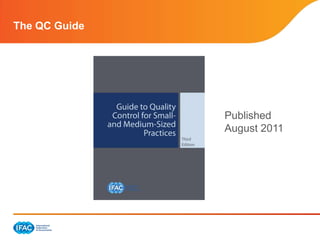
The QC Guide


               Published
               August 2011
The QC Guide


• Helps SMPs apply ISQC 1 proportionately and efficiently
• Provides practical guidance, but is no substitute for:
   – Reading and understanding ISQC 1 (itself, a requirement of ISQC 1)
   – Using professional judgment
• Helps firms develop a system of quality control
• Promotes consistent application of quality control
  requirements within audit, review, and other assurance
  and related service engagements
• May serve as a reference document for training within a
  firm
QC Guide


           Structure and Content
QC Guide

Structure and Content


• Modular approach to the elements of ISQC 1
     – Chapter 1: Leadership Responsibilities for Quality Within the Firm
     – Chapter 2: Relevant Ethical Requirements
     – Chapter 3: Acceptance and Continuance of Client Relationships and
       Specific Engagements
     – Chapter 4: Human Resources
     – Chapter 5: Engagement Performance
     – Chapter 6: Monitoring
     – Chapter 7: Documentation
• ―Helpful Hints‖
QC Guide

Structure and Content


• Case study—M.M. and Associates
     – Fictional sole practitioner employing four staff
     – Performs review engagements and a small number of audits
     – Illustrates the value of a system of quality control and how its elements
       may be applied to practical situations
• Sample forms and checklists
• Two sample Quality Control Manuals
     – Sole practitioner
     – 2-5 partner firm
QC Guide


           Chapters
Chapter 1

Leadership Responsibilities for Quality Within Firm


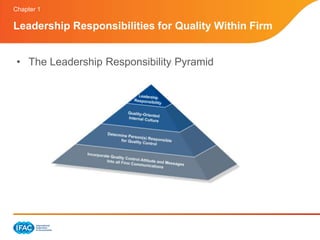
 • The Leadership Responsibility Pyramid
Chapter 1

Leadership Responsibilities for Quality Within Firm


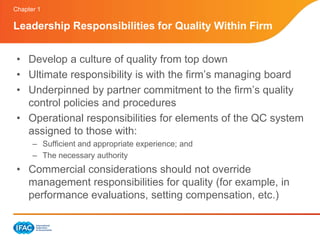
 • Develop a culture of quality from top down
 • Ultimate responsibility is with the firm’s managing board
 • Underpinned by partner commitment to the firm’s quality
   control policies and procedures
 • Operational responsibilities for elements of the QC system
   assigned to those with:
      – Sufficient and appropriate experience; and
      – The necessary authority
 • Commercial considerations should not override
   management responsibilities for quality (for example, in
   performance evaluations, setting compensation, etc.)
Chapter 2

Relevant Ethical Requirements


 • Embed within the firm the fundamental principles of
   professional ethics:
      –     Integrity
      –     Objectivity
      –     Professional competence and due care
      –     Confidentiality
      –     Professional behavior
 • Establish processes to identify and deal with non-
   adherence to the fundamental principles
Chapter 2

Relevant Ethical Requirements


 • Independence—required on all assurance engagements
 • Understand the threats and safeguards to independence,
   set out in the IESBA Code of Ethics
 • Maintain policies and procedures to enable threats to
   independence to be identified, documented, and managed
   appropriately, including:
      – Firm level—annual written confirmations from all partners and professional
        staff
      – Engagement level—written confirmation by engagement team
 • Identify and manage conflicts of interest
 • Establish confidentiality procedures
Chapter 3

Acceptance and Continuance of Client
Relationships and Specific Engagements
Chapter 3

Acceptance and Continuance of Client
Relationships and Specific Engagements

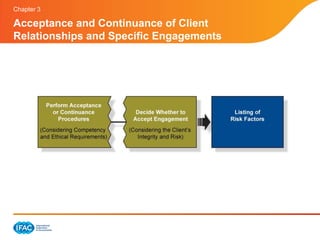
 • Ensure the firm has the competence and capability, can
   comply with ethical requirements, and considers the
   client’s integrity when deciding to accept or continue the
   engagement
   … and document risks and (any) safeguards

 • Withdrawal from engagements and/or client relationships
   … and document underlying factors
Chapter 4

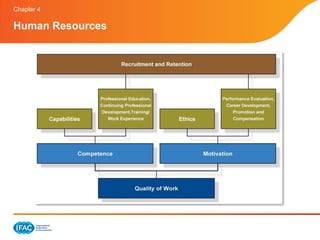
Human Resources
Chapter 4

Human Resources


 • Need sufficient personnel in the firm with the competence,
   capabilities, and commitment to ethical principles
   necessary to do the work
 • Focus on recruitment and retention relative to the needs of
   the firm and its clients
 • Ensure that staff and partners are appropriately trained
   and developed and that their competence is maintained
 • Assign engagement teams with the necessary
   competence and capabilities to do the work
 • Establish a disciplinary process
Chapter 5

Engagement Performance


 • Policies and procedures should ensure consistent quality
   output across the firm
 • Engagement partner has defined responsibilities
 • Establish:
      – Effective planning, supervision, and review procedures
      – Consultation procedures—when, who, how, etc.—including
        external sources if necessary
      – Procedures for resolving differences of opinion
Chapter 5

Engagement Performance


 • Engagement quality control reviews (EQCR)
      – Required for all audits of listed entities
      – Establish criteria for other engagements where EQCR would be desirable
        (e.g., high risk)
      – Defined minimum scope
 • Appoint suitable EQCR reviewer—internal or external
      – Technically capable
      – Necessary experience and authority
      – Objective
Chapter 6

Monitoring


 • Establish a monitoring program over the firm’s system of
   quality control
 • Inspection procedures:
      – Consider nature and extent, but ensure coverage of at least one
        engagement per partner at least every 3 years
      – External inspections may be desirable (e.g., fresh perspective or sharing
        of ideas) or necessary (if no suitable internal resource)
      – Formal reporting
 • Communicate deficiencies and take remedial actions
 • Establish procedures for dealing with complaints and
   allegations
Chapter 7

Documentation


 • Required of:
      – The firm’s quality control policies and procedures
      – Engagement files
      – Engagement quality control reviews
 • File access and retention
QC Guide


           Appendices
QC Guide

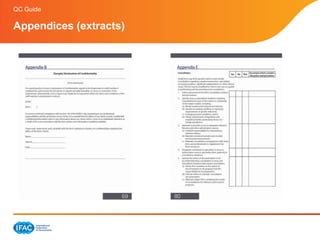
Appendices (extracts)
QC Guide

Using the Appendices


• Eight appendices, each of which may serve as a practice
  aid for firms to use within their quality control systems
• May be adapted as appropriate, for example, to conform
  with:
     – Regulatory and professional requirements in the applicable
       jurisdiction; and
     – The policies and procedures of the firm
QC Guide


           Sample Manuals
QC Guide

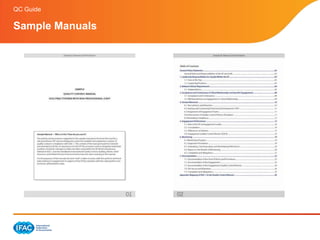
Sample Manuals
QC Guide

Using the Sample Manuals


• Determine the leadership positions that apply, or ought to
  apply, within the firm, for example:
     – Managing Partner
     – Ethics Leader
     – Human Resources
• Assign responsibility for all key, relevant quality control
  functions, ensuring those assigned have sufficient and
  appropriate experience, ability, and authority to carry out
  such responsibilities.
• Select from policies (where presented) or modify the
  policies as appropriate.
QC Guide

Using the Sample Manuals


• Ensure engagement templates are updated to reflect the
  policies in the manual.
• Ensure agreement by all partners (if a partnership).
• Present the manual to all partners and staff, preferably in a
  seminar environment.
• Provide the manual to new staff and perform a follow-up
  interview to ensure it has been read and understood.
• Review and update the manual as new standards or new
  firm policies are developed (suggested annually).
IFAC Resources
SMP Committee Home Page

www.ifac.org/smp


                          Access QC Guide
                          and Implementation
                          Resources from here
IFAC Resources

• Guide to Quality Control for Small- and Medium-Sized
  Practices
   – www.ifac.org/publications-resources/guide-quality-control-small-and-
     medium-sized-practices-third-edition-0
• For ISQC 1, clarified ISAs, and related implementation
  resources, see IAASB Clarity Center:
   – www.ifac.org/auditing-assurance/clarity-center
• Tips for Cost-Effective ISQC 1 Application article
   – www.ifac.org/publications-resources/tips-cost-effective-isqc-1-application
IFAC Resources


• Good practice guidance paper, Client Acceptance and
  Continuance
   – www.ifac.org/publications-resources/client-acceptance-and-continuance
• Policy Position Paper 2, Promoting a Single Set of
  Auditing Standards for All Audits, Including of Small- and
  Medium-Sized Entities
   – www.ifac.org/publications-resources/single-set-auditing-standards-audits-
     small-and-medium-sized-entities
• Links to other implementation resources
   – www.ifac.org/relevant-links-implementation
Copyright © April 2012 by the International Federation of Accountants (IFAC). All
rights reserved. Used with permission of IFAC. Contact permissions@ifac.org
for permission to reproduce, store, or transmit this document.


                         www.ifac.org/SMP

Quality Control Guide Orientation Slides

  • 1.
    QC Guide—Orientation IFAC SMPCommittee An Introduction to the Guide to Quality Control for Small- and Medium-Sized Practices April 2012
  • 2.
    QC Guide—Orientation Contents • InternationalStandard on Quality Control (ISQC) 1 • The QC Guide – Structure and Content – Chapters – Appendices – Sample Manuals • IFAC Resources
  • 3.
    International Standard onQuality Control (ISQC) 1 • ISQC 1, paragraph 11 – The objective of the firm is to establish and maintain a system of quality control to provide it with reasonable assurance that: • The firm and its personnel comply with professional standards and applicable legal and regulatory requirements; and • Reports issued by the firm or engagement partners are appropriate in the circumstances. • Applying ISQC 1 proportionately to the size and complexity of the firm is key to its efficient implementation
  • 4.
    The QC Guide Published August 2011
  • 5.
    The QC Guide •Helps SMPs apply ISQC 1 proportionately and efficiently • Provides practical guidance, but is no substitute for: – Reading and understanding ISQC 1 (itself, a requirement of ISQC 1) – Using professional judgment • Helps firms develop a system of quality control • Promotes consistent application of quality control requirements within audit, review, and other assurance and related service engagements • May serve as a reference document for training within a firm
  • 6.
    QC Guide Structure and Content
  • 7.
    QC Guide Structure andContent • Modular approach to the elements of ISQC 1 – Chapter 1: Leadership Responsibilities for Quality Within the Firm – Chapter 2: Relevant Ethical Requirements – Chapter 3: Acceptance and Continuance of Client Relationships and Specific Engagements – Chapter 4: Human Resources – Chapter 5: Engagement Performance – Chapter 6: Monitoring – Chapter 7: Documentation • ―Helpful Hints‖
  • 8.
    QC Guide Structure andContent • Case study—M.M. and Associates – Fictional sole practitioner employing four staff – Performs review engagements and a small number of audits – Illustrates the value of a system of quality control and how its elements may be applied to practical situations • Sample forms and checklists • Two sample Quality Control Manuals – Sole practitioner – 2-5 partner firm
  • 9.
    QC Guide Chapters
  • 10.
    Chapter 1 Leadership Responsibilitiesfor Quality Within Firm • The Leadership Responsibility Pyramid
  • 11.
    Chapter 1 Leadership Responsibilitiesfor Quality Within Firm • Develop a culture of quality from top down • Ultimate responsibility is with the firm’s managing board • Underpinned by partner commitment to the firm’s quality control policies and procedures • Operational responsibilities for elements of the QC system assigned to those with: – Sufficient and appropriate experience; and – The necessary authority • Commercial considerations should not override management responsibilities for quality (for example, in performance evaluations, setting compensation, etc.)
  • 12.
    Chapter 2 Relevant EthicalRequirements • Embed within the firm the fundamental principles of professional ethics: – Integrity – Objectivity – Professional competence and due care – Confidentiality – Professional behavior • Establish processes to identify and deal with non- adherence to the fundamental principles
  • 13.
    Chapter 2 Relevant EthicalRequirements • Independence—required on all assurance engagements • Understand the threats and safeguards to independence, set out in the IESBA Code of Ethics • Maintain policies and procedures to enable threats to independence to be identified, documented, and managed appropriately, including: – Firm level—annual written confirmations from all partners and professional staff – Engagement level—written confirmation by engagement team • Identify and manage conflicts of interest • Establish confidentiality procedures
  • 14.
    Chapter 3 Acceptance andContinuance of Client Relationships and Specific Engagements
  • 15.
    Chapter 3 Acceptance andContinuance of Client Relationships and Specific Engagements • Ensure the firm has the competence and capability, can comply with ethical requirements, and considers the client’s integrity when deciding to accept or continue the engagement … and document risks and (any) safeguards • Withdrawal from engagements and/or client relationships … and document underlying factors
  • 16.
  • 17.
    Chapter 4 Human Resources • Need sufficient personnel in the firm with the competence, capabilities, and commitment to ethical principles necessary to do the work • Focus on recruitment and retention relative to the needs of the firm and its clients • Ensure that staff and partners are appropriately trained and developed and that their competence is maintained • Assign engagement teams with the necessary competence and capabilities to do the work • Establish a disciplinary process
  • 18.
    Chapter 5 Engagement Performance • Policies and procedures should ensure consistent quality output across the firm • Engagement partner has defined responsibilities • Establish: – Effective planning, supervision, and review procedures – Consultation procedures—when, who, how, etc.—including external sources if necessary – Procedures for resolving differences of opinion
  • 19.
    Chapter 5 Engagement Performance • Engagement quality control reviews (EQCR) – Required for all audits of listed entities – Establish criteria for other engagements where EQCR would be desirable (e.g., high risk) – Defined minimum scope • Appoint suitable EQCR reviewer—internal or external – Technically capable – Necessary experience and authority – Objective
  • 20.
    Chapter 6 Monitoring •Establish a monitoring program over the firm’s system of quality control • Inspection procedures: – Consider nature and extent, but ensure coverage of at least one engagement per partner at least every 3 years – External inspections may be desirable (e.g., fresh perspective or sharing of ideas) or necessary (if no suitable internal resource) – Formal reporting • Communicate deficiencies and take remedial actions • Establish procedures for dealing with complaints and allegations
  • 21.
    Chapter 7 Documentation •Required of: – The firm’s quality control policies and procedures – Engagement files – Engagement quality control reviews • File access and retention
  • 22.
    QC Guide Appendices
  • 23.
  • 24.
    QC Guide Using theAppendices • Eight appendices, each of which may serve as a practice aid for firms to use within their quality control systems • May be adapted as appropriate, for example, to conform with: – Regulatory and professional requirements in the applicable jurisdiction; and – The policies and procedures of the firm
  • 25.
    QC Guide Sample Manuals
  • 26.
  • 27.
    QC Guide Using theSample Manuals • Determine the leadership positions that apply, or ought to apply, within the firm, for example: – Managing Partner – Ethics Leader – Human Resources • Assign responsibility for all key, relevant quality control functions, ensuring those assigned have sufficient and appropriate experience, ability, and authority to carry out such responsibilities. • Select from policies (where presented) or modify the policies as appropriate.
  • 28.
    QC Guide Using theSample Manuals • Ensure engagement templates are updated to reflect the policies in the manual. • Ensure agreement by all partners (if a partnership). • Present the manual to all partners and staff, preferably in a seminar environment. • Provide the manual to new staff and perform a follow-up interview to ensure it has been read and understood. • Review and update the manual as new standards or new firm policies are developed (suggested annually).
  • 29.
  • 30.
    SMP Committee HomePage www.ifac.org/smp Access QC Guide and Implementation Resources from here
  • 31.
    IFAC Resources • Guideto Quality Control for Small- and Medium-Sized Practices – www.ifac.org/publications-resources/guide-quality-control-small-and- medium-sized-practices-third-edition-0 • For ISQC 1, clarified ISAs, and related implementation resources, see IAASB Clarity Center: – www.ifac.org/auditing-assurance/clarity-center • Tips for Cost-Effective ISQC 1 Application article – www.ifac.org/publications-resources/tips-cost-effective-isqc-1-application
  • 32.
    IFAC Resources • Goodpractice guidance paper, Client Acceptance and Continuance – www.ifac.org/publications-resources/client-acceptance-and-continuance • Policy Position Paper 2, Promoting a Single Set of Auditing Standards for All Audits, Including of Small- and Medium-Sized Entities – www.ifac.org/publications-resources/single-set-auditing-standards-audits- small-and-medium-sized-entities • Links to other implementation resources – www.ifac.org/relevant-links-implementation
  • 33.
    Copyright © April2012 by the International Federation of Accountants (IFAC). All rights reserved. Used with permission of IFAC. Contact permissions@ifac.org for permission to reproduce, store, or transmit this document. www.ifac.org/SMP

Editor's Notes

  • #3 For permission to reproduce, adapt and/or translate the Guides to suit local, national or regional requirements, best practices, custom/culture and language, contact permissions@ifac.org. Permission is also required to reproduce, adapt and/or translate extracts from the Guides for use in other publications.
  • #4 Following on from the second bullet, the QC Guide is intended to help with proportionate and efficient implementation of ISQC 1.
  • #5 Introductory slide.
  • #6 The requirement to read and understand ISQC 1 is set out in ISQC 1 paragraph 13: “Personnel within the firm responsible for establishing and maintaining the firm’s system of quality control shall have an understanding of the entire text of this ISQC, including its application and other explanatory material, to understand its objective and to apply its requirements properly.”
  • #8 The seven chapters of the main body of the QC Guide follow this modular approach. The “Helpful Hints” are interspersed throughout these seven chapters.
  • #9 The case study is introduced on pages xi–xiii of the QC Guide. At the end of each of the seven chapters, the case study is used to illustrate the themes covered in that particular chapter. Sample forms and checklists are included in the QC Guide as Appendices A-H (pages 67-93). These are presented as practice aids to those firms that choose to use them. They may be adaptedas required, dependent upon the regulatory and professional requirements in the applicable jurisdiction, and may be customized as deemed appropriate based on the policies and procedures of the firm.The sample Quality Control Manuals are included at the end of the QC Guide.
  • #11 1) ISQC 1 paragraphs 18 and 19 set out the requirements in respect of “Leadership Responsibilities for Quality Within the Firm.” 2) This is an illustration from page 7 of the QC Guide. It is intended to help depict an infrastructure that facilitates a top-down approach to quality within a firm. Partner attitudes, behaviors and messaging to staff constitute the “tone at the top,” and this tone should convey strong support for quality work and a quality control culture. This is addressed further on the next slide.
  • #12 See also ISQC 1 application material, paragraphs A4-A6.
  • #13 ISQC 1 paragraphs 20-25 set out the requirements in respect of “Relevant Ethical Requirements.” See also ISQC 1 application material, paragraphs A7-A17.
  • #14 ISQC 1 paragraphs 20-25 set out the requirements in respect of “Relevant Ethical Requirements.” See also ISQC 1 application material, paragraphs A7-A17.
  • #15 1) ISQC 1 paragraphs 26-28 set out the requirements in respect of “Acceptance and Continuance of Client Relationships and Specific Engagements.” See also ISQC 1 application material, paragraphs A18-A23.2) This is an illustration from page 21 of the QC Guide. It depicts the sequence of performing acceptance procedures in order to arrive at a decision about whether to accept the engagement. If the engagement is accepted, the risk factors identified during the acceptance process should be recorded so they can be appropriately addressed in engagement planning and performance.
  • #16 These are the key messages reinforced in chapter 3. (ISQC 1 paragraphs 26-28 set out the requirements in respect of “Acceptance and Continuance of Client Relationships and Specific Engagements.” See also ISQC 1 application material, paragraphs A18-A23).
  • #17 ISQC 1 paragraphs 29-31 set out the requirements in respect of “Human Resources.” See also ISQC 1 application material, paragraphs A24-A31.This is an illustration from page 28 of the QC Guide. It depicts in broad terms the components of effective HR policies and their linkage with the competence and motivation that is needed for the firm to consistently deliver high-quality work.
  • #18 ISQC 1 paragraphs 29-31 set out the requirements in respect of “Human Resources.” See also ISQC 1 application material, paragraphs A24-A31.
  • #19 ISQC 1 paragraphs 32-47 set out the requirements in respect of “Engagement Performance.” See also ISQC 1 application material, paragraphs A32-A63.
  • #20 EQCRs are a key component of quality control over engagement performance and are required on certain engagements, as pre-defined by both ISQC 1 and by the firm itself. ISQC 1 paragraphs 35-44 set out the requirements in respect of EQCRs. See also ISQC 1 application material, paragraphs A41-A53.
  • #21 ISQC 1 paragraphs 48-56 set out the requirements in respect of “Monitoring.” See also ISQC 1 application material, paragraphs A64-A72.
  • #22 Throughout ISQC 1 there are a number of documentation requirements in addition to those specifically dealt with under the heading “Documentation” (ISQC 1, paragraphs 57-59). Chapter 7 of the QC Guide has been used to collect a number of the more prominent documentation requirements; however, Chapter 7 is not intended to be a comprehensive collection of all documentation requirements in ISQC 1.
  • #23 The appendices (pages 67-93 of the QC Guide) comprise a variety of sample forms and checklists.
  • #24 This is just an illustrative slide. There are eight appendices in total, namely:Appendix A — Partner and Staff Acknowledgement of Independence Appendix B — Declaration of Confidentiality Appendix C — Client Acceptance (suggested matters to consider) Appendix D — Assignment of Personnel to Engagements (suggested planning steps) Appendix E — Consultation Appendix F — Engagement Quality Control Review (suggested procedures) Appendix G — Quality Control System Monitoring Process (suggested considerations) Appendix H — Monitor’s Report (suggested content)
  • #26 The sample manuals are at the back of the QC Guide, following the appendices.
  • #27 This illustrates the cover and index of one of the two sample manuals (a similar style is used for both sample manuals).
  • #28 1) This slide and the next one illustrate ways firms could consider tailoring the sample manuals to suit their circumstances.2) Suggested leadership positions have been provided throughout the sample manuals—page five in both of the sample quality control manuals introduces suggested positions.
  • #33 The final bullet refers to links to resources relevant to SMPs from IFAC member bodies and other professional organizations, focusing in particular on practical implementation of a variety of accounting, audit/assurance and ethical requirements.