Embedded Systems
Quality Attributes
Contents
• Introduction
• Quality Attributes of Embedded
Systems
Operational Attributes
Non-operational Attributes
Quality Attributes: Non Operational
1. Testability and Debug-
ability
2. Evolvability
3. Portability
4. Time to prototype and
market
5. Per unit and total cost
Testability and Debug-ability
Testing
• How easily one can test
design and by which mean
can test it.
1. Hardware testing
2. Firmware testing
Debugging ability
• Fguring out the probable
sources that create
unexpected behavior in the
total system.
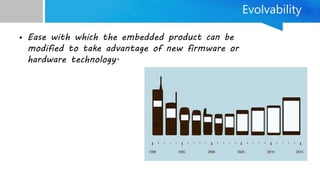
Evolvability
• Ease with which the embedded product can be
modified to take advantage of new firmware or
hardware technology.
Portability
• “System Independence”
• Is it capable of performing
its operation as it is
intended to do in various
environments irrespective of
different processor and or
controller and embedded
operating systems.
Time to prototype and market
Time to market:
Conceptualization Ready for selling or use.
of a product
Prototyping:
Informal kind of rapid product development in which
important feature of the under consider are develop.
• Reduces time to market.
• To shorten the time to prototype:
-Reuse
Time period elapsed
Per unit and total cost
• Cost is an important factor
which needs to be carefully
monitored.
• Monitoring cost right from
the initial period to the
maturing phase then till the
termination is essential
Conclusion
• While designing any
embedded system the
quality attributes play
an important role.

Quality attributes(Non operational) of embedded systems

  • 1.
  • 2.
    Contents • Introduction • QualityAttributes of Embedded Systems Operational Attributes Non-operational Attributes
  • 3.
    Quality Attributes: NonOperational 1. Testability and Debug- ability 2. Evolvability 3. Portability 4. Time to prototype and market 5. Per unit and total cost
  • 4.
    Testability and Debug-ability Testing •How easily one can test design and by which mean can test it. 1. Hardware testing 2. Firmware testing Debugging ability • Fguring out the probable sources that create unexpected behavior in the total system.
  • 5.
    Evolvability • Ease withwhich the embedded product can be modified to take advantage of new firmware or hardware technology.
  • 6.
    Portability • “System Independence” •Is it capable of performing its operation as it is intended to do in various environments irrespective of different processor and or controller and embedded operating systems.
  • 7.
    Time to prototypeand market Time to market: Conceptualization Ready for selling or use. of a product Prototyping: Informal kind of rapid product development in which important feature of the under consider are develop. • Reduces time to market. • To shorten the time to prototype: -Reuse Time period elapsed
  • 8.
    Per unit andtotal cost • Cost is an important factor which needs to be carefully monitored. • Monitoring cost right from the initial period to the maturing phase then till the termination is essential
  • 9.
    Conclusion • While designingany embedded system the quality attributes play an important role.