Dr.R.RAMNATH
Department of Education
Alagappa University
Karaikudi
Qualitative Methods in
Contemporary Educational Research
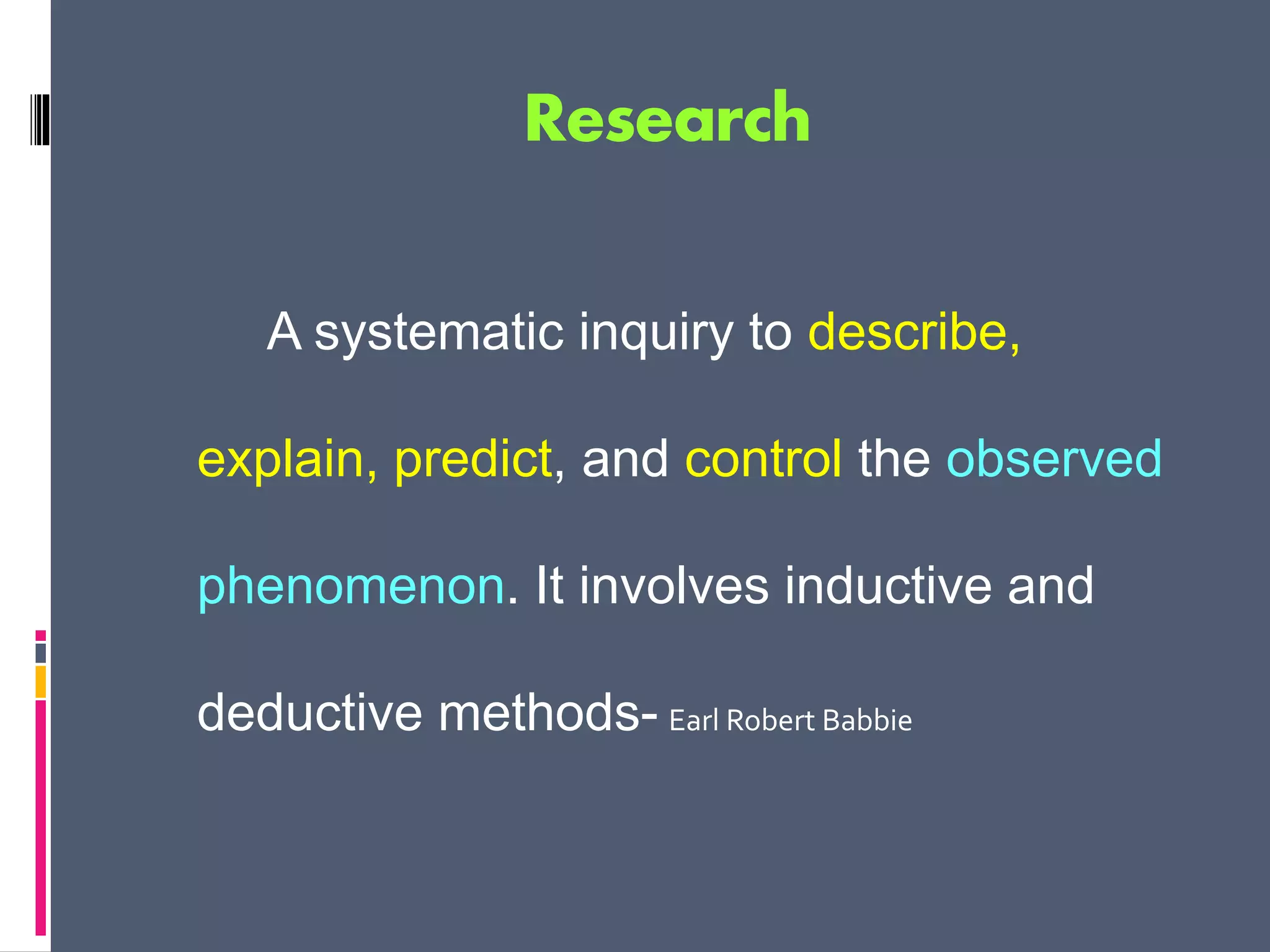
Research
A systematic inquiry to describe,
explain, predict, and control the observed
phenomenon. It involves inductive and
deductive methods- Earl Robert Babbie
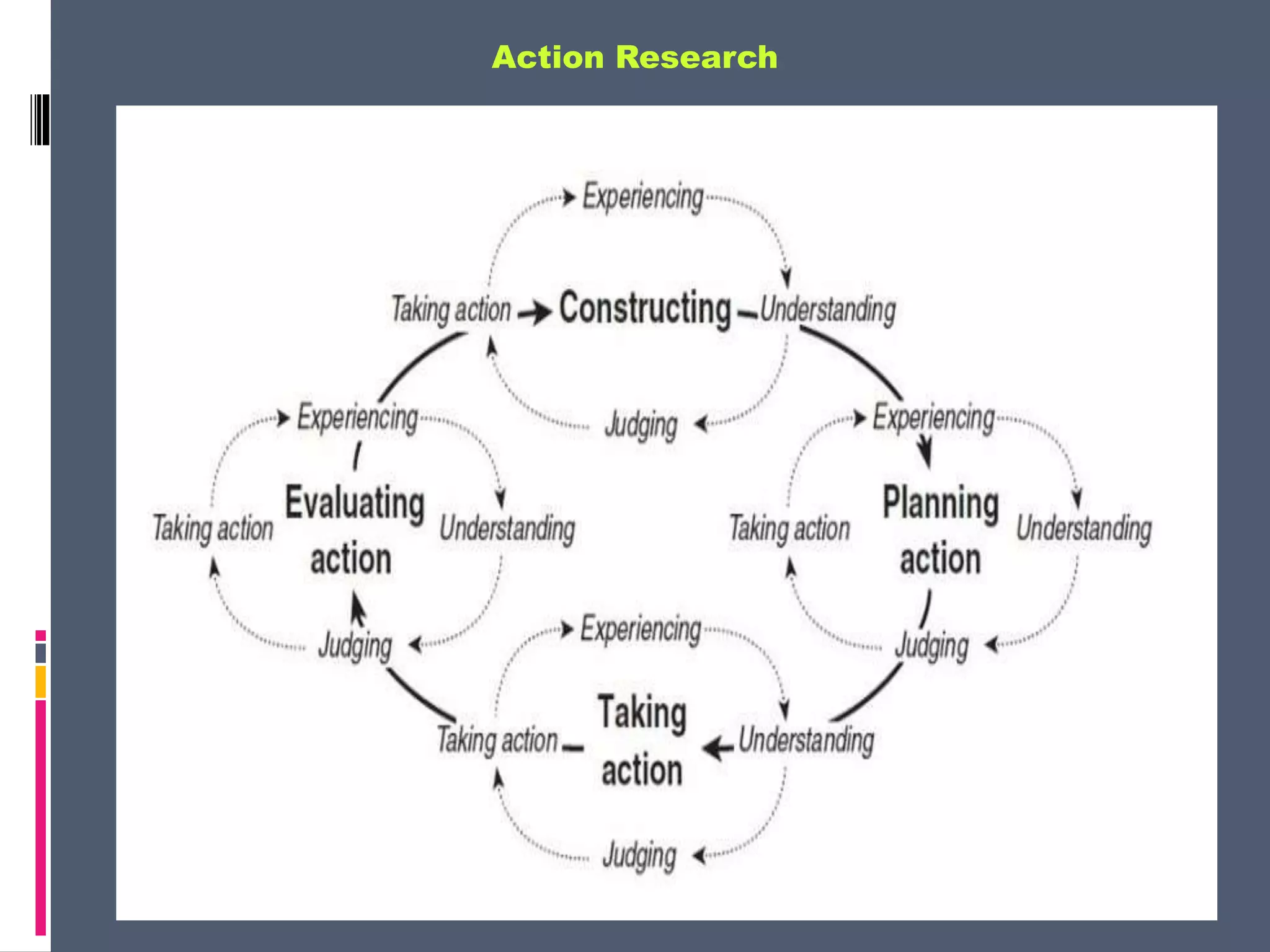
Action Research
• The data collected in qualitative research has been termed
ā€œsoftā€.
• Rich in description of people, places, and conversations, and not
easily handled by statistical procedures.
• ā€ Researchers do not approach their research with specific
questions to answer or hypotheses to test.
• They are concerned with understanding behavior from the
subject’s own frame of reference.
• Qualitative researcher believe that ā€œmultiple ways of interpreting
experiences are available to each of us through interacting with
others, and that it is the meaning of our experiences that
constitutes reality.
Our Qualitative Data (Instance)
ļ‚§ Notes from classroom observations.
ļ‚§ A student's work sample with comments from
their teacher.
ļ‚§ Feedback from a teacher about a student's
progress.
ļ‚§ A transcript from a focus group with parents.
ļ‚§ Audio/visual recordings of a class.

Some key terms
ļ‚§ gate keeper
ļ‚§ key informant.
ļ‚§ snowballing
ļ‚§ rich-thick description
ļ‚§ grand tour questions- general overview, the specific tour, the
guided tour, and the task-
related grand tour
ļ‚§ data saturation
Contemporary Needs
of
Qualitative Methods
ļ‚§ Qualitative methods help us understand the
nature of classrooms as socially and culturally
organized environments for learning (Erickson
& GutiƩrrez, 2002; Morningstar et al., 2015;
Shogren, Gross, et al., 2015).
ļ‚§ We may better understand how classrooms
seem to work for some students, but not for
Research and Practice ,Persons with Severe
Disabilities ,and others (Erickson, 2011).
ļ‚§ Qualitative methods revealed the differences
in approaches that led to similar reductions in
Horner et al. (2005) suggested specific criteria for single-case
research.
(a) specific descriptions of participants and settings (which
help to address context),
(b) precise description and measurement of dependent
variables,
(c) measurement of the fidelity of implementation of the
independent variable,
(d) the use of a baseline phase,
(e) specific steps to ensure internal validity and
experimental control, and
The degree to which participant
voice is heard and embedded in the
membership of the research team,
engagement of participants in the
research design, approaches to
transcript analysis, and ways in which
meaning is made, iterated, and shared
(Jayawickreme, Jayawickreme, &
Goonasekera, 2012)
May be best accommodated using
ļ‚§
ļ‚§ Policy makers continue to search for responses to the
pernicious and seemingly intractable issues that plague our
educational system.
ļ‚§ For instance, large percentages of students from specific
population groups exit school without graduating., families,
and teachers turn to remedies and solutions that have very
limited evidence to support their use (West et al., 2016).
ļ‚§ As Hudson et al. (2016) pointed out, the failure to adopt
EBPs stems from a complicated, context-driven, mƩlange of
reasons that derive validity from the social contexts of
educational practice.
ļ‚§
ļ‚§ Bryk, Gomez, Grunow, and LeMahieu (2015) argued that
the field has very few mechanisms that allow researchers
and practitioners to work together to accumulate and
legitimize knowledge through practice to provide answers to
these intractable problems.
ļ‚§ The notion in evidence-based medicine is that the best
available research, clinical expertise, and person-centered
values converge to create EBP (Sackett et al., 2000).
ļ‚§ EBP can empower practitioners and families to draw on
research that offers insight into the specific issue being
addressed,
ļ‚§ Connect it to craft knowledge built over time through
experience, and address family beliefs and expectations to
ļ‚§ Qualitative research methods offer feedback loops that can
provide information in enough depth and frequency that
school practitioners (i.e., leaders, teachers, para-educators,
related service providers, and staff) can shift, tune, and
transform their practice, all hallmarks of learning to improve.
ļ‚§ The design methodologies of qualitative research are
particularly robust when it comes to social validity,
culminating in the involvement of participants in member
checks of the analysis of qualitative data to ensure that the
interpretations of researchers reflect the realities experienced
by the individuals and contexts studied (Graungaard & Skov,
2007; Harrison, MacGibbon, & Morton, 2001).
ļ‚§ Keep in mind that mixed methodologies that focus on findings
that intersect across methodology approaches can offer great
benefit to practitioners and researchers alike (e.g., Ainbinder
et al., 1998; Carter et al., 2015; Dymond, Renzaglia, Gilson,
ļ‚§ Qualitative or case study or ethnography—can
make valuable contributions to educational
research, and that careful descriptive research
falls within the range of methods in education that
can be called scientific (Erickson & GutiƩrrez,
2002).
ļ‚§ Furthermore, in 2005, Brantlinger, Jimenez,
Klingner, Pugach, and Richardson reviewed the
kinds of qualitative design that meet standards of
trustworthiness and credibility that undergird
scientific evidence.
ļ‚§ Variance results from the dynamic culture of
everyday life that develops through resident
tools and the individuals who use them within
a specific context (Kozleski & Artiles, 2014).
ļ‚§ Symbolizes both activity and product.
ļ‚§ Nuanced understanding of human activity that
lends itself particularly well to observation,
interview, videotaping, artifact analysis, and
subsequent detailed analytic approaches.
ļ‚§ Through careful observation, informed
Thank You
rrnathedu@gmail.com
rrnathedn@yahoo.co.in

Qualitative methods

  • 1.
    Dr.R.RAMNATH Department of Education AlagappaUniversity Karaikudi Qualitative Methods in Contemporary Educational Research
  • 2.
    Research A systematic inquiryto describe, explain, predict, and control the observed phenomenon. It involves inductive and deductive methods- Earl Robert Babbie
  • 19.
  • 24.
    • The datacollected in qualitative research has been termed ā€œsoftā€. • Rich in description of people, places, and conversations, and not easily handled by statistical procedures. • ā€ Researchers do not approach their research with specific questions to answer or hypotheses to test. • They are concerned with understanding behavior from the subject’s own frame of reference. • Qualitative researcher believe that ā€œmultiple ways of interpreting experiences are available to each of us through interacting with others, and that it is the meaning of our experiences that constitutes reality.
  • 31.
    Our Qualitative Data(Instance) ļ‚§ Notes from classroom observations. ļ‚§ A student's work sample with comments from their teacher. ļ‚§ Feedback from a teacher about a student's progress. ļ‚§ A transcript from a focus group with parents. ļ‚§ Audio/visual recordings of a class.
  • 32.
    Some key terms ļ‚§gate keeper ļ‚§ key informant. ļ‚§ snowballing ļ‚§ rich-thick description ļ‚§ grand tour questions- general overview, the specific tour, the guided tour, and the task- related grand tour ļ‚§ data saturation
  • 33.
  • 34.
     Qualitative methodshelp us understand the nature of classrooms as socially and culturally organized environments for learning (Erickson & Gutiérrez, 2002; Morningstar et al., 2015; Shogren, Gross, et al., 2015).  We may better understand how classrooms seem to work for some students, but not for Research and Practice ,Persons with Severe Disabilities ,and others (Erickson, 2011).  Qualitative methods revealed the differences in approaches that led to similar reductions in
  • 35.
    Horner et al.(2005) suggested specific criteria for single-case research. (a) specific descriptions of participants and settings (which help to address context), (b) precise description and measurement of dependent variables, (c) measurement of the fidelity of implementation of the independent variable, (d) the use of a baseline phase, (e) specific steps to ensure internal validity and experimental control, and
  • 36.
    The degree towhich participant voice is heard and embedded in the membership of the research team, engagement of participants in the research design, approaches to transcript analysis, and ways in which meaning is made, iterated, and shared (Jayawickreme, Jayawickreme, & Goonasekera, 2012) May be best accommodated using
  • 37.
      Policy makerscontinue to search for responses to the pernicious and seemingly intractable issues that plague our educational system.  For instance, large percentages of students from specific population groups exit school without graduating., families, and teachers turn to remedies and solutions that have very limited evidence to support their use (West et al., 2016).  As Hudson et al. (2016) pointed out, the failure to adopt EBPs stems from a complicated, context-driven, mélange of reasons that derive validity from the social contexts of educational practice.
  • 38.
    ļ‚§ ļ‚§ Bryk, Gomez,Grunow, and LeMahieu (2015) argued that the field has very few mechanisms that allow researchers and practitioners to work together to accumulate and legitimize knowledge through practice to provide answers to these intractable problems. ļ‚§ The notion in evidence-based medicine is that the best available research, clinical expertise, and person-centered values converge to create EBP (Sackett et al., 2000). ļ‚§ EBP can empower practitioners and families to draw on research that offers insight into the specific issue being addressed, ļ‚§ Connect it to craft knowledge built over time through experience, and address family beliefs and expectations to
  • 39.
    ļ‚§ Qualitative researchmethods offer feedback loops that can provide information in enough depth and frequency that school practitioners (i.e., leaders, teachers, para-educators, related service providers, and staff) can shift, tune, and transform their practice, all hallmarks of learning to improve. ļ‚§ The design methodologies of qualitative research are particularly robust when it comes to social validity, culminating in the involvement of participants in member checks of the analysis of qualitative data to ensure that the interpretations of researchers reflect the realities experienced by the individuals and contexts studied (Graungaard & Skov, 2007; Harrison, MacGibbon, & Morton, 2001). ļ‚§ Keep in mind that mixed methodologies that focus on findings that intersect across methodology approaches can offer great benefit to practitioners and researchers alike (e.g., Ainbinder et al., 1998; Carter et al., 2015; Dymond, Renzaglia, Gilson,
  • 40.
    ļ‚§ Qualitative orcase study or ethnography—can make valuable contributions to educational research, and that careful descriptive research falls within the range of methods in education that can be called scientific (Erickson & GutiĆ©rrez, 2002). ļ‚§ Furthermore, in 2005, Brantlinger, Jimenez, Klingner, Pugach, and Richardson reviewed the kinds of qualitative design that meet standards of trustworthiness and credibility that undergird scientific evidence.
  • 41.
    ļ‚§ Variance resultsfrom the dynamic culture of everyday life that develops through resident tools and the individuals who use them within a specific context (Kozleski & Artiles, 2014). ļ‚§ Symbolizes both activity and product. ļ‚§ Nuanced understanding of human activity that lends itself particularly well to observation, interview, videotaping, artifact analysis, and subsequent detailed analytic approaches. ļ‚§ Through careful observation, informed
  • 42.