Analysis of Network Performance
in Online Games
Joe Krall
PhD Student
Presentation Overview
11/29/2010 Joe Krall - West Virginia University 2
Introduction
Fun in Video Games
Distractions to Fun
SPE in Online Games
Surveyed Papers
XBlast Experiment
Game Score Experiment
Conclusion
Introduction
11/29/2010 Joe Krall - West Virginia University 3
Introduction
Fun in Video Games
Distractions to Fun
SPE in Online Games
Surveyed Papers
XBlast Experiment
Game Score Experiment
Conclusion
Introduction
11/29/2010 Joe Krall - West Virginia University 4
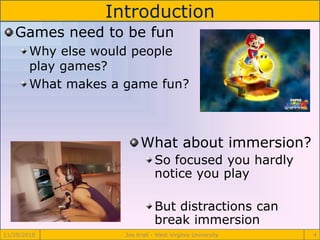
Games need to be fun
Why else would people
play games?
What makes a game fun?
What about immersion?
So focused you hardly
notice you play
But distractions can
break immersion
Introduction
11/29/2010 Joe Krall - West Virginia University 5
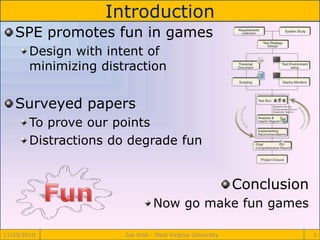
SPE promotes fun in games
Design with intent of
minimizing distraction
Surveyed papers
To prove our points
Distractions do degrade fun
Conclusion
Now go make fun games
Fun in Video Games
11/29/2010 Joe Krall - West Virginia University 6
Introduction
Fun in Video Games
Distractions to Fun
SPE in Online Games
Surveyed Papers
XBlast Experiment
Game Score Experiment
Conclusion
Fun in Video Games
11/29/2010 Joe Krall - West Virginia University 7
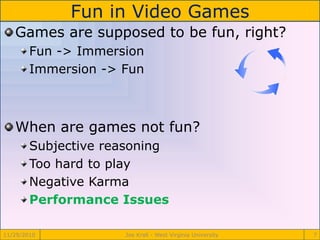
Games are supposed to be fun, right?
Fun -> Immersion
Immersion -> Fun
When are games not fun?
Subjective reasoning
Too hard to play
Negative Karma
Performance Issues
Fun in Video Games
11/29/2010 Joe Krall - West Virginia University 8
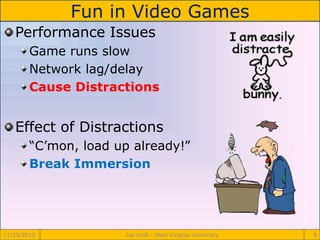
Performance Issues
Game runs slow
Network lag/delay
Cause Distractions
Effect of Distractions
“C’mon, load up already!”
Break Immersion
Distractions to Fun
11/29/2010 Joe Krall - West Virginia University 9
Introduction
Fun in Video Games
Distractions to Fun
SPE in Online Games
Surveyed Papers
XBlast Experiment
Game Score Experiment
Conclusion
Distractions to Fun
11/29/2010 Joe Krall - West Virginia University 10
What is a distraction?
Immersion
Requires steady state of concentration
No Immersion, No Fun
Two Kinds of Distractions:
External
Internal
An interruption; an
obstacle to concentration
Distractions to Fun
11/29/2010 Joe Krall - West Virginia University 11
External Distractions
Outside of the computer
In the Real World
Solutions
Earphones, private room?
No real Control
Distractions to Fun
11/29/2010 Joe Krall - West Virginia University 12
Internal Distraction
Inside the computer
Hardware, Software, Network
Hardware
Faulty I/O
Slow client or servers (Delay)
Solutions? – Buy Upgrades & SPE
Internal Distractions
11/29/2010 Joe Krall - West Virginia University 13
Software
Code not optimized
Too fancy, takes too long to run
Solutions: Optimize, Redesign & SPE
Network
End-to-End Delay / Latency
Packet Loss & Jitter
Solutions: Upgrade network & SPE
Common Solution: SPE
SPE in online Games
11/29/2010 Joe Krall - West Virginia University 14
Introduction
Fun in Video Games
Distractions to Fun
SPE in Online Games
Surveyed Papers
XBlast Experiment
Game Score Experiment
Conclusion
SPE in online Games
11/29/2010 Joe Krall - West Virginia University 15
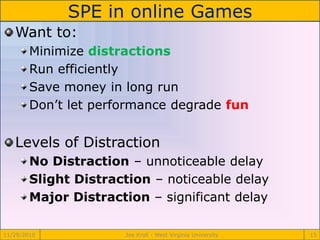
Want to:
Minimize distractions
Run efficiently
Save money in long run
Don’t let performance degrade fun
Levels of Distraction
No Distraction – unnoticeable delay
Slight Distraction – noticeable delay
Major Distraction – significant delay
SPE in online Games
11/29/2010 Joe Krall - West Virginia University 16
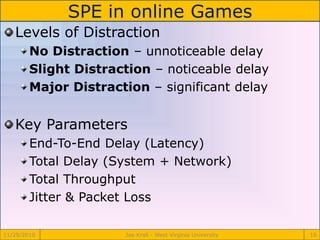
Levels of Distraction
No Distraction – unnoticeable delay
Slight Distraction – noticeable delay
Major Distraction – significant delay
Key Parameters
End-To-End Delay (Latency)
Total Delay (System + Network)
Total Throughput
Jitter & Packet Loss
SPE in online Games
11/29/2010 Joe Krall - West Virginia University 17
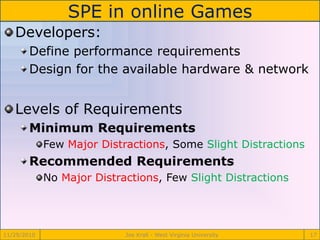
Developers:
Define performance requirements
Design for the available hardware & network
Levels of Requirements
Minimum Requirements
Few Major Distractions, Some Slight Distractions
Recommended Requirements
No Major Distractions, Few Slight Distractions
Surveyed Papers - XBlast
11/29/2010 Joe Krall - West Virginia University 18
Introduction
Fun in Video Games
Distractions to Fun
SPE in Online Games
Surveyed Papers
XBlast Experiment
Game Score Experiment
Conclusion
Surveyed Papers - XBlast
11/29/2010 Joe Krall - West Virginia University 19
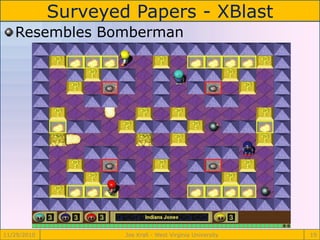
Resembles Bomberman
Surveyed Papers - XBlast
11/29/2010 Joe Krall - West Virginia University 20
Experiment:
12 Test Subjects
representative population
Test effect of Latency to MOS
Mean Opinion Score (MOS)
Scale from 1 to 5
Player perception (game rating)
5 = best
Surveyed Papers - XBlast
11/29/2010 Joe Krall - West Virginia University 21
Game Rules
140s long or lose all lives
Each player matched with another
Each player plays three times
Asked to rate each game on MOS
Control Variable
Induced Latency
Expect MOS to decrease for high latency
Subjects do not know the amount of latency
Surveyed Papers - XBlast
11/29/2010 Joe Krall - West Virginia University 22
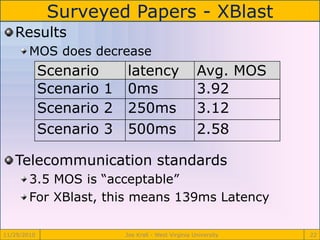
Results
MOS does decrease
Telecommunication standards
3.5 MOS is “acceptable”
For XBlast, this means 139ms Latency
Scenario latency Avg. MOS
Scenario 1 0ms 3.92
Scenario 2 250ms 3.12
Scenario 3 500ms 2.58
Surveyed Papers – Game Score
11/29/2010 Joe Krall - West Virginia University 23
Introduction
Fun in Video Games
Distractions to Fun
SPE in Online Games
Surveyed Papers
XBlast Experiment
Game Score Experiment
Conclusion
Surveyed Papers – Game Score
11/29/2010 Joe Krall - West Virginia University 24
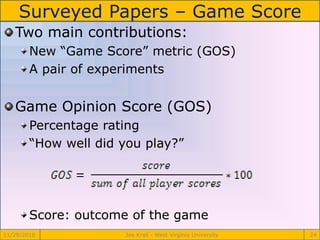
Two main contributions:
New “Game Score” metric (GOS)
A pair of experiments
Game Opinion Score (GOS)
Percentage rating
“How well did you play?”
Score: outcome of the game
Surveyed Papers – Game Score
11/29/2010 Joe Krall - West Virginia University 25
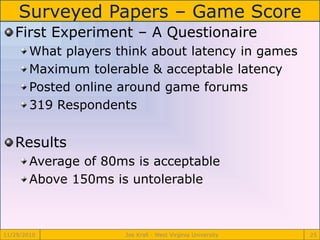
First Experiment – A Questionaire
What players think about latency in games
Maximum tolerable & acceptable latency
Posted online around game forums
319 Respondents
Results
Average of 80ms is acceptable
Above 150ms is untolerable
Surveyed Papers – Game Score
11/29/2010 Joe Krall - West Virginia University 26
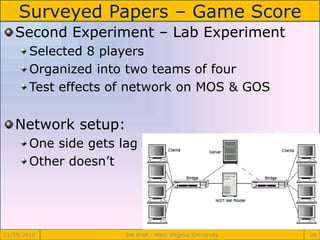
Second Experiment – Lab Experiment
Selected 8 players
Organized into two teams of four
Test effects of network on MOS & GOS
Network setup:
One side gets lag
Other doesn’t
Surveyed Papers – Game Score
11/29/2010 Joe Krall - West Virginia University 27
Tests:
3 Games: Need for Speed Underground 2,
Counter Strike and Unreal Tournament 2004
Latency vs. MOS & GOS
Jitter vs. MOS & GOS
Results:
Latency is a significant indicator of MOS
Latency – weird effects on GOS
Jitter is unsignificant
Surveyed Papers - Conclusion
11/29/2010 Joe Krall - West Virginia University 28
Introduction
Fun in Video Games
Distractions to Fun
SPE in Online Games
Surveyed Papers
XBlast Experiment
Game Score Experiment
Conclusion
Surveyed Papers - Conclusion
11/29/2010 Joe Krall - West Virginia University 29
Relationship between Fun & Immersion
Distractions break Immersion
Distractions caused by performance
Use SPE to keep distractions minimal
Set requirements and develop for them
Game should run smoothly now
But is the game fun? <Future research>
The End
11/29/2010 Joe Krall - West Virginia University 30
Thanks for listening!
Any Questions?

Joe krall presentation

  • 1.
    Analysis of NetworkPerformance in Online Games Joe Krall PhD Student
  • 2.
    Presentation Overview 11/29/2010 JoeKrall - West Virginia University 2 Introduction Fun in Video Games Distractions to Fun SPE in Online Games Surveyed Papers XBlast Experiment Game Score Experiment Conclusion
  • 3.
    Introduction 11/29/2010 Joe Krall- West Virginia University 3 Introduction Fun in Video Games Distractions to Fun SPE in Online Games Surveyed Papers XBlast Experiment Game Score Experiment Conclusion
  • 4.
    Introduction 11/29/2010 Joe Krall- West Virginia University 4 Games need to be fun Why else would people play games? What makes a game fun? What about immersion? So focused you hardly notice you play But distractions can break immersion
  • 5.
    Introduction 11/29/2010 Joe Krall- West Virginia University 5 SPE promotes fun in games Design with intent of minimizing distraction Surveyed papers To prove our points Distractions do degrade fun Conclusion Now go make fun games
  • 6.
    Fun in VideoGames 11/29/2010 Joe Krall - West Virginia University 6 Introduction Fun in Video Games Distractions to Fun SPE in Online Games Surveyed Papers XBlast Experiment Game Score Experiment Conclusion
  • 7.
    Fun in VideoGames 11/29/2010 Joe Krall - West Virginia University 7 Games are supposed to be fun, right? Fun -> Immersion Immersion -> Fun When are games not fun? Subjective reasoning Too hard to play Negative Karma Performance Issues
  • 8.
    Fun in VideoGames 11/29/2010 Joe Krall - West Virginia University 8 Performance Issues Game runs slow Network lag/delay Cause Distractions Effect of Distractions “C’mon, load up already!” Break Immersion
  • 9.
    Distractions to Fun 11/29/2010Joe Krall - West Virginia University 9 Introduction Fun in Video Games Distractions to Fun SPE in Online Games Surveyed Papers XBlast Experiment Game Score Experiment Conclusion
  • 10.
    Distractions to Fun 11/29/2010Joe Krall - West Virginia University 10 What is a distraction? Immersion Requires steady state of concentration No Immersion, No Fun Two Kinds of Distractions: External Internal An interruption; an obstacle to concentration
  • 11.
    Distractions to Fun 11/29/2010Joe Krall - West Virginia University 11 External Distractions Outside of the computer In the Real World Solutions Earphones, private room? No real Control
  • 12.
    Distractions to Fun 11/29/2010Joe Krall - West Virginia University 12 Internal Distraction Inside the computer Hardware, Software, Network Hardware Faulty I/O Slow client or servers (Delay) Solutions? – Buy Upgrades & SPE
  • 13.
    Internal Distractions 11/29/2010 JoeKrall - West Virginia University 13 Software Code not optimized Too fancy, takes too long to run Solutions: Optimize, Redesign & SPE Network End-to-End Delay / Latency Packet Loss & Jitter Solutions: Upgrade network & SPE Common Solution: SPE
  • 14.
    SPE in onlineGames 11/29/2010 Joe Krall - West Virginia University 14 Introduction Fun in Video Games Distractions to Fun SPE in Online Games Surveyed Papers XBlast Experiment Game Score Experiment Conclusion
  • 15.
    SPE in onlineGames 11/29/2010 Joe Krall - West Virginia University 15 Want to: Minimize distractions Run efficiently Save money in long run Don’t let performance degrade fun Levels of Distraction No Distraction – unnoticeable delay Slight Distraction – noticeable delay Major Distraction – significant delay
  • 16.
    SPE in onlineGames 11/29/2010 Joe Krall - West Virginia University 16 Levels of Distraction No Distraction – unnoticeable delay Slight Distraction – noticeable delay Major Distraction – significant delay Key Parameters End-To-End Delay (Latency) Total Delay (System + Network) Total Throughput Jitter & Packet Loss
  • 17.
    SPE in onlineGames 11/29/2010 Joe Krall - West Virginia University 17 Developers: Define performance requirements Design for the available hardware & network Levels of Requirements Minimum Requirements Few Major Distractions, Some Slight Distractions Recommended Requirements No Major Distractions, Few Slight Distractions
  • 18.
    Surveyed Papers -XBlast 11/29/2010 Joe Krall - West Virginia University 18 Introduction Fun in Video Games Distractions to Fun SPE in Online Games Surveyed Papers XBlast Experiment Game Score Experiment Conclusion
  • 19.
    Surveyed Papers -XBlast 11/29/2010 Joe Krall - West Virginia University 19 Resembles Bomberman
  • 20.
    Surveyed Papers -XBlast 11/29/2010 Joe Krall - West Virginia University 20 Experiment: 12 Test Subjects representative population Test effect of Latency to MOS Mean Opinion Score (MOS) Scale from 1 to 5 Player perception (game rating) 5 = best
  • 21.
    Surveyed Papers -XBlast 11/29/2010 Joe Krall - West Virginia University 21 Game Rules 140s long or lose all lives Each player matched with another Each player plays three times Asked to rate each game on MOS Control Variable Induced Latency Expect MOS to decrease for high latency Subjects do not know the amount of latency
  • 22.
    Surveyed Papers -XBlast 11/29/2010 Joe Krall - West Virginia University 22 Results MOS does decrease Telecommunication standards 3.5 MOS is “acceptable” For XBlast, this means 139ms Latency Scenario latency Avg. MOS Scenario 1 0ms 3.92 Scenario 2 250ms 3.12 Scenario 3 500ms 2.58
  • 23.
    Surveyed Papers –Game Score 11/29/2010 Joe Krall - West Virginia University 23 Introduction Fun in Video Games Distractions to Fun SPE in Online Games Surveyed Papers XBlast Experiment Game Score Experiment Conclusion
  • 24.
    Surveyed Papers –Game Score 11/29/2010 Joe Krall - West Virginia University 24 Two main contributions: New “Game Score” metric (GOS) A pair of experiments Game Opinion Score (GOS) Percentage rating “How well did you play?” Score: outcome of the game
  • 25.
    Surveyed Papers –Game Score 11/29/2010 Joe Krall - West Virginia University 25 First Experiment – A Questionaire What players think about latency in games Maximum tolerable & acceptable latency Posted online around game forums 319 Respondents Results Average of 80ms is acceptable Above 150ms is untolerable
  • 26.
    Surveyed Papers –Game Score 11/29/2010 Joe Krall - West Virginia University 26 Second Experiment – Lab Experiment Selected 8 players Organized into two teams of four Test effects of network on MOS & GOS Network setup: One side gets lag Other doesn’t
  • 27.
    Surveyed Papers –Game Score 11/29/2010 Joe Krall - West Virginia University 27 Tests: 3 Games: Need for Speed Underground 2, Counter Strike and Unreal Tournament 2004 Latency vs. MOS & GOS Jitter vs. MOS & GOS Results: Latency is a significant indicator of MOS Latency – weird effects on GOS Jitter is unsignificant
  • 28.
    Surveyed Papers -Conclusion 11/29/2010 Joe Krall - West Virginia University 28 Introduction Fun in Video Games Distractions to Fun SPE in Online Games Surveyed Papers XBlast Experiment Game Score Experiment Conclusion
  • 29.
    Surveyed Papers -Conclusion 11/29/2010 Joe Krall - West Virginia University 29 Relationship between Fun & Immersion Distractions break Immersion Distractions caused by performance Use SPE to keep distractions minimal Set requirements and develop for them Game should run smoothly now But is the game fun? <Future research>
  • 30.
    The End 11/29/2010 JoeKrall - West Virginia University 30 Thanks for listening! Any Questions?