Guided By: Bharti Mam
Submitted By: RAGSYA GROUP
1
 Rishabh Bahadur
 Shubham Vishwakarma
 Rahul Parpani
 Yogin Chetwani
 Yash Singh
 Sumit Manjhi
2
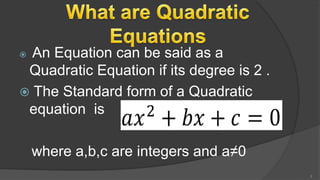
 An Equation can be said as a
Quadratic Equation if its degree is 2 .
 The Standard form of a Quadratic
equation is
where a,b,c are integers and a≠0
3
 6x² + 11x – 35 = 0
 2x² – 4x – 2 = 0
 2x² – 64 = 0
 x² – 16 = 0
 2x² + 8x = 0
4
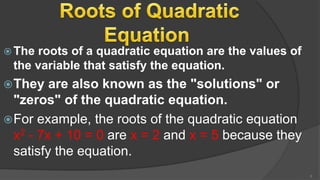
 The roots of a quadratic equation are the values of
the variable that satisfy the equation.
They are also known as the "solutions" or
"zeros" of the quadratic equation.
For example, the roots of the quadratic equation
x2 - 7x + 10 = 0 are x = 2 and x = 5 because they
satisfy the equation.
5
6
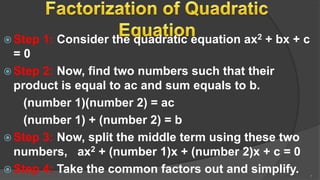
 Step 1: Consider the quadratic equation ax2 + bx + c
= 0
 Step 2: Now, find two numbers such that their
product is equal to ac and sum equals to b.
(number 1)(number 2) = ac
(number 1) + (number 2) = b
 Step 3: Now, split the middle term using these two
numbers, ax2 + (number 1)x + (number 2)x + c = 0
 Step 4: Take the common factors out and simplify. 7
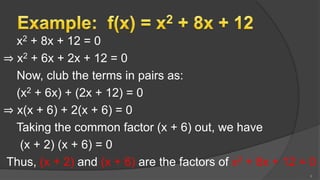
x2 + 8x + 12 = 0
⇒ x2 + 6x + 2x + 12 = 0
Now, club the terms in pairs as:
(x2 + 6x) + (2x + 12) = 0
⇒ x(x + 6) + 2(x + 6) = 0
Taking the common factor (x + 6) out, we have
(x + 2) (x + 6) = 0
Thus, (x + 2) and (x + 6) are the factors of x2 + 8x + 12 = 0
8
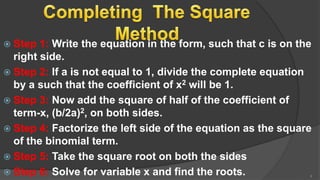
 Step 1: Write the equation in the form, such that c is on the
right side.
 Step 2: If a is not equal to 1, divide the complete equation
by a such that the coefficient of x2 will be 1.
 Step 3: Now add the square of half of the coefficient of
term-x, (b/2a)2, on both sides.
 Step 4: Factorize the left side of the equation as the square
of the binomial term.
 Step 5: Take the square root on both the sides
 Step 6: Solve for variable x and find the roots. 9
Example :- Find the roots of the
quadratic equation x2 + 4x – 5 = 0
Given quadratic equation is:
x2 + 4x – 5 = 0
Comparing the equation with the standard form,
b = 4, c = -5
(x + b/2)2 = -(c – b2/4)
So, [x + (4/2)]2 = -[-5 – (42/4)]
(x + 2)2 = 5 + 4 ⇒ (x + 2)2 = 9
⇒ (x + 2) = ±√9 ⇒ (x + 2) = ± 3
⇒ x + 2 = 3, x + 2 = -3 ⇒ x = 1 , -5
Therefore, the roots of the given equation are 1 and -5. 10
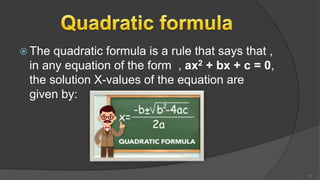
 The quadratic formula is a rule that says that ,
in any equation of the form , ax2 + bx + c = 0,
the solution X-values of the equation are
given by:
11
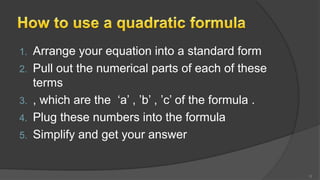
1. Arrange your equation into a standard form
2. Pull out the numerical parts of each of these
terms
3. , which are the ‘a’ , ’b’ , ’c’ of the formula .
4. Plug these numbers into the formula
5. Simplify and get your answer
12
13
Question: Factorize x2 + 4x – 21 =0
using quadratic formula.
x2 + 4x – 21 = 0
Here, a = 1, b = 4, c = -21
b2 – 4ac = (4)2 – 4(1)(-21) = 16 + 84 = 100
Substituting these values in the quadratic formula, we get;
x = [-4 ± √ (4)2 – 4(1)(-21)]/ 2(1)
= (-4 ± 10)/2
x = (-4 + 10)/2 , x = (-4 – 10)/2
x = 6/2 , x = -14/2
x = 3 , x = -7
Therefore, the factors of quadratic equation are (x – 3) and (x + 7).
14
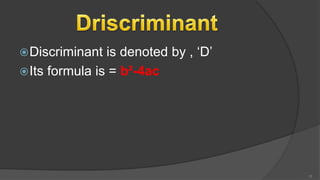
Discriminant is denoted by , ‘D’
Its formula is = b²-4ac
15
16
17
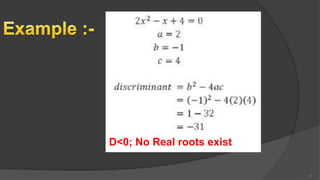
D<0; No Real roots exist
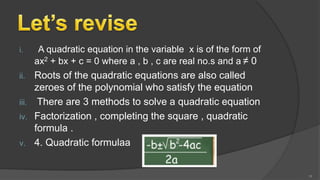
i. A quadratic equation in the variable x is of the form of
ax2 + bx + c = 0 where a , b , c are real no.s and a ≠ 0
ii. Roots of the quadratic equations are also called
zeroes of the polynomial who satisfy the equation
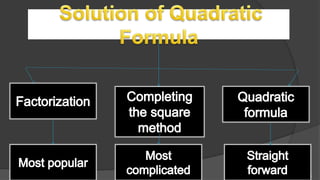
iii. There are 3 methods to solve a quadratic equation
iv. Factorization , completing the square , quadratic
formula .
v. 4. Quadratic formulaa
18
19

MATHS PRESENTATION OF CH 4.pptx

  • 1.
    Guided By: BhartiMam Submitted By: RAGSYA GROUP 1
  • 2.
     Rishabh Bahadur Shubham Vishwakarma  Rahul Parpani  Yogin Chetwani  Yash Singh  Sumit Manjhi 2
  • 3.
     An Equationcan be said as a Quadratic Equation if its degree is 2 .  The Standard form of a Quadratic equation is where a,b,c are integers and a≠0 3
  • 4.
     6x² +11x – 35 = 0  2x² – 4x – 2 = 0  2x² – 64 = 0  x² – 16 = 0  2x² + 8x = 0 4
  • 5.
     The rootsof a quadratic equation are the values of the variable that satisfy the equation. They are also known as the "solutions" or "zeros" of the quadratic equation. For example, the roots of the quadratic equation x2 - 7x + 10 = 0 are x = 2 and x = 5 because they satisfy the equation. 5
  • 6.
  • 7.
     Step 1:Consider the quadratic equation ax2 + bx + c = 0  Step 2: Now, find two numbers such that their product is equal to ac and sum equals to b. (number 1)(number 2) = ac (number 1) + (number 2) = b  Step 3: Now, split the middle term using these two numbers, ax2 + (number 1)x + (number 2)x + c = 0  Step 4: Take the common factors out and simplify. 7
  • 8.
    x2 + 8x+ 12 = 0 ⇒ x2 + 6x + 2x + 12 = 0 Now, club the terms in pairs as: (x2 + 6x) + (2x + 12) = 0 ⇒ x(x + 6) + 2(x + 6) = 0 Taking the common factor (x + 6) out, we have (x + 2) (x + 6) = 0 Thus, (x + 2) and (x + 6) are the factors of x2 + 8x + 12 = 0 8
  • 9.
     Step 1:Write the equation in the form, such that c is on the right side.  Step 2: If a is not equal to 1, divide the complete equation by a such that the coefficient of x2 will be 1.  Step 3: Now add the square of half of the coefficient of term-x, (b/2a)2, on both sides.  Step 4: Factorize the left side of the equation as the square of the binomial term.  Step 5: Take the square root on both the sides  Step 6: Solve for variable x and find the roots. 9
  • 10.
    Example :- Findthe roots of the quadratic equation x2 + 4x – 5 = 0 Given quadratic equation is: x2 + 4x – 5 = 0 Comparing the equation with the standard form, b = 4, c = -5 (x + b/2)2 = -(c – b2/4) So, [x + (4/2)]2 = -[-5 – (42/4)] (x + 2)2 = 5 + 4 ⇒ (x + 2)2 = 9 ⇒ (x + 2) = ±√9 ⇒ (x + 2) = ± 3 ⇒ x + 2 = 3, x + 2 = -3 ⇒ x = 1 , -5 Therefore, the roots of the given equation are 1 and -5. 10
  • 11.
     The quadraticformula is a rule that says that , in any equation of the form , ax2 + bx + c = 0, the solution X-values of the equation are given by: 11
  • 12.
    1. Arrange yourequation into a standard form 2. Pull out the numerical parts of each of these terms 3. , which are the ‘a’ , ’b’ , ’c’ of the formula . 4. Plug these numbers into the formula 5. Simplify and get your answer 12
  • 13.
  • 14.
    Question: Factorize x2+ 4x – 21 =0 using quadratic formula. x2 + 4x – 21 = 0 Here, a = 1, b = 4, c = -21 b2 – 4ac = (4)2 – 4(1)(-21) = 16 + 84 = 100 Substituting these values in the quadratic formula, we get; x = [-4 ± √ (4)2 – 4(1)(-21)]/ 2(1) = (-4 ± 10)/2 x = (-4 + 10)/2 , x = (-4 – 10)/2 x = 6/2 , x = -14/2 x = 3 , x = -7 Therefore, the factors of quadratic equation are (x – 3) and (x + 7). 14
  • 15.
    Discriminant is denotedby , ‘D’ Its formula is = b²-4ac 15
  • 16.
  • 17.
    17 D<0; No Realroots exist
  • 18.
    i. A quadraticequation in the variable x is of the form of ax2 + bx + c = 0 where a , b , c are real no.s and a ≠ 0 ii. Roots of the quadratic equations are also called zeroes of the polynomial who satisfy the equation iii. There are 3 methods to solve a quadratic equation iv. Factorization , completing the square , quadratic formula . v. 4. Quadratic formulaa 18
  • 19.