SERVER ARCHITECTURE
Server Architecture is nothing but
the way our server layers(server
,network connectivity and other
components connected to it) are
connected to one another. It depends
on :-
1.The architecture depends on type of
application and network layer.
2.based on targeted users.
3.Firmware and midware.
4.Any 3rd party application usage.
Objectives
• Explain the essential principles of client-
server architecture.
• Explain the differences between 2-tier, 3-tier,
and multitier architectures, including their
features and relative capacities.
• Recognize 2-tier, 3-tier, and multi-tier
architectures.
• Contrast the client-server architecture with
centralized and distributed architectures.
Types of application:-
 1.Stand-alone application – usually has
single tier architecture.
 2.Client-Server architecture – usually has
two tier(client and server) to multi-tier(n-
tier) architecture depending on
concurrent load.
 3.Web-server architecture - usually has
single tier to multi-tier(n-tier)
architecture depending on concurrent
load.
System Architecture
• The architecture of a computer system is the
high-level (most general) design on which the
system is based.
Architectural features include:
• Components.
• Collaborations (how components interact)
• Connectors (how components communicate)
SYSTEM
ARCHITECTURE
Common architectural patterns include
• Client-Server
• Layered
• Peer-to-peer
• Pipes and Filters
• etc.
Client-Server Architecture
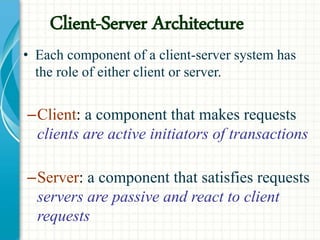
• Each component of a client-server system has
the role of either client or server.
–Client: a component that makes requests
clients are active initiators of transactions
–Server: a component that satisfies requests
servers are passive and react to client
requests
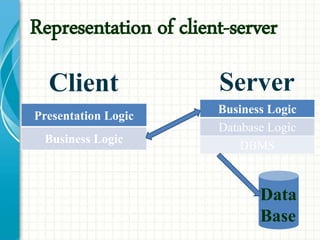
Representation of client-server
Client
Presentation Logic
Business Logic
Server
Business Logic
Database Logic
DBMS
Data
Base
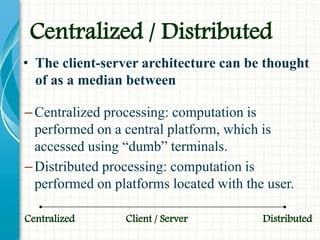
Centralized / Distributed
• The client-server architecture can be thought
of as a median between
–Centralized processing: computation is
performed on a central platform, which is
accessed using “dumb” terminals.
–Distributed processing: computation is
performed on platforms located with the user.
Centralized Client / Server Distributed
• The Web is a client-server system
• Web browsers act as clients, and make
requests to web servers
• Web servers respond to requests with
requested information and/or computation
Client-Server Architecture
Server
Server
ServerClient
Client
Client
Client
Client
request
Tiered Web Architectures
• Web applications are usually
implemented with 2-tier, 3-tier, or
multitier (N-tier) architectures
• Each tier is a platform (client or server)
with a unique responsibility
2-Tier C-S Architecture
• Tier 1: Client platform, hosting a web
browser
• Tier 2: server platform, hosting all server
software components
2-Tier Characteristics
• Typical application
– 10-100 users.
– Small company or organization, e.g., law office,
medical practice, local non-profit.
• Advantage:
– Inexpensive (single platform)
• Disadvantages
– Interdependency (coupling) of components.
– No redundancy.
– Limited scalability.
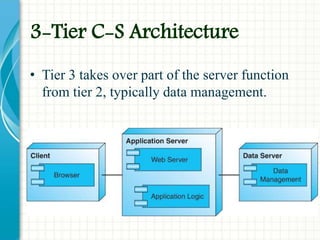
3-Tier C-S Architecture
• Tier 3 takes over part of the server function
from tier 2, typically data management.
3-TIER CHARACTERISTICS
• Advantage:
– Improved performance, from specialized hardware.
– Decreased coupling of software components.
– Improved scalability.
• Disadvantages
– No redundancy.
• Typical application
– 100-1000 users.
– Small business or regional organization, e.g., specialty
retailer, small college
MULTITIER C-S
ARCHITECTURE
• A multitier (N-tier) architecture is an expansion of
the 3-tier architecture, in one of several different
possible ways
– Replication of the function of a tier.
– Specialization of function within a tier.
– Portal services, focusing on handling incoming web
traffic.
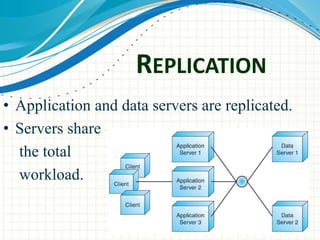
REPLICATION
• Application and data servers are replicated.
• Servers share
the total
workload.
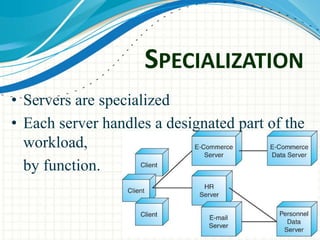
SPECIALIZATION
• Servers are specialized
• Each server handles a designated part of the
workload,
by function.
PORTAL SERVICES
• Portal servers handle incoming traffic, reducing
application server load.
– e.g., firewall, load balancer, transaction processing
manager.
MULTI-TIER
CHARACTERISTICS
• Advantage:
– Decoupling of software components.
– Flexibility to add/remove platforms in response to load.
– Scalability.
– Redundancy.
• Disadvantages
– Higher costs (maintenance, design, electrical load,
cooling)
• Typical Application
– 1000+ users.
– Large business or organization.
CHARACTERISTICS
SUMMARY
2-Tier
3-Tier
N-Tier
10
100
1000
users
•Large e-commerce,
business, or
organization
•Small e-commerce,
regional business or
organization
•Local business or
organization
Capacity
Scalability
Redundancy
Cost
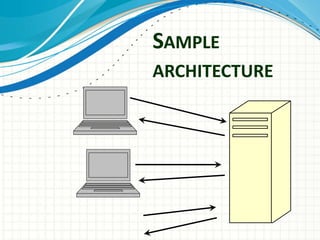
SAMPLE
ARCHITECTURE
SAMPLE
ARCHITECTURE
TYPICAL DETAILS OF WINDOWS IIS
SERVER AND APACHE SERVER

QSpiders - Server Architecture

  • 1.
    SERVER ARCHITECTURE Server Architectureis nothing but the way our server layers(server ,network connectivity and other components connected to it) are connected to one another. It depends on :- 1.The architecture depends on type of application and network layer. 2.based on targeted users. 3.Firmware and midware. 4.Any 3rd party application usage.
  • 2.
    Objectives • Explain theessential principles of client- server architecture. • Explain the differences between 2-tier, 3-tier, and multitier architectures, including their features and relative capacities. • Recognize 2-tier, 3-tier, and multi-tier architectures. • Contrast the client-server architecture with centralized and distributed architectures.
  • 3.
    Types of application:- 1.Stand-alone application – usually has single tier architecture.  2.Client-Server architecture – usually has two tier(client and server) to multi-tier(n- tier) architecture depending on concurrent load.  3.Web-server architecture - usually has single tier to multi-tier(n-tier) architecture depending on concurrent load.
  • 4.
    System Architecture • Thearchitecture of a computer system is the high-level (most general) design on which the system is based. Architectural features include: • Components. • Collaborations (how components interact) • Connectors (how components communicate)
  • 5.
    SYSTEM ARCHITECTURE Common architectural patternsinclude • Client-Server • Layered • Peer-to-peer • Pipes and Filters • etc.
  • 6.
    Client-Server Architecture • Eachcomponent of a client-server system has the role of either client or server. –Client: a component that makes requests clients are active initiators of transactions –Server: a component that satisfies requests servers are passive and react to client requests
  • 7.
    Representation of client-server Client PresentationLogic Business Logic Server Business Logic Database Logic DBMS Data Base
  • 8.
    Centralized / Distributed •The client-server architecture can be thought of as a median between –Centralized processing: computation is performed on a central platform, which is accessed using “dumb” terminals. –Distributed processing: computation is performed on platforms located with the user. Centralized Client / Server Distributed
  • 9.
    • The Webis a client-server system • Web browsers act as clients, and make requests to web servers • Web servers respond to requests with requested information and/or computation Client-Server Architecture Server Server ServerClient Client Client Client Client request
  • 10.
    Tiered Web Architectures •Web applications are usually implemented with 2-tier, 3-tier, or multitier (N-tier) architectures • Each tier is a platform (client or server) with a unique responsibility
  • 11.
    2-Tier C-S Architecture •Tier 1: Client platform, hosting a web browser • Tier 2: server platform, hosting all server software components
  • 12.
    2-Tier Characteristics • Typicalapplication – 10-100 users. – Small company or organization, e.g., law office, medical practice, local non-profit. • Advantage: – Inexpensive (single platform) • Disadvantages – Interdependency (coupling) of components. – No redundancy. – Limited scalability.
  • 13.
    3-Tier C-S Architecture •Tier 3 takes over part of the server function from tier 2, typically data management.
  • 14.
    3-TIER CHARACTERISTICS • Advantage: –Improved performance, from specialized hardware. – Decreased coupling of software components. – Improved scalability. • Disadvantages – No redundancy. • Typical application – 100-1000 users. – Small business or regional organization, e.g., specialty retailer, small college
  • 15.
    MULTITIER C-S ARCHITECTURE • Amultitier (N-tier) architecture is an expansion of the 3-tier architecture, in one of several different possible ways – Replication of the function of a tier. – Specialization of function within a tier. – Portal services, focusing on handling incoming web traffic.
  • 16.
    REPLICATION • Application anddata servers are replicated. • Servers share the total workload.
  • 17.
    SPECIALIZATION • Servers arespecialized • Each server handles a designated part of the workload, by function.
  • 18.
    PORTAL SERVICES • Portalservers handle incoming traffic, reducing application server load. – e.g., firewall, load balancer, transaction processing manager.
  • 19.
    MULTI-TIER CHARACTERISTICS • Advantage: – Decouplingof software components. – Flexibility to add/remove platforms in response to load. – Scalability. – Redundancy. • Disadvantages – Higher costs (maintenance, design, electrical load, cooling) • Typical Application – 1000+ users. – Large business or organization.
  • 20.
    CHARACTERISTICS SUMMARY 2-Tier 3-Tier N-Tier 10 100 1000 users •Large e-commerce, business, or organization •Smalle-commerce, regional business or organization •Local business or organization Capacity Scalability Redundancy Cost
  • 21.
  • 22.
  • 23.
    TYPICAL DETAILS OFWINDOWS IIS SERVER AND APACHE SERVER