IMPLEMENTATION OF THE MATATAG K TO 10 CURRICULUM
Lesson Exemplar
for TLE
Lesson
7
7
Quarter 4
Lesson Exemplar for TLE Grade 7
Quarter 4: Lesson 7 (Week 7)
SY 2024-2025
This material is intended exclusively for teachers participating in the implementation of the MATATAG K to 10 Curriculum during the School Year 2024-
2025. It aims to assist in delivering the curriculum content, standards, and lesson competencies. Any unauthorized reproduction, distribution, modification, or
utilization of this material beyond the designated scope is strictly prohibited and may result in appropriate legal actions and disciplinary measures.
Their respective copyright holders own borrowed content included in this material. Every effort has been made to locate and obtain permission to use
these materials from their respective copyright owners. The publisher and development team do not represent nor claim ownership over them.
Every care has been taken to ensure the accuracy of the information provided in this material. For inquiries or feedback, please write or call the Office
of the Director of the Bureau of Learning Resources via telephone at (02) 8634-1072 and 8631-6922 or by email at blr.od@deped.gov.ph.
Development Team
Writer:
• Marian N. Roque (Gen T. De Leon National High School- Valenzuela)
Validator:
• Victor S. Rosales, PhD TM (Mindanao State University – Iligan Institute of
Technology)
Management Team
Philippine Normal University
Research Institute for Teacher Quality
SiMERR National Research Centre
1
TLE /QUARTER 4/ GRADE 7
I. CURRICULUM CONTENT, STANDARDS, AND LESSON COMPETENCIES
A. Content
Standards
The learners demonstrate an understanding of the concepts and principles in performing mensuration and
calculations.
B. Performance
Standards
The learners perform mensuration and calculations following safety precautions
C. Learning
Competencies
and Objectives
Learning Competency
Interpret the readings in different measuring instruments.
Learning Objectives
At the end of the lesson, the students are expected to:
1. Explain the function and uses of tachometer, oscilloscope, and ampere meter.
2. Identify the parts of the tachometer, oscilloscope, and ampere meter.
3. Interpret the readings of tachometer, oscilloscope, and ampere meter.
D. Content Topic: Scale Reading
Subtopics: Tachometer, Oscilloscope, Ampere meter
E. Integration SDG 9: Industry Innovation and Structures
II. LEARNING RESOURCES
Ammeters - A complete guide. (2023, March 7). Industrial Solutions & Electrical Components | RS. https://ph.rs-
online.com/web/content/discovery/ideas-and-advice/ammeters-guide
How to measure current (Amperes) using analog multi-meter. (2021, June 28).
YouTube. https://youtu.be/CcfQFqcMa7U?si=v31yCNTeM1giOB8j
Huang, Y. (2022, June 21). How does a tachometer work? | KUS Americas, Inc. KUS USA. https://kus-usa.com/resources/how-does-a-
tachometer-work/
Kulkarni, A. (2022, April 15). What is ammeter? Uses and benefits | Complete guide on ammeter. BEEMET. https://beemet.com/ammeter-
guide/
Tachometer: Uses, types, measurement & working. (2021, November 29). Tesca Global Blog. https://www.tescaglobal.com/blog/digital-and-
mechanical-tachometer/
Tachometers - A complete guide. (2023, January 24). Industrial Solutions & Electrical Components | RS. https://uk.rs-
online.com/web/content/discovery/ideas-and-advice/tachometers-guide
2
Understanding oscilloscope parts and function: A comprehensive guide - Keysight technologies.
(n.d.). https://savings.em.keysight.com/en/knowledge/guides/used-oscilloscope-buying-guide/oscilloscope-parts-and-function
What is an oscilloscope? (2021, May 11). Test and Measurement Equipment | Tektronix. https://www.tek.com/en/blog/what-is-an-
oscilloscope#EbUses
III. TEACHING AND LEARNING PROCEDURE NOTES TO TEACHERS
A. Activating Prior
Knowledge
DAY 1
1. Short Review
Pass the Cabbage
Create a cabbage-like vegetable made of crumpled papers, cabbage will be
passed to one another as the class sings any type of song. Once the music stops,
a student who got the cabbage will peel one page and answer the question that
is written on the cabbage paper.
2. Feedback (Optional)
Create a set of questions about
VOM Scale, Ohmmeter
Function and Voltmeter
Function. A teacher may also
include questions about
students’ personal experiences
in connection with the previous
topic. Write each set of question
on each leaf of a cabbage-like
paper.
B. Establishing
Lesson Purpose
1. Lesson Purpose
Ask students if they have seen their grandfather, father, uncle, or elder brother
using Multi tester at home. Let them share their experiences and encounters
seeing multi tester being used.
2. Unlocking Content Vocabulary
• Tachometer – It is an instrument that measures the working speed of an
engine, typically in revolutions per minute (RPM).
• Oscilloscope – It is an instrument that graphically displays electrical signals
and shows how those signals change over time.
• Ammeter – It is a measuring device that measures the flow of current in a
circuit.
• Milliammeter – A measuring instrument that measures small electrical
currents (milliamps).
Show a picture or actual Multi
tester to let students think and
share their experiences.
3
C. Developing and
Deepening
Understanding
SUB-TOPIC 1: Tachometer
1. Explicitation
A tachometer is an instrument that is used to measure the working speed of
an engine, usually in revolutions per minute (RPM). It is commonly used in
cars, boats, planes, and other types of vehicles. Most tachometer gauges have
either an analog (dial) or digital (LCD or LED screen) display.
A. Types Tachometer:
• Analog Tachometer
- It is used to count the RPM based on the period. It uses a series
of reeds that helps in detecting the engine speed. It is a device that
has all centrifugal force. It has a power on the rotating mass that
helps in extending and compressing the mechanical spring.
• Electronic Tachometer
- An Electronic Tachometer is a significant component that helps
measure the engine’s speed in RPM. It is a device that is available in
the car’s dashboard to measure the driving speed. This device uses a
magnetic pickup that you can find here the rotating engine. It
produces electric pulses. The pulses that this device causes has a
frequency proportional to the engine speed.
B. Parts of Tachometer
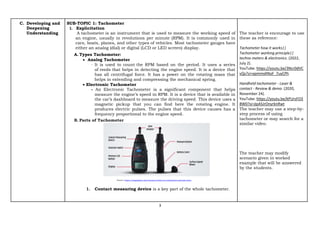
1. Contact measuring device is a key part of the whole tachometer.
The teacher is encourage to use
these as reference:
Tachometer how it works||
Tachometer working principle||
techno meters & electronics. (2022,
July 2).
YouTube. https://youtu.be/3Ncr0dVC
vQs?si=xpmmxXNoF_7uyCPh
Handheld tachometer - Laser &
contact - Review & demo. (2020,
November 24).
YouTube. https://youtu.be/kPUrsFO3
8W0?si=jIpASJrOnyrknRwt
The teacher may use a step-by-
step process of using
tachometer or may search for a
similar video.
The teacher may modify
scenario given in worked
example that will be answered
by the students.
Source: https://megadepot.com/resource/what-is-a-tachometer-and-how-does-
it-work
4
2. RPM adapter is the element that contacts the object the speed of
which you want to measure.
3. Function switch is used to switch between the units of
measurement.
4. Memory call button is used to show the last reading.
5. Display shows the readings or result.
6. Measure button is used to start the measurement.
7. Battery cover is used to cover and protect the battery from dust
and any damage.
2. Worked Example: Class sharing
1. Reflect on your own vehicle experiences. Based on what we discussed today,
do you think tachometer displays an important role in our daily living?
2. Recall the time when you observed someone driving a vehicle. How did this
lesson impact you as a person riding any type of vehicle?
3. Lesson Activity: Vehicle Operator
Directions: Students will
portray as a vehicle
operator. As an operator,
what will be your plans to be
done before driving or
operating a vehicle? List
down your answers on the
space below. (See worksheet
#1 for the activity which
students will accomplish.)
DAY 2
SUB-TOPIC 2: Oscilloscope
1. Explicitation
Formerly known as an oscillograph (informally scope, oscope, or o-scope), is a
device that graphically displays electrical signals and exhibits how those
signals change over time. It measures these signals by connecting with a
How to use an Oscilloscope:
Name and Section
https://www.vecteezy.com/vector-art
27259058-driver-line-icon-isolated-on-
white-background
5
sensor, which is a device that creates an electrical signal in response to
physical stimuli like sound, light and heat.
The oscilloscope, an indispensable piece of equipment in signal analysis,
helping engineers reveal the hidden rhythms of electricity.
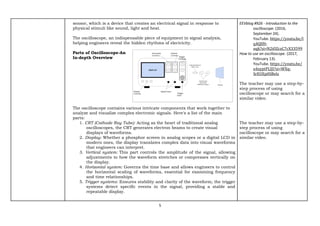
Parts of Oscilloscope-An
In-depth Overview
The oscilloscope contains various intricate components that work together to
analyze and visualize complex electronic signals. Here's a list of the main
parts:
1. CRT (Cathode Ray Tube): Acting as the heart of traditional analog
oscilloscopes, the CRT generates electron beams to create visual
displays of waveforms.
2. Display: Whether a phosphor screen in analog scopes or a digital LCD in
modern ones, the display translates complex data into visual waveforms
that engineers can interpret.
3. Vertical system: This part controls the amplitude of the signal, allowing
adjustments to how the waveform stretches or compresses vertically on
the display.
4. Horizontal system: Governs the time base and allows engineers to control
the horizontal scaling of waveforms, essential for examining frequency
and time relationships.
5. Trigger systems: Ensures stability and clarity of the waveform; the trigger
systems detect specific events in the signal, providing a stable and
repeatable display.
EEVblog #926 - Introduction to the
oscilloscope. (2016,
September 24).
YouTube. https://youtu.be/I
q4QlfH-
oqk?si=N2iOZczC7cX33599
How to use an oscilloscope. (2017,
February 13).
YouTube. https://youtu.be/
u4zyptPLlJI?si=WXq-
SrEUEp0SBelz
The teacher may use a step-by-
step process of using
oscilloscope or may search for a
similar video.
The teacher may use a step-by-
step process of using
oscilloscope or may search for a
similar video.
6
6. Probes and input channels: Acts as the link between the circuit under test
and the oscilloscope. These components provide various connection
options and enable accurate measurements.
7. Control panels: The command center of the oscilloscope, control panels
offer knobs, buttons, and interfaces for precise control and customization
of measurements.
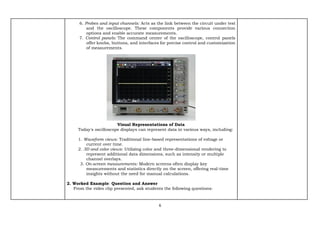
Visual Representations of Data
Today's oscilloscope displays can represent data in various ways, including:
1. Waveform views: Traditional line-based representations of voltage or
current over time.
2. 3D and color views: Utilizing color and three-dimensional rendering to
represent additional data dimensions, such as intensity or multiple
channel overlays.
3. On-screen measurements: Modern screens often display key
measurements and statistics directly on the screen, offering real-time
insights without the need for manual calculations.
2. Worked Example: Question and Answer
From the video clip presented, ask students the following questions:
7
1. Do you think the oscilloscope is an accurate device to measure electronic
signals?
2. Will this help the electricians or engineers find if the appliances are in
good condition or not?
3. What is the importance of using oscilloscope in our industry?
3. Lesson Activity: Describe me
Directions: Describe the characteristics and physical features an oscilloscope
have that you observe from the video clip presented earlier. Write your positive
description in an addition shape and write your negative description in a
subtraction symbol. (See worksheet #2 for the activity which students will
accomplish.)
DAY 3
SUB-TOPIC 3: AMPERE METER
1. Explicitation
An ammeter (abbreviation of Ampere meter) is an instrument used to measure
the current in a circuit. Electric currents are measured in amperes (A).
An ammeter is a measuring device that measures the flow of current in a
circuit. It gives the exact reading of how much current passes through the
conductor. Ammeter is derived from the Greek word ‘amps’ which means
current.
Applications of an Ammeter
Ammeters are the current navigators in a variety of situations. From home to
industry, they silently play a crucial part in maintaining a balanced current
The teacher should emphasize
the difference between AC
Current and DC Current.
8
flow and enhancing our electrical experiences. Let’s take a look at their
applications:
Home Wiring Check: Ammeters lend a hand in confirming if your home’s
electrical system is running smoothly. By measuring current flow, they ensure
that circuits aren’t overloaded, averting potential problems.
Gadget Performance: By hooking up to devices like your computer or fridge,
they unveil their power consumption details.
Car Troubleshooting: Behind a vehicle’s dashboard, ammeters can uncover if
the battery and alternator are matched perfectly. Too much or too little current
can point to issues that need fixing.
Industrial Buzz: Ammeters are like stage managers in factories. They keep tabs
on the currents feeding heavy machinery, guaranteeing a smooth performance.
Renewable Energy Setup: Ammeters can help us monitor and optimize the
energy harnessed from solar panels and wind turbines.
Electronics Creation: They can help fine-tune the components, ensuring they
consume the right amount of current.
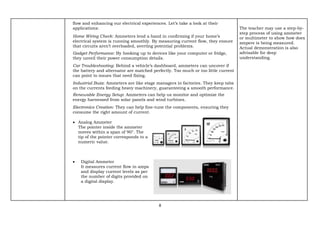
• Analog Ammeter
The pointer inside the ammeter
moves within a span of 90°. The
tip of the pointer corresponds to a
numeric value.
• Digital Ammeter
It measures current flow in amps
and display current levels as per
the number of digits provided on
a digital display.
The teacher may use a step-by-
step process of using ammeter
or multimeter to show how does
ampere is being measured.
Actual demonstration is also
advisable for deep
understanding.
9
How to use an Ammeter
Follow the basic steps using ammeter correctly and safely:
1. Choose the right model. Do you need analog or digital? Do you need
high or low capacity?
2. Before you begin, make sure that all th equipment is use has been
checked thoroughly for any faults. Use insulated gloves to protect you
from live electrical current.
3. Apply the ammeter leads to the target area-the point at which you
want to measure the current. Use a crocodile clip, attach the red lead
to the wire nearest the positive terminal and black lead to the wire
nearest to the negative terminal on the device you are measuring.
4. Check your reading. On analogue panel ammeters, look for the
nearest marker to the needle.
Note: A multimeter is a great little tool used for testing and checking electrical
circuits in your vehicle or electrical devices. The most common use is to
check the voltage of electrical circuits, but they can also be used to check the
Amperage and Ohms.
Milli-Ammeter: Measuring Small Amount of Current
1. When operating on the 50μA range, we utilize the 0-50 scale and read the
scale directly.
2. To read current in the 2.5mA range, read the black 0-250 scale and move
the decimal point two places to the left.
3. If the instrument is operated on its 25mA range, read the black 0-250 scale
and move the decimal point just once to the left.
4. When the VOM is set to its 0.25 range, read the black 0-250 scale and move
the decimal point three places to the left.
Observe correct polarity of the instrument when measuring DC current. Be very
careful against overloading your meter. If you are doubt of approximate reading,
always start with the highest range. If the pointer deflects lefts across zero point,
just reverse the connections; no damage to the meter if this occurs.
Since milli-ammeter function is
not tackled in the previous
exemplar, and the subtopic of
this exemplar is ammeter. The
teacher is encouraged to
expound the milli-ammeter
function of the VOM
The teacher may use this
source: Analog multimeter DC
current reading Part4. (2021,
October 26).
YouTube. https://youtu.be/YR
meMa5j1qI?si=zfbgd6ngcwwmf
XOk
If digital VOM is available, the
teacher has the discretion to
use reliable source to support
the learning process.
The teacher may use these as
references:
How to measure DC amps with a
multimeter. (2022, July 29).
YouTube. https://youtu.be/F_A2T
YEfCk0?si=SJH_YGfAH41mt4kb
How to read the ammeter. (2023,
June 10).
YouTube. https://youtu.be/tcuyM
xBo-Y8?si=w9cSzPkw3Mf4rjcu
10
DAY 4
2. Worked Example: Class demonstration
By peers, students will demonstrate the proper way of measuring amperes
using multi meter.
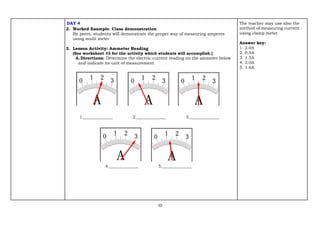
3. Lesson Activity: Ammeter Reading
(See worksheet #3 for the activity which students will accomplish.)
A.Directions: Determine the electric current reading on the ammeter below
and indicate its unit of measurement.
1.______________ 2.______________ 3.______________
4.______________ 5.______________
The teacher may use also the
method of measuring current
using clamp meter.
Answer key:
1. 2.0A
2. 0.5A
3. 1.5A
4. 3.0A
5. 1.6A
11
B. Directions: Draw your own ammeter with the range of 0 to 1A, smallest
division is 0.02A. Show five ammeter results, write the readings on the
space provided.
1. __________ 7. __________ 8. __________
9. __________ 10. __________
D. Making
Generalizations
1. Learners’ Takeaways
• Can you summarize the four different scale reading device and state its
functions? What is its importance in our daily lives?
• Consider that you are owning any type of business, for you, what is the
implication of understanding this lesson?
2. Reflection on Learning
• Let the students make a reflection on what was discussed in this lesson
by listing the remarkable information they’ve got.
12
IV. EVALUATING LEARNING: FORMATIVE ASSESSMENT AND TEACHER’S REFLECTION NOTES TO TEACHERS
A. Evaluating
Learning
1. Formative Assessment
Multiple Choice Quiz. Students will take the 5-item test.
1. What scale reading device is commonly used in cars, boats, planes, and other
vehicles?
A. Ammeter
B. Oscilloscope
C. Tachometer
D. Volt-ohm-milliammeter
2. What part of tachometer is used to show the last readings or result?
A. Battery cover
B. Contact measuring device
C. Function switch
D. Memory call button
3. What part of oscilloscope is used to have knobs, buttons and interfaces for
precise control and customization of measurements?
A. Control panels
B. Display
C. Horizontal System
D. Probes
4. Which of the following device creates an electrical signal in response to physical
stimuli like sound, light and heat and is formerly known as oscillograph?
A. Ammeter
B. Oscilloscope
C. Tachometer
D. Volt-ohm-milliammeter
5. What type of ammeter is used to measure current flow in amps and display
current levels as per the number of digits provided on a digital display?
A. Analog Ammeter
B. Combined Ammeter
C. Digital Ammeter
D. Mechanical Ammeter
Answer Key:
1. C
2. D
3. A
4. B
5. C
13
2. Homework (Optional)
B. Teacher’s
Remarks
Note observations on
any of the following
areas:
Effective Practices Problems Encountered
The teacher may take note of
some observations related to
the effective practices and
problems encountered after
utilizing the different strategies,
materials used, learner
engagement and other related
stuff.
Teachers may also suggest
ways to improve the different
activities explored/ lesson
exemplar.
strategies explored
materials used
learner engagement/
interaction
others
C. Teacher’s
Reflection
Reflection guide or prompt can be on:
▪ principles behind the teaching
What principles and beliefs informed my lesson?
Why did I teach the lesson the way I did?
▪ students
What roles did my students play in my lesson?
What did my students learn? How did they learn?
▪ ways forward
What could I have done differently?
What can I explore in the next lesson?
Teacher’s reflection in every
lesson conducted/ facilitated is
essential and necessary to
improve practice. You may also
consider this as an input for
the LAC/Collab sessions.

Q4_LE_TLE 7_LESSON 7 Lesson 7_Week 7.pdf

  • 1.
    IMPLEMENTATION OF THEMATATAG K TO 10 CURRICULUM Lesson Exemplar for TLE Lesson 7 7 Quarter 4
  • 2.
    Lesson Exemplar forTLE Grade 7 Quarter 4: Lesson 7 (Week 7) SY 2024-2025 This material is intended exclusively for teachers participating in the implementation of the MATATAG K to 10 Curriculum during the School Year 2024- 2025. It aims to assist in delivering the curriculum content, standards, and lesson competencies. Any unauthorized reproduction, distribution, modification, or utilization of this material beyond the designated scope is strictly prohibited and may result in appropriate legal actions and disciplinary measures. Their respective copyright holders own borrowed content included in this material. Every effort has been made to locate and obtain permission to use these materials from their respective copyright owners. The publisher and development team do not represent nor claim ownership over them. Every care has been taken to ensure the accuracy of the information provided in this material. For inquiries or feedback, please write or call the Office of the Director of the Bureau of Learning Resources via telephone at (02) 8634-1072 and 8631-6922 or by email at blr.od@deped.gov.ph. Development Team Writer: • Marian N. Roque (Gen T. De Leon National High School- Valenzuela) Validator: • Victor S. Rosales, PhD TM (Mindanao State University – Iligan Institute of Technology) Management Team Philippine Normal University Research Institute for Teacher Quality SiMERR National Research Centre
  • 3.
    1 TLE /QUARTER 4/GRADE 7 I. CURRICULUM CONTENT, STANDARDS, AND LESSON COMPETENCIES A. Content Standards The learners demonstrate an understanding of the concepts and principles in performing mensuration and calculations. B. Performance Standards The learners perform mensuration and calculations following safety precautions C. Learning Competencies and Objectives Learning Competency Interpret the readings in different measuring instruments. Learning Objectives At the end of the lesson, the students are expected to: 1. Explain the function and uses of tachometer, oscilloscope, and ampere meter. 2. Identify the parts of the tachometer, oscilloscope, and ampere meter. 3. Interpret the readings of tachometer, oscilloscope, and ampere meter. D. Content Topic: Scale Reading Subtopics: Tachometer, Oscilloscope, Ampere meter E. Integration SDG 9: Industry Innovation and Structures II. LEARNING RESOURCES Ammeters - A complete guide. (2023, March 7). Industrial Solutions & Electrical Components | RS. https://ph.rs- online.com/web/content/discovery/ideas-and-advice/ammeters-guide How to measure current (Amperes) using analog multi-meter. (2021, June 28). YouTube. https://youtu.be/CcfQFqcMa7U?si=v31yCNTeM1giOB8j Huang, Y. (2022, June 21). How does a tachometer work? | KUS Americas, Inc. KUS USA. https://kus-usa.com/resources/how-does-a- tachometer-work/ Kulkarni, A. (2022, April 15). What is ammeter? Uses and benefits | Complete guide on ammeter. BEEMET. https://beemet.com/ammeter- guide/ Tachometer: Uses, types, measurement & working. (2021, November 29). Tesca Global Blog. https://www.tescaglobal.com/blog/digital-and- mechanical-tachometer/ Tachometers - A complete guide. (2023, January 24). Industrial Solutions & Electrical Components | RS. https://uk.rs- online.com/web/content/discovery/ideas-and-advice/tachometers-guide
  • 4.
    2 Understanding oscilloscope partsand function: A comprehensive guide - Keysight technologies. (n.d.). https://savings.em.keysight.com/en/knowledge/guides/used-oscilloscope-buying-guide/oscilloscope-parts-and-function What is an oscilloscope? (2021, May 11). Test and Measurement Equipment | Tektronix. https://www.tek.com/en/blog/what-is-an- oscilloscope#EbUses III. TEACHING AND LEARNING PROCEDURE NOTES TO TEACHERS A. Activating Prior Knowledge DAY 1 1. Short Review Pass the Cabbage Create a cabbage-like vegetable made of crumpled papers, cabbage will be passed to one another as the class sings any type of song. Once the music stops, a student who got the cabbage will peel one page and answer the question that is written on the cabbage paper. 2. Feedback (Optional) Create a set of questions about VOM Scale, Ohmmeter Function and Voltmeter Function. A teacher may also include questions about students’ personal experiences in connection with the previous topic. Write each set of question on each leaf of a cabbage-like paper. B. Establishing Lesson Purpose 1. Lesson Purpose Ask students if they have seen their grandfather, father, uncle, or elder brother using Multi tester at home. Let them share their experiences and encounters seeing multi tester being used. 2. Unlocking Content Vocabulary • Tachometer – It is an instrument that measures the working speed of an engine, typically in revolutions per minute (RPM). • Oscilloscope – It is an instrument that graphically displays electrical signals and shows how those signals change over time. • Ammeter – It is a measuring device that measures the flow of current in a circuit. • Milliammeter – A measuring instrument that measures small electrical currents (milliamps). Show a picture or actual Multi tester to let students think and share their experiences.
  • 5.
    3 C. Developing and Deepening Understanding SUB-TOPIC1: Tachometer 1. Explicitation A tachometer is an instrument that is used to measure the working speed of an engine, usually in revolutions per minute (RPM). It is commonly used in cars, boats, planes, and other types of vehicles. Most tachometer gauges have either an analog (dial) or digital (LCD or LED screen) display. A. Types Tachometer: • Analog Tachometer - It is used to count the RPM based on the period. It uses a series of reeds that helps in detecting the engine speed. It is a device that has all centrifugal force. It has a power on the rotating mass that helps in extending and compressing the mechanical spring. • Electronic Tachometer - An Electronic Tachometer is a significant component that helps measure the engine’s speed in RPM. It is a device that is available in the car’s dashboard to measure the driving speed. This device uses a magnetic pickup that you can find here the rotating engine. It produces electric pulses. The pulses that this device causes has a frequency proportional to the engine speed. B. Parts of Tachometer 1. Contact measuring device is a key part of the whole tachometer. The teacher is encourage to use these as reference: Tachometer how it works|| Tachometer working principle|| techno meters & electronics. (2022, July 2). YouTube. https://youtu.be/3Ncr0dVC vQs?si=xpmmxXNoF_7uyCPh Handheld tachometer - Laser & contact - Review & demo. (2020, November 24). YouTube. https://youtu.be/kPUrsFO3 8W0?si=jIpASJrOnyrknRwt The teacher may use a step-by- step process of using tachometer or may search for a similar video. The teacher may modify scenario given in worked example that will be answered by the students. Source: https://megadepot.com/resource/what-is-a-tachometer-and-how-does- it-work
  • 6.
    4 2. RPM adapteris the element that contacts the object the speed of which you want to measure. 3. Function switch is used to switch between the units of measurement. 4. Memory call button is used to show the last reading. 5. Display shows the readings or result. 6. Measure button is used to start the measurement. 7. Battery cover is used to cover and protect the battery from dust and any damage. 2. Worked Example: Class sharing 1. Reflect on your own vehicle experiences. Based on what we discussed today, do you think tachometer displays an important role in our daily living? 2. Recall the time when you observed someone driving a vehicle. How did this lesson impact you as a person riding any type of vehicle? 3. Lesson Activity: Vehicle Operator Directions: Students will portray as a vehicle operator. As an operator, what will be your plans to be done before driving or operating a vehicle? List down your answers on the space below. (See worksheet #1 for the activity which students will accomplish.) DAY 2 SUB-TOPIC 2: Oscilloscope 1. Explicitation Formerly known as an oscillograph (informally scope, oscope, or o-scope), is a device that graphically displays electrical signals and exhibits how those signals change over time. It measures these signals by connecting with a How to use an Oscilloscope: Name and Section https://www.vecteezy.com/vector-art 27259058-driver-line-icon-isolated-on- white-background
  • 7.
    5 sensor, which isa device that creates an electrical signal in response to physical stimuli like sound, light and heat. The oscilloscope, an indispensable piece of equipment in signal analysis, helping engineers reveal the hidden rhythms of electricity. Parts of Oscilloscope-An In-depth Overview The oscilloscope contains various intricate components that work together to analyze and visualize complex electronic signals. Here's a list of the main parts: 1. CRT (Cathode Ray Tube): Acting as the heart of traditional analog oscilloscopes, the CRT generates electron beams to create visual displays of waveforms. 2. Display: Whether a phosphor screen in analog scopes or a digital LCD in modern ones, the display translates complex data into visual waveforms that engineers can interpret. 3. Vertical system: This part controls the amplitude of the signal, allowing adjustments to how the waveform stretches or compresses vertically on the display. 4. Horizontal system: Governs the time base and allows engineers to control the horizontal scaling of waveforms, essential for examining frequency and time relationships. 5. Trigger systems: Ensures stability and clarity of the waveform; the trigger systems detect specific events in the signal, providing a stable and repeatable display. EEVblog #926 - Introduction to the oscilloscope. (2016, September 24). YouTube. https://youtu.be/I q4QlfH- oqk?si=N2iOZczC7cX33599 How to use an oscilloscope. (2017, February 13). YouTube. https://youtu.be/ u4zyptPLlJI?si=WXq- SrEUEp0SBelz The teacher may use a step-by- step process of using oscilloscope or may search for a similar video. The teacher may use a step-by- step process of using oscilloscope or may search for a similar video.
  • 8.
    6 6. Probes andinput channels: Acts as the link between the circuit under test and the oscilloscope. These components provide various connection options and enable accurate measurements. 7. Control panels: The command center of the oscilloscope, control panels offer knobs, buttons, and interfaces for precise control and customization of measurements. Visual Representations of Data Today's oscilloscope displays can represent data in various ways, including: 1. Waveform views: Traditional line-based representations of voltage or current over time. 2. 3D and color views: Utilizing color and three-dimensional rendering to represent additional data dimensions, such as intensity or multiple channel overlays. 3. On-screen measurements: Modern screens often display key measurements and statistics directly on the screen, offering real-time insights without the need for manual calculations. 2. Worked Example: Question and Answer From the video clip presented, ask students the following questions:
  • 9.
    7 1. Do youthink the oscilloscope is an accurate device to measure electronic signals? 2. Will this help the electricians or engineers find if the appliances are in good condition or not? 3. What is the importance of using oscilloscope in our industry? 3. Lesson Activity: Describe me Directions: Describe the characteristics and physical features an oscilloscope have that you observe from the video clip presented earlier. Write your positive description in an addition shape and write your negative description in a subtraction symbol. (See worksheet #2 for the activity which students will accomplish.) DAY 3 SUB-TOPIC 3: AMPERE METER 1. Explicitation An ammeter (abbreviation of Ampere meter) is an instrument used to measure the current in a circuit. Electric currents are measured in amperes (A). An ammeter is a measuring device that measures the flow of current in a circuit. It gives the exact reading of how much current passes through the conductor. Ammeter is derived from the Greek word ‘amps’ which means current. Applications of an Ammeter Ammeters are the current navigators in a variety of situations. From home to industry, they silently play a crucial part in maintaining a balanced current The teacher should emphasize the difference between AC Current and DC Current.
  • 10.
    8 flow and enhancingour electrical experiences. Let’s take a look at their applications: Home Wiring Check: Ammeters lend a hand in confirming if your home’s electrical system is running smoothly. By measuring current flow, they ensure that circuits aren’t overloaded, averting potential problems. Gadget Performance: By hooking up to devices like your computer or fridge, they unveil their power consumption details. Car Troubleshooting: Behind a vehicle’s dashboard, ammeters can uncover if the battery and alternator are matched perfectly. Too much or too little current can point to issues that need fixing. Industrial Buzz: Ammeters are like stage managers in factories. They keep tabs on the currents feeding heavy machinery, guaranteeing a smooth performance. Renewable Energy Setup: Ammeters can help us monitor and optimize the energy harnessed from solar panels and wind turbines. Electronics Creation: They can help fine-tune the components, ensuring they consume the right amount of current. • Analog Ammeter The pointer inside the ammeter moves within a span of 90°. The tip of the pointer corresponds to a numeric value. • Digital Ammeter It measures current flow in amps and display current levels as per the number of digits provided on a digital display. The teacher may use a step-by- step process of using ammeter or multimeter to show how does ampere is being measured. Actual demonstration is also advisable for deep understanding.
  • 11.
    9 How to usean Ammeter Follow the basic steps using ammeter correctly and safely: 1. Choose the right model. Do you need analog or digital? Do you need high or low capacity? 2. Before you begin, make sure that all th equipment is use has been checked thoroughly for any faults. Use insulated gloves to protect you from live electrical current. 3. Apply the ammeter leads to the target area-the point at which you want to measure the current. Use a crocodile clip, attach the red lead to the wire nearest the positive terminal and black lead to the wire nearest to the negative terminal on the device you are measuring. 4. Check your reading. On analogue panel ammeters, look for the nearest marker to the needle. Note: A multimeter is a great little tool used for testing and checking electrical circuits in your vehicle or electrical devices. The most common use is to check the voltage of electrical circuits, but they can also be used to check the Amperage and Ohms. Milli-Ammeter: Measuring Small Amount of Current 1. When operating on the 50μA range, we utilize the 0-50 scale and read the scale directly. 2. To read current in the 2.5mA range, read the black 0-250 scale and move the decimal point two places to the left. 3. If the instrument is operated on its 25mA range, read the black 0-250 scale and move the decimal point just once to the left. 4. When the VOM is set to its 0.25 range, read the black 0-250 scale and move the decimal point three places to the left. Observe correct polarity of the instrument when measuring DC current. Be very careful against overloading your meter. If you are doubt of approximate reading, always start with the highest range. If the pointer deflects lefts across zero point, just reverse the connections; no damage to the meter if this occurs. Since milli-ammeter function is not tackled in the previous exemplar, and the subtopic of this exemplar is ammeter. The teacher is encouraged to expound the milli-ammeter function of the VOM The teacher may use this source: Analog multimeter DC current reading Part4. (2021, October 26). YouTube. https://youtu.be/YR meMa5j1qI?si=zfbgd6ngcwwmf XOk If digital VOM is available, the teacher has the discretion to use reliable source to support the learning process. The teacher may use these as references: How to measure DC amps with a multimeter. (2022, July 29). YouTube. https://youtu.be/F_A2T YEfCk0?si=SJH_YGfAH41mt4kb How to read the ammeter. (2023, June 10). YouTube. https://youtu.be/tcuyM xBo-Y8?si=w9cSzPkw3Mf4rjcu
  • 12.
    10 DAY 4 2. WorkedExample: Class demonstration By peers, students will demonstrate the proper way of measuring amperes using multi meter. 3. Lesson Activity: Ammeter Reading (See worksheet #3 for the activity which students will accomplish.) A.Directions: Determine the electric current reading on the ammeter below and indicate its unit of measurement. 1.______________ 2.______________ 3.______________ 4.______________ 5.______________ The teacher may use also the method of measuring current using clamp meter. Answer key: 1. 2.0A 2. 0.5A 3. 1.5A 4. 3.0A 5. 1.6A
  • 13.
    11 B. Directions: Drawyour own ammeter with the range of 0 to 1A, smallest division is 0.02A. Show five ammeter results, write the readings on the space provided. 1. __________ 7. __________ 8. __________ 9. __________ 10. __________ D. Making Generalizations 1. Learners’ Takeaways • Can you summarize the four different scale reading device and state its functions? What is its importance in our daily lives? • Consider that you are owning any type of business, for you, what is the implication of understanding this lesson? 2. Reflection on Learning • Let the students make a reflection on what was discussed in this lesson by listing the remarkable information they’ve got.
  • 14.
    12 IV. EVALUATING LEARNING:FORMATIVE ASSESSMENT AND TEACHER’S REFLECTION NOTES TO TEACHERS A. Evaluating Learning 1. Formative Assessment Multiple Choice Quiz. Students will take the 5-item test. 1. What scale reading device is commonly used in cars, boats, planes, and other vehicles? A. Ammeter B. Oscilloscope C. Tachometer D. Volt-ohm-milliammeter 2. What part of tachometer is used to show the last readings or result? A. Battery cover B. Contact measuring device C. Function switch D. Memory call button 3. What part of oscilloscope is used to have knobs, buttons and interfaces for precise control and customization of measurements? A. Control panels B. Display C. Horizontal System D. Probes 4. Which of the following device creates an electrical signal in response to physical stimuli like sound, light and heat and is formerly known as oscillograph? A. Ammeter B. Oscilloscope C. Tachometer D. Volt-ohm-milliammeter 5. What type of ammeter is used to measure current flow in amps and display current levels as per the number of digits provided on a digital display? A. Analog Ammeter B. Combined Ammeter C. Digital Ammeter D. Mechanical Ammeter Answer Key: 1. C 2. D 3. A 4. B 5. C
  • 15.
    13 2. Homework (Optional) B.Teacher’s Remarks Note observations on any of the following areas: Effective Practices Problems Encountered The teacher may take note of some observations related to the effective practices and problems encountered after utilizing the different strategies, materials used, learner engagement and other related stuff. Teachers may also suggest ways to improve the different activities explored/ lesson exemplar. strategies explored materials used learner engagement/ interaction others C. Teacher’s Reflection Reflection guide or prompt can be on: ▪ principles behind the teaching What principles and beliefs informed my lesson? Why did I teach the lesson the way I did? ▪ students What roles did my students play in my lesson? What did my students learn? How did they learn? ▪ ways forward What could I have done differently? What can I explore in the next lesson? Teacher’s reflection in every lesson conducted/ facilitated is essential and necessary to improve practice. You may also consider this as an input for the LAC/Collab sessions.