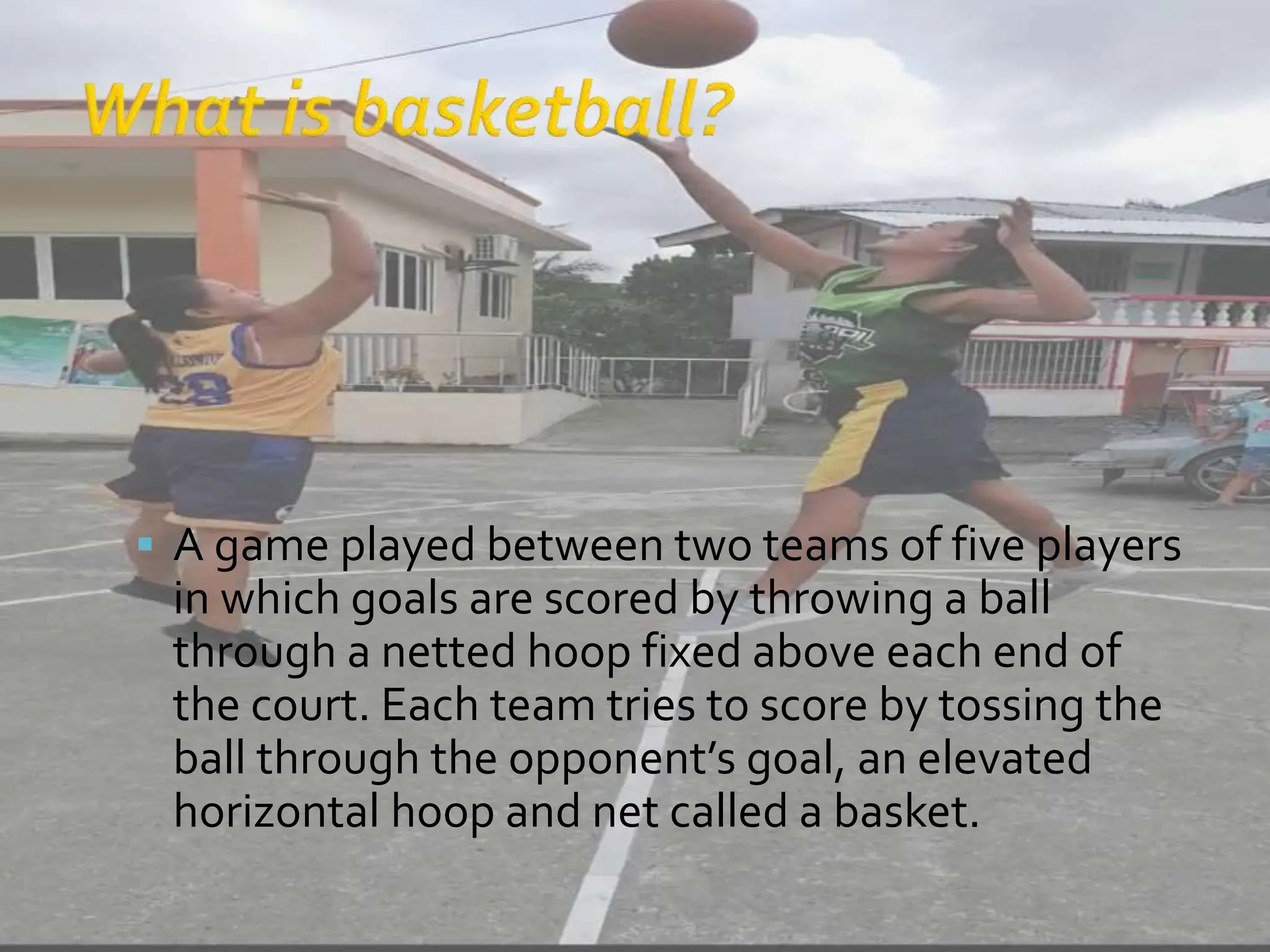
 A game played between two teams of five players
in which goals are scored by throwing a ball
through a netted hoop fixed above each end of
the court. Each team tries to score by tossing the
ball through the opponent’s goal, an elevated
horizontal hoop and net called a basket.
 Basketball was invented by James Naismith
(1861- 1939) on or about December 1, 1891, at
the InternationalYoung Men’s Christian
Association ( YMCA) training school (now
Springfield College), Springfield,
Massachusetts, where Naismith was an
instructor in physical education.
 The official NBA and competitive
professional basketball is 29.5”| 74.9 cm in
circumference with a diameter between 9.43”
-9.51” |24- 24.2 cm.
 Professional basketballs must be inflated to a
pressure between 7.5- 8.5 PSI and cannot
exceed the maximum weight of 22 ounces.
 Throughout gyms, parks, and driveways
around the world, basketball hoops are
almost always 10 feet ( 3 meters ) off the
ground. Some leagues for young children
play on shorter hoops, but from junior high
schools through the professional leagues, the
game is played on hoops of the standard 10-
foot height.
 The measure of the international courts
consists of a standardized measure of 28 by
15 meters. Meanwhile, in the NBA ( National
BasketballAssociation) the court have
measure of 29 by 15 meters.
 SleevelessT-shirt
 Short or shorts
 Shoes with a design suitable for quick braking
 Socks: generally, cotton and with a height of
approximately 10 cm.
 Knee pads
 Mouth guard
 Lace guards
 The center is the tallest player on each team,
playing near the basket. On offense, the
center tries to score on close shots and
rebound.
 But on defense, the center tries to block
opponents’ shots and rebound their misses.
 The power forward does many of the things a
center does, playing near the basket while
rebounding and defending taller players. But
power forwards also take longer shots than
center.
 The small forward plays against small and
large players.They roam all over on the court.
 Small forwards can score from long shots and
close ones.
 The point guard runs the offense and usually
is the team’s best dribbler and passer.
 The point guard defends the opponent’s
point guard and tries to steal the ball.
 The shooting guard is usually the team’s best
shooter.The shooting guard can make shots
from long distance and also is a good
dribbler.
 Teamwork
 Speed
 Physical
 Accuracy
 Defensive three second violation ( illegal
defense) (penalized as a technical foul)
 Five second rule
 Shot clock violation
 Time line violation, exceeding the time limit
to reach the frontcourt ( 8- or 10 second
violation)
 Three seconds rule ( lane violation)
 Backcourt violation ( over and back)
 Carrying or palming
 Double- dribble
 Traveling
 Basket interference
 Goaltending
 Stepping out of bounds and throwing the ball
out of bounds may also be considered
violations that result in loss of the ball
 Acts involving contact between opponents or
unsportsmanlike conduct are called fouls,
usually a personal foul.
 The rules of basketball can vary slightly
depending on the level of play ( example;
professional rules differ from college rules) or
where the gamed is played ( international
rules are different from USA professional
rules.
 The winner of a basketball game is the team
with the most points.
 In regular play a basket made from within the
three point line is worth 2 points and a basket
shot from outside the three point line is
worth three points.
 When shooting a free throw, each free throw
is worth 1 point.
 The player must bounce, or dribble, the ball
with one hand while moving both feet.
 If, at any time, both hands touch the ball or
the player stops dribbling, the player must
only move one foot.
 The foot that is stationary is called the pivot
foot.
 The basketball player can only one turn at
dribbling. In other words, once a player has
stopped dribbling they cannot start another
dribble.
 A player who starts dribbling again is called for a
double- dribbling violation and looses the
basketball to the other team.
 A player can only start another dribble after
another player from either team touches or
gains control of the basketball.
 This is usually after a shot or pass.
 The ball must stay in bounds.
 If the offensive team looses the ball out of
bounds the other team gets control of the
basketball.
 The players hand must be on top of the ball
while dribbling.
 If they touch the bottom of the basketball
while dribbling and continue to dribble this is
called carrying the ball and the player will lose
the ball to the other team.
 Once the offensive team crosses half court,
they may not go back into the backcourt.(
this is called the backcourt violation)
 If the defensive team knocks the ball into the
backcourt, then the offensive team can
recover the ball legally.
The team on defense is the team without the
basketball.
• The main rule for the defensive player is not
to foul.
• A foul is described as gaining an unfair
advantage through physical contact.
 There is some interpretation that has to be
made by the referee, but, in general, the
defensive player may not touch the offensive
player in a way that causes the offensive
player to lose the ball or miss a shot.
 Although the foul rule is described above as a
defensive rule, it applies exactly the same to
all players on the court including offensive
players.
 Basketball players cannot kick the ball or hit it
with their fist.
 No player can touch the basketball while it is
traveling downward towards the basket or if
it is on the rim.
 This is called goaltending.( touching the ball
on the rim is legal in some games)
 Every player on the court is subject to the
same rules regardless of the position they
play.
 The positions in basketball are just for team
basketball strategy and there are no positions
in the rule.
 The ball may be thrown in any direction with
one or both hands
 The ball may be batted in any direction with
one or both hands ( never with the fist )
 A player cannot run with the ball.The player
must throw it from the spot on which he
catches it, allowance to be made for a man
who catches the ball when running at a good
speed if he tries to stop.
 The ball must be held in or between the
hands; the arms or body must not be used for
holding it.
 No shouldering, holding, pushing, tripping, or
striking in any way the person of an opponent
shall be allowed.
 The first infringement of this rule by any
player shall count as a foul, the second shall
disqualify him until the next goal is made, or,
if there was evident to injure the person, for
the whole of the game, no substitute
allowed.
 A foul is striking at the ball with the fist,
violation of rules 3,4, and such as described in
rule 5.
 If either side makes three consecutive fouls, it
shall count a goal for the opponents
(consecutive means without the opponents in
the mean time making a foul)
 A goal shall be made when the ball is thrown
or batted from the grounds into the basket
and stays there, providing those defending
the goal do not touch or disturb the goal.
 If the ball rests on the edges, and the
opponent moves the basket, it shall count as
a goal.
 When the ball goes out of bounds, it shall be
thrown into the field of play by the person
first touching it.
 In case of a dispute, the umpire shall throw it
straight into the field.
 The thrower- in is allowed five seconds; if he
holds it longer, it shall go to the opponent.
 If any side persists in delaying the game, the
umpire shall call a foul on that side.
 The umpire shall be judge of the men and
shall note the fouls and notify the referee
when three consecutive fouls have been
made.
 He shall have power to disqualify men
according to rule 5
 The referee shall be judge of the ball and shall
decide when the ball is in play, in bounds, to
which side it belongs, and shall keep the time.
 He shall decide when a goal has been made,
and keep account of the goals with any other
duties that are usually performed by a
referee.
 The time shall be two 15- minute halves, with
five minutes’ rest between.
 The side making the most goals in that time
shall be declared the winner.
 In case of a draw, the game may, by
agreement of the captains, be continued until
another goal is made.
 Three Referees
---these are responsible for commanding the
game and ensuring that players comply with
the rules of basketball.
 They have a function to fill the bulletin of the
game with the numbers of absences by team
and per player, to register the points marked,
etc..
Time keeper
• Responsible for the game clock and the time
of discounts.
 This has the function to control the time of
the attack of the teams, being that each team
has 24 seconds to do it.
 When a player uses their hands to grab their
opponent to empede or prevent them from
moving or advancing with or without the ball
 When a player fails to maintain a set position
while setting a screen or pick. Screens must
be performed in a standstill manner.
 When a player continually uses their hands on
an opposing player.This foul is typically called
on defenders at the perimeter to keep a safe
distance between the ballhandler and the
basket
 Similar to holding, this is when a player uses
their hands in a fashion that referees deem
illegal, typically in the form of touching a
shooter’s arm or hand through their release
or touching after an attempted steal.
 When a player uses their leg or foot to throw
off their opponent’s balance.
 When a player excessively swings their
elbows and hits another player.
 When an offensive player makes contact with
a defender who has established position in
front of an offensive player with or without
the basketball and is not moving.
 When a defender makes contact with an
offensive player without established position,
without giving proper space or is in the
charge circle.
 When a player or coach displays
unsportsmanlike behavior, such as foul
language, obscene gestures or arguing.Two
technical fouls will result in ejection from the
game.
 When a player performs an act of violence
that can seriously injure or harm others on
the court.
 This can be unintentional or deliberate.
 Flagrant foul can also result in player
ejections at the referee’s discretion.

pe. basketball physical education project.pptx

  • 2.
     A gameplayed between two teams of five players in which goals are scored by throwing a ball through a netted hoop fixed above each end of the court. Each team tries to score by tossing the ball through the opponent’s goal, an elevated horizontal hoop and net called a basket.
  • 3.
     Basketball wasinvented by James Naismith (1861- 1939) on or about December 1, 1891, at the InternationalYoung Men’s Christian Association ( YMCA) training school (now Springfield College), Springfield, Massachusetts, where Naismith was an instructor in physical education.
  • 4.
     The officialNBA and competitive professional basketball is 29.5”| 74.9 cm in circumference with a diameter between 9.43” -9.51” |24- 24.2 cm.  Professional basketballs must be inflated to a pressure between 7.5- 8.5 PSI and cannot exceed the maximum weight of 22 ounces.
  • 5.
     Throughout gyms,parks, and driveways around the world, basketball hoops are almost always 10 feet ( 3 meters ) off the ground. Some leagues for young children play on shorter hoops, but from junior high schools through the professional leagues, the game is played on hoops of the standard 10- foot height.
  • 6.
     The measureof the international courts consists of a standardized measure of 28 by 15 meters. Meanwhile, in the NBA ( National BasketballAssociation) the court have measure of 29 by 15 meters.
  • 7.
     SleevelessT-shirt  Shortor shorts  Shoes with a design suitable for quick braking  Socks: generally, cotton and with a height of approximately 10 cm.  Knee pads  Mouth guard  Lace guards
  • 9.
     The centeris the tallest player on each team, playing near the basket. On offense, the center tries to score on close shots and rebound.  But on defense, the center tries to block opponents’ shots and rebound their misses.
  • 10.
     The powerforward does many of the things a center does, playing near the basket while rebounding and defending taller players. But power forwards also take longer shots than center.
  • 11.
     The smallforward plays against small and large players.They roam all over on the court.  Small forwards can score from long shots and close ones.
  • 12.
     The pointguard runs the offense and usually is the team’s best dribbler and passer.  The point guard defends the opponent’s point guard and tries to steal the ball.
  • 13.
     The shootingguard is usually the team’s best shooter.The shooting guard can make shots from long distance and also is a good dribbler.
  • 14.
     Teamwork  Speed Physical  Accuracy
  • 16.
     Defensive threesecond violation ( illegal defense) (penalized as a technical foul)  Five second rule  Shot clock violation  Time line violation, exceeding the time limit to reach the frontcourt ( 8- or 10 second violation)  Three seconds rule ( lane violation)
  • 17.
     Backcourt violation( over and back)  Carrying or palming  Double- dribble  Traveling
  • 18.
     Basket interference Goaltending  Stepping out of bounds and throwing the ball out of bounds may also be considered violations that result in loss of the ball  Acts involving contact between opponents or unsportsmanlike conduct are called fouls, usually a personal foul.
  • 20.
     The rulesof basketball can vary slightly depending on the level of play ( example; professional rules differ from college rules) or where the gamed is played ( international rules are different from USA professional rules.
  • 21.
     The winnerof a basketball game is the team with the most points.  In regular play a basket made from within the three point line is worth 2 points and a basket shot from outside the three point line is worth three points.  When shooting a free throw, each free throw is worth 1 point.
  • 22.
     The playermust bounce, or dribble, the ball with one hand while moving both feet.  If, at any time, both hands touch the ball or the player stops dribbling, the player must only move one foot.  The foot that is stationary is called the pivot foot.
  • 23.
     The basketballplayer can only one turn at dribbling. In other words, once a player has stopped dribbling they cannot start another dribble.  A player who starts dribbling again is called for a double- dribbling violation and looses the basketball to the other team.
  • 24.
     A playercan only start another dribble after another player from either team touches or gains control of the basketball.  This is usually after a shot or pass.  The ball must stay in bounds.
  • 25.
     If theoffensive team looses the ball out of bounds the other team gets control of the basketball.  The players hand must be on top of the ball while dribbling.
  • 26.
     If theytouch the bottom of the basketball while dribbling and continue to dribble this is called carrying the ball and the player will lose the ball to the other team.  Once the offensive team crosses half court, they may not go back into the backcourt.( this is called the backcourt violation)
  • 27.
     If thedefensive team knocks the ball into the backcourt, then the offensive team can recover the ball legally.
  • 28.
    The team ondefense is the team without the basketball. • The main rule for the defensive player is not to foul. • A foul is described as gaining an unfair advantage through physical contact.
  • 29.
     There issome interpretation that has to be made by the referee, but, in general, the defensive player may not touch the offensive player in a way that causes the offensive player to lose the ball or miss a shot.
  • 30.
     Although thefoul rule is described above as a defensive rule, it applies exactly the same to all players on the court including offensive players.  Basketball players cannot kick the ball or hit it with their fist.
  • 31.
     No playercan touch the basketball while it is traveling downward towards the basket or if it is on the rim.  This is called goaltending.( touching the ball on the rim is legal in some games)
  • 32.
     Every playeron the court is subject to the same rules regardless of the position they play.  The positions in basketball are just for team basketball strategy and there are no positions in the rule.
  • 34.
     The ballmay be thrown in any direction with one or both hands  The ball may be batted in any direction with one or both hands ( never with the fist )
  • 35.
     A playercannot run with the ball.The player must throw it from the spot on which he catches it, allowance to be made for a man who catches the ball when running at a good speed if he tries to stop.  The ball must be held in or between the hands; the arms or body must not be used for holding it.
  • 36.
     No shouldering,holding, pushing, tripping, or striking in any way the person of an opponent shall be allowed.  The first infringement of this rule by any player shall count as a foul, the second shall disqualify him until the next goal is made, or, if there was evident to injure the person, for the whole of the game, no substitute allowed.
  • 37.
     A foulis striking at the ball with the fist, violation of rules 3,4, and such as described in rule 5.  If either side makes three consecutive fouls, it shall count a goal for the opponents (consecutive means without the opponents in the mean time making a foul)
  • 38.
     A goalshall be made when the ball is thrown or batted from the grounds into the basket and stays there, providing those defending the goal do not touch or disturb the goal.  If the ball rests on the edges, and the opponent moves the basket, it shall count as a goal.
  • 39.
     When theball goes out of bounds, it shall be thrown into the field of play by the person first touching it.  In case of a dispute, the umpire shall throw it straight into the field.
  • 40.
     The thrower-in is allowed five seconds; if he holds it longer, it shall go to the opponent.  If any side persists in delaying the game, the umpire shall call a foul on that side.
  • 41.
     The umpireshall be judge of the men and shall note the fouls and notify the referee when three consecutive fouls have been made.  He shall have power to disqualify men according to rule 5
  • 42.
     The refereeshall be judge of the ball and shall decide when the ball is in play, in bounds, to which side it belongs, and shall keep the time.  He shall decide when a goal has been made, and keep account of the goals with any other duties that are usually performed by a referee.
  • 43.
     The timeshall be two 15- minute halves, with five minutes’ rest between.  The side making the most goals in that time shall be declared the winner.  In case of a draw, the game may, by agreement of the captains, be continued until another goal is made.
  • 44.
     Three Referees ---theseare responsible for commanding the game and ensuring that players comply with the rules of basketball.
  • 45.
     They havea function to fill the bulletin of the game with the numbers of absences by team and per player, to register the points marked, etc.. Time keeper • Responsible for the game clock and the time of discounts.
  • 46.
     This hasthe function to control the time of the attack of the teams, being that each team has 24 seconds to do it.
  • 48.
     When aplayer uses their hands to grab their opponent to empede or prevent them from moving or advancing with or without the ball
  • 49.
     When aplayer fails to maintain a set position while setting a screen or pick. Screens must be performed in a standstill manner.
  • 50.
     When aplayer continually uses their hands on an opposing player.This foul is typically called on defenders at the perimeter to keep a safe distance between the ballhandler and the basket
  • 51.
     Similar toholding, this is when a player uses their hands in a fashion that referees deem illegal, typically in the form of touching a shooter’s arm or hand through their release or touching after an attempted steal.
  • 52.
     When aplayer uses their leg or foot to throw off their opponent’s balance.
  • 53.
     When aplayer excessively swings their elbows and hits another player.
  • 54.
     When anoffensive player makes contact with a defender who has established position in front of an offensive player with or without the basketball and is not moving.
  • 55.
     When adefender makes contact with an offensive player without established position, without giving proper space or is in the charge circle.
  • 56.
     When aplayer or coach displays unsportsmanlike behavior, such as foul language, obscene gestures or arguing.Two technical fouls will result in ejection from the game.
  • 57.
     When aplayer performs an act of violence that can seriously injure or harm others on the court.  This can be unintentional or deliberate.  Flagrant foul can also result in player ejections at the referee’s discretion.