CHAPTER 10
 What Is Personal Relationship?
 How Are Attachments Developed?
 What Drives Attraction?
 Love and Intimacy
Commitment: Saying Yes and Meaning It
 Responsibilities in a Relationship
What Is Personal
Relationship?
Write the word True if the statement is
correct and write the word False if the
statement is not correct. Write your answer
on a separate sheet of paper.
 _______1. Attraction is a force that unite
people.
 _______2.Affection is one of human beings'
greatest emotions.
 _______3.Infatuation is love without
engagement or intimacy.
 _______4. People differ in what they consider
attractive.
 _______5. Relationship is a one-way traffic.
Write the word Yes if the statement is
correct and write the word No if the
statement is not correct.
 ______1.Filipino culture is bound to believe that a
decent display of someone's feelings also a must, to be
accepted by society;
 ______2.Macoi has leadership and work skills but does
not have good looks. Is it attractive to ladies?
______3.Majelyn dictates to her boyfriend how to
dress up and what to eat. Is this a controlling issue?
 ______4. Is “Love” one of the three components of a
healthy relationship according to Sternberg?
 ______5 Is cheating one of the unacceptable issues in
any relationship?
Even before language was invented, pre-historic humans
were already interacting through many other forms of behavior.
They may have learned how to smile or greet each other;
show love, affection, and even loyalty to the group; and hunt
together for food.
This interaction was necessary for survival of the group
where an individual belonged.
Survival was the primary reason why human beings have the
fundamental need to belong.
What Is Personal Relationship?
In today’s world, this need to belong still exists, perhaps
because it has been imprinted in our genetic memory that was
passed on to us by our ancestors.
Belonging to a group generates many benefits like
having a support system when you need some shoulder to cry
on or draw some strength from.
The relationships that are nurtured in a group help each
one of us survive.
What Is Personal Relationship?
HOW DO YOU EXPRESS YOUR
ATTRACTION TOWARD ANOTHER
PERSON?
A HEALTHY RELATIONSHIP WITH
FRIENDS IS A SOURCE OF LIFETIME
HAPPINESS.
Researchers have found that relationships
are important to one’s happiness.
The absence of close relationships can
produce a deep negative effect on a individual
who is deny of it, such as feeling worthless,
powerless, and alienated.
A HEALTHY RELATIONSHIP WITH
FRIENDS IS A SOURCE OF LIFETIME
HAPPINESS.
BUT HOW DO WE DEFINE
RELATIONSHIP?
Merriam-Webster Online Dictionary
defines relationship as:
“The way in which two or more
people, groups, countries, etc., talk to
and deal with each other.”
The definition is extended to include
“the way in which two or more people or
things are connected.”
TYPES OF RELATIONSHIPS DEPENDING
ON THE NATURE OF INTERACTION
THAT EXIST BETWEEN TWO OR MORE
ENTITIES
 Business transactional relationship
 Professional relationship
 Familyrelationship
 Friendlyrelationship
 Romanticrelationship
We can also say that every
relationship has specific objectives or
purpose that a person wishes to pursue,
either because of need, want, or desire.
HOW ARE ATTACHMENTS
DEVELOPED?
The very first meaningful
relationship every human being
encounters is with one’s mother.
Even before birth, the mother-
child relationship is already
established.
HOW ARE ATTACHMENTS DEVELOPED?
The intimacy that is nurtured
during the nine months of pregnancy
will be enhanced and developed
further after the birth of the child.
HOW ARE ATTACHMENTS DEVELOPED?
A careless and non-caring
pregnant mother can affect the child
in the womb, which may leave
psychological and emotional scars even
before the child is born.
HOW ARE ATTACHMENTS DEVELOPED?
Research has confirmed that
emotional experiences of expectant
mothers, particularly strong emotions
such as anger or anxiety, which
produce chemicals in the body such as
adrenaline, affect the child in the
womb.
HOW ARE ATTACHMENTS DEVELOPED?
At the moment of birth when the
child is laid beside the mother to be
fed and cuddled, bonding occurs and
the infant develops an attachment to
the mother, and later on with the
father.
HOW ARE ATTACHMENTS DEVELOPED?
At the moment of birth when the
child is laid beside the mother to be
fed and cuddled, bonding occurs and
the infant develops an attachment to
the mother, and later on with the
father.
HOW ARE ATTACHMENTS DEVELOPED?
A mother who gazes at her
child’s face and the child responding
with a smile are the foundations of
our sense of physiological and
psychological well-being.
HOW ARE ATTACHMENTS DEVELOPED?
1. SECURE ATTACHMENT
2. AVOIDANT ATTACHMENT
3. ANXIOUS-AMBIVALENT
ATTACHMENT
THREE DIFFERENT ATTACHMENT STYLES
1. SECURE ATTACHMENT
 Is when the primary caregiver is the most of
the time present and when all the emotional
needs of an infant are providing a sense of
security to the infant.
 Chances for a child who is exposed to this style
of attachment, grow up to have more secure and
stable relationships.
THREE DIFFERENT ATTACHMENT STYLES
2. AVOIDANT ATTACHMENT
is cold and
to a child’s
 Is when the primary caregiver
detached, and even unresponsive
need.
 A person
attachment
who experienced this style of
in infancy and childhood will
oftentimes experience unstable relationships in
the future.
THREE DIFFERENT ATTACHMENT STYLES
3. ANXIOUS-AMBIVALENT ATTACHMENT
 Is when the primary caregiver is not consistent
in terms of presence and in the meeting a child’s
emotional needs.
 A person who experienced this style of
attachment in childhood may develop separation
anxieties with a loved one, or may have mixed
feelings between hesitancy and commitment when
entering into meaningful relationships.
THREE DIFFERENT ATTACHMENT STYLES
WHAT DRIVES ATTRACTION?
When attraction between two persons is
discussed, it is often understood as based on
physical appearance.
While this might be true to a certain extent,
there is more to attraction that what we already
know.
WHAT DRIVES ATTRACTION?
In the British Broadcasting Company (BBC)
website under Science:
Human Body and Mind, attraction is the first
stage, and during changes of personality
development it lead to closeness and commitment.
WHAT DRIVES ATTRACTION?
According to the website which referred to the
biological model of love as proposed by
anthropologist Helen Fisher of Rutgers University
in New Jersey:
Attraction is primarily based on physiology or
certain hormones that persons who get attracted
to others often pick up with their noses.
WHAT DRIVES ATTRACTION?
Being attracted to another person may also
mean liking their genes that are perceived through
their physical looks.
THREE STAGES OF FALLING IN LOVE
by Helen Fisher
1. LUST
2. ATTRACTION
3. ATTACHMENT
THREE STAGES OF FALLING IN LOVE
by Helen Fisher
1. LUST
 Is driven by the sex hormones, testosterone,
and estrogen. These hormones affect both
sexes.
THREE STAGES OF FALLING IN LOVE
by Helen Fisher
2. ATTRACTION
 Is described as the lovestruck phase, which
involves neurotransmitters in the brain such
as dopamine, neropinephrine, and serotonin.
 This is the stage when a person loses sleep
and appetite over someone, and become very
excited to someone while daydreaming of
this special person.
THREE STAGES OF FALLING IN LOVE
by Helen Fisher
3. ATTACHMENT
 When the couple in love decides to continue
with the relationship, they enter the
attachment stage where long-lasting
commitments are exchanged and may lead to
raising a family
OTHER REASON WHY PEOPLE ATTRACTED TO ONE ANOTHER
according to Rozenberg Quarterly
1. TRANSFERENCE EFFECT
2. PROPINQUITY EFFECT
3. SIMILARITY
4. RECIPROCITY
5. PHYSICAL ATTRACTIVENESS
6. PERSONALITY CHARACTERISTICS AND
TRAITS
OTHER REASON WHY PEOPLE ATTRACTED TO ONE ANOTHER
according to Rozenberg Quarterly
1. TRANSFERENCE EFFECT
 There are times we meet people who we
immediately like or dislike. Usually, these
people remind us of someone in the past who
has affected our sense of self and our
behavior.
OTHER REASON WHY PEOPLE ATTRACTED TO ONE ANOTHER
according to Rozenberg Quarterly
2. PROPINQUITY EFFECT
 We often develop a sense of familiarity with
people who live close to us, work with us, or
go to school with us, which leads us to liking
them more.
OTHER REASON WHY PEOPLE ATTRACTED TO ONE ANOTHER
according to Rozenberg Quarterly
3. SIMILARITY
 We often like people who we have
similarities with, such as social class
background, religious beliefs, age, and
education.
OTHER REASON WHY PEOPLE ATTRACTED TO ONE ANOTHER
according to Rozenberg Quarterly
3. SIMILARITY
 We are often attracted to like-minded
persons and those who have similar beliefs
and values as ours, because the similarity is a
validation of our innermost values and belief
system, and who we are as a person.
OTHER REASON WHY PEOPLE ATTRACTED TO ONE ANOTHER
according to Rozenberg Quarterly
4. RECIPROCITY
 We like people who like us back. The more we
are liked by someone we equally like, the
more we behave in ways that promote mutual
feeling of liking.
OTHER REASON WHY PEOPLE ATTRACTED TO ONE ANOTHER
according to Rozenberg Quarterly
4. PHYSICAL ATTRACTIVENESS
 Several research studies were conducted to
confirm that physical attractiveness is a
major factor in liking someone, and usually,
first impression counts a lot, too.
OTHER REASON WHY PEOPLE ATTRACTED TO ONE ANOTHER
according to Rozenberg Quarterly
5. PERSONALITY CHARACTERISTICS AND TRAITS
 People get attracted to characteristics that
lead to liking the other person.
 Emphatic persons, who exude warmth and
sympathy and who are also optimistic and
maintain positive views; and socially
competent person, who are good
communicators and enjoy good conversations.
LOVE AND INTIMACY
LOVE AND INTIMACY
There has been a raging debate over the definition of love.
 Is love a feeling?
 Is love a though?
 Is love physical?
 The definition of love is a feeling of deep affection,
passion, or strong liking for a person or thing.
LOVE AND
INTIMACY
The American Heritage Dictionary defines love as:
 A strong feeling of affection and concern toward
another person, as that arising from kinship or close
friendship;
 A strong feeling of affection and concern for another
person accompanied by sexual attraction;
 A feeling of devotion or adoration toward God or a god;
 A feeling kindness or concern by God or a good toward
humans;
 Sexual desire or activity: the pleasures of love;
LOVE AND
INTIMACY
Based on these definitions, we see angles of what love is?
It is an emotion, a feeling, a virtue, an action, and an
experience. Love is also defined differently in different
cultures.
DIFFERENT COMPONENTS OF LOVE
As theorized in Robert Sternberg’s Triangular Theory of Love
1. INTIMACY
2. COMMITMENT
3. PASSION
DIFFERENT COMPONENTS OF LOVE
As theorized in Robert Sternberg’s Triangular Theory of Love
1. INTIMACY
 Researchers Reis, Clark, and Holmes and Shaver
defined intimacy as:
“ That lovely moment when someone understands and
validate us. “
DIFFERENT COMPONENTS OF LOVE
As theorized in Robert Sternberg’s
Triangular Theory of Love
1. INTIMACY
o Close Familiarity / Friendship / Closeness
 Researchers Reis, Clark, and Holmes and Shaver
defined intimacy as:
“ That lovely moment when someone understands and validate us. “
DIFFERENT COMPONENTS OF LOVE
As theorized in Robert Sternberg’s Triangular Theory of Love
1. INTIMACY
 Being intimate with another person is about being open
and vulnerable to that person whom we deeply trust, who
we feel connected with, and who values us with
unconditional positive regard, which is viewing the other
person with complete trust and free of suspicion or
negative thought.
DIFFERENT COMPONENTS OF LOVE
As theorized in Robert Sternberg’s Triangular Theory of Love
1. INTIMACY
 Communication is a key component in developing intimacy,
where self-disclosure is practiced which leads to
profound and meaningful conservations that nurture and
strengthen intimacy.
 Self-disclosure requires honesty for it to work, and is a
tool in enhancing the love relationship between two
person.
DIFFERENT COMPONENTS OF LOVE
As theorized in Robert Sternberg’s Triangular Theory of Love
1. COMMITMENT
 Is an act of deciding to consistently fulfill and live by
agreements made with another person, entity, or cause,
and where the values of integrity and respect serve as a
guide to one’s behavior and thinking.
 Commitment in a love relationship is expressed
continuously in caring and loving actions for the beloved.
DIFFERENT COMPONENTS OF LOVE
As theorized in Robert Sternberg’s Triangular Theory of Love
1. PASSION
 Passion, as defined in generic terms, is the intense state
of being that drives and consumes a person to pursue an
interest, a vision, or a person.
 In terms of romantic love, passion connotes sexual
attraction, as well as intimacy.
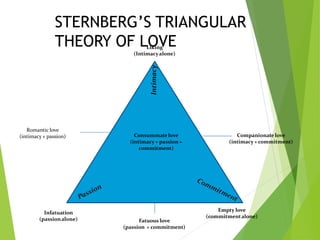
STERNBERG’S TRIANGULAR
THEORY OF LOVE
Liking
(Intimacyalone)
Empty love
(commitmentalone)
Infatuation
(passionalone) Fatuous love
(passion + commitment)
Romantic love
(intimacy+ passion) Companionatelove
(intimacy + commitment)
Consummatelove
(intimacy+ passion+
commitment)
Intimacy
DIFFERENT COMPONENTS OF LOVE
As theorized in Robert Sternberg’s
Triangular Theory of Love
Attraction serves as the first step toward liking
someone, and among all the basis of attraction that were
discussed, reciprocity (mutual liking) is what triggers a
couple to move forward romance and intimacy, and
eventually, to commitment.
COMMITMENT: SAYING YES
AND MEANING IT
COMMITMENT: SAYING YES AND
MEANING IT
We defined commitment as a continuing process of
showing love and care; fulfilling the promises or
agreements made with each other; and through bad times
and good times, the commitment stays firm and in place.
COMMITMENT: SAYING YES AND MEANING IT
Psychologist have conducted research on
commitment and have identified three variables related
to it (Rozenberg Quarterly):
1. Accumulation of all rewards of the relationship
2. Temptation of alternative partners
3. Investments made by couple in the relationship
This are variables involved in strengthening and
maintaining commitment.
COMMITMENT: SAYING YES AND MEANING IT
1. Accumulation of all rewards of the relationship
 Considered as the most important determinant of
satisfaction in a relationship.
 Rewards of the relationship include:
 Support from the partner
 Sexual satisfaction
 Emotional
 Financial
 Physical security
 Adventure
 Novelty
COMMITMENT: SAYING YES AND
MEANING IT
2. Temptation of alternative partners
 It was noted that the fewer options a party in a
relationship gets exposed to, the lesser the
possibility of breaking the relationship.
COMMITMENT: SAYING YES AND MEANING IT
3. Investments made by the couple in the relationship
 These investments may include time spent
together, common beliefs and experiences, mutual
experiences with mutual friends, and bearing
children. It was also discovered that religious
beliefs reinforce commitment.
COMMITMENT: SAYING YES AND
MEANING IT
Researchers identified behaviors married couples
may do that can predict a divorce or separation:
1. Criticism
2. Denial of the existence of conflict
3. Contempt
COMMITMENT: SAYING YES AND MEANING IT
1. Criticism
 This happens when there is the absence of
unconditional positive regard for each other in a
relationship.
 Constantly finding fault in the other partner will
result in negative feelings and resentment.
COMMITMENT: SAYING YES AND
MEANING IT
2. Denial of the existence of conflict
 When one party eludes the presence of a problem and
refuses to discuss it, as if belittling the problem, it
will result in frustration on the side of the other
party.
COMMITMENT: SAYING YES AND
MEANING IT
3. Contempt
 Like criticism, contempt is present when someone who
looks down on the party as inferior does not give
unconditional positive regard, and aggravates the
situation by expressing superiority over the other
 According to research (Rozenberg Quarterly), this is
the “ultimate expression of disillusionment and highly
predictive of divorce” or separation.
RESPONSIBILITIES IN A
RELATIONSHIP
Some important responsibilities that are necessary in
a relationship to make it flourish and stay beneficial
for the parties involved:
1. Be responsible for what you think and say to the
other person.
2. Be responsible for what you promise to do or not to
do.
3. Ensure the relationship is mutually beneficial.
4. Respect the other party or parties involved.
5. Be ready to provide support when needed.
ACTIVITY
NO. 1
1. How do you show responsibility in your relationships:
1. When your at home?
2. With the authorities in school?
3. With your friends?
4. With someone you have a romantic relationship
with?

Q2-Chapter 10 PERSONAL RELATIONSHIP.pptx

  • 1.
    CHAPTER 10  WhatIs Personal Relationship?  How Are Attachments Developed?  What Drives Attraction?  Love and Intimacy Commitment: Saying Yes and Meaning It  Responsibilities in a Relationship
  • 2.
  • 3.
    Write the wordTrue if the statement is correct and write the word False if the statement is not correct. Write your answer on a separate sheet of paper.  _______1. Attraction is a force that unite people.  _______2.Affection is one of human beings' greatest emotions.  _______3.Infatuation is love without engagement or intimacy.  _______4. People differ in what they consider attractive.  _______5. Relationship is a one-way traffic.
  • 4.
    Write the wordYes if the statement is correct and write the word No if the statement is not correct.  ______1.Filipino culture is bound to believe that a decent display of someone's feelings also a must, to be accepted by society;  ______2.Macoi has leadership and work skills but does not have good looks. Is it attractive to ladies? ______3.Majelyn dictates to her boyfriend how to dress up and what to eat. Is this a controlling issue?  ______4. Is “Love” one of the three components of a healthy relationship according to Sternberg?  ______5 Is cheating one of the unacceptable issues in any relationship?
  • 5.
    Even before languagewas invented, pre-historic humans were already interacting through many other forms of behavior. They may have learned how to smile or greet each other; show love, affection, and even loyalty to the group; and hunt together for food. This interaction was necessary for survival of the group where an individual belonged. Survival was the primary reason why human beings have the fundamental need to belong. What Is Personal Relationship?
  • 6.
    In today’s world,this need to belong still exists, perhaps because it has been imprinted in our genetic memory that was passed on to us by our ancestors. Belonging to a group generates many benefits like having a support system when you need some shoulder to cry on or draw some strength from. The relationships that are nurtured in a group help each one of us survive. What Is Personal Relationship?
  • 7.
    HOW DO YOUEXPRESS YOUR ATTRACTION TOWARD ANOTHER PERSON?
  • 8.
    A HEALTHY RELATIONSHIPWITH FRIENDS IS A SOURCE OF LIFETIME HAPPINESS.
  • 9.
    Researchers have foundthat relationships are important to one’s happiness. The absence of close relationships can produce a deep negative effect on a individual who is deny of it, such as feeling worthless, powerless, and alienated. A HEALTHY RELATIONSHIP WITH FRIENDS IS A SOURCE OF LIFETIME HAPPINESS.
  • 10.
    BUT HOW DOWE DEFINE RELATIONSHIP?
  • 11.
    Merriam-Webster Online Dictionary definesrelationship as: “The way in which two or more people, groups, countries, etc., talk to and deal with each other.” The definition is extended to include “the way in which two or more people or things are connected.”
  • 12.
    TYPES OF RELATIONSHIPSDEPENDING ON THE NATURE OF INTERACTION THAT EXIST BETWEEN TWO OR MORE ENTITIES  Business transactional relationship  Professional relationship  Familyrelationship  Friendlyrelationship  Romanticrelationship
  • 13.
    We can alsosay that every relationship has specific objectives or purpose that a person wishes to pursue, either because of need, want, or desire.
  • 14.
  • 15.
    The very firstmeaningful relationship every human being encounters is with one’s mother. Even before birth, the mother- child relationship is already established. HOW ARE ATTACHMENTS DEVELOPED?
  • 16.
    The intimacy thatis nurtured during the nine months of pregnancy will be enhanced and developed further after the birth of the child. HOW ARE ATTACHMENTS DEVELOPED?
  • 17.
    A careless andnon-caring pregnant mother can affect the child in the womb, which may leave psychological and emotional scars even before the child is born. HOW ARE ATTACHMENTS DEVELOPED?
  • 18.
    Research has confirmedthat emotional experiences of expectant mothers, particularly strong emotions such as anger or anxiety, which produce chemicals in the body such as adrenaline, affect the child in the womb. HOW ARE ATTACHMENTS DEVELOPED?
  • 19.
    At the momentof birth when the child is laid beside the mother to be fed and cuddled, bonding occurs and the infant develops an attachment to the mother, and later on with the father. HOW ARE ATTACHMENTS DEVELOPED?
  • 20.
    At the momentof birth when the child is laid beside the mother to be fed and cuddled, bonding occurs and the infant develops an attachment to the mother, and later on with the father. HOW ARE ATTACHMENTS DEVELOPED?
  • 21.
    A mother whogazes at her child’s face and the child responding with a smile are the foundations of our sense of physiological and psychological well-being. HOW ARE ATTACHMENTS DEVELOPED?
  • 22.
    1. SECURE ATTACHMENT 2.AVOIDANT ATTACHMENT 3. ANXIOUS-AMBIVALENT ATTACHMENT THREE DIFFERENT ATTACHMENT STYLES
  • 23.
    1. SECURE ATTACHMENT Is when the primary caregiver is the most of the time present and when all the emotional needs of an infant are providing a sense of security to the infant.  Chances for a child who is exposed to this style of attachment, grow up to have more secure and stable relationships. THREE DIFFERENT ATTACHMENT STYLES
  • 24.
    2. AVOIDANT ATTACHMENT iscold and to a child’s  Is when the primary caregiver detached, and even unresponsive need.  A person attachment who experienced this style of in infancy and childhood will oftentimes experience unstable relationships in the future. THREE DIFFERENT ATTACHMENT STYLES
  • 25.
    3. ANXIOUS-AMBIVALENT ATTACHMENT Is when the primary caregiver is not consistent in terms of presence and in the meeting a child’s emotional needs.  A person who experienced this style of attachment in childhood may develop separation anxieties with a loved one, or may have mixed feelings between hesitancy and commitment when entering into meaningful relationships. THREE DIFFERENT ATTACHMENT STYLES
  • 26.
  • 27.
    WHAT DRIVES ATTRACTION? Whenattraction between two persons is discussed, it is often understood as based on physical appearance. While this might be true to a certain extent, there is more to attraction that what we already know.
  • 28.
    WHAT DRIVES ATTRACTION? Inthe British Broadcasting Company (BBC) website under Science: Human Body and Mind, attraction is the first stage, and during changes of personality development it lead to closeness and commitment.
  • 29.
    WHAT DRIVES ATTRACTION? Accordingto the website which referred to the biological model of love as proposed by anthropologist Helen Fisher of Rutgers University in New Jersey: Attraction is primarily based on physiology or certain hormones that persons who get attracted to others often pick up with their noses.
  • 30.
    WHAT DRIVES ATTRACTION? Beingattracted to another person may also mean liking their genes that are perceived through their physical looks.
  • 31.
    THREE STAGES OFFALLING IN LOVE by Helen Fisher 1. LUST 2. ATTRACTION 3. ATTACHMENT
  • 32.
    THREE STAGES OFFALLING IN LOVE by Helen Fisher 1. LUST  Is driven by the sex hormones, testosterone, and estrogen. These hormones affect both sexes.
  • 33.
    THREE STAGES OFFALLING IN LOVE by Helen Fisher 2. ATTRACTION  Is described as the lovestruck phase, which involves neurotransmitters in the brain such as dopamine, neropinephrine, and serotonin.  This is the stage when a person loses sleep and appetite over someone, and become very excited to someone while daydreaming of this special person.
  • 34.
    THREE STAGES OFFALLING IN LOVE by Helen Fisher 3. ATTACHMENT  When the couple in love decides to continue with the relationship, they enter the attachment stage where long-lasting commitments are exchanged and may lead to raising a family
  • 35.
    OTHER REASON WHYPEOPLE ATTRACTED TO ONE ANOTHER according to Rozenberg Quarterly 1. TRANSFERENCE EFFECT 2. PROPINQUITY EFFECT 3. SIMILARITY 4. RECIPROCITY 5. PHYSICAL ATTRACTIVENESS 6. PERSONALITY CHARACTERISTICS AND TRAITS
  • 36.
    OTHER REASON WHYPEOPLE ATTRACTED TO ONE ANOTHER according to Rozenberg Quarterly 1. TRANSFERENCE EFFECT  There are times we meet people who we immediately like or dislike. Usually, these people remind us of someone in the past who has affected our sense of self and our behavior.
  • 37.
    OTHER REASON WHYPEOPLE ATTRACTED TO ONE ANOTHER according to Rozenberg Quarterly 2. PROPINQUITY EFFECT  We often develop a sense of familiarity with people who live close to us, work with us, or go to school with us, which leads us to liking them more.
  • 38.
    OTHER REASON WHYPEOPLE ATTRACTED TO ONE ANOTHER according to Rozenberg Quarterly 3. SIMILARITY  We often like people who we have similarities with, such as social class background, religious beliefs, age, and education.
  • 39.
    OTHER REASON WHYPEOPLE ATTRACTED TO ONE ANOTHER according to Rozenberg Quarterly 3. SIMILARITY  We are often attracted to like-minded persons and those who have similar beliefs and values as ours, because the similarity is a validation of our innermost values and belief system, and who we are as a person.
  • 40.
    OTHER REASON WHYPEOPLE ATTRACTED TO ONE ANOTHER according to Rozenberg Quarterly 4. RECIPROCITY  We like people who like us back. The more we are liked by someone we equally like, the more we behave in ways that promote mutual feeling of liking.
  • 41.
    OTHER REASON WHYPEOPLE ATTRACTED TO ONE ANOTHER according to Rozenberg Quarterly 4. PHYSICAL ATTRACTIVENESS  Several research studies were conducted to confirm that physical attractiveness is a major factor in liking someone, and usually, first impression counts a lot, too.
  • 42.
    OTHER REASON WHYPEOPLE ATTRACTED TO ONE ANOTHER according to Rozenberg Quarterly 5. PERSONALITY CHARACTERISTICS AND TRAITS  People get attracted to characteristics that lead to liking the other person.  Emphatic persons, who exude warmth and sympathy and who are also optimistic and maintain positive views; and socially competent person, who are good communicators and enjoy good conversations.
  • 43.
  • 44.
    LOVE AND INTIMACY Therehas been a raging debate over the definition of love.  Is love a feeling?  Is love a though?  Is love physical?  The definition of love is a feeling of deep affection, passion, or strong liking for a person or thing.
  • 45.
    LOVE AND INTIMACY The AmericanHeritage Dictionary defines love as:  A strong feeling of affection and concern toward another person, as that arising from kinship or close friendship;  A strong feeling of affection and concern for another person accompanied by sexual attraction;  A feeling of devotion or adoration toward God or a god;  A feeling kindness or concern by God or a good toward humans;  Sexual desire or activity: the pleasures of love;
  • 46.
    LOVE AND INTIMACY Based onthese definitions, we see angles of what love is? It is an emotion, a feeling, a virtue, an action, and an experience. Love is also defined differently in different cultures.
  • 47.
    DIFFERENT COMPONENTS OFLOVE As theorized in Robert Sternberg’s Triangular Theory of Love 1. INTIMACY 2. COMMITMENT 3. PASSION
  • 48.
    DIFFERENT COMPONENTS OFLOVE As theorized in Robert Sternberg’s Triangular Theory of Love 1. INTIMACY  Researchers Reis, Clark, and Holmes and Shaver defined intimacy as: “ That lovely moment when someone understands and validate us. “
  • 49.
    DIFFERENT COMPONENTS OFLOVE As theorized in Robert Sternberg’s Triangular Theory of Love 1. INTIMACY o Close Familiarity / Friendship / Closeness  Researchers Reis, Clark, and Holmes and Shaver defined intimacy as: “ That lovely moment when someone understands and validate us. “
  • 50.
    DIFFERENT COMPONENTS OFLOVE As theorized in Robert Sternberg’s Triangular Theory of Love 1. INTIMACY  Being intimate with another person is about being open and vulnerable to that person whom we deeply trust, who we feel connected with, and who values us with unconditional positive regard, which is viewing the other person with complete trust and free of suspicion or negative thought.
  • 51.
    DIFFERENT COMPONENTS OFLOVE As theorized in Robert Sternberg’s Triangular Theory of Love 1. INTIMACY  Communication is a key component in developing intimacy, where self-disclosure is practiced which leads to profound and meaningful conservations that nurture and strengthen intimacy.  Self-disclosure requires honesty for it to work, and is a tool in enhancing the love relationship between two person.
  • 52.
    DIFFERENT COMPONENTS OFLOVE As theorized in Robert Sternberg’s Triangular Theory of Love 1. COMMITMENT  Is an act of deciding to consistently fulfill and live by agreements made with another person, entity, or cause, and where the values of integrity and respect serve as a guide to one’s behavior and thinking.  Commitment in a love relationship is expressed continuously in caring and loving actions for the beloved.
  • 53.
    DIFFERENT COMPONENTS OFLOVE As theorized in Robert Sternberg’s Triangular Theory of Love 1. PASSION  Passion, as defined in generic terms, is the intense state of being that drives and consumes a person to pursue an interest, a vision, or a person.  In terms of romantic love, passion connotes sexual attraction, as well as intimacy.
  • 54.
    STERNBERG’S TRIANGULAR THEORY OFLOVE Liking (Intimacyalone) Empty love (commitmentalone) Infatuation (passionalone) Fatuous love (passion + commitment) Romantic love (intimacy+ passion) Companionatelove (intimacy + commitment) Consummatelove (intimacy+ passion+ commitment) Intimacy
  • 55.
    DIFFERENT COMPONENTS OFLOVE As theorized in Robert Sternberg’s Triangular Theory of Love Attraction serves as the first step toward liking someone, and among all the basis of attraction that were discussed, reciprocity (mutual liking) is what triggers a couple to move forward romance and intimacy, and eventually, to commitment.
  • 56.
  • 57.
    COMMITMENT: SAYING YESAND MEANING IT We defined commitment as a continuing process of showing love and care; fulfilling the promises or agreements made with each other; and through bad times and good times, the commitment stays firm and in place.
  • 58.
    COMMITMENT: SAYING YESAND MEANING IT Psychologist have conducted research on commitment and have identified three variables related to it (Rozenberg Quarterly): 1. Accumulation of all rewards of the relationship 2. Temptation of alternative partners 3. Investments made by couple in the relationship This are variables involved in strengthening and maintaining commitment.
  • 59.
    COMMITMENT: SAYING YESAND MEANING IT 1. Accumulation of all rewards of the relationship  Considered as the most important determinant of satisfaction in a relationship.  Rewards of the relationship include:  Support from the partner  Sexual satisfaction  Emotional  Financial  Physical security  Adventure  Novelty
  • 60.
    COMMITMENT: SAYING YESAND MEANING IT 2. Temptation of alternative partners  It was noted that the fewer options a party in a relationship gets exposed to, the lesser the possibility of breaking the relationship.
  • 61.
    COMMITMENT: SAYING YESAND MEANING IT 3. Investments made by the couple in the relationship  These investments may include time spent together, common beliefs and experiences, mutual experiences with mutual friends, and bearing children. It was also discovered that religious beliefs reinforce commitment.
  • 62.
    COMMITMENT: SAYING YESAND MEANING IT Researchers identified behaviors married couples may do that can predict a divorce or separation: 1. Criticism 2. Denial of the existence of conflict 3. Contempt
  • 63.
    COMMITMENT: SAYING YESAND MEANING IT 1. Criticism  This happens when there is the absence of unconditional positive regard for each other in a relationship.  Constantly finding fault in the other partner will result in negative feelings and resentment.
  • 64.
    COMMITMENT: SAYING YESAND MEANING IT 2. Denial of the existence of conflict  When one party eludes the presence of a problem and refuses to discuss it, as if belittling the problem, it will result in frustration on the side of the other party.
  • 65.
    COMMITMENT: SAYING YESAND MEANING IT 3. Contempt  Like criticism, contempt is present when someone who looks down on the party as inferior does not give unconditional positive regard, and aggravates the situation by expressing superiority over the other  According to research (Rozenberg Quarterly), this is the “ultimate expression of disillusionment and highly predictive of divorce” or separation.
  • 66.
    RESPONSIBILITIES IN A RELATIONSHIP Someimportant responsibilities that are necessary in a relationship to make it flourish and stay beneficial for the parties involved: 1. Be responsible for what you think and say to the other person. 2. Be responsible for what you promise to do or not to do. 3. Ensure the relationship is mutually beneficial. 4. Respect the other party or parties involved. 5. Be ready to provide support when needed.
  • 67.
    ACTIVITY NO. 1 1. Howdo you show responsibility in your relationships: 1. When your at home? 2. With the authorities in school? 3. With your friends? 4. With someone you have a romantic relationship with?