Having and building relationship
with others is natural, yet
sometimes, it could be challenging
and confusing.
Attraction
The Merriam-Webster
dictionary, collegiately
defined attraction as: the
action or power of evoking
interest, pleasure, or liking
for someone or something;
and a quality or feature that
evokes interest, liking, or
desire.
Attraction
it could be said that attraction
is a positive connection
between two or more people
that share something in
common, like interests,
likes/dislikes, or desires. Some
qualities may catch your
attention, and which could
spark a certain kind of
relationship.
Key Components of Attraction
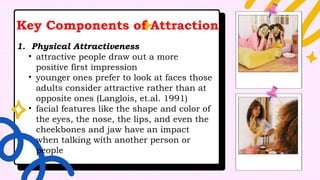
1. Physical Attractiveness
• attractive people draw out a more
positive first impression
• younger ones prefer to look at faces those
adults consider attractive rather than at
opposite ones (Langlois, et.al. 1991)
• facial features like the shape and color of
the eyes, the nose, the lips, and even the
cheekbones and jaw have an impact
when talking with another person or
people
Key Components of Attraction
2. Similarity
• you are “on the same wavelength” that is why you
find it easy to get along with him/her because you
share the same interests and opinions.
• people classify other people based on information
they already knew about them.
• social categorization, wherein, people mentally group
others on where they belong and that with the same
characteristics with them, like group age, religion,
personality, attitude, social status, or education.
• When people rely too much on that mentality, it
results to stereotyping, where someone is being
judged by others only because they were part of a
specific group they knew and not based on who
he/she is.
Key Components of Attraction
3. Proximity
• pertains to physical distance with other
people and it is related to functional
distance
• the more you encounter or interact with
the person, the more you allow yourself
to get to know him/her better which
leads to a better relationship like
friendship or intimate relationship
Key Components of Attraction
4. Reciprocity
• we tend to get along with people or with
someone whom we have the same feelings
toward people classify other people based on
information they already knew about them.
• it is when feelings with someone are being
reciprocated or returned in the same way as
you do.
• attraction is something that may happen in
different ways, with different people, and in
different circumstances, and may lead to a
much deeper connection or relation with
others.
Key Components of Attraction
4. Reciprocity
• According to Brannan and Mohr,
authors of one of the modules of in the
book of Together: The Science of Social
Psychology, “Another way to think of it
is that relationships are built on a give
and take; if one side is not
reciprocating, then the relationship is
doomed”. These may happen in any
relationship, with friends, classmates,
family members, or romantic partners.
Love
It appears that the word Love has
many meanings. Some definitions
in the Meriam-Webster dictionary
are:
(a) strong affection for another
arising out of kinship or personal
ties;
(b) attraction based on sexual
desire: affection and tenderness felt
by lovers;
(c) affection based on admiration,
benevolence, or common interests
Love
• an assurance of affection
• it may differ depending on one’s
experience and knowledge of
love, though. Sometimes, it may
affect the emotional and
psychological being of a person,
thus influencing his/her emotion
toward another. This emotional
bond depends on the presence or
absence of support from others.
Love
Accountable Chemicals for the
Connection of two Individuals
• Oxytocin - between mother
and child inside her womb and
even after giving birth
• Peptide - known as the love
hormone, a female
reproduction hormone, which
helps to deepen the connection
between mother and child
through breastfeeding
Love
Accountable Chemicals for the
Connection of two Individuals
• Oxytocin, Endorphin, Serotonin,
and Dopamine - are so-called “feel
good” chemicals that promote
strong connections/bonds between
people since it releases during
happy moments.
• Vasopressin -another element that
promotes love. It is also a peptide
that conveys the behavior of an
individual’s social engagement
Intimacy
is consisting of affective variables
such as closeness, caring, and
emotional support; Passion consists
of physiological and affective variables
like physical attraction, emotional
responses that promote physiological
changes, and sexual arousal; and
Commitment is a cognitive process
and decision to dedicate love to
another individual with the
willingness to keep the relationship
lasts (Brannan, D. & Mohr, C. D.,
2020)
Love
Attachment Style according
to Eastwick & Finkel
1.Secure Attachment Style – a healthy style
wherein the children used to receive care and
easily communicate with the parents since they
feel that they are always available to listen and
keep them safe.
2.Anxious/ambivalent Attachment Style - when
children are lacking or seeking more affection
from parents because they are too dependent on
them.
3.Avoidant Attachment Style – it is when
children are distant to the parent/s, sometimes
due to unpleasant experiences.
Commitment
• it is a long-term relationship
between individuals
• more complex relationship that
resulted to increasingly turn to
each other not only for social
support but also for help in
coordinating activities,
remembering dates and
appointments, and
accomplishing tasks (Wegner,
Erber, & Raymond, 1991).
Commitment
• Dr. Rajiv Jhangiani and Dr.
Hammond Tarry reiterated the
Slotter et al., 2011 that
“commitment refers to the
feelings and action that keep
partners working together to
maintain the relationship”. Any
relationship will last through the
cooperation of both parties,
without this, the relationship will
not last and ends with breaking
up.
Commitment
• is a choice, a long
and not an easy
process that needs to
be participated by
you and your partner
Tips on how to Keep
Healthy Relationships
with Others.
Stay happy. Happiness gives you the feeling of
satisfaction for both abstract and concrete things.
Be empathic. Empathizing with another is acting with
greater cooperation and overall selflessness—the desire
to help, even at a potential cost to the self.
Keep open communication. It provides an opportunity
to size up the trustworthiness of a person by verbally
committing to cooperate with another.
Always trust. Working with others toward a common
goal requires a level of faith that others will repay our
hard work and generosity. Supporting their interests is
also showing your trust.
Show respect. People are likely to give respect to others
by being polite, honest, and by showing kindness all the
time.
Be a helping hand. In times of trouble (e.g., mentally/
emotionally), make him/her feel that he/she always has
you on his/her side.
What I Can Do
In this activity, you are going to express
your best way of expressing your
attraction love or showing commitment
to someone by creating a mini poster out
of cut-outs from magazines, newspapers,
or other printed materials. Your mini
poster should be done on a short bond
paper and must showcase your ways of
expressing affections to develop a long
term-relationship. Write a brief
explanation of your work at the back of
your mini poster.
Thank you!

2.-Personal-Relationship.Personal Development

  • 5.
    Having and buildingrelationship with others is natural, yet sometimes, it could be challenging and confusing.
  • 6.
    Attraction The Merriam-Webster dictionary, collegiately definedattraction as: the action or power of evoking interest, pleasure, or liking for someone or something; and a quality or feature that evokes interest, liking, or desire.
  • 7.
    Attraction it could besaid that attraction is a positive connection between two or more people that share something in common, like interests, likes/dislikes, or desires. Some qualities may catch your attention, and which could spark a certain kind of relationship.
  • 8.
    Key Components ofAttraction 1. Physical Attractiveness • attractive people draw out a more positive first impression • younger ones prefer to look at faces those adults consider attractive rather than at opposite ones (Langlois, et.al. 1991) • facial features like the shape and color of the eyes, the nose, the lips, and even the cheekbones and jaw have an impact when talking with another person or people
  • 9.
    Key Components ofAttraction 2. Similarity • you are “on the same wavelength” that is why you find it easy to get along with him/her because you share the same interests and opinions. • people classify other people based on information they already knew about them. • social categorization, wherein, people mentally group others on where they belong and that with the same characteristics with them, like group age, religion, personality, attitude, social status, or education. • When people rely too much on that mentality, it results to stereotyping, where someone is being judged by others only because they were part of a specific group they knew and not based on who he/she is.
  • 10.
    Key Components ofAttraction 3. Proximity • pertains to physical distance with other people and it is related to functional distance • the more you encounter or interact with the person, the more you allow yourself to get to know him/her better which leads to a better relationship like friendship or intimate relationship
  • 11.
    Key Components ofAttraction 4. Reciprocity • we tend to get along with people or with someone whom we have the same feelings toward people classify other people based on information they already knew about them. • it is when feelings with someone are being reciprocated or returned in the same way as you do. • attraction is something that may happen in different ways, with different people, and in different circumstances, and may lead to a much deeper connection or relation with others.
  • 12.
    Key Components ofAttraction 4. Reciprocity • According to Brannan and Mohr, authors of one of the modules of in the book of Together: The Science of Social Psychology, “Another way to think of it is that relationships are built on a give and take; if one side is not reciprocating, then the relationship is doomed”. These may happen in any relationship, with friends, classmates, family members, or romantic partners.
  • 13.
    Love It appears thatthe word Love has many meanings. Some definitions in the Meriam-Webster dictionary are: (a) strong affection for another arising out of kinship or personal ties; (b) attraction based on sexual desire: affection and tenderness felt by lovers; (c) affection based on admiration, benevolence, or common interests
  • 14.
    Love • an assuranceof affection • it may differ depending on one’s experience and knowledge of love, though. Sometimes, it may affect the emotional and psychological being of a person, thus influencing his/her emotion toward another. This emotional bond depends on the presence or absence of support from others.
  • 15.
    Love Accountable Chemicals forthe Connection of two Individuals • Oxytocin - between mother and child inside her womb and even after giving birth • Peptide - known as the love hormone, a female reproduction hormone, which helps to deepen the connection between mother and child through breastfeeding
  • 16.
    Love Accountable Chemicals forthe Connection of two Individuals • Oxytocin, Endorphin, Serotonin, and Dopamine - are so-called “feel good” chemicals that promote strong connections/bonds between people since it releases during happy moments. • Vasopressin -another element that promotes love. It is also a peptide that conveys the behavior of an individual’s social engagement
  • 17.
    Intimacy is consisting ofaffective variables such as closeness, caring, and emotional support; Passion consists of physiological and affective variables like physical attraction, emotional responses that promote physiological changes, and sexual arousal; and Commitment is a cognitive process and decision to dedicate love to another individual with the willingness to keep the relationship lasts (Brannan, D. & Mohr, C. D., 2020)
  • 18.
  • 19.
    Attachment Style according toEastwick & Finkel 1.Secure Attachment Style – a healthy style wherein the children used to receive care and easily communicate with the parents since they feel that they are always available to listen and keep them safe. 2.Anxious/ambivalent Attachment Style - when children are lacking or seeking more affection from parents because they are too dependent on them. 3.Avoidant Attachment Style – it is when children are distant to the parent/s, sometimes due to unpleasant experiences.
  • 20.
    Commitment • it isa long-term relationship between individuals • more complex relationship that resulted to increasingly turn to each other not only for social support but also for help in coordinating activities, remembering dates and appointments, and accomplishing tasks (Wegner, Erber, & Raymond, 1991).
  • 21.
    Commitment • Dr. RajivJhangiani and Dr. Hammond Tarry reiterated the Slotter et al., 2011 that “commitment refers to the feelings and action that keep partners working together to maintain the relationship”. Any relationship will last through the cooperation of both parties, without this, the relationship will not last and ends with breaking up.
  • 22.
    Commitment • is achoice, a long and not an easy process that needs to be participated by you and your partner
  • 23.
    Tips on howto Keep Healthy Relationships with Others.
  • 24.
    Stay happy. Happinessgives you the feeling of satisfaction for both abstract and concrete things. Be empathic. Empathizing with another is acting with greater cooperation and overall selflessness—the desire to help, even at a potential cost to the self. Keep open communication. It provides an opportunity to size up the trustworthiness of a person by verbally committing to cooperate with another. Always trust. Working with others toward a common goal requires a level of faith that others will repay our hard work and generosity. Supporting their interests is also showing your trust. Show respect. People are likely to give respect to others by being polite, honest, and by showing kindness all the time. Be a helping hand. In times of trouble (e.g., mentally/ emotionally), make him/her feel that he/she always has you on his/her side.
  • 25.
    What I CanDo In this activity, you are going to express your best way of expressing your attraction love or showing commitment to someone by creating a mini poster out of cut-outs from magazines, newspapers, or other printed materials. Your mini poster should be done on a short bond paper and must showcase your ways of expressing affections to develop a long term-relationship. Write a brief explanation of your work at the back of your mini poster.
  • 26.

Editor's Notes

  • #10 Most likely, the people always near you just like your classmate or neighbor has a big tendency to become your friend.
  • #18 Since love has its different types, we could say that it may happen any time, to any individual, at a different level with people around us like friends, classmates, neighbors, family members, etc.