What gets us together and then keeps us that way
PRESENTED BY-
PRITAMSARKAR
UNDERVISION-
NANA AKHOBADZE
 What exactly is it ?
 An attitude ?
 A phenomenon ?
 Hard to define – can it be measured ?
Falling in love can induce a calming effect on
the body and mind, raising levels of nerve
growth factor for up to a year.
A strong affection for one another arising out of :
Personal ties
Attraction based on sexual desire
Affection based on admiration, benevolence, or
common interests
 The Love Scale had three components:
 Attachment – the desire for another’s presence
and emotional support
 Caring – concern for the other’s well being
 Intimacy – desire for close, confidential
communication
 Is the Love Scale meaningful ?
 Maybe, couples who scored high
spend more time looking in each
others eyes
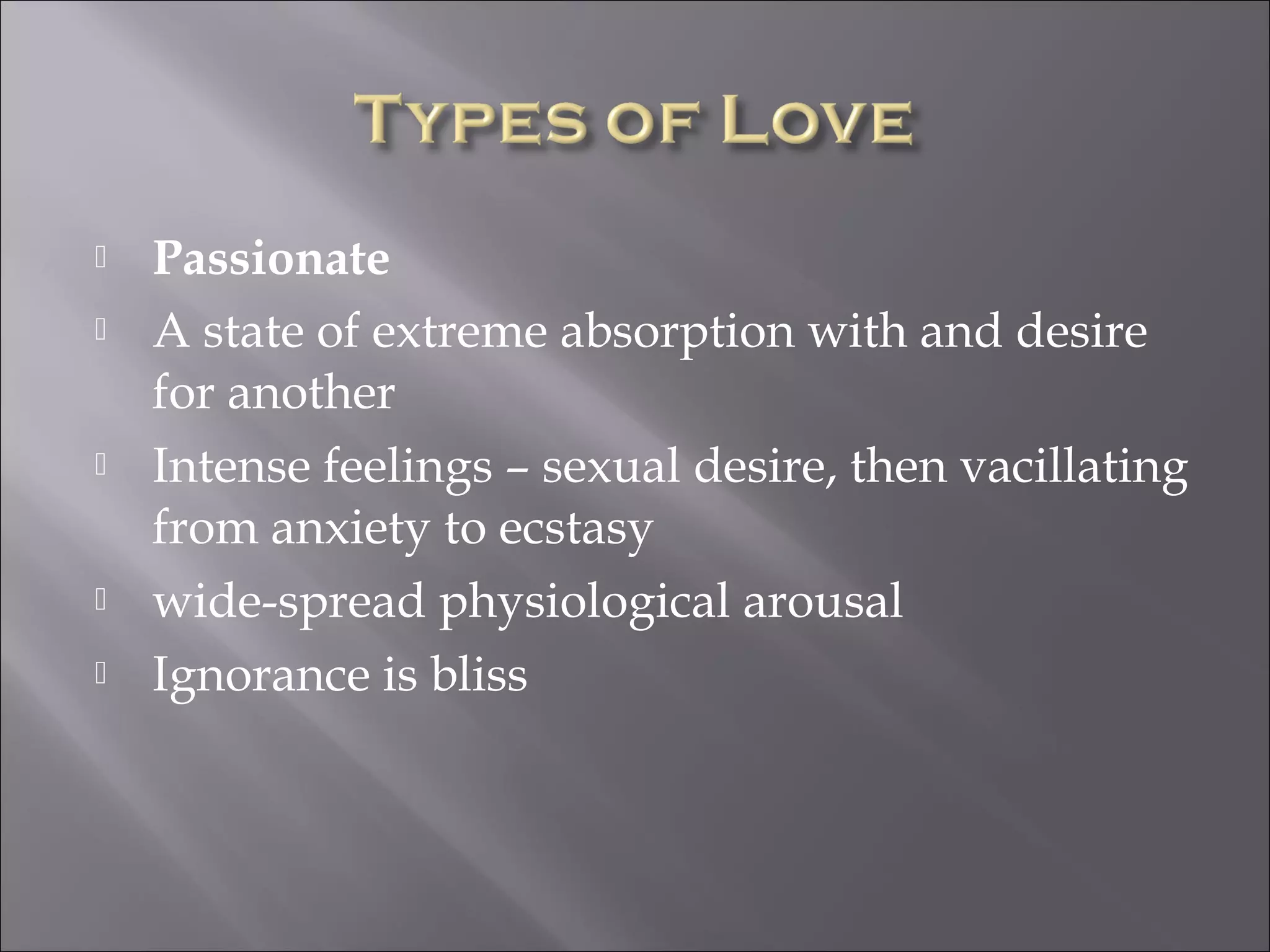
 Passionate
 A state of extreme absorption with and desire
for another
 Intense feelings – sexual desire, then vacillating
from anxiety to ecstasy
 wide-spread physiological arousal
 Ignorance is bliss
 Typically hits fast
 Logic is pushed aside
 Can lead to premature commitments
 Or, the big fade
 Based on friendly affection and deep attachment due
to extensive familiarity
 Less intense
 Knowing and forgiving
 Willing to work
 Endures after passion evaporates
 Sex is rich, mature, communicative, willing to
take risks
 While occasionally passionate love can reemerge
as companionate love, sometimes the reverse
happens and old friends or co-workers can see
their affections ignite sexually
 Love’s Three Faces
 Passion
 Fuels romantic feelings and desire for sexual
interaction and unification
 Similar to an addiction, intensity causes a
powerful craving
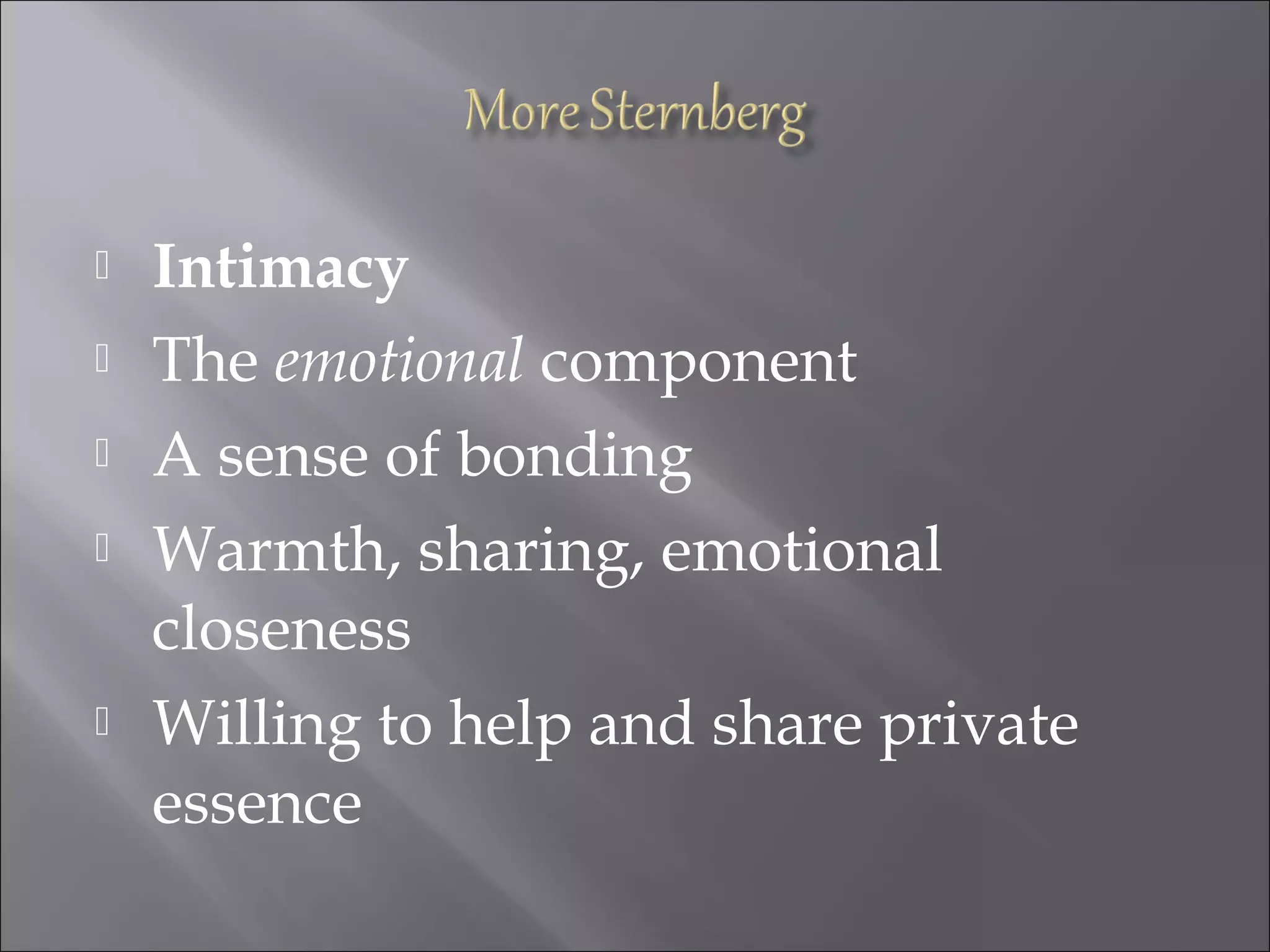
 Intimacy
 The emotional component
 A sense of bonding
 Warmth, sharing, emotional
closeness
 Willing to help and share private
essence
 Commitment
 The cognitive aspect
 A conscious decision to love another
 The choice to maintain a relationship
despite challenges
 Putting it all together
 Sternberg explains the transition from
passionate to companionate love
 Passionate love develops rapidly and intensely,
then declines. Intimacy and commitment grow. If
they don’t, the drop in passion likely signals
the relationship’s end.
 The interplay of these three components and
their varying power over time results in
differences in how we experience love.
 Isolating and combining the three faces gives
us informative labels for differing types of love.
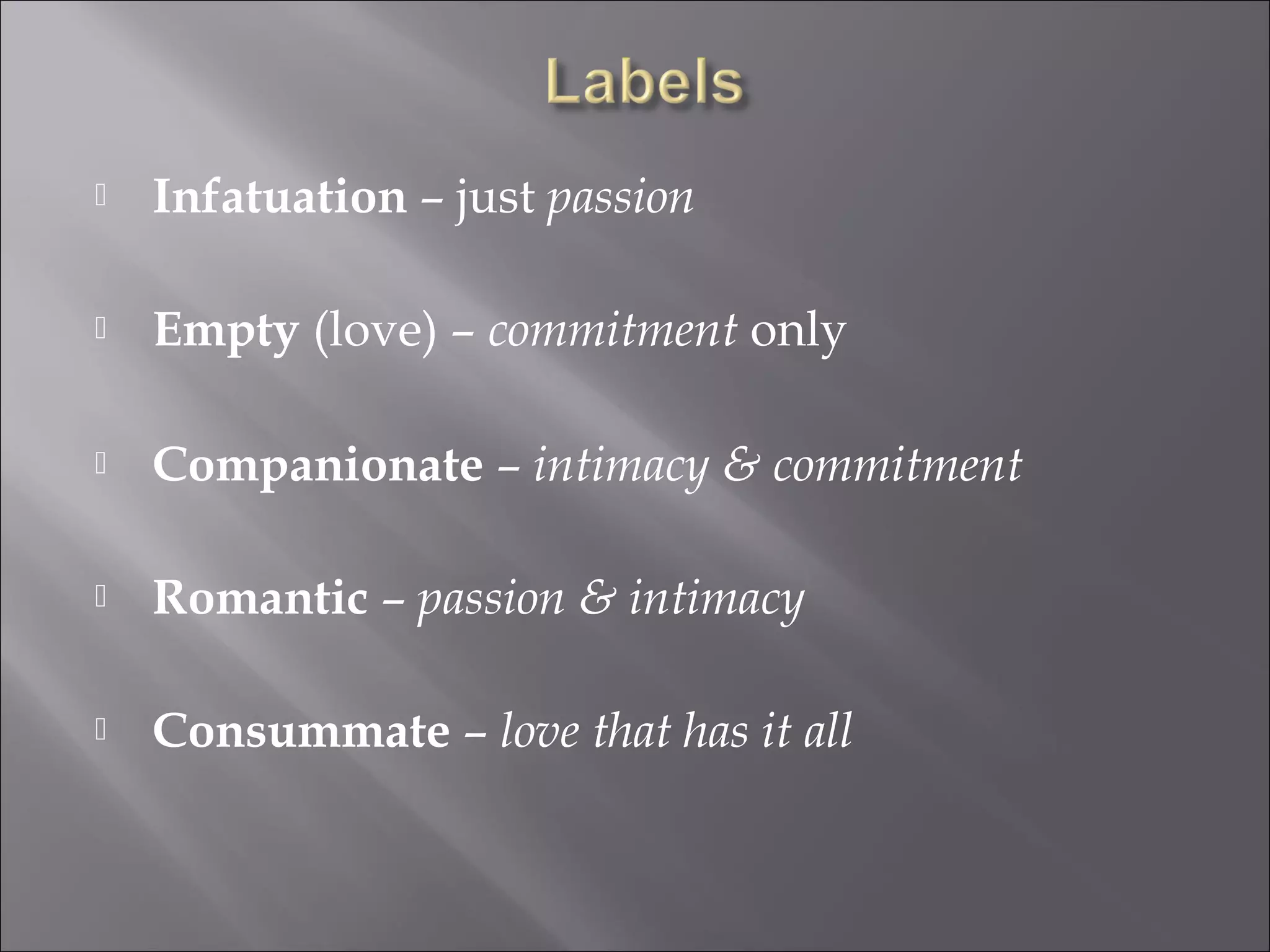
 Infatuation – just passion
 Empty (love) – commitment only
 Companionate – intimacy & commitment
 Romantic – passion & intimacy
 Consummate – love that has it all
 Research shows that:
1) the presence of intimacy and commitment
predict stability and duration,
2) married have more commitment
3) intimacy continually rises in long term
relationships
4) passion drops more sharply for women
 Why do we fall in love?
 Is it to escape loneliness?
 To answer our deepest need?
 The ultimate extension of our social network?
 Geographic nearness
 The Mere Exposure Effect – repeated contact
with novel stimuli tends to increase liking for the
stimuli
 People also tend to meet in locations engaging
in activities that reflect common interests – the
NHSLS confirms this
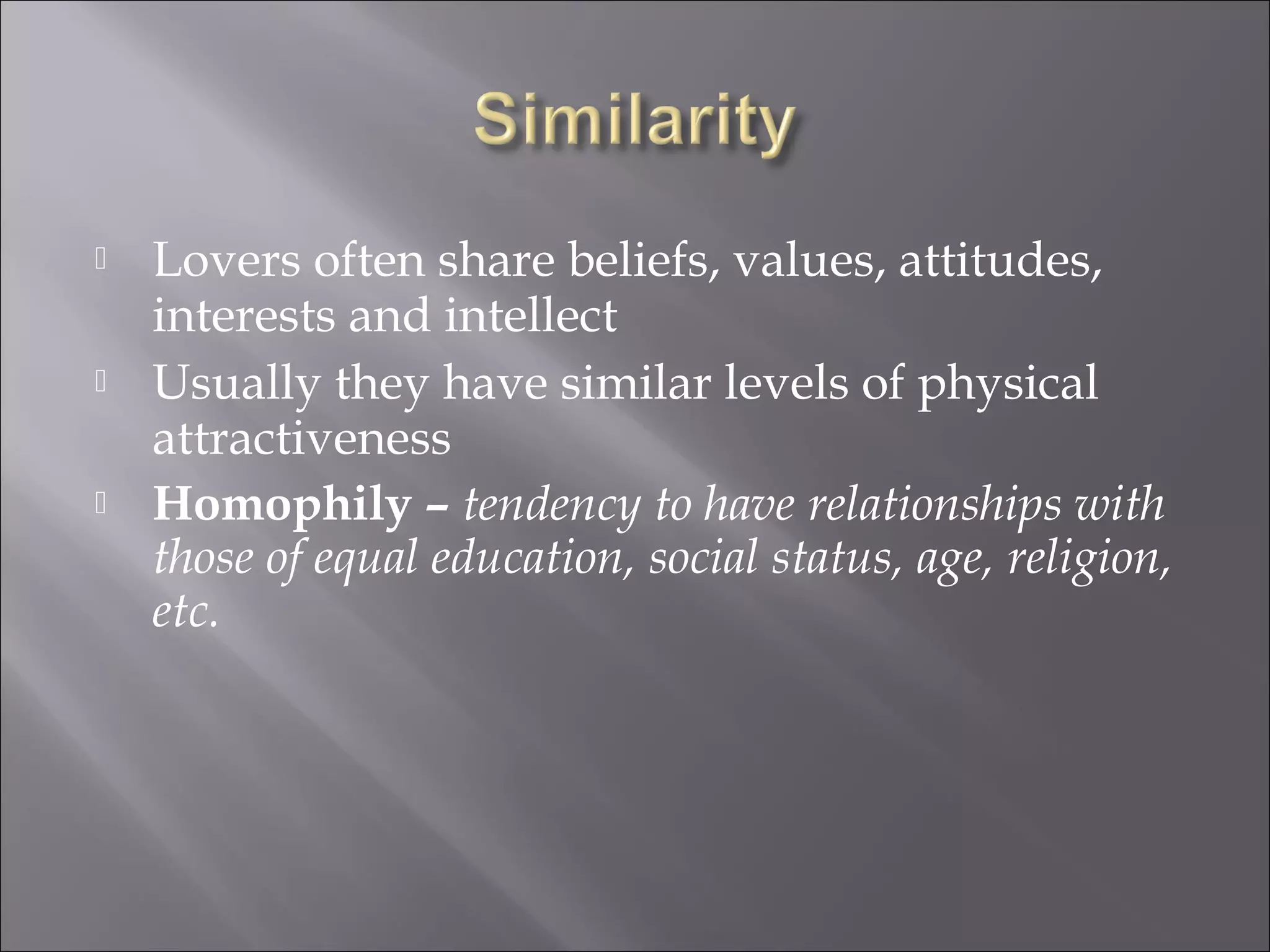
 Lovers often share beliefs, values, attitudes,
interests and intellect
 Usually they have similar levels of physical
attractiveness
 Homophily – tendency to have relationships with
those of equal education, social status, age, religion,
etc.
 We tend to like people who like us
 Couples who show equal levels of affection last
longer
 Attractive people ate both sought as friends
and lovers and perceived as possessing many
desired qualities
 We like to look at them
 We think they have more to offer
 We like being seen with them
 Maybe they are more confident
 We think they are healthier
 Plenty of proximity
 Similar interests
 Same social class
 Abundant reciprocity
 Both physically attractive
 Is this preference innate?
 Men, world-wide, are especially influenced by
physical attractiveness in particular youth and
healthiness.
 Desire to maximize reproductive capabilities?
 But as time goes on the importance of beauty
fades.
 An intense emotional tie between two individuals,
usually, but not always, mother and child
 Three major styles
1) Secure – Mom as base for exploration, only
moderately distressed when she leaves,
reassured at return, then more exploration
2) Anxious-Ambivalent – marked by extreme
separation anxiety
3) Avoidant – cannot decide if they want to be
close to Mom or not
 Both styles result from child’s temperament and
Mom’s parenting
 Children with secure attachment
show much greater social
competence
 Easier to get close to people
 No fear of abandonment
 Loving, sexual relationships have their
downside, more:
criticism
conflict
ambivalence, and
talk
 If that wasn’t enough – less tolerance
 There is a complex interplay between love and
sex.
 For while most of us can be sexually attracted
to someone we do not love, feelings of love and
sexual attraction are usually both present and
desired.
 Evaluate your expectations and needs
 Think about your values
 Decide how you will protect yourself and your
partner from complications
 Will the decision to engage in a sexual
relationship – with this person, right now –
increase positive feelings about myself and my
partner?
 If the answer is NO – communication is a must.
 Most of us want it crisp and clear
 The one breaking off the relationship suffers
more?
 Perhaps they initially feel guilt, discomfort, etc.
 But who feels worse two weeks later?
 unrequited love – 90% have loved someone
who doesn’t feel the same way.
 Is it an appraisal of your worth/value?
 No, usually just personal preference
 “Better to have loved and lost than …”?
 But what about that withdrawal effect?
 An unpleasant emotional reaction brought to
life by a real or imagined relationship involving
one’s partner and a third party
 Is it a necessary sign of love?
 Or is it a sign of someone losing what they
control or possess?
 A blow to self-esteem?
 People with low esteem
 Those who see a big gap between who they are
and who they would like to be, an idealized self
image
 People who highly value status and physical
attractiveness
?
 Can cause violence both in marriages and
dating relationships
 Usually it is directed against lover/partner
rather than the rival
 Mix in alcohol ….
 All due to evolution?
 Men fear that “their" children are really
someone else’s?
 Women fear that emotional “betrayal” will
soon be followed by abandonment,
jeopardizing her children’s future?
 Does perceived parenting ability play a role?
People often have to deal with ex-partner
still being around
If you are the one who was left, Ex-partner
is constant reminder of rejection.
 "Love is the voice under all silences, the hope which has no opposite in fear; the
strength so strong mere force is feebleness: the truth more first than sun, more last than
star."
— E.E. Cummings
"Love is a smoke and is made with the fume of sighs."
— William Shakespeare
 "Love is the answer to everything. It's the only reason to do anything. If
you don't write stories you love, you'll never make it. If you don't write
stories that other people love, you'll never make it."
— Ray Bradbury
 "Love is like a friendship caught on fire. In the beginning a flame, very pretty, often hot
and fierce, but still only light and flickering.
As love grows older, our hearts mature and our love becomes as coals, deep-burning
and unquenchable."
— Bruce Lee
Humse pucho kya hota hai pal pal bitana,Bahut mushkil hota hai dil ko
samjana,Yaar zindagi toh beet jayegi,Bus mushkil hota hai kuch logo ko bhul
pana.
Ishq sabhi ko jena sikha deta hai,wafa ke naam par marna sikha deta hai,ishq
nahi kiya to karke dekho,zalim har dard sehna sikha deta hai!
Toota ho dil to dukh hota hai,Karke mohabbat kisi se ye dil rota hai,Dard ka
ehsaas to tab hota hai,Jab kisi se mohabbat ho aur uske dil mai koi aur hota hai.
Rudra ppt on love...

Rudra ppt on love...

  • 1.
    What gets ustogether and then keeps us that way PRESENTED BY- PRITAMSARKAR UNDERVISION- NANA AKHOBADZE
  • 2.
     What exactlyis it ?  An attitude ?  A phenomenon ?  Hard to define – can it be measured ? Falling in love can induce a calming effect on the body and mind, raising levels of nerve growth factor for up to a year.
  • 3.
    A strong affectionfor one another arising out of : Personal ties Attraction based on sexual desire Affection based on admiration, benevolence, or common interests
  • 4.
     The LoveScale had three components:  Attachment – the desire for another’s presence and emotional support  Caring – concern for the other’s well being  Intimacy – desire for close, confidential communication
  • 5.
     Is theLove Scale meaningful ?  Maybe, couples who scored high spend more time looking in each others eyes
  • 6.
     Passionate  Astate of extreme absorption with and desire for another  Intense feelings – sexual desire, then vacillating from anxiety to ecstasy  wide-spread physiological arousal  Ignorance is bliss
  • 7.
     Typically hitsfast  Logic is pushed aside  Can lead to premature commitments  Or, the big fade
  • 8.
     Based onfriendly affection and deep attachment due to extensive familiarity  Less intense  Knowing and forgiving  Willing to work  Endures after passion evaporates
  • 9.
     Sex isrich, mature, communicative, willing to take risks  While occasionally passionate love can reemerge as companionate love, sometimes the reverse happens and old friends or co-workers can see their affections ignite sexually
  • 10.
     Love’s ThreeFaces  Passion  Fuels romantic feelings and desire for sexual interaction and unification  Similar to an addiction, intensity causes a powerful craving
  • 11.
     Intimacy  Theemotional component  A sense of bonding  Warmth, sharing, emotional closeness  Willing to help and share private essence
  • 12.
     Commitment  Thecognitive aspect  A conscious decision to love another  The choice to maintain a relationship despite challenges
  • 13.
     Putting itall together  Sternberg explains the transition from passionate to companionate love  Passionate love develops rapidly and intensely, then declines. Intimacy and commitment grow. If they don’t, the drop in passion likely signals the relationship’s end.
  • 14.
     The interplayof these three components and their varying power over time results in differences in how we experience love.  Isolating and combining the three faces gives us informative labels for differing types of love.
  • 15.
     Infatuation –just passion  Empty (love) – commitment only  Companionate – intimacy & commitment  Romantic – passion & intimacy  Consummate – love that has it all
  • 16.
     Research showsthat: 1) the presence of intimacy and commitment predict stability and duration, 2) married have more commitment 3) intimacy continually rises in long term relationships 4) passion drops more sharply for women
  • 17.
     Why dowe fall in love?  Is it to escape loneliness?  To answer our deepest need?  The ultimate extension of our social network?
  • 18.
     Geographic nearness The Mere Exposure Effect – repeated contact with novel stimuli tends to increase liking for the stimuli  People also tend to meet in locations engaging in activities that reflect common interests – the NHSLS confirms this
  • 19.
     Lovers oftenshare beliefs, values, attitudes, interests and intellect  Usually they have similar levels of physical attractiveness  Homophily – tendency to have relationships with those of equal education, social status, age, religion, etc.
  • 20.
     We tendto like people who like us  Couples who show equal levels of affection last longer
  • 21.
     Attractive peopleate both sought as friends and lovers and perceived as possessing many desired qualities  We like to look at them  We think they have more to offer  We like being seen with them  Maybe they are more confident  We think they are healthier
  • 22.
     Plenty ofproximity  Similar interests  Same social class  Abundant reciprocity  Both physically attractive
  • 23.
     Is thispreference innate?  Men, world-wide, are especially influenced by physical attractiveness in particular youth and healthiness.  Desire to maximize reproductive capabilities?  But as time goes on the importance of beauty fades.
  • 24.
     An intenseemotional tie between two individuals, usually, but not always, mother and child  Three major styles 1) Secure – Mom as base for exploration, only moderately distressed when she leaves, reassured at return, then more exploration
  • 25.
    2) Anxious-Ambivalent –marked by extreme separation anxiety 3) Avoidant – cannot decide if they want to be close to Mom or not  Both styles result from child’s temperament and Mom’s parenting
  • 26.
     Children withsecure attachment show much greater social competence  Easier to get close to people  No fear of abandonment
  • 27.
     Loving, sexualrelationships have their downside, more: criticism conflict ambivalence, and talk  If that wasn’t enough – less tolerance
  • 28.
     There isa complex interplay between love and sex.  For while most of us can be sexually attracted to someone we do not love, feelings of love and sexual attraction are usually both present and desired.
  • 29.
     Evaluate yourexpectations and needs  Think about your values  Decide how you will protect yourself and your partner from complications
  • 30.
     Will thedecision to engage in a sexual relationship – with this person, right now – increase positive feelings about myself and my partner?  If the answer is NO – communication is a must.
  • 31.
     Most ofus want it crisp and clear  The one breaking off the relationship suffers more?  Perhaps they initially feel guilt, discomfort, etc.  But who feels worse two weeks later?
  • 32.
     unrequited love– 90% have loved someone who doesn’t feel the same way.  Is it an appraisal of your worth/value?  No, usually just personal preference  “Better to have loved and lost than …”?  But what about that withdrawal effect?
  • 33.
     An unpleasantemotional reaction brought to life by a real or imagined relationship involving one’s partner and a third party  Is it a necessary sign of love?  Or is it a sign of someone losing what they control or possess?  A blow to self-esteem?
  • 34.
     People withlow esteem  Those who see a big gap between who they are and who they would like to be, an idealized self image  People who highly value status and physical attractiveness ?
  • 35.
     Can causeviolence both in marriages and dating relationships  Usually it is directed against lover/partner rather than the rival  Mix in alcohol ….
  • 36.
     All dueto evolution?  Men fear that “their" children are really someone else’s?  Women fear that emotional “betrayal” will soon be followed by abandonment, jeopardizing her children’s future?  Does perceived parenting ability play a role?
  • 37.
    People often haveto deal with ex-partner still being around If you are the one who was left, Ex-partner is constant reminder of rejection.
  • 38.
     "Love is thevoice under all silences, the hope which has no opposite in fear; the strength so strong mere force is feebleness: the truth more first than sun, more last than star." — E.E. Cummings "Love is a smoke and is made with the fume of sighs." — William Shakespeare  "Love is the answer to everything. It's the only reason to do anything. If you don't write stories you love, you'll never make it. If you don't write stories that other people love, you'll never make it." — Ray Bradbury  "Love is like a friendship caught on fire. In the beginning a flame, very pretty, often hot and fierce, but still only light and flickering. As love grows older, our hearts mature and our love becomes as coals, deep-burning and unquenchable." — Bruce Lee
  • 39.
    Humse pucho kyahota hai pal pal bitana,Bahut mushkil hota hai dil ko samjana,Yaar zindagi toh beet jayegi,Bus mushkil hota hai kuch logo ko bhul pana. Ishq sabhi ko jena sikha deta hai,wafa ke naam par marna sikha deta hai,ishq nahi kiya to karke dekho,zalim har dard sehna sikha deta hai! Toota ho dil to dukh hota hai,Karke mohabbat kisi se ye dil rota hai,Dard ka ehsaas to tab hota hai,Jab kisi se mohabbat ho aur uske dil mai koi aur hota hai.