QUARTER 2
MODULE 1:
PERSONAL RELATIONSHIP
Personal Relationship
CONTENTS 1
Attraction, Love And Commitment
2
Being Responsible in a Healthy
Relationship
3
QUARTER 2; MODULE 1:
PERSONAL RELATIONSHIP
LESSON 1: PERSONAL
RELATIONSHIP
Title
refers to the association and
close connections between
people, formed by emotional
bonds and interactions. These
bonds often grow from and are
formed by mutual experiences.
PERSONAL RELATIONSHIP
Title
FAMILY RELATIONSHIP
Family is defined as “two or more persons who are
related by birth, marriage, or adoption, and who live
together as one household.” It includes siblings and
parents who may with you as you grow up, and relatives
such as grandparents, aunts,uncles, and cousins who you
may not see frequently.
Family bond plays a vital role in person’s well-being
since it may form other kinds of relationships such as
friendships and romantic relationships. Having strong
family relationships is ideal although it doesn’t happen
always. There should be love and closeness. Parents and
older relatives role is to guide discipline and support you
when needed
Title
Arguments, disagreements, moments of
anger and hurt are normal in a family
since you spend so much time together,
and these are short-lived for families
still love and care about each other.
There is an increase of arguments and
conflicts with parents when teenagers
assert their independence and find their
identity as adult. These shall pass after
teenage years.
Title
FRIENDSHIPS
Friends are the people who we are not
related to but who we choose to interact
with. They are the people who we trust,
respect, care about and feel that we can
confide in and want to spend time with. A
friendship is a reciprocal relationship.
Both people must see each other as a
friend for it to exist.
Title
There are different degrees of friendship. You may
find that you feel closer to some friends than others.
This is perfectly normal. Some friends, especially if they
have only been known for a short time or are not seen
very often, may not be appropriate to confide in about
personal issues or concerns. You may find that you feel
more comfortable and able to confide in friends whom
you have known for longer or spend more time with.
Some people have many friends, while others may
only have one or two. There is no right or wrong
number of friends to have and everyone is different.
Good friendships are mutually respectful, supportive
and share common interests and ideas. It should be
built on honesty, support and loyalty. Romantic contact
or Being intimate physically is not appropriate in a
friendship.
Title
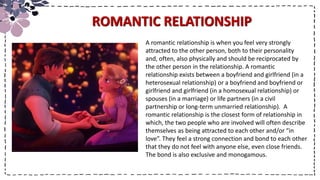
ROMANTIC RELATIONSHIP
A romantic relationship is when you feel very strongly
attracted to the other person, both to their personality
and, often, also physically and should be reciprocated by
the other person in the relationship. A romantic
relationship exists between a boyfriend and girlfriend (in a
heterosexual relationship) or a boyfriend and boyfriend or
girlfriend and girlfriend (in a homosexual relationship) or
spouses (in a marriage) or life partners (in a civil
partnership or long-term unmarried relationship). A
romantic relationship is the closest form of relationship in
which, the two people who are involved will often describe
themselves as being attracted to each other and/or “in
love”. They feel a strong connection and bond to each other
that they do not feel with anyone else, even close friends.
The bond is also exclusive and monogamous.
Title
Romantic Relationship
Arguments and disagreements occur in
romantic relationships sometimes. Some
relationships quickly become apparent that
the two people involved are not
compatible and do not want to spend their
lives together, and so the relationship may
end after only a few months. In other
cases, both may be together for many
years or may stay together for the rest of
their lives.
Title
Romantic Relationship
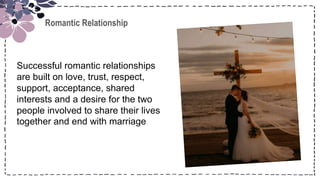
Successful romantic relationships
are built on love, trust, respect,
support, acceptance, shared
interests and a desire for the two
people involved to share their lives
together and end with marriage
LESSON 2: ATTRACTION, LOVE AND
COMMITMENT
Title
Attraction, Love And
Affection
According to Helen Fisher, attraction is primarily
on physiology or certain hormones that get
attracted to others and is the first stage during the
changes of personality development which leads
to closeness, love and commitment. But,
disappointments in relationships occur usually
because of the misunderstanding about the
different ways of expressing their attraction, love
and commitment.
In the biological model of love as proposed by
anthropologist Helen Fisher, love can start with
any of these three feelings: lust, attraction and
attachment depending on the person
Title
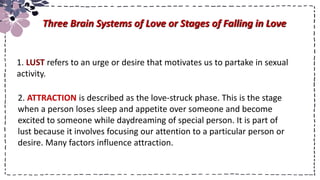
Three Brain Systems of Love or Stages of Falling in Love
1. LUST refers to an urge or desire that motivates us to partake in sexual
activity.
2. ATTRACTION is described as the love-struck phase. This is the stage
when a person loses sleep and appetite over someone and become
excited to someone while daydreaming of special person. It is part of
lust because it involves focusing our attention to a particular person or
desire. Many factors influence attraction.
Title
1. Physical Attractiveness
It is one of the primary determinants of romantic attraction. Most people prefer whom they consider
physically attractive especially in the early stages of dating.
2. Proximity
People tend to get attracted to people who are geographically closer to them. They are more likely to
develop feelings of mutual familiarity with the people who live close to us or go to school with us and
increased level of comfort when there is regular contact and no prior negative feelings.
3. Similarity
People pick partners who we have similarities with such as social class, background, religious beliefs, age
and education. The more attitudes and opinions two people share, especially when they are similar, the
more they will want to do the same activities, and would create a strong bond between them.
4. Reciprocity
People like others who like them back. People feel indebted when someone does something good for them
and tend to reciprocate the action. The more we are liked by someone they equally like, the more we
behave in ways that promote mutual feelings of liking.
FACTORS OF ATTRACTION
Title
1. ATTACHMENT is a deep and enduring emotional bond that
connects one person to another across time and space. It is when
long-lasting commitments are exchanged.
Title
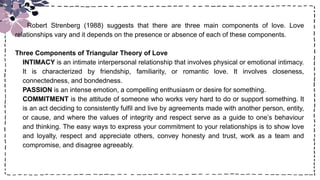
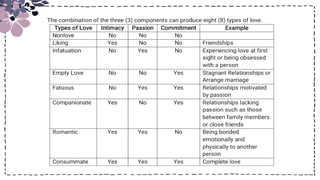
Robert Strenberg (1988) suggests that there are three main components of love. Love
relationships vary and it depends on the presence or absence of each of these components.
Three Components of Triangular Theory of Love
INTIMACY is an intimate interpersonal relationship that involves physical or emotional intimacy.
It is characterized by friendship, familiarity, or romantic love. It involves closeness,
connectedness, and bondedness.
PASSION is an intense emotion, a compelling enthusiasm or desire for something.
COMMITMENT is the attitude of someone who works very hard to do or support something. It
is an act deciding to consistently fulfil and live by agreements made with another person, entity,
or cause, and where the values of integrity and respect serve as a guide to one’s behaviour
and thinking. The easy ways to express your commitment to your relationships is to show love
and loyalty, respect and appreciate others, convey honesty and trust, work as a team and
compromise, and disagree agreeably.
Title
Title
Text
Text
Text
Love occurs not solely between romantic
partners only. Humans can experience
different types of love in various
relationships, such as with romantic
partners, friends, family and even strangers.
Ancient Greeks studied love and denote
each type by giving each one a Greek name.
Lee (1973) offers a theory love styles which
are derived from an analysis of writings
about love through centuries.
Title
LOVE PHILIA – Affectionate Love
It is love that runs deep in true friendships. Love
without romantic attraction and occurs between
friends and family members. It is called brotherly
love when both people share the same values and
respect each other.
Ways to show this love:
 Engage in deep conversation with a friend.
 Exchange beliefs and imperfections with close
friends.
 Be open and trustworthy
 Be supportive in difficult times.
Title
LOVE
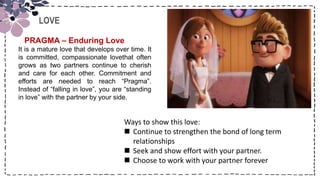
PRAGMA – Enduring Love
It is a mature love that develops over time. It
is committed, compassionate lovethat often
grows as two partners continue to cherish
and care for each other. Commitment and
efforts are needed to reach “Pragma”.
Instead of “falling in love”, you are “standing
in love” with the partner by your side.
Ways to show this love:
 Continue to strengthen the bond of long term
relationships
 Seek and show effort with your partner.
 Choose to work with your partner forever
Title
LOVE
STORGE – Familiar love
It is naturally occurring love rooted in parents and children, as well
as best friends. It’s an infinite love built upon acceptance and deep
emotional connection. This love come easily and immediately in
parent and child relationships. It flows between parents and children
or childhood friends.
Ways to show this love:
 Sacrifice your time, self or personal pleasures.
 Quickly forgive harmful actions.
 Share memorable and impactful moments.
 Show gratitude towards the people close to you.
LOVE
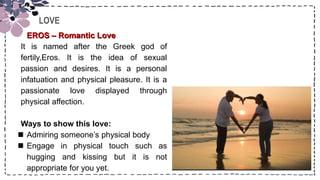
EROS – Romantic Love
It is named after the Greek god of
fertily,Eros. It is the idea of sexual
passion and desires. It is a personal
infatuation and physical pleasure. It is a
passionate love displayed through
physical affection.
Ways to show this love:
 Admiring someone’s physical body
 Engage in physical touch such as
hugging and kissing but it is not
appropriate for you yet.
Title
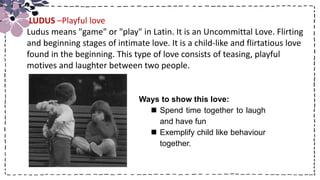
Ways to show this love:
 Spend time together to laugh
and have fun
 Exemplify child like behaviour
together.
LUDUS –Playful love
Ludus means "game" or "play" in Latin. It is an Uncommittal Love. Flirting
and beginning stages of intimate love. It is a child-like and flirtatious love
found in the beginning. This type of love consists of teasing, playful
motives and laughter between two people.
Title
LOVE
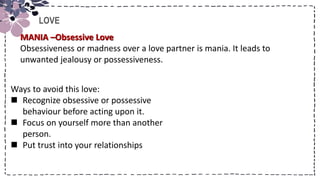
Ways to avoid this love:
 Recognize obsessive or possessive
behaviour before acting upon it.
 Focus on yourself more than another
person.
 Put trust into your relationships
MANIA –Obsessive Love
Obsessiveness or madness over a love partner is mania. It leads to
unwanted jealousy or possessiveness.
Title
LOVE
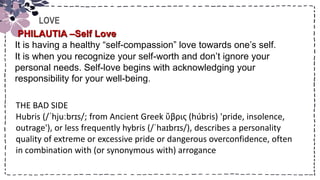
PHILAUTIA –Self Love
It is having a healthy “self-compassion” love towards one’s self.
It is when you recognize your self-worth and don’t ignore your
personal needs. Self-love begins with acknowledging your
responsibility for your well-being.
THE BAD SIDE
Hubris (/ˈhjuːbrɪs/; from Ancient Greek ὕβρις (húbris) 'pride, insolence,
outrage'), or less frequently hybris (/ˈhaɪbrɪs/), describes a personality
quality of extreme or excessive pride or dangerous overconfidence, often
in combination with (or synonymous with) arrogance
Title
LOVE
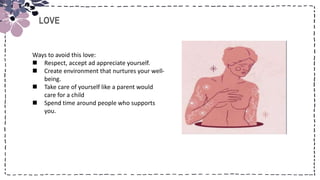
Ways to avoid this love:
 Respect, accept ad appreciate yourself.
 Create environment that nurtures your well-
being.
 Take care of yourself like a parent would
care for a child
 Spend time around people who supports
you.
Title
LOVE
AGAPE –Selfless Love, Unconditional
Love
It is an empathetic attitude of love for
everyone and anyone. It is the highest love to
offer. It is given without any expectations of
receiving anything in return. It is considered
as unconditional love.
Agape is a girl's name of Greek origin,
meaning “love,” “affection,” and “esteem.”
Agape is an incredibly prevalent word in
Christianity and refers to the fatherly love of
God for humans and their reciprocity
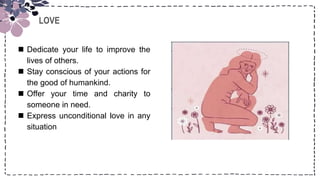
LOVE
 Dedicate your life to improve the
lives of others.
 Stay conscious of your actions for
the good of humankind.
 Offer your time and charity to
someone in need.
 Express unconditional love in any
situation
Title
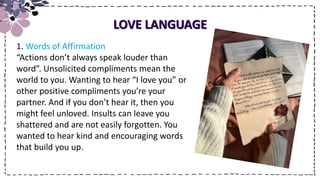
LOVE LANGUAGE
1. Words of Affirmation
“Actions don’t always speak louder than
word”. Unsolicited compliments mean the
world to you. Wanting to hear “I love you” or
other positive compliments you’re your
partner. And if you don’t hear it, then you
might feel unloved. Insults can leave you
shattered and are not easily forgotten. You
wanted to hear kind and encouraging words
that build you up.
Title
Love Language
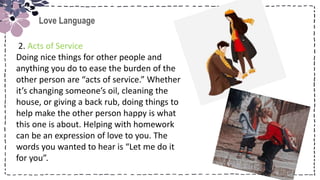
2. Acts of Service
Doing nice things for other people and
anything you do to ease the burden of the
other person are “acts of service.” Whether
it’s changing someone’s oil, cleaning the
house, or giving a back rub, doing things to
help make the other person happy is what
this one is about. Helping with homework
can be an expression of love to you. The
words you wanted to hear is “Let me do it
for you”.
Title
Love Language
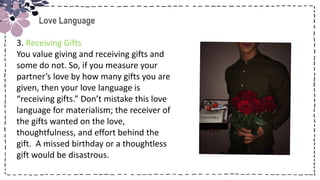
3. Receiving Gifts
You value giving and receiving gifts and
some do not. So, if you measure your
partner’s love by how many gifts you are
given, then your love language is
“receiving gifts.” Don’t mistake this love
language for materialism; the receiver of
the gifts wanted on the love,
thoughtfulness, and effort behind the
gift. A missed birthday or a thoughtless
gift would be disastrous.
Title
Love Language
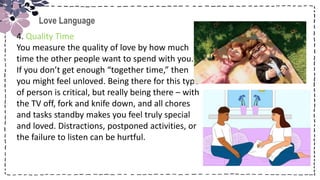
4. Quality Time
You measure the quality of love by how much
time the other people want to spend with you.
If you don’t get enough “together time,” then
you might feel unloved. Being there for this type
of person is critical, but really being there – with
the TV off, fork and knife down, and all chores
and tasks standby makes you feel truly special
and loved. Distractions, postponed activities, or
the failure to listen can be hurtful.
Title
Love Language
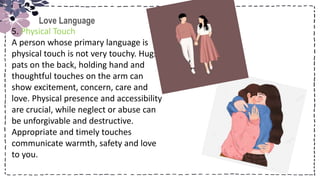
5. Physical Touch
A person whose primary language is
physical touch is not very touchy. Hugs,
pats on the back, holding hand and
thoughtful touches on the arm can
show excitement, concern, care and
love. Physical presence and accessibility
are crucial, while neglect or abuse can
be unforgivable and destructive.
Appropriate and timely touches
communicate warmth, safety and love
to you.
LESSON 3: BEING RESPONSIBLE
IN A HEALTHY RELATIONSHIP
Title
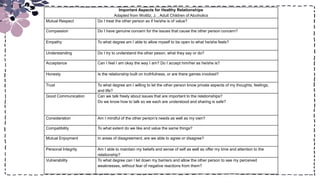
Important Aspects for Healthy Relationships
Adapted from Woititz, J. , Adult Children of Alcoholics
Mutual Respect Do I treat the other person as if he/she is of value?
Compassion Do I have genuine concern for the issues that cause the other person concern?
Empathy To what degree am I able to allow myself to be open to what he/she feels?
Understanding Do I try to understand the other peson, what they say or do?
Acceptance Can I feel I am okay the way I am? Do I accept him/her as he/she is?
Honesty Is the relationship built on truthfulness, or are there games involved?
Trust To what degree am I willing to let the other person know private aspects of my thoughts, feelings,
and life?
Good Communication Can we talk freely about issues that are important to the relationships?
Do we know how to talk so we each are understood and sharing is safe?
Consideration Am I mindful of the other person’s needs as well as my own?
Compatibility To what extent do we like and value the same things?
Mutual Enjoyment In areas of disagreement, are we able to agree or disagree?
Personal Integrity Am I able to maintain my beliefs and sense of self as well as offer my time and attention to the
relationship?
Vulnerability To what degree can I let down my barriers and allow the other person to see my perceived
weaknesses, without fear of negative reactions from them?
THANKS