


Prof. Dr. Abdul Moqim Rahmanzai
2
Nazzir Hussain Bin Haji Mydeen
(814066)
Question 32:
Describe the characteristics
of servant leadership by
providing examples for each
characteristic as it applies to
school.
Servant leadership is an ancient
philosophy and is both a
leadership philosophy and set of
leadership practices. While
servant leadership is a timeless
concept, the phrase “servant
leadership” was coined by
Robert K. Greenleaf in The
Servant as Leader, an essay
that he first published in 1970.
Traditional leadership generally
involves the accumulation and
exercise of power by one at the
“top of the pyramid.” By
comparison, the servant-leader
shares power puts the needs of
others first and helps people
develop and perform as highly as
possible.
Servant Leadership can be most
likely associated with the
participative leadership style.
The highest priority of a servant
leader is to encourage, support
and enable subordinates to
unfold their full potential and
abilities. This leads to an
obligation to delegate
responsibility and engage in
participative decision-making.
In the managerial grid model of
Blake and Mouton, the
participative style of leadership
is presented as the approach
with the greatest possible
performance and employee
satisfaction.
The servant leadership approach
goes beyond employee-related
behavior and calls for a
rethinking of the hierarchical
relationship between leaders and
subordinates. The focus of
leadership responsibilities is the
promotion of performance and
satisfaction of employees.
Characteristics of being a
servant leader that the Scholars
generally agree that are central
to the development of a servant-
leader……
Characteristics of being a
servant leader that the Scholars
generally agree that are central
to the development of a servant-
leader……
Listening:
A servant leader has to listen
actively to subordinates and
support them in decision
identification. The servant leader
particularly needs to pay attention
to what remains unspoken in the
management setting. This means
relying on his inner voice in order
to find out what the body, mind and
spirit are communicating.
Empathy:
A servant leader attempts to
understand and empathize with
others. Workers are not only
employees, but are also people who
deserve respect, appreciation and
space for their personal
development. Leadership is seen as a
special type of human work, which
ultimately generates a competitive
advantage.
Healing:
A great strength of a Servant Leader is
the ability for healing one’s self and
others. A servant leader tries to help
people solve their problems and
conflicts in relationships, because he
wants to encourage and support the
personal development of each
individual. This leads to the formation
of a business culture, in which the
working environment is dynamic, fun
and free of the fear of failure.
Awareness:
A servant leader needs to gain general
awareness and especially self-awareness.
He has the ability to view situations from
a more integrated, holistic position. As a
result, he gets a better understanding
about ethics and values.
Persuasion:
A Servant Leader does not take
advantage of their power and status by
coercing compliance; they rather try to
convince those they manage. This
element distinguishes servant leadership
most clearly from traditional,
authoritarian models.
Conceptualization:
A servant leader thinks beyond day-to-
day realities. That means he has the
ability to see beyond the limits of the
operating business and also focuses on
long term operating goals. A Leader
constructs a personal vision that only
he/she can develop by reflecting on the
meaning of life. As a result, he/she
derives specific goals and
implementation strategies.
Foresight:
Foresight is the ability to foresee the
likely outcome of a situation. It enables
the servant leader to learn about the
past and to achieve a better
understanding about the current reality.
It also enables the servant leader to
identify consequences about the future.
This characteristic is closely related to
conceptualization.
Stewardship:
CEOs, staffs and trustees have the task to
hold their institution in trust for the
greater good of society. Servant
leadership is seen as an obligation to
help and serve others. Openness and
persuasion are more important than
control.
Commitment to the growth of people:
A servant leader is convinced that people have
an intrinsic value beyond their contributions as
workers. Therefore, they should nurture the
personal, professional and spiritual growth of
employees. For example, they spend money for
the personal and professional development of
the people who make up their organization.
The servant leader will also encourage the
ideas of everyone and involve workers in
decision making.
Building community:
A servant leader identifies means to build a
strong community within his organization and
wants to develop a true community among
businesses and institutions.
As a result it has to be emphasized
that these 10 characteristics are by
no means exhaustive. They should
not be interpreted as a certain
manner to behave and they do not
represent the best method to gain
aims. Rather every person shall
reflect, if these characteristics can
be useful for his personal
development.
9
Qualities of the
Servant Leader
Values diverse opinions
A servant leader values everyone’s
contributions and regularly seeks out
opinions. If you must parrot back
the leader’s opinion, you are not in a
servant-led organization.
Cultivates a culture of trust
People don’t meet at the water
cooler to gossip. Pocket vetoes
where instead of taking action to
support an initiative, nothing is
done, killing it are rejected..
Develops other leaders.
The replication factor is so
important. It means teaching others
to lead, providing opportunities for
growth and demonstrating by
example. That means the leader is
not always leading, but instead
giving up power and deputizing
others to lead.
Helps people with life issues (not
just work issues).
It’s important to offer opportunities
for personal development beyond
the job. Let’s say you run a
company program to lose weight, or
lower personal debt, or a class on
etiquette. None of these may help
an immediate corporate need, but
each may be important.
Encourages
The hallmark of a servant leader is
encouragement. And a true servant
leader says, “Let’s go do it,” not,
“You go do it.”
Sells instead of tells
A servant leader is the opposite of a
dictator. It’s a style all about
persuading, not commanding.
Thinks “you,” not “me.”
There’s a selfless quality about a
servant leader. Someone who is
thinking only, “How does this benefit
me?” is disqualified.
Thinks long-term
A servant leader is thinking about
the next generation, the next leader,
the next opportunity. That means a
tradeoff between what’s important
today versus tomorrow, and making
choices to benefit the future.
Acts with humility
The leader doesn’t wear a title as a way
to show who’s in charge, doesn’t think
he’s better than everyone else, and acts
in a way to care for others. She may, in
fact, pick up the trash or clean up a
table. Setting an example of service,
the servant leader understands that it is
not about the leader, but about others.
Conclusion
The servant leadership philosophy and
practices have been expressed in many
ways and applied in many contexts.
Overall though, servant leadership is
important for its holistic views of
corporations, individuals and
communities, and how to protect and
encourage their well-being.
Servant leadership has many useful
concepts that can be applied to
organizations to help them run more
effectively and efficiently.
Servant leadership steers clear of a
centralized, command-and-control style,
opting for a humanistic approach as a
more effective way to manage the
organization.
In a school enviroment, a servant leader
will be the one who is teacher of
teachers, who in turn will be a friend,
confidante and sounding board to his
subordinates while all time keeps his
sights on the objectives of the
organization.
Question 32:
If you are a manager, how do
you identify your subordinate
is experiencing anger and
stress, what is the best way
for you to overcome this?
When you have two or more people
working closely together, there are bound
to be some tensions or discomfort when
egos, ideals or objectives collide
These collisions will undoubtedly lead to
anger and stress, which could turn out
detrimental to the esprit de corp within
organization.
Anger is a natural emotion that every
human experiences. Mild forms of human
anger may include displeasure, irritation
or dislike. When we react to frustration,
criticism or a threat, we may become
angry and usually this is a healthy
response. Anger may be a secondary
response to feeling sad, lonely or
frightened.
When anger becomes a full-blown rage
our judgment and thinking can become
impaired and we are more likely to do
and say unreasonable and irrational
things.
The emotion of anger is neither good nor
bad. It’s perfectly healthy and normal to
feel angry when you’ve been mistreated
or wronged. The feeling isn't the
problem—it's what you do with it that
makes a difference. Anger becomes a
problem when it harms you or others.
Strictly anger is the external expression
of stress. But stress does not only contain
anger but also includes anxiety,
nervousness and worry.
When under stress there is a feeling of a
need to do something, to express oneself
in some way but it’s not the only way it’s
expressed. Other forms of self-expression
can be more violent or dangerous.
Stress in the workplace can be assessed
like any other risk if the matter is
approached systematically. There are
indicators which signal that danger is
arising.
Stress, having a variety of causes, has a
range of symptoms. By recognizing these
signs it can be identified.
Stress in the workplace can be assessed
like any other risk if the matter is
approached systematically. There are
indicators which signal that danger is
arising.
Stress, having a variety of causes, has a
range of symptoms. By recognizing these
signs it can be identified.
Psychological signs
 Inability to concentrate or make simple
decisions
 Memory lapses
 Becoming rather vague
 Easily distracted
 Less intuitive & creative
 Worrying
 Negative thinking
 Depression & anxiety
Emotional signs
Tearful
 Irritable
 Mood swings
 Extra sensitive to criticism
 Defensive
 Feeling out of control
 Lack of motivation
 Angry
 Frustrated
 Lack of confidence
 Lack of self-esteem
Behavioral signs
 No time for relaxation or pleasurable activities
 Prone to accidents, forgetfulness
 Increased reliance on alcohol, smoking, caffeine,
recreational or illegal drugs
 Becoming a workaholic
 Poor time management and/or poor standards of
work
 Absenteeism
 Self-neglect/change in appearance
 Social withdrawal
 Relationship problems
 Insomnia or waking tired
 Reckless
 Aggressive/anger outbursts
 Nervous
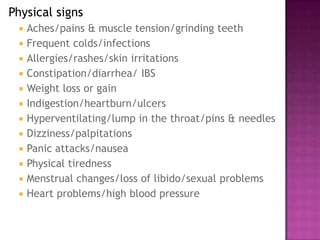
Physical signs
 Aches/pains & muscle tension/grinding teeth
 Frequent colds/infections
 Allergies/rashes/skin irritations
 Constipation/diarrhea/ IBS
 Weight loss or gain
 Indigestion/heartburn/ulcers
 Hyperventilating/lump in the throat/pins & needles
 Dizziness/palpitations
 Panic attacks/nausea
 Physical tiredness
 Menstrual changes/loss of libido/sexual problems
 Heart problems/high blood pressure
 As well as taking steps to acknowledge and
identify stress, it's also sensible to have
measures in place to manage and control it
when it does occur.
 An open door policy to hear employees’
grievances would be a step in the right
direction
 Always remember to separate personal and
work issues.
 Assess the situation and understand the
emotions involved. Look at the bigger picture
and see where it's coming from. The response
will make or break the organization. Being
proactive is the better approach.
 Open communications to end up in a "win-win"
situation for both parties. An effective
communication to find out the root of the
problem so as to attack the problems, not the
persons involved.
 Empower your employees. Empowering the
employee does not mean going against the
workplace policy. It simply means changing the
way the employee sees him and looks at the
bigger picture. Replacing negative things with
positive ones, as a workplace asset.
 Recognize that each individual has a different
way in dealing with stress. The key is each
employee understands himself better. Practice
grace under pressure.
 Prevention is better than cure, encouraging a
healthy lifestyle among the members of the
organization to cope with the stresses and
prevent more destructive aspects of it.
Conclusion
Stress and anger is commonplace in work
environment. The only thing to be done is learn
to cope and deal with the stresses involved. As a
leader, our role is to provide a conducive
working environment in which our subordinates
will be able work and grow professionally to
achieve their full and optimum potential
Sekian,
Terima Kasih

Q 24 & 32

  • 1.
    Prof. Dr. AbdulMoqim Rahmanzai
  • 2.
    2 Nazzir Hussain BinHaji Mydeen (814066)
  • 3.
    Question 32: Describe thecharacteristics of servant leadership by providing examples for each characteristic as it applies to school.
  • 4.
    Servant leadership isan ancient philosophy and is both a leadership philosophy and set of leadership practices. While servant leadership is a timeless concept, the phrase “servant leadership” was coined by Robert K. Greenleaf in The Servant as Leader, an essay that he first published in 1970.
  • 5.
    Traditional leadership generally involvesthe accumulation and exercise of power by one at the “top of the pyramid.” By comparison, the servant-leader shares power puts the needs of others first and helps people develop and perform as highly as possible.
  • 6.
    Servant Leadership canbe most likely associated with the participative leadership style. The highest priority of a servant leader is to encourage, support and enable subordinates to unfold their full potential and abilities. This leads to an obligation to delegate responsibility and engage in participative decision-making.
  • 7.
    In the managerialgrid model of Blake and Mouton, the participative style of leadership is presented as the approach with the greatest possible performance and employee satisfaction.
  • 8.
    The servant leadershipapproach goes beyond employee-related behavior and calls for a rethinking of the hierarchical relationship between leaders and subordinates. The focus of leadership responsibilities is the promotion of performance and satisfaction of employees.
  • 9.
    Characteristics of beinga servant leader that the Scholars generally agree that are central to the development of a servant- leader……
  • 10.
    Characteristics of beinga servant leader that the Scholars generally agree that are central to the development of a servant- leader……
  • 11.
    Listening: A servant leaderhas to listen actively to subordinates and support them in decision identification. The servant leader particularly needs to pay attention to what remains unspoken in the management setting. This means relying on his inner voice in order to find out what the body, mind and spirit are communicating.
  • 12.
    Empathy: A servant leaderattempts to understand and empathize with others. Workers are not only employees, but are also people who deserve respect, appreciation and space for their personal development. Leadership is seen as a special type of human work, which ultimately generates a competitive advantage.
  • 13.
    Healing: A great strengthof a Servant Leader is the ability for healing one’s self and others. A servant leader tries to help people solve their problems and conflicts in relationships, because he wants to encourage and support the personal development of each individual. This leads to the formation of a business culture, in which the working environment is dynamic, fun and free of the fear of failure.
  • 14.
    Awareness: A servant leaderneeds to gain general awareness and especially self-awareness. He has the ability to view situations from a more integrated, holistic position. As a result, he gets a better understanding about ethics and values.
  • 15.
    Persuasion: A Servant Leaderdoes not take advantage of their power and status by coercing compliance; they rather try to convince those they manage. This element distinguishes servant leadership most clearly from traditional, authoritarian models.
  • 16.
    Conceptualization: A servant leaderthinks beyond day-to- day realities. That means he has the ability to see beyond the limits of the operating business and also focuses on long term operating goals. A Leader constructs a personal vision that only he/she can develop by reflecting on the meaning of life. As a result, he/she derives specific goals and implementation strategies.
  • 17.
    Foresight: Foresight is theability to foresee the likely outcome of a situation. It enables the servant leader to learn about the past and to achieve a better understanding about the current reality. It also enables the servant leader to identify consequences about the future. This characteristic is closely related to conceptualization.
  • 18.
    Stewardship: CEOs, staffs andtrustees have the task to hold their institution in trust for the greater good of society. Servant leadership is seen as an obligation to help and serve others. Openness and persuasion are more important than control.
  • 19.
    Commitment to thegrowth of people: A servant leader is convinced that people have an intrinsic value beyond their contributions as workers. Therefore, they should nurture the personal, professional and spiritual growth of employees. For example, they spend money for the personal and professional development of the people who make up their organization. The servant leader will also encourage the ideas of everyone and involve workers in decision making.
  • 20.
    Building community: A servantleader identifies means to build a strong community within his organization and wants to develop a true community among businesses and institutions.
  • 21.
    As a resultit has to be emphasized that these 10 characteristics are by no means exhaustive. They should not be interpreted as a certain manner to behave and they do not represent the best method to gain aims. Rather every person shall reflect, if these characteristics can be useful for his personal development.
  • 22.
  • 23.
    Values diverse opinions Aservant leader values everyone’s contributions and regularly seeks out opinions. If you must parrot back the leader’s opinion, you are not in a servant-led organization.
  • 24.
    Cultivates a cultureof trust People don’t meet at the water cooler to gossip. Pocket vetoes where instead of taking action to support an initiative, nothing is done, killing it are rejected..
  • 25.
    Develops other leaders. Thereplication factor is so important. It means teaching others to lead, providing opportunities for growth and demonstrating by example. That means the leader is not always leading, but instead giving up power and deputizing others to lead.
  • 26.
    Helps people withlife issues (not just work issues). It’s important to offer opportunities for personal development beyond the job. Let’s say you run a company program to lose weight, or lower personal debt, or a class on etiquette. None of these may help an immediate corporate need, but each may be important.
  • 27.
    Encourages The hallmark ofa servant leader is encouragement. And a true servant leader says, “Let’s go do it,” not, “You go do it.”
  • 28.
    Sells instead oftells A servant leader is the opposite of a dictator. It’s a style all about persuading, not commanding.
  • 29.
    Thinks “you,” not“me.” There’s a selfless quality about a servant leader. Someone who is thinking only, “How does this benefit me?” is disqualified.
  • 30.
    Thinks long-term A servantleader is thinking about the next generation, the next leader, the next opportunity. That means a tradeoff between what’s important today versus tomorrow, and making choices to benefit the future.
  • 31.
    Acts with humility Theleader doesn’t wear a title as a way to show who’s in charge, doesn’t think he’s better than everyone else, and acts in a way to care for others. She may, in fact, pick up the trash or clean up a table. Setting an example of service, the servant leader understands that it is not about the leader, but about others.
  • 32.
  • 33.
    The servant leadershipphilosophy and practices have been expressed in many ways and applied in many contexts. Overall though, servant leadership is important for its holistic views of corporations, individuals and communities, and how to protect and encourage their well-being.
  • 34.
    Servant leadership hasmany useful concepts that can be applied to organizations to help them run more effectively and efficiently. Servant leadership steers clear of a centralized, command-and-control style, opting for a humanistic approach as a more effective way to manage the organization.
  • 35.
    In a schoolenviroment, a servant leader will be the one who is teacher of teachers, who in turn will be a friend, confidante and sounding board to his subordinates while all time keeps his sights on the objectives of the organization.
  • 36.
    Question 32: If youare a manager, how do you identify your subordinate is experiencing anger and stress, what is the best way for you to overcome this?
  • 37.
    When you havetwo or more people working closely together, there are bound to be some tensions or discomfort when egos, ideals or objectives collide These collisions will undoubtedly lead to anger and stress, which could turn out detrimental to the esprit de corp within organization.
  • 38.
    Anger is anatural emotion that every human experiences. Mild forms of human anger may include displeasure, irritation or dislike. When we react to frustration, criticism or a threat, we may become angry and usually this is a healthy response. Anger may be a secondary response to feeling sad, lonely or frightened.
  • 39.
    When anger becomesa full-blown rage our judgment and thinking can become impaired and we are more likely to do and say unreasonable and irrational things. The emotion of anger is neither good nor bad. It’s perfectly healthy and normal to feel angry when you’ve been mistreated or wronged. The feeling isn't the problem—it's what you do with it that makes a difference. Anger becomes a problem when it harms you or others.
  • 40.
    Strictly anger isthe external expression of stress. But stress does not only contain anger but also includes anxiety, nervousness and worry. When under stress there is a feeling of a need to do something, to express oneself in some way but it’s not the only way it’s expressed. Other forms of self-expression can be more violent or dangerous.
  • 41.
    Stress in theworkplace can be assessed like any other risk if the matter is approached systematically. There are indicators which signal that danger is arising. Stress, having a variety of causes, has a range of symptoms. By recognizing these signs it can be identified.
  • 42.
    Stress in theworkplace can be assessed like any other risk if the matter is approached systematically. There are indicators which signal that danger is arising. Stress, having a variety of causes, has a range of symptoms. By recognizing these signs it can be identified.
  • 43.
    Psychological signs  Inabilityto concentrate or make simple decisions  Memory lapses  Becoming rather vague  Easily distracted  Less intuitive & creative  Worrying  Negative thinking  Depression & anxiety
  • 44.
    Emotional signs Tearful  Irritable Mood swings  Extra sensitive to criticism  Defensive  Feeling out of control  Lack of motivation  Angry  Frustrated  Lack of confidence  Lack of self-esteem
  • 45.
    Behavioral signs  Notime for relaxation or pleasurable activities  Prone to accidents, forgetfulness  Increased reliance on alcohol, smoking, caffeine, recreational or illegal drugs  Becoming a workaholic  Poor time management and/or poor standards of work  Absenteeism  Self-neglect/change in appearance  Social withdrawal  Relationship problems  Insomnia or waking tired  Reckless  Aggressive/anger outbursts  Nervous
  • 46.
    Physical signs  Aches/pains& muscle tension/grinding teeth  Frequent colds/infections  Allergies/rashes/skin irritations  Constipation/diarrhea/ IBS  Weight loss or gain  Indigestion/heartburn/ulcers  Hyperventilating/lump in the throat/pins & needles  Dizziness/palpitations  Panic attacks/nausea  Physical tiredness  Menstrual changes/loss of libido/sexual problems  Heart problems/high blood pressure
  • 47.
     As wellas taking steps to acknowledge and identify stress, it's also sensible to have measures in place to manage and control it when it does occur.  An open door policy to hear employees’ grievances would be a step in the right direction  Always remember to separate personal and work issues.
  • 48.
     Assess thesituation and understand the emotions involved. Look at the bigger picture and see where it's coming from. The response will make or break the organization. Being proactive is the better approach.  Open communications to end up in a "win-win" situation for both parties. An effective communication to find out the root of the problem so as to attack the problems, not the persons involved.
  • 49.
     Empower youremployees. Empowering the employee does not mean going against the workplace policy. It simply means changing the way the employee sees him and looks at the bigger picture. Replacing negative things with positive ones, as a workplace asset.  Recognize that each individual has a different way in dealing with stress. The key is each employee understands himself better. Practice grace under pressure.
  • 50.
     Prevention isbetter than cure, encouraging a healthy lifestyle among the members of the organization to cope with the stresses and prevent more destructive aspects of it.
  • 51.
    Conclusion Stress and angeris commonplace in work environment. The only thing to be done is learn to cope and deal with the stresses involved. As a leader, our role is to provide a conducive working environment in which our subordinates will be able work and grow professionally to achieve their full and optimum potential
  • 52.